Best Value ETFs for Singapore Investors (2026 Guide)
IWVL vs VTV vs SPYV — expense ratios, withholding tax, and which value ETF actually suits a Singapore portfolio.
A value ETF Singapore investors can access most tax-efficiently is the iShares Edge MSCI World Value Factor UCITS ETF (IWVL), listed on the London Stock Exchange and domiciled in Ireland with a 0.25% TER. It suffers only 15% US dividend withholding tax versus 30% for US-listed alternatives like Vanguard’s VTV or SPDR’s SPYV, and carries no US estate tax exposure.
Not financial advice. All figures are for educational reference only. Data verified as at October 2026 unless noted.
What Is Value Investing?
Value investing means buying stocks that trade cheaply relative to their earnings, book value, or cash flow — the opposite approach to growth investing, which chases companies with the fastest revenue expansion regardless of today’s price tag. A value ETF systematically screens an index for these cheaper, often more mature businesses: banks, industrials, energy producers, and consumer staples tend to dominate value baskets, while high-multiple technology names are underweighted or excluded.
For a Singapore investor who already holds a core global equity ETF such as VWRA or CSPX, a value ETF is a satellite tilt — a way to deliberately overweight cheaper companies and reduce concentration in a handful of expensive mega-cap technology names without abandoning a core index strategy entirely.
Why Value ETFs Are Back in Focus in 2026
Value investing has had an unusually volatile 2026. Large-cap value stocks outperformed growth by more than 11 percentage points in the early part of the year as investors rotated out of expensive AI-linked names, before growth clawed back ground in April and May on stronger-than-expected tech earnings. By late June, value had retaken the lead — Vanguard’s Value ETF (VTV) was up roughly 14.4% year-to-date versus 1.8% for Vanguard’s Growth ETF, according to a Motley Fool analysis published 26 June 2026. The rotation has been driven by cheaper starting valuations in financials and industrials, a hawkish rate environment that favours companies with stable near-term cash flows, and periodic profit-taking in concentrated AI winners.
That volatility is itself the argument for a diversified value ETF rather than picking individual value stocks: the sector and factor leadership has swung sharply more than once in a single year, and a broad value index spreads that bet across hundreds of holdings instead of a handful of single-stock calls.
Best Value ETFs for Singapore Investors
Three value ETFs cover the main routes available to a Singapore-based investor: one UCITS fund listed on the London Stock Exchange, and two US-listed funds accessible through brokers like Interactive Brokers, Saxo, or Syfe Brokerage.
| ETF | Exchange / Domicile | Index Tracked | TER | AUM | Structure |
|---|---|---|---|---|---|
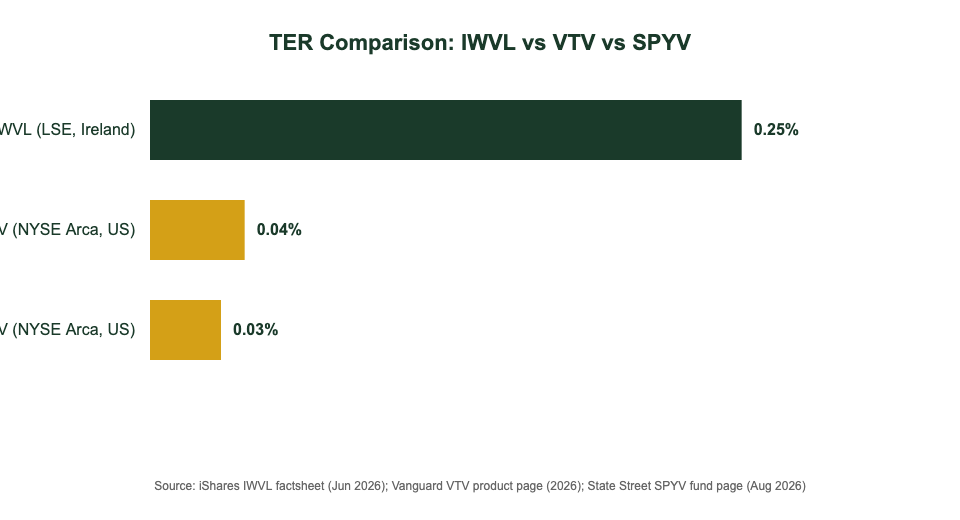
| IWVL (iShares Edge MSCI World Value Factor) | LSE / Ireland | MSCI World Enhanced Value | 0.25% | ~USD 4.5B | Accumulating |
| VTV (Vanguard Value ETF) | NYSE Arca / USA | CRSP US Large Cap Value | 0.03% | ~USD 168B | Distributing |
| SPYV (SPDR Portfolio S&P 500 Value) | NYSE Arca / USA | S&P 500 Value | 0.04% | ~USD 36.3B | Distributing |
Source: iShares IWVL factsheet (June 2026); Vanguard VTV product page (2026); State Street SPYV fund page (Aug 2026). AUM figures are approximate and vary by data provider and date.
IWVL is the only one of the three that uses a dedicated “enhanced value” factor methodology — screening on valuation ratios like price-to-book and price-to-earnings and overweighting the cheapest names within the MSCI World universe — rather than simply tracking a broad value sub-index of the S&P 500 or CRSP universe. VTV and SPYV are both US large-cap value funds with heavy overlap in financials, healthcare, and industrials; IWVL is globally diversified, including Japan, the UK, and continental Europe alongside the US.
Tax & Cost Comparison: IWVL vs VTV vs SPYV
The headline TER gap favours the US-listed funds — VTV at 0.03% and SPYV at 0.04% are both cheaper than IWVL’s 0.25%. But TER is only part of the cost picture for a Singapore investor. US-domiciled ETFs withhold 30% US tax on dividends paid to Singapore residents, because Singapore has no tax treaty with the US. Ireland-domiciled funds like IWVL benefit from the US-Ireland tax treaty, which caps withholding at 15% on US-sourced dividends inside the fund. US-domiciled ETFs also expose non-resident holders to US estate tax on US situs assets above USD 60,000 — a risk that does not apply to an Ireland-domiciled, LSE-listed ETF.
| ETF | Domicile | US Dividend WHT | US Estate Tax Risk |
|---|---|---|---|
| IWVL (LSE) | Ireland | 15% | None |
| VTV / SPYV (NYSE Arca) | USA | 30% | Yes (above USD 60k) |
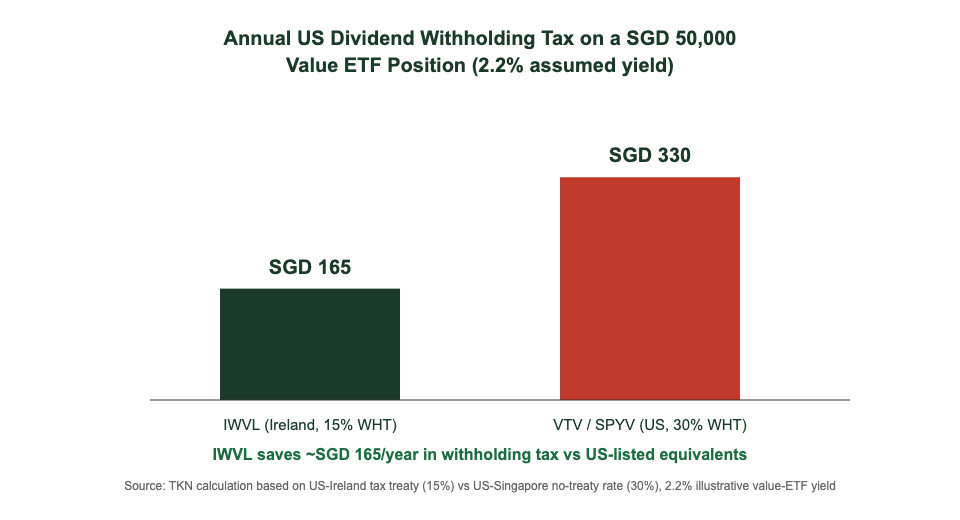
Worked example: a Singapore investor holding SGD 50,000 in a value ETF yielding roughly 2.2% annually would receive about SGD 1,100 in gross dividends. At 15% WHT (IWVL), about SGD 165 is withheld; at 30% WHT (VTV or SPYV), about SGD 330 is withheld — a difference of roughly SGD 165 a year that compounds over a long holding period. On the fee side, IWVL’s higher 0.25% TER costs an extra SGD 110 a year versus VTV’s 0.03% on the same SGD 50,000 position (SGD 125 vs SGD 15). Netting the two effects, IWVL’s withholding tax saving largely offsets its higher expense ratio for income-focused value exposure, while a purely accumulation-minded investor with a smaller estate-tax concern may still prefer VTV’s rock-bottom fee.
How to Buy Value ETFs in Singapore
For IWVL on the London Stock Exchange: fund your brokerage account, search “IWVL” and select the LSE listing (quoted in USD), then place a market or limit order. Interactive Brokers and Saxo Markets both offer direct LSE access with competitive FX spreads; MooMoo Singapore also lists IWVL under its international markets tab. For VTV or SPYV on NYSE Arca, the same brokers work, plus Syfe Brokerage and Tiger Brokers for US market access — search the ticker directly and note that US-listed purchases will trigger the 30% dividend withholding tax and US estate tax exposure discussed above.
A Singapore Supplementary Retirement Scheme (SRS) account can hold value ETFs through platforms like Endowus or FSMOne that support SRS-funded overseas ETF purchases, which is useful for investors looking to tilt their retirement portfolio toward value while deferring income tax on SRS contributions — see our CPF investment strategy guide for how this fits a broader retirement plan, or run the numbers with our Singapore retirement calculator. CPF Ordinary and Special Account funds cannot be used to buy LSE- or NYSE-listed ETFs directly under CPFIS rules, which only cover a restricted list of unit trusts and SGX-listed instruments.
Risks to Consider
Value investing is a long-term factor bet, not a guaranteed outperformer — as the 2026 rotation between value and growth leadership shows, the premium can disappear or reverse for extended stretches. IWVL’s “enhanced value” methodology concentrates more heavily in cheap stocks than a plain market-cap value index, which can mean higher volatility and sector concentration (financials and energy are often overweight) if those sectors underperform. Currency risk also applies: IWVL and VTV/SPYV are all USD-denominated, so SGD-based investors bear USD/SGD fluctuation on top of the underlying equity risk. If you’d rather diversify income risk through Singapore-listed assets instead, our Singapore REIT ETF guide covers a SGD-denominated alternative. Finally, remember that past value outperformance — including the figures cited above for 2026 — is not a guarantee of future results, and a value tilt should complement, not replace, a diversified core global equity holding.
Not financial advice. All figures are for educational reference only and were verified as at October 2026. Past performance does not guarantee future results.
Frequently Asked Questions
What is the best value ETF for Singapore investors?
For tax efficiency, IWVL (iShares Edge MSCI World Value Factor UCITS ETF) is generally the better fit for Singapore investors because it is Ireland-domiciled and LSE-listed, carrying 15% US dividend withholding tax and no US estate tax exposure. Investors prioritising the lowest possible expense ratio and comfortable with US estate tax planning may prefer VTV or SPYV instead.
Is IWVL the same as VTV?
No. IWVL tracks the MSCI World Enhanced Value index and holds roughly 400 stocks globally, including Japan, the UK, and Europe, while VTV tracks the CRSP US Large Cap Value Index and is US-only. IWVL also uses a quantitative value-factor screen, which tends to concentrate more heavily in the cheapest stocks than VTV’s broader value-tilt methodology.
Can I buy value ETFs using my CPF or SRS funds?
CPF Ordinary and Special Account funds cannot be used to buy LSE- or NYSE-listed value ETFs like IWVL, VTV, or SPYV directly, since CPFIS only covers a restricted list of SGX-listed instruments and approved unit trusts. SRS funds can be used through brokers such as Endowus or FSMOne that support SRS-funded overseas ETF purchases.
Which broker is best for buying value ETFs in Singapore?
Interactive Brokers and Saxo Markets both offer low-cost access to IWVL on the LSE and VTV or SPYV on NYSE Arca. MooMoo Singapore and Syfe Brokerage are simpler options for beginners buying the US-listed funds, though they may have narrower international market coverage for LSE-listed ETFs.
Is a value ETF safe for a long-term retirement portfolio?
A value ETF is a diversified basket of hundreds of established companies, so it carries equity market risk but not single-stock risk. It should be used as a satellite tilt alongside a core global index holding such as VWRA rather than a standalone retirement portfolio, since value and growth leadership can swing sharply, as seen during 2026.
What happens if value stocks underperform growth stocks again?
If growth regains leadership, a value ETF will likely lag broad market or growth-tilted benchmarks for that period, as happened in April and May 2026. This is the nature of a factor bet — investors holding a value ETF should expect multi-year stretches of both outperformance and underperformance relative to the broader market, not a permanent edge.
Ready to Add a Value Tilt to Your Portfolio?
Open a brokerage account and buy your first value ETF today. Use our referral links for exclusive sign-up bonuses.
This article was researched with the help of AI. While we strive to keep all information accurate and up to date, there may be errors. If you notice any discrepancies, please contact us.