Medisave Limit 2026: What Happens When You Switch Integrated Shield Plans?
Updated October 2026 · Integrated Shield Plans · 12 min read
Your Medisave limit of S$79,000 (the 2026 Basic Healthcare Sum) does not change when you switch Integrated Shield Plans — it stays with your CPF Medisave account regardless of which insurer you use. What does change is underwriting. Switching to a different insurer triggers a fresh round of health checks, and any pre-existing conditions covered under your old ISP may be excluded from your new one. The Medisave Additional Withdrawal Limit (AWL) for ISP premiums also remains tied to your age, not your insurer — so your Medisave keeps paying the same annual amount whether you stay or switch.
Not financial advice. All figures are for educational reference only. Data verified as at 19 October 2026 against CPF Board and MOH sources. Always verify current limits with your insurer or CPF Board before making decisions.
In This Guide
- Why Singaporeans Consider Switching ISPs
- Your Medisave Limit Stays at S$79,000
- Medisave AWL for ISP Premiums: Same Regardless of Insurer
- The Big Risk: Underwriting and Pre-Existing Conditions
- MediShield Life Continues Without Interruption
- Timing Your Switch: Renewal Date and Pro-Rated Refunds
- Medisave Cost Scenarios: Before and After Switching
- Should You Switch? A 5-Point Checklist
- Frequently Asked Questions
Why Singaporeans Consider Switching ISPs
Each year, thousands of Singaporeans weigh up whether to switch their Integrated Shield Plan. The 2026 landscape has added more reasons than ever: base premiums have risen across all five insurers following MOH’s adjustments in 2025, the rider co-payment rules introduced in 2021 are now fully bedded in, and many policyholders are asking whether they are on the right plan for their age and ward preference.
The most common reasons to switch are:
- Premium savings. A lower-tier ISP (say, from a private hospital plan to a Class A plan) can save hundreds of dollars a year in premiums — and a larger share of those premiums can be paid using Medisave AWL for ISP premiums when you drop to a cheaper plan.
- Better panel access. Some insurers have wider GP or specialist panels, making day-to-day healthcare more affordable with the rider’s panel discounts.
- Rider quality. Post-2021 rider rules are the same industry-wide, but the specific rider products — premium amounts, annual claim limits, and panel coverage — differ between AIA, Great Eastern, Income, Prudential, and Singlife.
- Customer service dissatisfaction. Claims experience and insurer responsiveness vary meaningfully across the five providers.
Understanding what happens to your Medisave before you commit to a switch prevents costly surprises — particularly around coverage gaps and the loss of pre-existing condition coverage.
Your Medisave Limit Stays at S$79,000
Your Medisave account and its limit belong to you — not to your insurer. The Medisave limit for 2026 is set at S$79,000, which is the Basic Healthcare Sum (BHS) announced by the CPF Board for this year. When you switch ISPs, this cap does not reset, reduce, or change in any way. Your existing Medisave balance is portable across all insurers.
What the BHS means in practice: once your Medisave balance reaches S$79,000, any further CPF contributions earmarked for Medisave flow automatically into your Special Account (if you are below 55) or Retirement Account (if you are 55 and above). Switching ISPs has zero effect on this threshold.
| Year Turned 65 | Cohort BHS (Fixed for Life) | Prevailing BHS (Under 65) |
|---|---|---|
| 2026 | S$79,000 | S$79,000 |
| 2025 | S$75,500 (locked) | — |
| 2024 | S$71,500 (locked) | — |
| 2023 | S$68,500 (locked) | — |
Source: CPF Board, October 2026. Members who turned 65 in a given year have their BHS locked at the prevailing amount for that year. The 2026 BHS of S$79,000 applies to all members below 65.
One nuance worth knowing: if you have a rider attached to your ISP, you cannot use Medisave to pay the rider premium. The Medisave AWL covers only the base IP premium (the private insurer’s portion above MediShield Life). The rider must be paid in cash — and this rule applies regardless of which insurer you are with.
Medisave AWL for ISP Premiums: Same Regardless of Insurer
The Medisave Additional Withdrawal Limit (AWL) for ISP premiums is set by the government and applies uniformly across all five ISP insurers. Switching from AIA to Prudential, for example, does not change how much Medisave you are allowed to withdraw each year — the limit is purely a function of your age.
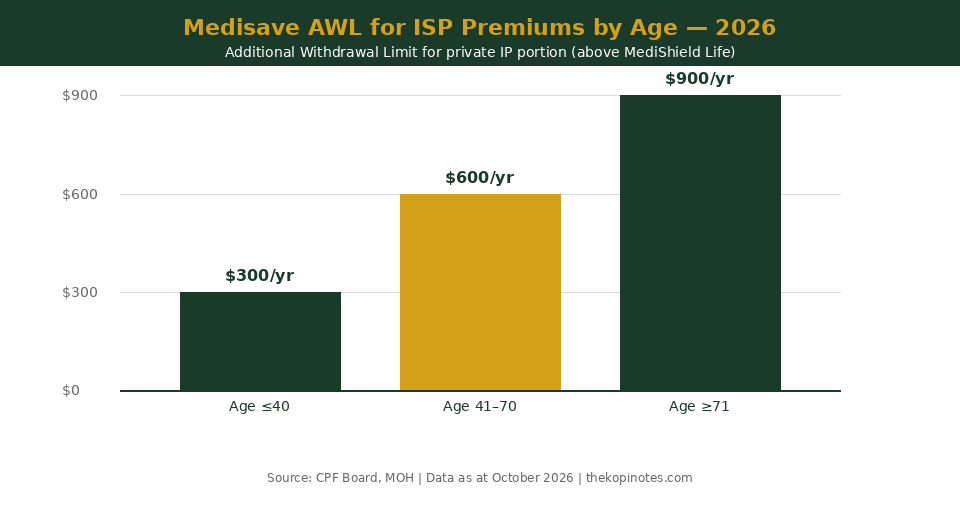
| Age Next Birthday | Medisave AWL for ISP Premium (per year) | What This Covers |
|---|---|---|
| 40 and below | S$300 | Private IP portion only (above MediShield Life) |
| 41 to 70 | S$600 | Private IP portion only (above MediShield Life) |
| 71 and above | S$900 | Private IP portion only (above MediShield Life) |
Source: CPF Board, MOH. AWL applies to the private insurer’s IP premium only. MediShield Life premiums are handled separately through Medisave. Data as at October 2026.
The practical implication for switchers: if you are 55 years old and your new ISP has a lower base premium than your old one, your Medisave will simply withdraw a lower amount each year (up to the S$600 AWL cap). If your new plan’s premium exceeds the AWL, you pay the balance in cash — a rule that doesn’t change based on insurer, only on your age and plan tier.
For a deeper look at how the AWL interacts with your plan choice, the Medisave AWL 2026 ISP premium guide walks through the exact calculations for each age group.
The Big Risk: Underwriting and Pre-Existing Conditions
This is where switching ISPs gets genuinely complicated — and where most policyholders underestimate the downside risk.
When you switch to a different insurer, the new insurer will require you to go through full underwriting. This means you must disclose all medical conditions, surgeries, and diagnoses on your application form. The new insurer then decides:
- Accept you with standard terms (no exclusions)
- Accept you with exclusions (specific conditions or body parts excluded from coverage)
- Accept you with a premium loading (you pay more because of higher risk)
- Decline your application entirely
Here is the critical issue: any condition that was already covered under your old ISP may be excluded by the new insurer. For example, if you had a knee surgery five years ago and your existing AIA plan covers your knee with no exclusion (because it accepted you under moratorium underwriting before the knee became a known issue), switching to Prudential means Prudential will see the knee surgery on your disclosure form and may apply a knee exclusion permanently.
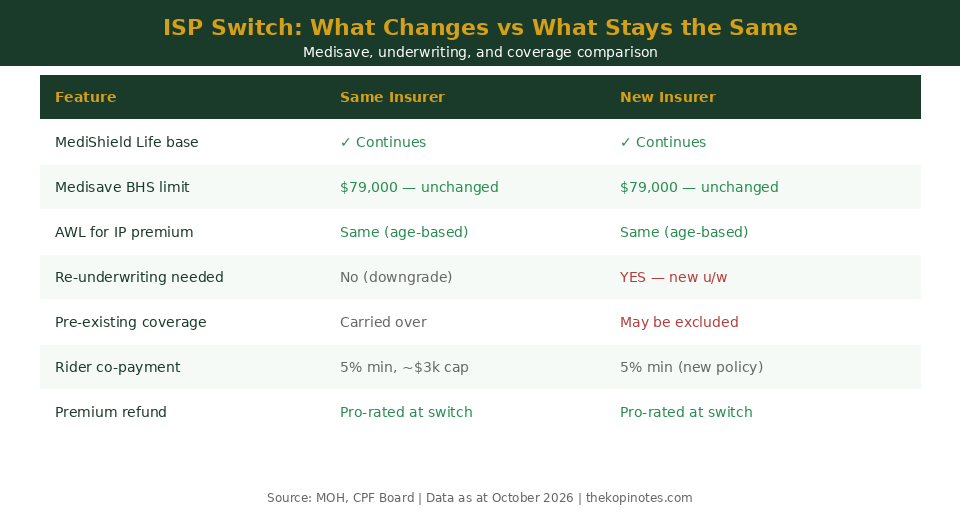
| What Happens To… | Downgrade (Same Insurer) | Switch (New Insurer) |
|---|---|---|
| MediShield Life base | ✓ Continues, no interruption | ✓ Continues, no interruption |
| Medisave limit (BHS) | S$79,000 — unchanged | S$79,000 — unchanged |
| AWL for IP premium | Same (age-based, not insurer-based) | Same (age-based, not insurer-based) |
| Re-underwriting needed | No (for downgrade only) | YES — fresh underwriting required |
| Pre-existing condition coverage | Existing exclusions carry over | Previously covered conditions may be newly excluded |
| Rider co-payment | 5% min, ~S$3,000/yr cap (same terms) | 5% min, ~S$3,000/yr cap (new policy, may differ) |
| Premium refund at switch | Pro-rated refund for unused months | Pro-rated refund for unused months |
Source: MOH, CPF Board. Data as at October 2026. Always consult your insurer before switching.
One important exception: downgrading within the same insurer (for example, moving from AIA HealthShield Gold Max to AIA HealthShield Gold Max B) generally does not require fresh underwriting, and any existing exclusions simply carry over to the new tier. This is why many policyholders who want to reduce premiums choose to downgrade with their existing insurer rather than switch to a cheaper insurer altogether.
For a side-by-side look at whether a full ISP comparison across all five insurers is worth the switch, the plan comparison guide covers all five insurers’ current premiums, rider terms, and panel sizes.
MediShield Life Continues Without Interruption
MediShield Life is your base government health insurance plan, administered by the CPF Board — not by any private insurer. It runs underneath your ISP and continues regardless of whether you switch, downgrade, or let your ISP lapse entirely.
This means you will always have some level of hospitalisation coverage, even during the administrative period between surrendering your old ISP and your new one taking effect. MediShield Life covers:
- Class B2/C ward hospitalisation at restructured hospitals
- Selected day surgeries and outpatient treatments
- Higher claim limits for ICU stays (up to S$2,200 per day, subject to deductibles and co-insurance)
However, MediShield Life alone will not cover private hospital stays or Class A/B1 wards at restructured hospitals at the same level as an ISP. During any gap period between your old and new ISP, you are effectively back to MediShield Life-level coverage only — which is an important consideration if you have a planned surgery or an ongoing treatment cycle.
To understand how the rider vs no rider decision interacts with MediShield Life’s base coverage, the dedicated guide compares out-of-pocket costs at each tier.
Timing Your Switch: Renewal Date and Pro-Rated Refunds
If you have decided to switch, timing matters. ISP premiums are collected annually by Medisave deduction, typically around your policy anniversary date. If you switch mid-year, your current insurer will refund the unused premium on a pro-rated basis (calculated from the cancellation date to the next premium anniversary).
To minimise double-paying premiums:
- Start your new ISP application 4–6 weeks before your current policy anniversary date to allow for underwriting processing time.
- Request that the new policy start date aligns as closely as possible with your old policy’s cancellation date.
- Do not cancel your old ISP until your new policy is confirmed and in force — never leave a gap if you have a chronic condition or pending procedure.
- If your switch application is rejected or has unwanted exclusions, you retain the right to continue your existing ISP (you have not yet cancelled it).
Note: if you applied for your original ISP under moratorium underwriting (which excludes pre-existing conditions for the first 12 months and then covers them if no symptoms arise), switching to a new insurer resets this clock — you start a new moratorium period from scratch.
Medisave Cost Scenarios: Before and After Switching
To illustrate how switching affects your actual Medisave usage, consider three profiles:
Profile A — 45-year-old switching from private hospital plan to Class A plan (same insurer):
Old annual IP premium: S$1,800 (Medisave pays S$600 AWL, cash pays S$1,200 + rider).
New annual IP premium: S$980 (Medisave pays S$600 AWL, cash pays S$380 + rider).
Cash saving: S$820 per year. Medisave impact: nil (same AWL applies). No underwriting needed (same insurer downgrade).
Profile B — 45-year-old switching to a different insurer’s Class A plan:
New IP premium: S$890 (Medisave pays S$600 AWL, cash pays S$290 + rider).
Risk: must complete new underwriting. If knee arthritis (diagnosed in 2023) is on file, new insurer may exclude knee-related hospitalisation. Cash saving of S$910/year — but potential knee exclusion could cost tens of thousands in a worst-case scenario.
Profile C — 72-year-old switching insurers:
AWL increases to S$900 at 71+, partially offsetting premium increases. But at this age, health declarations are more complex. The probability of underwriting exclusions or premium loadings is higher. Most financial advisors recommend 72-year-olds remain with their existing insurer unless premiums become genuinely unaffordable — in which case downgrading to a lower tier within the same insurer is the lower-risk path.
For a full walkthrough of how an ISP claim works at a private hospital, including how Medisave, MediShield Life, the IP, and the rider interact at billing time, the step-by-step claim guide covers each layer in detail.
Should You Switch? A 5-Point Checklist
Before submitting a switch application, work through these five questions:
- Do you have any diagnosed conditions that your current ISP already covers? If yes, a switch to a new insurer almost certainly means losing that coverage. Do not switch unless you have confirmed in writing that the new insurer will cover the condition.
- Is the premium saving worth the underwriting risk? Calculate the annual saving in premiums. Then estimate the cost of a hospitalisation for your most likely health risk if it is excluded. If the exclusion risk is worth more than 3–5 years of premium savings, the maths do not favour switching.
- Have you checked whether a downgrade within your existing insurer achieves similar savings? Many policyholders discover they can move from a private hospital plan to a Class A plan with the same insurer, save S$500–S$1,000 per year, and need zero underwriting. This is almost always the lower-risk path.
- Is there any planned medical procedure in the next 12 months? Never switch during a period of active treatment or while awaiting a scheduled surgery. Your old ISP’s coverage for that condition may not transfer.
- Have you spoken to your existing insurer about retention options? Insurers sometimes offer discounts, rider restructuring, or flexible premium options to retain long-term policyholders. It is worth asking before committing to a switch.
If you need to review whether to cancel your ISP rider as part of a wider premium reduction strategy, the rider cancellation guide covers the financial trade-offs in full.
Frequently Asked Questions
Does my Medisave balance transfer to my new insurer when I switch ISPs?
What is the Medisave limit in 2026 and does switching ISPs affect it?
Will I lose coverage for my existing conditions if I switch to a new ISP insurer?
Is there a waiting period when I switch to a new ISP?
Can I switch ISPs if I already have an exclusion on my current policy?
How does the Medisave AWL work if I switch to a cheaper ISP?
Make the Right ISP Decision for 2026
Compare all five Integrated Shield Plans in Singapore, understand your true out-of-pocket costs, and see how your Medisave AWL applies at your age.
Get Free Insurance Advice
Speak with a licensed insurance advisor. No obligation, no cost.
By submitting this form, you agree to our Privacy Policy.
This article was researched with the help of AI. While we strive to keep all information accurate and up to date, there may be errors. If you notice any discrepancies, please contact us.