Keppel DC REIT 2026: How AI Data Centre Demand Is Driving DPU Growth
Published October 2026 · 8 min read · SGX: DC6U
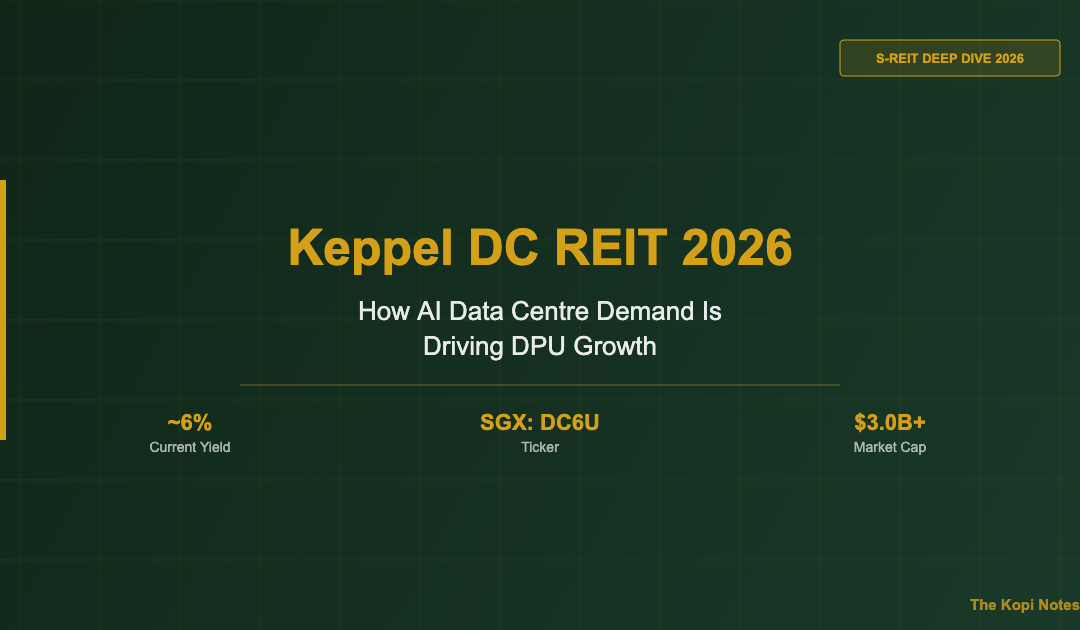
Keppel DC REIT (SGX: DC6U) is Singapore’s largest pure-play data centre REIT, owning 23 data centres across 10 countries with a portfolio valued at approximately SGD 3.5 billion. As AI workloads surge globally, demand for data centre capacity has accelerated dramatically — positioning KDC REIT as a direct beneficiary. With occupancy above 97% in Singapore and a DPU of ~10 cents per unit, KDC REIT offers Singapore investors rare exposure to a structural growth theme at a ~6% yield.
Not financial advice. All figures are for educational reference only. Data as at October 2026 unless noted.
What Is Keppel DC REIT?
Keppel DC REIT (SGX: DC6U) was listed on the Singapore Exchange in December 2014, making it Singapore’s first and largest data centre REIT by total assets. It is managed by Keppel DC REIT Management Pte. Ltd., a wholly-owned subsidiary of Keppel Ltd., one of Singapore’s leading infrastructure conglomerates.
The REIT invests in income-producing real estate assets used primarily for data centre purposes. Its current portfolio spans 23 data centres across Singapore, Australia, Germany, the Netherlands, Ireland, Italy, Malaysia, China, Japan, and the United Kingdom — offering Singapore investors diversified exposure to global digital infrastructure.
Unlike a typical S-REIT that owns offices or retail malls, KDC REIT’s tenants are technology companies, cloud service providers, and enterprises that require highly secure, always-on computing facilities. Key tenants include hyperscalers and colocation customers on long-term leases — a profile that delivers exceptional income stability.
Key Facts at a Glance
| Metric | Value |
|---|---|
| SGX Ticker | DC6U |
| Listed | December 2014 |
| Number of Properties | 23 data centres |
| Countries | 10 (SG, AU, DE, NL, IE, IT, MY, CN, JP, UK) |
| Portfolio Value | ~SGD 3.5 billion (est.) |
| Market Cap | ~SGD 3.0 billion (est.) |
| Annualised DPU (2026E) | ~10.15 SGD cents |
| Indicative Yield | ~5.8%–6.2% (at SGD 1.65) |
| Aggregate Leverage | ~36.5% (1H2026) |
| WALE | ~7.4 years |
Source: Keppel DC REIT 1H2026 Investor Presentation. Figures are indicative estimates.
AI Demand: The Structural Tailwind Driving Data Centres
The rise of artificial intelligence has created unprecedented demand for data centre infrastructure. AI model training and inference workloads require enormous computational power — translating directly into data centre capacity demand. More AI = more racks, more power, more cooling, more real estate.
According to McKinsey Digital’s research on data centre economics, global data centre demand is projected to more than triple by 2030. Southeast Asia — including Singapore — is among the fastest-growing regions, driven by digital economy expansion, regional cloud adoption, and AI adoption across enterprise and government sectors.
How AI Workloads Translate Into REIT Revenue
For a Singapore investor, the AI-to-DPU mechanism works like this:
- Higher power density: AI GPU clusters demand 10–50x more power per rack than traditional IT, allowing landlords to charge higher rents per MW.
- Longer leases: Hyperscale AI tenants typically sign 10–20 year leases, providing exceptional income visibility and extending WALE.
- Rental escalations: KDC REIT’s leases include CPI-linked or fixed-step escalations of 2–4% per annum.
- Development pipeline: Keppel Ltd.’s right-of-first-refusal pipeline gives KDC REIT a steady flow of acquisition opportunities without relying solely on the open market.
Singapore is an ideal AI data centre hub — offering political stability, world-class submarine cable connectivity, reliable power infrastructure, and an IMDA regulatory framework that actively manages (and limits) new supply. After a moratorium on data centre approvals (2019–2022), the government reopened licensing in 2023 with strict energy efficiency requirements — a barrier to entry that protects incumbent operators like KDC REIT’s Singapore portfolio.
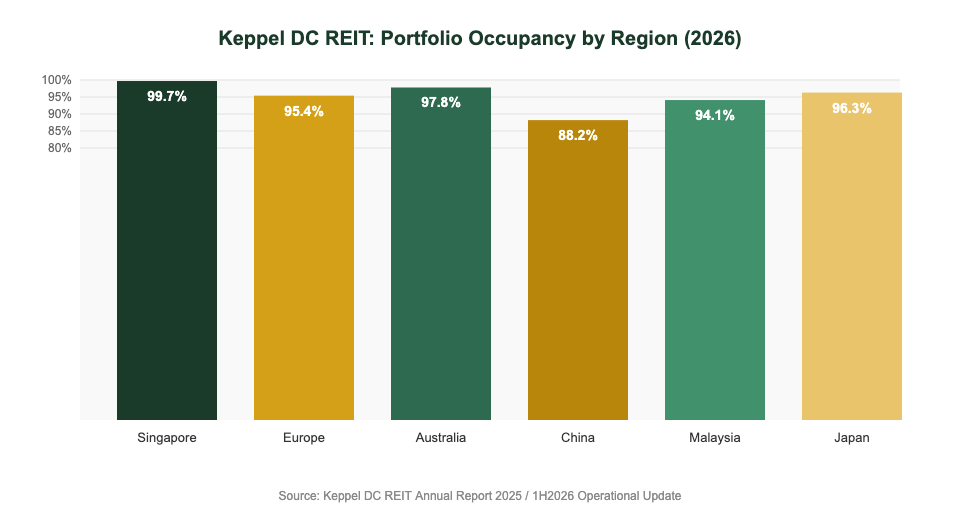
KDC REIT Portfolio Overview 2026
Keppel DC REIT’s 23 assets are distributed across 10 countries. Singapore is the anchor market contributing ~25–30% of portfolio value at near-100% occupancy. Geographic diversification hedges against single-country regulatory or economic shocks.
| Region | Occupancy | Tenant Type | Lease Structure |
|---|---|---|---|
| Singapore | 99.7% | Shell & hyperscale | Triple-net, 10–20yr |
| Europe | 95.4% | Colocation, enterprise | CPI-linked, 7–15yr |
| Australia | 97.8% | Government, enterprise | Fixed escalation, 10yr |
| China | 88.2% | Internet, cloud | Variable, 3–5yr |
| Malaysia | 94.1% | Telco, colocation | Fixed, 7yr |
| Japan | 96.3% | Enterprise, cloud | CPI-linked, 5–10yr |
Source: Keppel DC REIT 1H2026 Investor Presentation. All occupancy figures are estimates based on public disclosures.
The China portfolio at 88.2% occupancy is the watch point. Regulatory pressure on foreign data infrastructure and slower China tech recovery have dampened leasing velocity. Management has signalled selective asset recycling, which could strengthen portfolio quality if executed at accretive pricing.
Singapore investors researching the best S-REITs in Singapore 2026 consistently rank KDC REIT highly for its defensive occupancy profile and long WALE — both critical for income stability in a higher-for-longer interest rate environment.
DPU & Yield Analysis
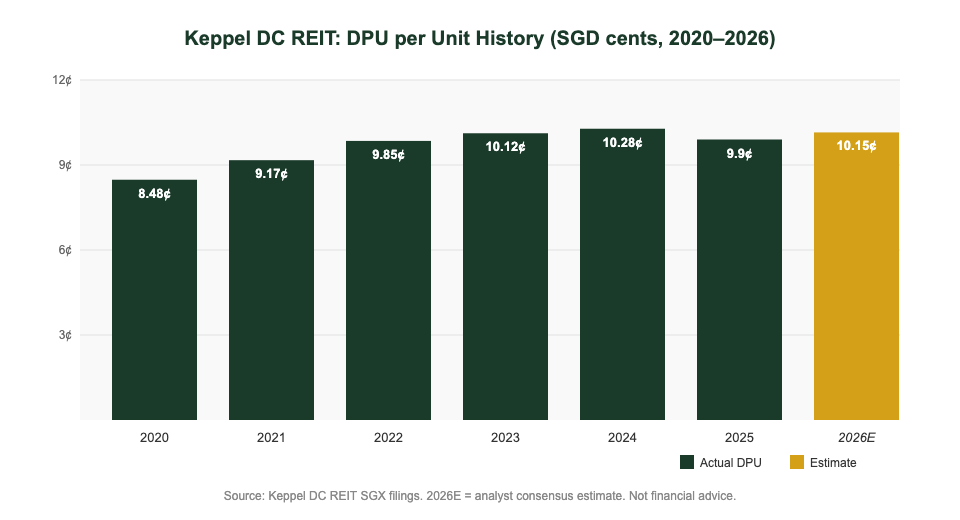
Keppel DC REIT has grown its DPU from 8.48 cents in FY2020 to an estimated 10.15 cents for FY2026 — approximately 20% growth over six years. This growth has been driven by acquisitions, rental escalations, and organic occupancy improvements. KDC REIT distributes quarterly.
For a Singapore investor who purchased KDC REIT at the IPO price of SGD 0.93 in December 2014, the yield-on-cost by 2026 would exceed 10.9% — a compelling demonstration of compounding DPU growth rewarding long-term holders.
Yield Scenarios at Different Entry Prices
| Entry Price (SGD) | DPU (est.) | Forward Yield | Yield-on-Cost (5yr est.) |
|---|---|---|---|
| SGD 1.40 | 10.15¢ | 7.25% | ~8.5% |
| SGD 1.55 | 10.15¢ | 6.55% | ~7.7% |
| SGD 1.65 | 10.15¢ | 6.15% | ~7.2% |
| SGD 1.80 | 10.15¢ | 5.64% | ~6.6% |
| SGD 2.00 | 10.15¢ | 5.08% | ~6.0% |
Source: TKN calculations based on estimated DPU of 10.15 SGD cents. Yield-on-cost assumes 2% annual DPU growth. Past performance is not indicative of future results.
For investors using a Singapore retirement calculator to model income portfolios, KDC REIT’s 5.6%–7.3% yield range makes it one of the more attractive yield instruments among Singapore-listed securities — especially with data centre sector growth upside.
Singapore investors pay no withholding tax on REIT distributions, unlike foreign ETFs. This makes KDC REIT efficient for CPF OA and SRS deployment. Platforms like Endowus (referral code 2V343) allow CPF and SRS funds to access Singapore REITs in a managed portfolio format.
Why KDC REIT Is an AI Infrastructure Beneficiary
The core investment thesis for KDC REIT in 2026 is straightforward: every AI model trained, every inference request served, every cloud workload migrated requires more data centre capacity. KDC REIT owns that capacity.
1. Singapore as an AI Hub
Singapore’s IMDA Digital Infrastructure Act and Smart Nation initiative position the city-state as a tier-1 regional AI hub. New data centre approvals reopened in 2023 with strict energy efficiency requirements — a moat protecting KDC REIT’s existing Singapore assets from oversupply.
2. Rental Reversions at Lease Renewal
Colocation rates in Singapore have risen 30–50% from 2019 levels, according to JLL Asia-Pacific Data Centre Outlook 2026. As legacy contracts roll over, KDC REIT’s Singapore assets are positioned for positive rental reversion — translating directly into higher DPU.
3. Keppel Ltd. Development Pipeline
Keppel Ltd.’s committed data centre developments in Singapore, Malaysia, and Japan provide KDC REIT with a right-of-first-refusal acquisition pipeline. For investors focused on passive income in Singapore, this pipeline visibility differentiates KDC REIT from S-REITs that must rely on open-market third-party acquisitions.
4. Interest Rate Environment
With ~36.5% gearing and ~75% fixed-rate debt, KDC REIT’s interest expense is well-managed. As the Fed continues gradual rate reductions in 2026, floating rate exposure will benefit — widening the spread between property yield and borrowing cost, and supporting DPU growth.
Risks & Challenges
KDC REIT is not without risk. Singapore investors considering this REIT should weigh the following factors carefully before committing capital.
1. Concentration Risk
Singapore accounts for approximately 29% of KDC REIT’s portfolio by asset value. While geographic diversification reduces single-market risk, Singapore represents the highest-yield and highest-quality segment. Any policy change by IMDA regarding data centre development moratoriums or energy use quotas could affect new acquisitions.
2. Tenant Concentration
KDC REIT’s top 10 tenants account for a significant portion of revenue. While these include blue-chip global operators (hyperscalers, telcos, financial institutions), the loss of a single major tenant — particularly in a facility with limited alternate uses — would materially impact DPU. Investors should monitor tenant announcements closely.
3. High Price-to-Book Ratio
KDC REIT consistently trades at a premium to book value (P/B ~1.3–1.6x). This reflects investor confidence in the AI data centre growth thesis but leaves limited margin of safety if the sector re-rates downward. Compare this to traditional S-REITs (office, retail) trading at or below book. For investors focused on capital preservation alongside yield, the premium valuation is worth noting.
4. Currency Risk (European & Australian Assets)
A portion of KDC REIT’s portfolio is denominated in EUR and AUD. SGD strength vs. EUR/AUD will negatively affect distributable income. This is partially hedged but not fully eliminated. Check KDC REIT’s quarterly financial statements for the current hedge ratio.
5. Capital Expenditure & Uptime Requirements
Data centres require continuous capital expenditure to maintain Tier III/IV uptime standards, power redundancy, and cooling efficiency. As AI workloads intensify energy density requirements, older facilities may require expensive retrofits. This capex drag can reduce distributable income if not managed carefully.
For comparison: Singapore T-bills 2026 currently yield around 3.3–3.5% with zero capital risk — so an investor accepting KDC REIT’s share price volatility needs confidence that the premium yield and growth potential justify the risk.
Investment Verdict: KDC REIT in 2026
Keppel DC REIT is the clearest way for Singapore retail investors to gain listed exposure to the AI data centre infrastructure boom. Its track record of DPU growth, 100% occupancy in Singapore, blue-chip sponsor pipeline, and regulatory moat combine to make it a high-conviction holding for investors willing to accept some valuation premium.
For a balanced S-REIT portfolio, KDC REIT works well paired with a diversified income REIT such as one of the best S-REITs for 2026 — with KDC providing the growth kicker and others providing dividend yield stability.
Summary verdict:
- ✅ Strong AI-demand growth thesis with real portfolio proof
- ✅ DPU growth track record — 20% increase over 6 years
- ✅ Singapore assets irreplaceable due to regulatory moat
- ✅ Excellent dividend yield of ~5.6%–7.3% depending on entry price
- ⚠️ Trades at premium to book — not a “deep value” play
- ⚠️ Tenant concentration risk worth monitoring
- ⚠️ Higher beta than pure-yield S-REITs
Not financial advice. All yield and DPU figures are estimates based on available data as at October 2026. Always conduct your own due diligence before investing.
Ready to Invest in Data Centre REITs?
Singapore investors can buy KDC REIT through any SGX-connected broker. For cost-efficient investing, consider these platforms:
- Syfe (referral code SRPRFFFCD) — managed REIT portfolios including data centre exposure, available via SRS
- Endowus (referral code 2V343) — invest CPF OA/SA and SRS in REIT funds with low fees
- FSMOne (referral code P0544985) — low-cost brokerage with regular savings plan option
Use the Singapore retirement calculator to model how KDC REIT dividends could contribute to your income portfolio over time.
Frequently Asked Questions
What is Keppel DC REIT and what does it invest in?
What is Keppel DC REIT's dividend yield in 2026?
How does AI demand affect Keppel DC REIT's performance?
Can Singapore investors use CPF or SRS to invest in KDC REIT?
What is KDC REIT's current gearing ratio?
How does KDC REIT compare to other Singapore REITs?
This article was researched with the help of AI. While we strive to keep all information accurate and up to date, there may be errors. If you notice any discrepancies, please contact us.