SRS Account Withdrawal Rules Singapore 2026: How to Withdraw Tax-Free
By The Kopi Notes | Updated October 2026 | Retirement Planning
📋 Table of Contents
Jump to Section
- What Is the Supplementary Retirement Scheme (SRS)?
- When Can You Withdraw from Your SRS Account?
- The 50% Tax Exemption on SRS Withdrawals Explained
- Early Withdrawal Penalty: What Happens If You Withdraw Before 63?
- The 10-Year Withdrawal Window Strategy
- How to Grow Your SRS Balance Before Withdrawal
- Practical Worked Examples
- Frequently Asked Questions
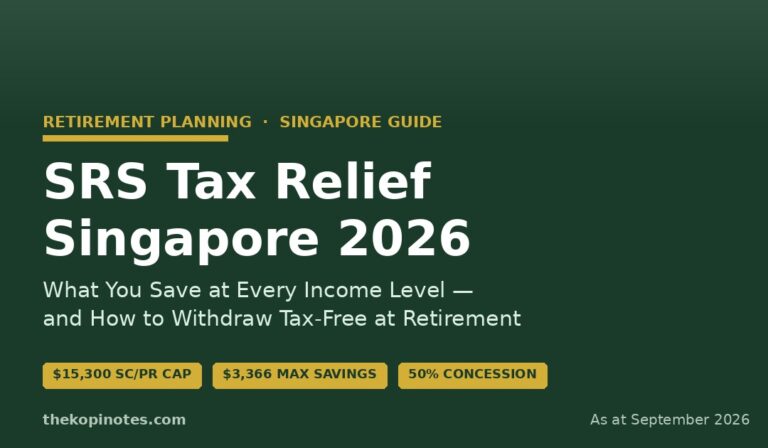
The SRS (Supplementary Retirement Scheme) account in Singapore offers a powerful tax benefit on withdrawal: only 50% of the amount you withdraw after the statutory retirement age of 63 is added to your taxable income. The other 50% is completely tax-free. By spreading your SRS withdrawals over 10 years — the allowable withdrawal window — many retirees can withdraw their entire SRS balance with little to no income tax payable. This guide explains the exact rules, penalties, and optimal withdrawal strategy for 2026.
Not financial advice. All figures are for educational reference only. Data as at October 2026 unless noted.
What Is the Supplementary Retirement Scheme (SRS)?
The Supplementary Retirement Scheme (SRS) is a voluntary savings scheme administered by the Ministry of Finance and managed through three approved banks — DBS, OCBC, and UOB. It was designed to supplement CPF savings and encourage Singaporeans to build a larger retirement nest egg.
Here is how SRS works at a glance:
- Voluntary contributions: Unlike CPF, you choose how much to contribute (up to the annual cap)
- Upfront tax relief: Every dollar contributed reduces your chargeable income dollar-for-dollar, up to the annual cap
- Annual contribution cap (2026): S$15,300 for Singapore Citizens and PRs; S$35,700 for foreigners
- Investment flexibility: SRS funds can be invested in SGX-listed stocks, ETFs, unit trusts, Singapore Government Securities, Singapore Savings Bonds, and eligible insurance products
- Tax on withdrawal: Only 50% of withdrawals made at or after the statutory retirement age is taxable — the key benefit
For a deep-dive on where to invest your SRS funds for growth, see our guide on SRS investment options Singapore 2026.
When Can You Withdraw from Your SRS Account?
The most important date for SRS withdrawal is the statutory retirement age. As of 2026, this is 63 years old (raised from 62 in 2022). The Singapore government has announced it will continue to rise gradually — to 64 in 2026 and 65 in 2030.
⚠️ Important: Retirement Age Locked at First Contribution
Your eligible SRS withdrawal age is the prevailing statutory retirement age when you first made an SRS contribution, not the retirement age when you reach that age. If you started your SRS in 2020 when the retirement age was 62, you can begin withdrawing at 62 — even if the retirement age has since risen to 63 or 64.
| Withdrawal Condition | Tax Treatment | Penalty? |
|---|---|---|
| At/after statutory retirement age (63) | 50% of withdrawal added to income | No |
| Before statutory retirement age | 100% of withdrawal added to income | Yes — 5% penalty |
| Death or permanent incapacity | 50% of withdrawal added to income | No |
| Foreigner departing Singapore permanently (after 10 years in scheme) | 50% of withdrawal added to income | No |
Source: CPF Board — SRS guidelines, October 2026
The 50% Tax Exemption on SRS Withdrawals Explained
When you withdraw from your SRS account on or after the statutory retirement age, only 50% of the withdrawn amount is included in your chargeable income. The remaining 50% is fully exempt from income tax. This is the single biggest tax advantage of the SRS scheme.
How the 50% Exemption Works (Example)
If you withdraw S$40,000 in a year from your SRS account after reaching retirement age:
- Taxable amount: S$20,000 (50%)
- Tax-exempt amount: S$20,000 (50%)
- If S$20,000 is your only income: Tax payable = S$0 (below the S$20,000 personal income tax relief threshold)
Effective tax on S$40,000 SRS withdrawal = S$0
This is why the SRS scheme is so powerful for retirement planning. Compare this with regular savings or fixed deposits — withdrawals from those are not taxable at all, but you also get no upfront tax relief. With SRS, you get tax relief now (when your income and tax rate is likely higher) and pay very little tax later (when you have little other income in retirement).
To estimate your own retirement income needs and tax position, use our free Singapore retirement calculator.
Early Withdrawal Penalty: What Happens If You Withdraw Before 63?
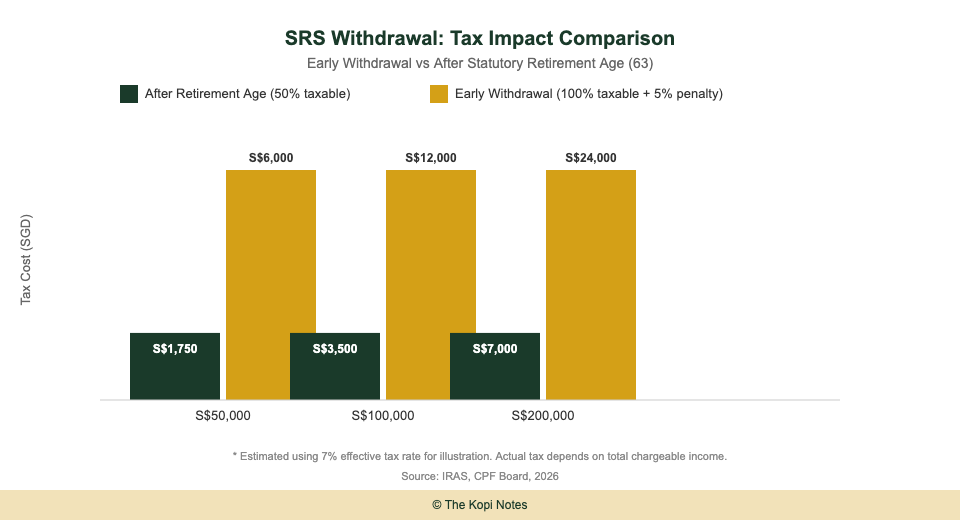
If you need to withdraw from your SRS before reaching the statutory retirement age, the tax consequences are significantly more punishing. There are two costs:
- 5% early withdrawal penalty — charged on the full amount withdrawn
- 100% of the withdrawal is taxable — instead of the usual 50%
This effectively doubles the tax burden and adds the 5% penalty on top. Let us work through an example:
| Scenario | Withdrawal Amount | Penalty | Taxable Amount | Est. Total Cost* |
|---|---|---|---|---|
| Early withdrawal (before 63) | S$100,000 | S$5,000 | S$100,000 (100%) | ~S$16,200 |
| After retirement age (63) | S$100,000 | S$0 | S$50,000 (50%) | ~S$3,500 |
*Estimated tax cost assumes withdrawal is the only income and standard personal income tax rates apply. Actual tax payable depends on total chargeable income. Source: IRAS tax tables 2026.
💡 Exception: No Penalty for Foreigners After 10 Years
Foreign nationals who are departing Singapore permanently are eligible to withdraw their SRS balance without the 5% penalty — provided they have been a SRS account holder for at least 10 years. Only 50% of the balance remains taxable.
The 10-Year Withdrawal Window Strategy
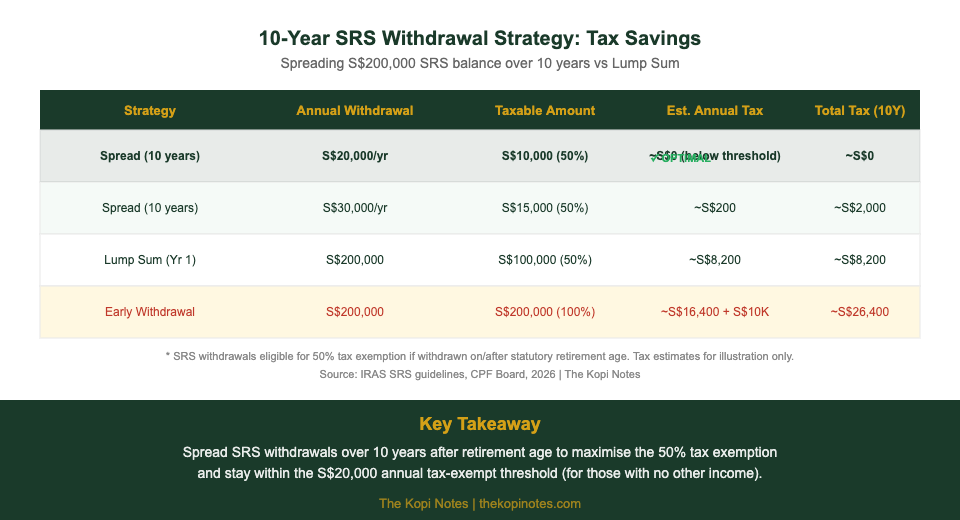
The most powerful feature of the SRS scheme is the 10-year withdrawal window. Once you make your first SRS withdrawal, the clock starts. You have 10 years to draw down your entire SRS balance. Any amount remaining at the end of 10 years is deemed fully withdrawn on that date — so you must plan carefully to avoid a large taxable event.
The optimal strategy for most SRS holders is to spread withdrawals evenly over the 10-year window to minimise annual taxable income.
How to Trigger the 10-Year Window Without Losing Tax Benefits
There is a useful planning technique: you can make a partial withdrawal of just S$1 on the day you reach statutory retirement age to start the 10-year clock. This locks in your start date without creating a meaningful taxable event. Your remaining SRS balance continues to be invested and grow.
For example, if you reach age 63 in January 2026:
- Withdraw S$1 in January 2026 — clock starts, 10-year window ends January 2036
- Withdraw S$20,000–S$40,000/year from 2026 to 2035 (tailored to stay below any tax threshold)
- Ensure the balance reaches zero before January 2036
Keep the SRS funds invested in low-risk instruments (SSBs, money market funds, or dividend stocks) during the drawdown period. To compare how SRS stacks up against other CPF-linked retirement options, see our analysis on SRS vs CPF top-up Singapore.
How to Grow Your SRS Balance Before Withdrawal
One of the most underutilised aspects of the SRS scheme is that your funds do not have to sit idle. You can invest SRS funds in a wide range of instruments to grow your balance before retirement.
| Investment Type | Examples | Best For |
|---|---|---|
| Singapore Savings Bonds (SSB) | Oct 2026 SSB: ~2.8% p.a. | Capital preservation, risk-free |
| Singapore T-Bills | 6-month T-bill: ~3.1% | Short-term, highest risk-free return |
| SGX-Listed Stocks / REITs | DBS, CICT, MNACT | Long-term growth, dividend income |
| ETFs | Nikko AM STI ETF, ABF Bond ETF | Diversified, passive growth |
| Unit Trusts / Robo-Advisors | Endowus (referral code 2V343), FSMOne | Hands-off, globally diversified |
| Annuities / Insurance | CPF LIFE-equivalent private annuities | Guaranteed income for life |
Source: IRAS SRS guidelines, CPF Board 2026
Endowus is one of the most popular platforms for SRS investing in Singapore. It accepts direct SRS transfers, offers globally diversified funds at low fees, and lets you set up a systematic drawdown plan. Use Endowus referral code 2V343 for a fee rebate when you open your account.
Similarly, Syfe (referral code SRPRFFFCD) accepts SRS funds for its income and REIT+ portfolios, making it a solid option for those who prefer a managed approach. For broader CPF and retirement planning strategy, our guide on CPF LIFE payout deferment at 65 vs 70 is worth reading alongside this one.
Practical Worked Examples
Example 1: Retiree with S$200,000 SRS Balance, No Other Income
- SRS balance at 63: S$200,000
- Strategy: Withdraw S$40,000/year for 5 years (or S$20,000/year for 10 years)
- Taxable amount/year (at S$20,000/year): S$10,000 (50% of S$20,000)
- Tax payable: S$0 — S$10,000 is below the effective taxable threshold after personal reliefs
- Total tax over 10 years: S$0
Example 2: Retiree with S$200,000 SRS Balance, CPF LIFE Payout of S$1,800/month
- CPF LIFE income: S$21,600/year (not taxable)
- Strategy: Withdraw S$30,000/year from SRS
- Taxable SRS amount: S$15,000 (50% of S$30,000)
- Other taxable income: S$0 (CPF LIFE payouts are not taxable)
- Total chargeable income: S$15,000 minus personal reliefs = likely S$0 tax
- Total tax over ~6-7 years: S$0 to minimal
These examples illustrate why SRS is considered one of the most tax-efficient retirement vehicles for Singaporeans. The key is to plan early and structure withdrawals to keep annual taxable income below the effective tax threshold. Use our Singapore retirement calculator to model your own scenario.
Frequently Asked Questions: SRS Account Withdrawal Rules Singapore
What is the statutory retirement age for SRS withdrawal in Singapore 2026?
Can I withdraw from SRS before retirement age?
How does the 50% tax exemption on SRS work?
What happens if I don't fully withdraw my SRS by the end of 10 years?
Can I invest my SRS funds while I am withdrawing?
Is CPF LIFE income counted when calculating SRS withdrawal tax?
Which is better: SRS or topping up CPF SA/RA?
Start Planning Your SRS Withdrawal Strategy Today
The SRS scheme is one of Singapore’s most powerful retirement tax tools — but only if you plan your withdrawals correctly. The key rules to remember are:
- Withdraw only after statutory retirement age (63) to get the 50% tax exemption
- Spread withdrawals over the 10-year window to minimise annual taxable income
- Keep SRS funds invested (SSBs, ETFs, unit trusts) during the withdrawal period
- Trigger the 10-year clock with a S$1 withdrawal on your retirement date
- Avoid early withdrawal — the 5% penalty + 100% tax treatment is a significant cost
To maximise your SRS returns before retirement, consider platforms like Endowus (referral code 2V343) and Syfe (referral code SRPRFFFCD) which both accept SRS funds and offer globally diversified portfolios. For more ideas on what to invest in, see our full guide on SRS investment options Singapore 2026.
All content is for informational and educational purposes only and does not constitute financial advice. Please consult a licensed financial adviser before making any retirement planning decisions.
This article was researched with the help of AI. While we strive to keep all information accurate and up to date, there may be errors. If you notice any discrepancies, please contact us.