The 1-year Singapore Government T-bill auction is scheduled for Wednesday, 15 October 2026 — and the application deadline is tomorrow, 14 October, at 9pm. With an expected cut-off yield of around 1.74% per annum, Singapore retail investors are weighing this against 12-month fixed deposits, the November Singapore Savings Bond, and CPF voluntary top-ups. Here is everything you need to know before the window closes tonight.
⚠️ Disclaimer: The information in this article is for general educational purposes only and does not constitute financial advice. Singapore T-bill yields are not guaranteed — actual cut-off yields may differ from estimates. Past yields are not indicative of future results. Please consult a licensed financial adviser before making any investment decisions.
What Is a 1-Year Singapore Government T-Bill?
A Singapore Government T-bill (Treasury Bill) is a short-term debt security issued by the Singapore Government and managed by the Monetary Authority of Singapore (MAS). Singapore T-bills come in two standard tenors: 6-month and 1-year. Unlike fixed deposits or coupon bonds, T-bills are sold at a discount to their face value and redeemed at face value at maturity — you do not receive periodic interest payments.
Here is how the mechanics work: if the cut-off yield is 1.74% per annum and you apply for S$10,000 in 1-year T-bills, you pay approximately S$9,828 upfront. When the T-bill matures in October 2027, the government pays you back the full S$10,000 face value — a return of S$172, equivalent to 1.74% p.a. on your principal.
Because T-bills are backed by the Singapore Government — which carries a AAA sovereign credit rating — they carry zero default risk. This makes them one of the safest fixed-income instruments available to retail investors in Singapore.
Application Deadline: Tomorrow, 14 October at 9pm
The application deadline for the October 15, 2026 1-year T-bill auction is Tuesday, 14 October 2026 at 9:00pm — one business day before the auction, as per MAS’s standard T-bill timeline. If you want in, you need to submit your application by tomorrow night.
You can apply through the following channels:
- DBS/POSB ATM or iBanking — Select “Invest” → “Singapore Government Securities” → “T-Bills”
- OCBC ATM or iBanking — Select “Investments” → “T-Bills & Bonds”
- UOB ATM or iBanking — Select “Investment” → “T-Bills”
- CPF Investment Scheme (CPFIS) — To apply using your CPF Ordinary Account (OA) funds via your CPFIS agent bank
- Supplementary Retirement Scheme (SRS) — Via your SRS agent bank (DBS, OCBC, or UOB)
The minimum investment is S$1,000, in multiples of S$1,000, with no maximum cap for individual investors. If you are applying through CPFIS or SRS, note that your agent bank may have earlier internal cut-off times — call ahead to confirm. Results will be announced on October 15, and any cash refunds for unsuccessful or partially allotted applications are typically credited within three to five business days.
What Yield Can You Expect?
Based on the secondary market closing yield tracked as of October 8, 2026, the consensus estimate for the October 15 cut-off yield is approximately 1.74% per annum. That said, actual results can deviate meaningfully from pre-auction estimates — both upward and downward — depending on competitive bidding by institutions.
Here is how the October 15 expected yield compares to recent 1-year T-bill auctions:
| Auction Month | Cut-Off Yield (p.a.) | vs Previous |
|---|---|---|
| January 2026 | 1.65% | — |
| April 2026 | 1.66% | +0.01% |
| July 2026 | 1.68% | +0.02% |
| October 15, 2026 (Estimated) | ~1.74% | +0.06% |
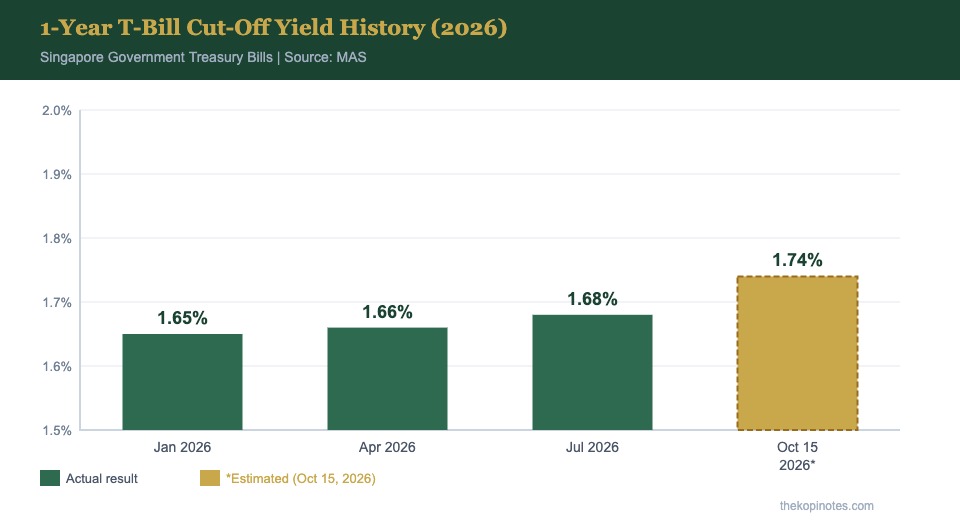
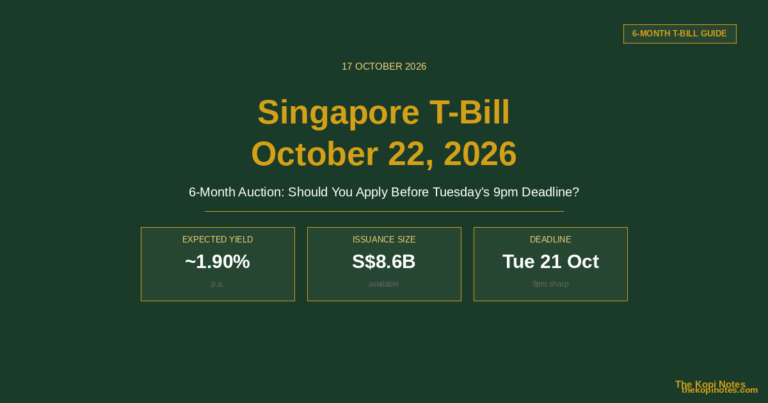
The gradual uptick across 2026 reflects shifting global rate expectations, with the October auction showing the largest single-quarter jump this year. Notably, this 1-year yield (1.74%) remains below the 6-month T-bill cut-off from October 8 (1.90%) — a yield curve inversion that suggests the market anticipates short-term rates remaining elevated in the near term before easing over a longer horizon.
How Does the 1-Year T-Bill Compare to Other Options?
Before deciding whether to apply, it helps to benchmark the 1-year T-bill against other widely available cash management tools for Singapore retail investors:
| Option | Est. Return (p.a.) | Min. Amount | Tenor | Liquidity |
|---|---|---|---|---|
| 1-Year T-Bill (Oct 15) | ~1.74% | S$1,000 | 12 months | Low (SGX secondary) |
| 6-Month T-Bill (Oct 8 result) | 1.90% | S$1,000 | 6 months | Low (SGX secondary) |
| Best 12-Month FD (HL Bank / Singapura Finance) | 2.08% | S$10,000 | 12 months | None (penalties apply) |
| SSB November 2026 (Year 1 Rate) | 1.67% | S$500 | Up to 10 years | High (monthly redemption) |
| SSB November 2026 (10-Year Avg) | 2.45% | S$500 | 10 years | High (monthly redemption) |
| CPF Ordinary Account (voluntary top-up) | 2.50% | — | Indefinite | Very restricted |
| CPF SA / SMRA (voluntary top-up) | 4.00% | S$8,000 (ERS) | Indefinite | Very restricted (retirement use) |
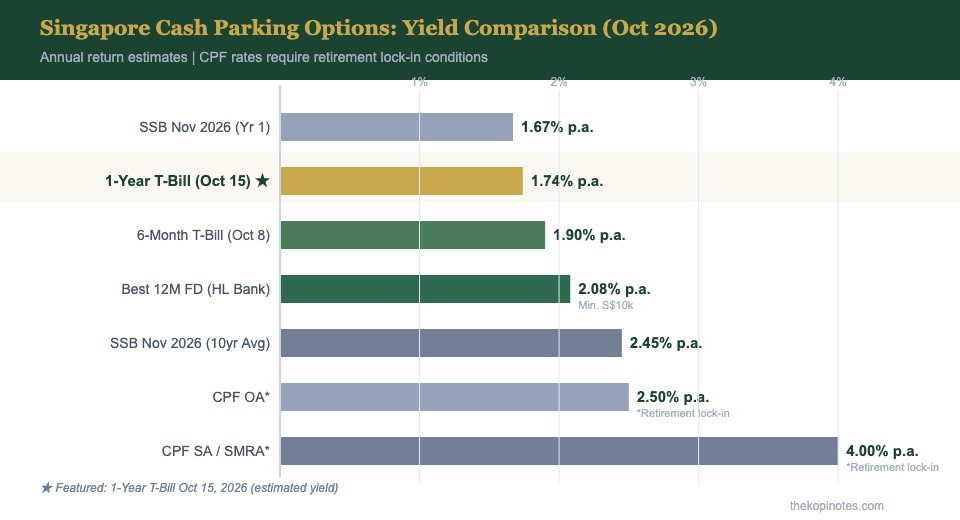
Note: CPF interest rates are included for opportunity-cost context. CPF funds are subject to withdrawal restrictions tied to retirement milestones and are not directly comparable as a cash parking option.
On yield alone, the best 12-month fixed deposit (2.08% from HL Bank or Singapura Finance) beats the expected T-bill rate of 1.74%. However, the T-bill has meaningful advantages: a lower entry point of S$1,000 versus S$10,000 for the top FDs, government backing with zero counterparty risk, and no relationship requirement with any specific bank. If liquidity is your priority and you may need to access your funds before October 2027, the Singapore Savings Bond is the better fit — see our SSB Redemption vs T-Bills (October 2026) comparison and the T-Bill Oct 8 Results + SSB November 2026 Full Comparison for a deeper analysis.
The MAS October 14 Factor: What It Means for Your Application
Here is something unique about this T-bill round: the Monetary Authority of Singapore is releasing its Monetary Policy Statement (MPS) for October 2026 on the morning of October 14 — the same day as the T-bill application deadline. For more background on how MAS policy has shaped Singapore’s T-bill yield environment this year, see our Singapore T-Bill Interest Rate 2026 guide.
The MAS manages Singapore’s monetary policy through the S$NEER (Singapore Dollar Nominal Effective Exchange Rate) policy band, adjusting the slope, width, and centre of the band rather than setting an interest rate directly. A policy tightening — such as steepening the appreciation slope or re-centring the band upward — signals a stronger SGD and lower domestic inflation expectations ahead.
Two scenarios and their implications for T-bill investors:
- If MAS tightens the S$NEER slope: A hawkish stance can marginally attract capital inflows into SGD-denominated assets, which may push T-bill prices slightly higher — meaning yields could come in slightly below the 1.74% estimate. The practical impact on a single retail auction is typically modest.
- If MAS holds policy unchanged: Markets would see no policy surprise, and the T-bill yield is likely to come in close to the estimated 1.74%.
The silver lining for retail investors: the MAS MPS is typically released at approximately 8:00am, giving you the full day to assess the decision before the 9pm application deadline. You can check the MAS announcement tomorrow morning at mas.gov.sg before committing your funds.
Non-Competitive vs Competitive Bids: Which Should You Choose?
Most retail investors apply via non-competitive bids — meaning you accept whatever cut-off yield the auction determines. You are guaranteed an allotment at the final cut-off rate (subject to overall auction demand), and there is no risk of being shut out because you misjudged the market yield.
Competitive bids require you to specify the maximum yield you are willing to accept. Bids at or below the cut-off are filled; bids above are rejected entirely. This approach is better suited to institutional investors or sophisticated retail investors who actively track the secondary market and want precise yield control.
For the vast majority of retail investors — especially those applying for amounts between S$5,000 and S$200,000 — non-competitive bidding is the right choice. It is simpler, removes execution risk, and ensures you participate at the market-clearing rate.
Who Should (and Shouldn’t) Apply?
The 1-year T-bill makes sense if:
- You have idle cash earning less than 1.74% in a savings account or current account
- You are comfortable locking up funds for 12 months and do not need the money before October 2027
- You want the simplicity and safety of a sovereign-backed instrument without bank relationship requirements
- You have less than S$10,000 to deploy (putting you below the threshold for the best FD rates)
You may want to skip this round if:
- You can meet the S$10,000 minimum for a 12-month FD at 2.08% — that yields an extra S$34 per S$10,000 over 12 months
- You may need access to your money before October 2027 — the SSB’s monthly redemption feature makes it far more flexible, and the November 2026 SSB application window remains open until October 24
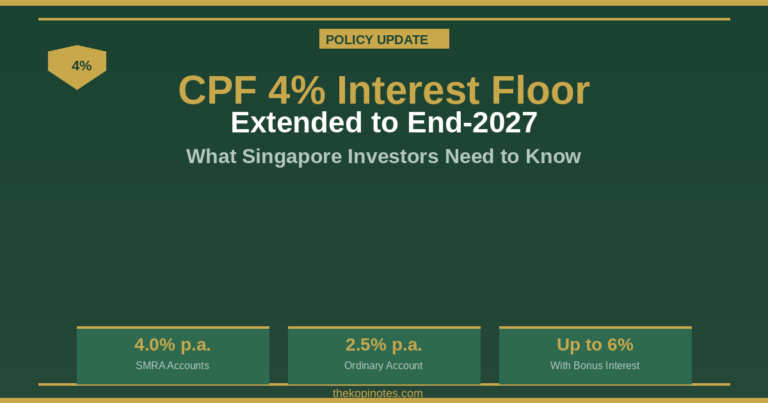
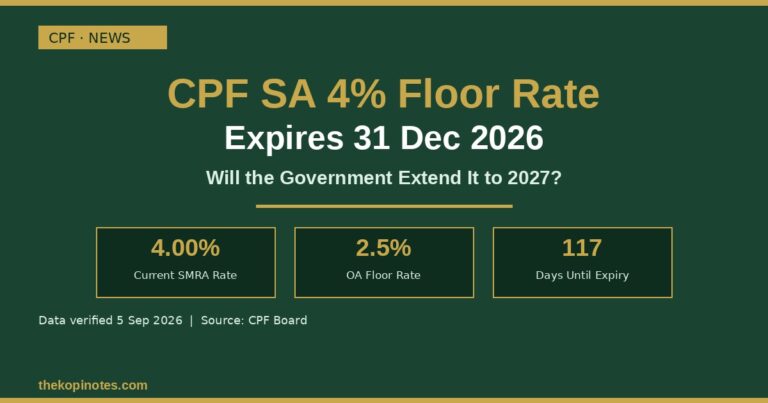
- You have unused CPF SA or SMRA voluntary top-up room — the guaranteed 4.00% rate there is more than double the expected T-bill yield and compounds tax-free over your working life
- You are waiting to see whether T-bill yields climb further in subsequent quarterly auctions
💡 Bottom Line for SG Investors
The 1-year T-bill at an expected 1.74% p.a. is a safe, fuss-free option for idle cash — but it is not the highest-yielding instrument on the table. If you can meet the S$10,000 minimum for a 12-month FD, you will earn meaningfully more (2.08%). If flexibility matters, the SSB beats the T-bill hands-down with monthly redemption and a higher long-run average. And if you have CPF top-up room, that 4.00% guaranteed rate should come first.
Where the T-bill earns its place: investors who want government-backed certainty from as little as S$1,000, with a clean 12-month term and no bank product strings attached. If that describes you, apply by 9pm tomorrow, 14 October.
Frequently Asked Questions
1. When will I know the actual cut-off yield for the October 15 T-bill?
The MAS typically announces the cut-off yield and allotment results on the auction date itself — October 15, 2026. Results are usually published on the MAS website and your bank’s investment portal by afternoon. The application window closes the night before (October 14 at 9pm), so you commit before knowing the final yield.
2. What happens if my application is not fully allotted?
If demand exceeds supply — meaning the competitive bids come in below the cut-off rate and crowd out non-competitive bids — your application may be only partially filled or not filled at all. Any unallotted funds are refunded to your linked bank account, typically within three to five business days after the auction (by approximately October 20–21, 2026).
3. Can I sell my 1-year T-bill before it matures in October 2027?
Yes. Singapore Government T-bills are listed on the Singapore Exchange (SGX), so you can sell them in the secondary market before maturity. However, the secondary market for T-bills is relatively illiquid, and your sale price will depend on prevailing yields at that time — meaning you could receive less than your purchase price if yields have risen. For most retail investors, holding to maturity is the cleanest strategy.
4. Should I use my CPF OA funds to apply for T-bills via CPFIS?
At the expected yield of 1.74%, using your CPF OA funds through CPFIS to buy T-bills is not advantageous. Your CPF OA already earns a guaranteed 2.50% per annum (with the first S$20,000 earning an extra 1%). Since the T-bill yield is lower than the OA rate, you would actually be earning less by moving your OA funds into T-bills. Leave your OA funds in CPF for the higher guaranteed return.
5. How is the return from a T-bill taxed in Singapore?
Singapore does not impose withholding tax or personal income tax on returns from Singapore Government Securities (SGS), including T-bills, for individual resident investors. The discount you earn on redemption is effectively tax-exempt. This makes T-bills straightforward from a tax perspective — no forms to file, no deductions to claim.
6. I missed this round. When is the next 1-year T-bill auction?
The 1-year T-bill is auctioned on a quarterly basis. If you miss the October 15 round, the next 1-year T-bill auction is expected in approximately January 2027. In the meantime, you can consider the 6-month T-bill (auctioned every two weeks), the Singapore Savings Bond (November 2026 applications close October 24), or available 12-month fixed deposit promotions from banks.
This article was researched with the help of AI. While we strive to keep all information accurate and up to date, there may be errors. If you notice any discrepancies, please contact us.