How Much Critical Illness Insurance Do You Need in Singapore (2026 Guide)
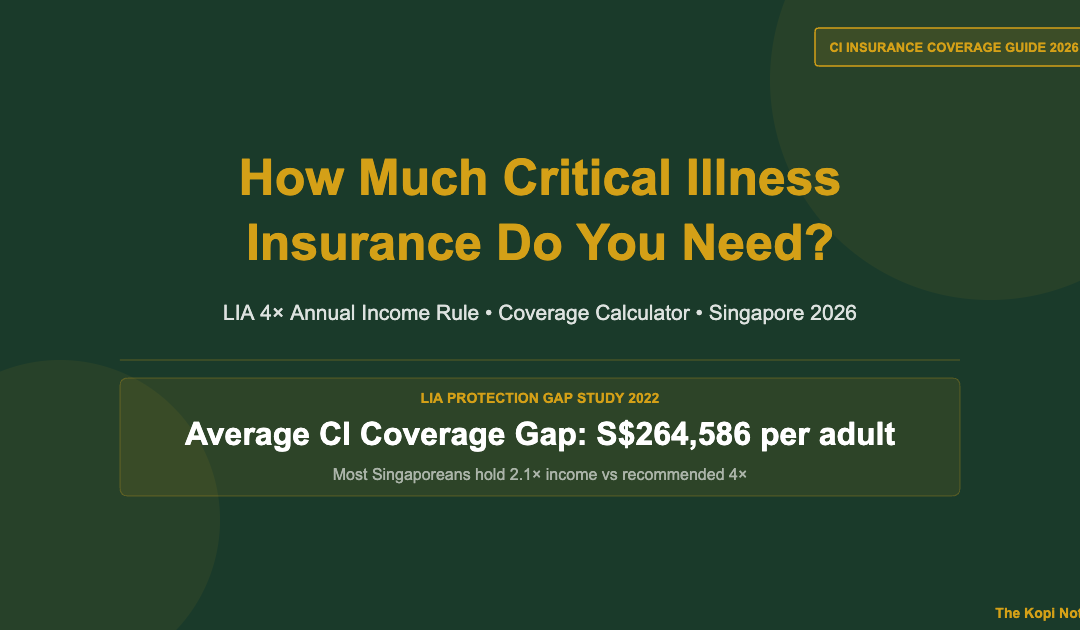
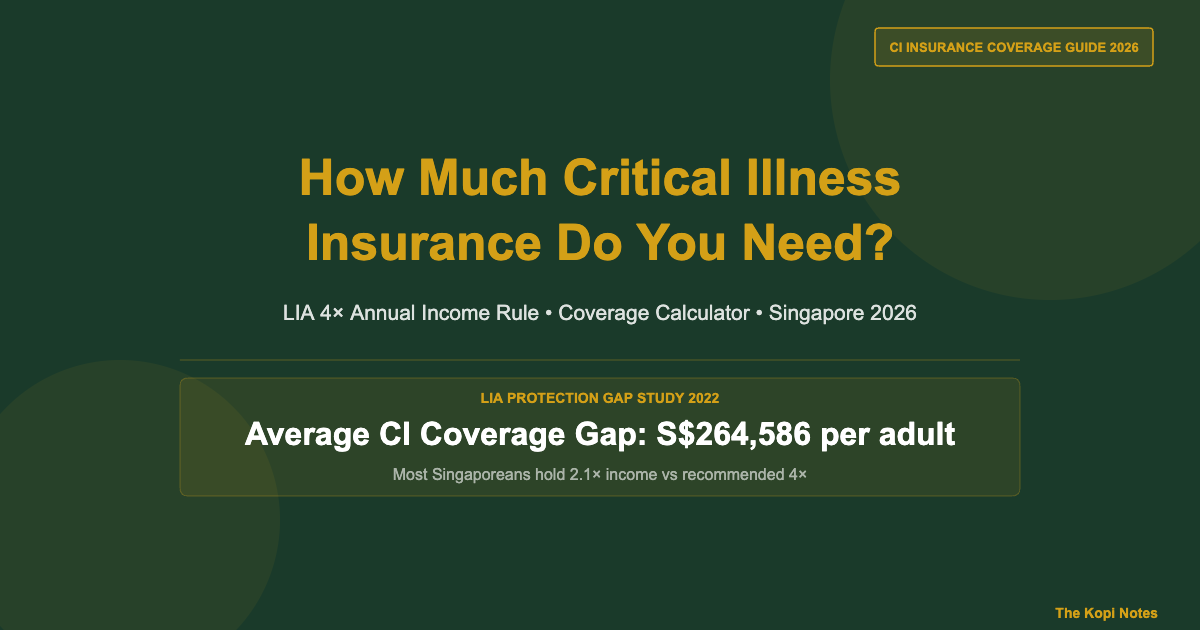
In Singapore, the Life Insurance Association (LIA) recommends a minimum of 4× your annual income in critical illness (CI) insurance coverage. For a median-income Singaporean earning $5,000/month, that means at least $240,000 in CI coverage — yet the average working adult holds just 2.1× their annual income. This 2026 guide shows you exactly how to calculate your CI coverage needs, what the LIA Protection Gap data says, and the 5 conditions driving 93% of all CI claims in Singapore.
Not financial advice. All figures are for educational reference only. Data verified as at October 2026 unless noted.
Why CI Coverage Amount Matters
When a serious illness strikes, the financial impact extends far beyond hospital bills. MediShield Life and your Integrated Shield Plan (ISP) cover hospitalisation and treatment costs — but they do not replace your income during recovery. A cancer diagnosis may require 6 to 24 months of treatment and a further 1 to 3 years before you can return to full-time work.
During this period, your monthly expenses continue — mortgage, utilities, school fees, family needs — while your income drops to zero or is severely reduced. This is precisely what critical illness insurance is designed for: a lump-sum cash payout upon diagnosis of a covered condition, giving you the financial flexibility to focus on recovery rather than bills.
For a comprehensive overview of your overall insurance needs, read our guide on life insurance needs analysis using the DIME method.
The LIA 4× Annual Income Rule
The Life Insurance Association Singapore (LIA) recommends CI coverage of at least 4× your annual income. This benchmark is based on the assumption that a critical illness may sideline you for up to 5 years before you can return to the workforce.
The 2022 LIA Protection Gap Study found that Singaporeans are significantly under-protected:
- Average CI coverage held: 2.1× annual income
- Average CI protection gap: S$264,586 per working adult
- CI protection gap narrowed from 81% (2017) to 74% (2022) — progress, but still significant
- LIA Q1 2026: Industry paid out S$555 million in CI, death, and TPD claims in a single quarter
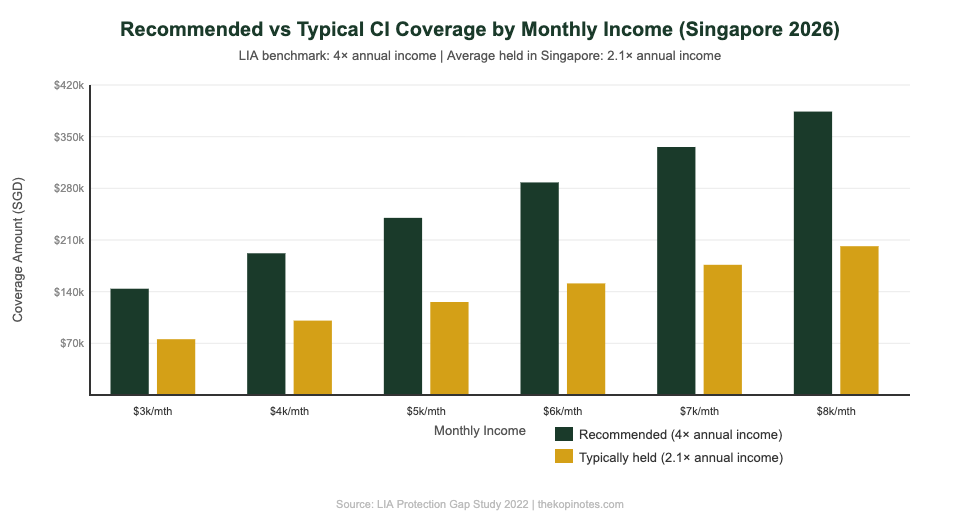
Recommended CI Coverage by Monthly Income (Singapore 2026)
| Monthly Income | Annual Income | Recommended CI (4×) | Typically Held (2.1×) | Coverage Gap |
|---|---|---|---|---|
| $3,000 | $36,000 | $144,000 | $75,600 | $68,400 |
| $4,000 | $48,000 | $192,000 | $100,800 | $91,200 |
| $5,000 | $60,000 | $240,000 | $126,000 | $114,000 |
| $6,000 | $72,000 | $288,000 | $151,200 | $136,800 |
| $7,000 | $84,000 | $336,000 | $176,400 | $159,600 |
| $8,000 | $96,000 | $384,000 | $201,600 | $182,400 |
Source: LIA Protection Gap Study 2022. Recommended coverage = 4× annual income; Typically held = 2.1× average per LIA data.
The chart above shows the coverage gap across different income levels. A Singaporean earning $5,000/month should target at least $240,000 in CI coverage — yet the typical individual holds only $126,000.
How to Calculate Your CI Coverage Needs
While the 4× rule is a good starting point, your actual needs depend on your personal financial profile. Use this 5-step formula:
- Income replacement: Monthly living expenses × 12 months × recovery years (use 5 years as default)
- Add outstanding debts: Mortgage balance, car loan, personal loans
- Add out-of-pocket medical costs: ISP deductibles, co-insurance, treatments not covered
- Add family support: Children’s education fund, dependant expenses if applicable
- Less existing CI coverage: Employer group insurance, existing CI riders, early CI plans
Worked Example — 35-year-old professional earning $5,500/month:
- Monthly living expenses: $3,500 × 12 × 5 years = $210,000
- HDB mortgage balance: $180,000
- Medical out-of-pocket (ISP deductibles + co-insurance): $30,000
- Children’s education fund (2 children): $40,000
- Total CI coverage needed: $460,000
- Less: CI rider on existing life policy: $100,000
- Net additional CI coverage required: $360,000
In this scenario, a standalone CI plan of $300,000–$400,000 would close the protection gap. You can model your retirement needs using our retirement planning calculator for Singapore.
CI Coverage by Life Stage in Singapore
Your CI coverage needs evolve through life. The biggest coverage requirements typically occur between ages 35–50, when income dependency is highest (young children, mortgage, single or sole-breadwinner households). Here is a life-stage framework to guide your planning:
Recommended CI Coverage by Life Stage (Singapore 2026)
| Life Stage | Profile | Typical Income | Recommended CI Coverage |
|---|---|---|---|
| Young Single (25–30) | No dependants, minimal debt | $3,500–$5,000/mth | $150,000–$200,000 |
| Newly Married (30–35) | Dual income, new mortgage | $5,000–$7,000/mth | $200,000–$320,000 |
| Young Family (35–45) | Children, mortgage, one income | $6,000–$9,000/mth | $300,000–$500,000 |
| Pre-Retiree (50–62) | Lower debt, near retirement | $5,000–$8,000/mth | $200,000–$300,000 |
| Retiree (65+) | No active income, CPF/investments | CPF LIFE payouts | $80,000–$150,000 |
Source: TKN analysis based on LIA guidelines and financial planning best practices, October 2026.
If you are a retiree assessing your CI needs, see our dedicated guide on CI insurance for retirees in Singapore.
The Top 5 Critical Illnesses in Singapore
Not all 37 covered CI conditions carry equal risk. Industry analysis shows that 5 conditions account for 93.45% of all CI claims in Singapore:
- Major Cancers — The largest share of CI claims by a wide margin. Singapore has one of the highest cancer rates in Asia. Colorectal, breast, and lung cancers are particularly prevalent. Treatment costs can range from $50,000 to $250,000+.
- Heart Attack of Specified Severity — The second most common CI claim. Cardiac treatments including stenting, bypass, or medication cycles can cost $30,000–$100,000.
- Stroke with Permanent Neurological Deficit — Often results in long-term rehabilitation costs and reduced earning capacity.
- Coronary Artery Bypass Surgery (CABG) — A major cardiac procedure with full recovery taking 6–12 months.
- End-Stage Kidney Failure — Dialysis costs in Singapore average $2,000–$3,000/month, making this a high long-term financial burden.
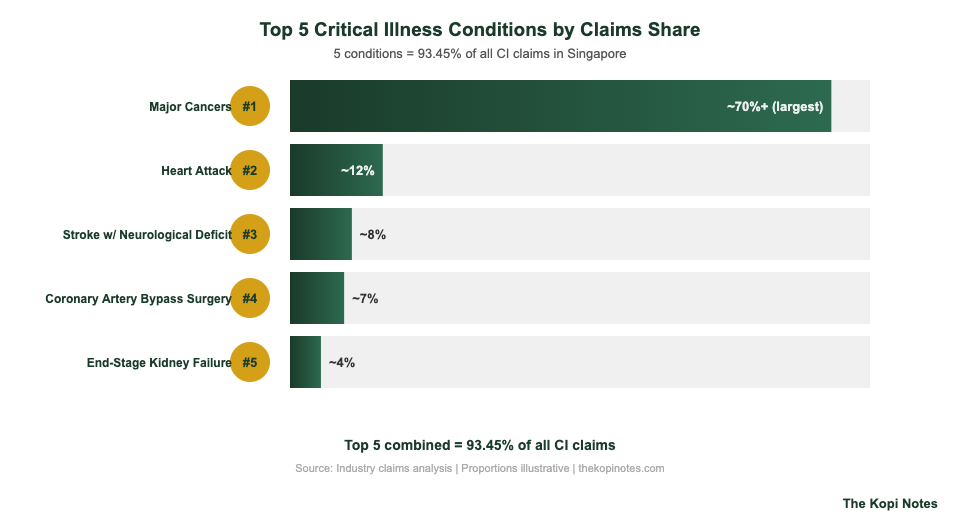
Top 5 CI conditions = 93.45% of all CI claims | Source: Industry claims analysis
For young adults specifically, see our guide on CI insurance for young adults in Singapore.
Standalone vs Rider CI Insurance
You can get CI coverage via two main routes: as a standalone CI plan, or as a rider attached to your life insurance policy. Each has its trade-offs:
| Feature | Standalone CI Plan | CI Rider on Life Policy |
|---|---|---|
| Premium | Higher | Lower (bundled savings) |
| Portability | Yes — independent policy | Tied to base life policy |
| Sum Assured | Flexible (up to $500k+) | Often limited by base policy |
| Early CI Option | Available (separate plan) | Some policies offer early CI |
| Multiple Payouts | Multi-pay CI plans available | Usually single payout |
| Best For | Comprehensive top-up coverage | Cost-effective base coverage |
Source: TKN analysis, October 2026.
Best strategy for most Singaporeans: Start with a CI rider on your life policy for base coverage ($100,000–$200,000), then add a standalone CI plan to top up to your target amount. This balances cost efficiency with adequate protection.
If you’re looking to invest alongside your insurance, the Endowus referral code 2V343 gives you a fee rebate when starting your investment journey, while Syfe (referral code SRPRFFFCD) offers flexible portfolios suited to different risk profiles.
5 Ways to Get More CI Coverage for Less
- Buy young — CI premiums increase significantly with age. Buying at 28 vs 38 can reduce premiums by 40–60% for the same sum assured.
- Choose term CI instead of whole-of-life CI — Term CI (coverage up to age 65 or 70) is significantly cheaper than whole-of-life CI, and most Singaporeans’ peak coverage need ends around retirement age.
- Use CPF MediSave — Premiums for eligible CI plans (integrated with life insurance) can be partially paid using CPF MediSave, subject to annual MediSave withdrawal limits.
- Consider a multi-pay CI plan for cancer coverage — Cancer recurrence rates are significant. A multi-pay plan pays out again on recurrence rather than lapsing after the first claim.
- Review and consolidate — Check if your employer provides any group CI coverage. Subtract this from your total need to avoid over-insuring and paying unnecessary premiums.
Frequently Asked Questions: CI Insurance Coverage in Singapore
What is the minimum CI coverage I should have in Singapore?
The LIA recommends at least 4× your annual income as a minimum CI coverage target. For a Singaporean earning $4,000/month, that is $192,000. If you have a mortgage, dependants, or high monthly expenses, you may need $300,000 or more. Use the 5-step formula in this article to calculate your personal requirement.
Does MediShield Life or my ISP cover critical illness costs?
MediShield Life and Integrated Shield Plans (ISPs) cover hospitalisation bills and certain outpatient treatments — but they do not replace your income during recovery. CI insurance provides a lump-sum payout upon diagnosis, which you can use for income replacement, family expenses, or any other financial need during your recovery period.
Can I use CPF MediSave to pay CI insurance premiums?
Yes, CPF MediSave can be used to pay premiums for certain approved CI plans, subject to annual MediSave withdrawal limits set by the Ministry of Health. CI plans bundled with life or health insurance are typically eligible. Check with your insurer or CPF Board for specific eligibility criteria.
Is early CI coverage worth the extra premium?
Early CI plans cover conditions at an earlier, less severe stage — such as early-stage cancer or a minor heart attack — and typically pay out 20–25% of the sum assured. For those with a family history of cancer or heart disease, early CI coverage is generally worthwhile. The additional premium is usually modest relative to the broader standalone CI plan cost.
What is the difference between multi-pay CI and standard CI?
Standard CI plans pay out once upon diagnosis of a covered condition. Multi-pay CI plans can pay out multiple times — for example, if you recover from cancer and then suffer a heart attack, or if a cancer recurs. Multi-pay plans are particularly valuable for younger policyholders who may face multiple health events across a long policy term.
How do I know if I already have CI coverage?
Check the following sources: (1) Your employer’s group insurance benefits — many companies provide group term CI riders. (2) Any life insurance policies you hold — review if a CI rider is attached. (3) Your CPF-linked policies if applicable. Consolidate these amounts and compare against your target CI coverage using the formula in this article.
Get Free Insurance Advice
Speak with a licensed insurance advisor. No obligation, no cost.
By submitting this form, you agree to our Privacy Policy.
This article was researched with the help of AI. While we strive to keep all information accurate and up to date, there may be errors. If you notice any discrepancies, please contact us.