How to Invest in Singapore: Monthly Investment Plan for $300, $500 & $1,000 (2026)
A step-by-step guide to building wealth on a monthly budget — from FSMOne RSP to Endowus SRS to IBKR, with real SGD examples.
A monthly investment plan in Singapore lets you build long-term wealth from as little as SGD 300 per month through dollar-cost averaging into global ETFs, Singapore REITs, and government-backed fixed income. With zero capital gains tax, SRS tax savings of up to SGD 3,213 per year, and automated platforms like FSMOne RSP charging just 0.08% commission, consistent monthly investing is the most accessible wealth-building strategy for Singapore residents in 2026.
Not financial advice. All figures are for educational reference only. Data as at October 2026 unless noted. Verify current rates at official sources before investing.
Table of Contents
Contents — Click to expand
Why Monthly Investing Beats Lump-Sum Saving in Singapore
Most Singapore investors make the same mistake: they save in a bank account earning 0.05%–0.50% per year, waiting for the “right time” to invest. The right time never arrives. Inflation at 2–3% silently erodes their savings, and they miss years of compound growth that cannot be recovered.
Monthly investing solves this through dollar-cost averaging (DCA): investing a fixed SGD amount every month, regardless of market conditions. When prices are high, your fixed amount buys fewer units. When prices fall, the same amount buys more at a discount. Over time, your average cost per unit is lower than an investor who bought only during highs.
Singapore offers structural advantages for monthly investors:
- Zero capital gains tax — every dollar of ETF growth is yours to keep
- SRS tax deductions — up to S$15,300/year of SRS contributions reduce your chargeable income, saving up to S$3,213 in tax annually (at 21% marginal rate)
- LSE ETF access — Ireland-domiciled ETFs like CSPX attract only 15% WHT on US dividends (vs 30% for US-domiciled ETFs), and accumulating share classes auto-reinvest dividends
- Low-cost platforms — FSMOne RSP charges just 0.08% per transaction, minimum S$1, making even S$50/month cost-efficient
How Dollar-Cost Averaging Works in Singapore
DCA means investing a fixed amount at regular intervals. Here is a simple three-month illustration for a Singapore investor buying CSPX via FSMOne RSP at S$500/month:
| Month | CSPX Price (USD) | SGD Invested | Units Bought | Cum. Units |
|---|---|---|---|---|
| Month 1 | $550 | S$500 | 0.83 | 0.83 |
| Month 2 (market dips) | $490 | S$500 | 0.93 | 1.76 |
| Month 3 (recovery) | $530 | S$500 | 0.86 | 2.62 |
| Average cost/unit | $523 (market avg) | $519 (DCA avg) |
Source: TKN illustration. CSPX price is indicative. USD/SGD ≈ 1.34. Fractional units via FSMOne RSP.
The investor’s average cost (USD 519) is lower than the market average (USD 523) because they automatically bought more units when the price fell. Compounded over years, this advantage is substantial.
Three Monthly Investment Plans: $300, $500 and $1,000
Plan A — SGD 300/Month: The Starter Plan
At S$300/month, simplicity is key. The recommended setup: 100% into CSPX or VUAA via FSMOne RSP (referral code P0544985). Fee: 0.08%, minimum S$1. Set the RSP to execute on the 5th of each month before you can spend the money. CSPX tracks the S&P 500 with accumulating dividends and a 0.07% TER — one of the cheapest globally diversified equity funds accessible to Singapore retail investors. For global diversification, substitute VWRA (FTSE All-World, 0.22% TER) instead.
Plan B — SGD 500/Month: The Balanced Plan
At S$500/month, split S$400 into CSPX/VWRA via FSMOne RSP and S$100 into Singapore Savings Bonds (SSBs). The SSB is government-guaranteed with zero risk of capital loss, redeemable any month with 30 days notice, and earns a 10-year average of 2.32% p.a. (October 2026 issue). The equity RSP handles long-term growth; the SSB layer builds a liquid safety net that outperforms bank savings. If you have an SRS account, topping it up first produces an immediate tax saving of 8%–21% on contributions before investing — see the CPF investment strategy guide for the full account sequence.
Plan C — SGD 1,000/Month: The Optimised Plan
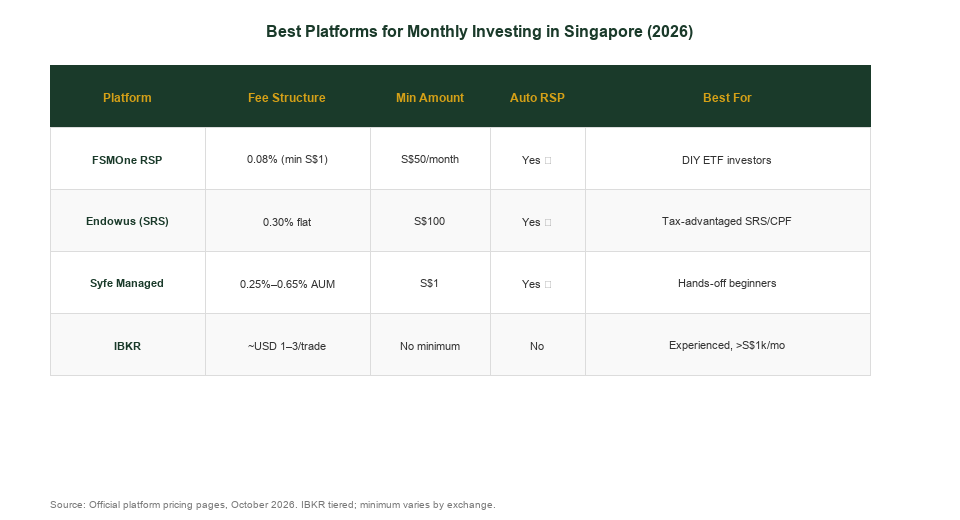
At S$1,000/month, run a four-layer portfolio: S$600 into CSPX/VWRA via FSMOne RSP or IBKR (manual purchase), S$250 into Endowus SRS managed portfolio (referral code 2V343, flat 0.30% fee on SRS), S$100 into MAS T-bills or SSBs, and S$50 into a thematic play via FSMOne. At 8% CAGR over 10 years, S$1,000/month grows to approximately S$184,000 — on S$120,000 invested.
| Budget | Allocation | Platform(s) | 10-Year Proj. (8% CAGR) |
|---|---|---|---|
| S$300/month | 100% CSPX/VUAA ETF | FSMOne RSP | ~S$55,100 |
| S$500/month | 80% ETF + 20% SSB | FSMOne RSP + MAS | ~S$91,000 |
| S$1,000/month | 60% ETF + 25% SRS + 15% Gov’t bonds | FSMOne/Endowus + MAS | ~S$184,000 |
Source: TKN calculations. 8% p.a. on equity, 2.32% on SSB/T-bill, monthly compounding. Illustrative only.
Best Platforms for Monthly Investing in Singapore (2026)
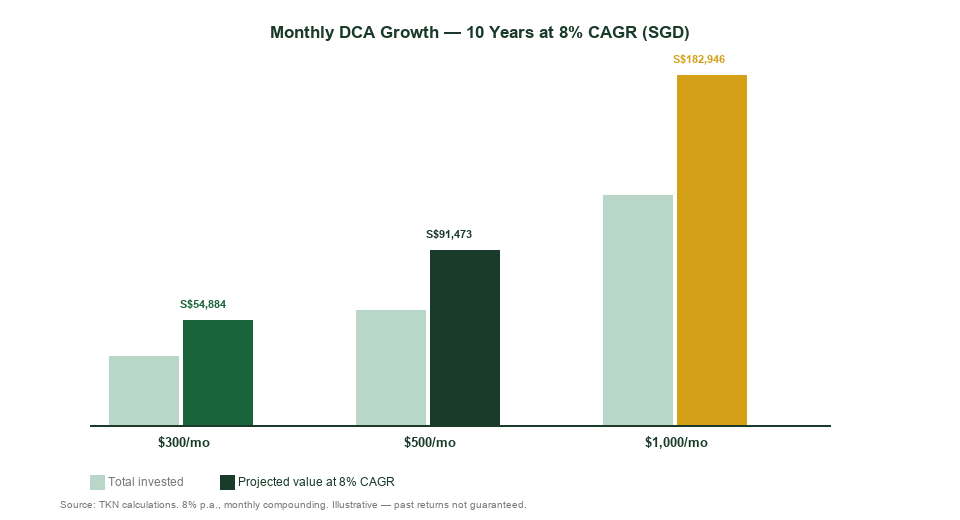
Platform selection matters as much as asset selection. A high-commission brokerage erodes returns significantly on small monthly purchases. For S$300–S$1,000/month, the fee structure compounds over a decade into a meaningful difference in final portfolio value.
FSMOne RSP is the standout choice for most monthly ETF investors. Its Regular Savings Plan charges just 0.08% per transaction with a minimum of S$1, making a S$500 monthly purchase cost just S$0.40. FSMOne supports RSP into LSE-listed ETFs including CSPX, VUAA, VWRA and IWDA, with a minimum S$50 per RSP per month. It also supports SRS accounts at 0.35% for non-fixed-income funds. Sign up with FSMOne referral code P0544985 for a new-account bonus.
Endowus is the platform of choice if you have SRS or CPF funds to deploy monthly. Endowus charges a flat 0.30% on SRS and 0.40% on CPF — not tiered by AUM — giving access to institutional fund classes and automated rebalancing. Open with Endowus referral code 2V343 for a fee rebate on your first S$10,000. Endowus’s Singapore Savings Bonds integration also lets you hold SSBs within the same platform.
Syfe suits investors who want a fully managed portfolio. Syfe’s Core and REIT+ portfolios carry a tiered AUM fee from 0.65% (below S$20,000) to 0.25% (above S$100,000), with no transaction fees and a minimum monthly investment of S$1. Get started with Syfe referral code SRPRFFFCD for three months of fee waiver. For passive income exposure, Syfe’s REIT+ portfolio covers the best S-REITs in Singapore in a managed format.
IBKR is cost-effective for monthly amounts above S$1,000 where per-trade commission becomes a smaller percentage. IBKR offers access to LSE-listed ETFs with competitive commission rates, but does not support automated monthly RSP — each purchase is placed manually. Referral code jianxiong368 for new account bonuses. IBKR is better suited to investors who are comfortable monitoring their portfolio and placing orders themselves.
Worked Example: SGD 500/Month Over 10 Years
Consider Wei Ling, a 32-year-old Singaporean earning S$7,500/month. She saves S$500/month for investing after setting aside a 6-month emergency fund. Her plan: S$400/month into CSPX via FSMOne RSP on the 5th of each month (fee: S$0.32), and S$100/month saved over six months then deployed into Singapore Savings Bonds (two applications per year, in March and September).
After 10 years at 8% CAGR on the equity portion and 2.32% on SSBs:
| Component | Total Invested | Projected Value | Net Gain |
|---|---|---|---|
| CSPX via FSMOne RSP (S$400/mo × 120) | S$48,000 | S$73,700 | +S$25,700 |
| Singapore Savings Bonds (S$100/mo, 2.32%) | S$12,000 | S$13,500 | +S$1,500 |
| Total Portfolio | S$60,000 | S$87,200 | +S$27,200 (+45%) |
Source: TKN calculations. CSPX projected at 8% p.a. (30-yr S&P 500 avg ~10% minus 2% inflation adjustment). SSB at MAS Oct 2026 10-year avg rate 2.32%. SGD figures. Capital gains tax: zero (Singapore).
Wei Ling’s total FSMOne RSP fees over 10 years: approximately S$38 (S$0.32 × 120 months). The main cost is CSPX’s 0.07% TER — around S$52/year at maturity — already embedded in the NAV. Use the Singapore retirement calculator to model your own numbers.
5 Rules to Maximise Your Monthly Investment Returns
Rule 1: Maximise SRS First
The Supplementary Retirement Scheme gives Singapore citizens and PRs up to S$15,300/year in tax relief (2026 cap). At a 21% marginal tax rate, that is S$3,213 in immediate, risk-free savings — equivalent to a guaranteed 21% return on the first S$15,300 invested. Monthly, that is S$1,275/month to max the SRS. Deploy SRS funds via Endowus or FSMOne SRS into diversified fund portfolios. Foreigners’ SRS cap is S$35,700/year.
Rule 2: Choose Accumulating ETFs
Always choose accumulating classes (CSPX, VUAA, VWRA, IWDA) over distributing ones when available via FSMOne RSP. Accumulating ETFs auto-reinvest dividends within the fund with no withholding tax event at the investor level. Over 10 years, reinvesting a ~1.3% annual dividend yield adds materially to total return versus dividends sitting idle in a brokerage account.
Rule 3: Automate — Remove the Human Decision Point
Set up FSMOne RSP or Endowus monthly top-up to invest automatically on a fixed date. Any month where the decision “should I invest given market conditions?” must be made is a month where emotions can override discipline. Automation eliminates this risk entirely.
Rule 4: Emergency Fund First
Never start a monthly investment plan without 3–6 months of expenses in a liquid account (high-yield savings or Singapore Savings Bonds). Without this buffer, a job loss or medical bill forces you to sell investments at a loss to fund emergencies. The emergency fund is the foundation; the monthly plan sits above it. See our guide on building passive income in Singapore for the full financial hierarchy.
Rule 5: Review Annually, Not Monthly
Monthly portfolio checks introduce emotional risk. Annual reviews are sufficient: check whether your asset allocation still suits your age and risk tolerance, whether your SRS has been topped up, and whether platform fees remain competitive. That is all the active management a long-term DCA plan needs. Use the retirement planning calculator to project forward at each annual review.
Frequently Asked Questions
How much should I invest per month in Singapore as a beginner?
Starting with S$100–S$300/month is realistic for most Singapore beginners. Consistency matters more than the initial amount. S$100/month invested in CSPX via FSMOne RSP for 20 years at 8% CAGR grows to approximately S$59,000 — significantly more than the same money in a savings account. Increase contributions by S$100 every 6 months as your income grows. The most important step is to start, automate, and not stop during market downturns.
What is the best ETF for monthly investing in Singapore?
For most Singapore investors, CSPX (iShares Core S&P 500 UCITS ETF, LSE-listed, accumulating, TER 0.07%) or VWRA (Vanguard FTSE All-World UCITS ETF, LSE-listed, accumulating, TER 0.22%) are the top choices. Both are Ireland-domiciled, meaning only 15% WHT on US dividends (vs 30% for US-domiciled VOO/VTI), and neither exposes Singapore investors to US estate tax risk on holdings under USD 60,000. Choose CSPX for pure S&P 500 exposure or VWRA for global diversification including emerging markets.
Can I invest monthly using my SRS account?
Yes. You can invest monthly via SRS through Endowus (0.30% flat fee, access to institutional fund classes) or FSMOne (0.35% for non-fixed-income SRS funds). The SRS contribution cap for Singapore citizens and PRs is S$15,300/year — or S$1,275/month to fully maximise it. Contributions reduce your chargeable income dollar-for-dollar, saving 8%–24% in tax immediately. At the SRS withdrawal age (from 64, effective 1 July 2026), only 50% of SRS withdrawals are taxable — making SRS one of Singapore’s most tax-efficient investment vehicles.
What is the minimum amount to start investing monthly in Singapore?
The FSMOne RSP minimum is S$50/month per fund. Syfe managed portfolios accept contributions from S$1. Endowus starts at S$100 for most portfolios. For the absolute lowest barrier, Syfe is technically the entry point, but FSMOne RSP at S$50/month into CSPX offers the best combination of low minimums and extremely low fees (0.08%, min S$1 per transaction). Build up to S$100–S$300/month as quickly as possible for meaningful compound growth.
Is it better to invest monthly or quarterly in Singapore?
Monthly is better for most investors. More frequent DCA intervals smooth out more price volatility, especially for volatile assets like equity ETFs. Monthly also aligns with salary cycles for Singapore employees, making automation easier and more psychologically sustainable. For investors receiving quarterly bonuses or irregular income, quarterly investing is still effective — the key is maintaining consistent contributions and not trying to time entries.
What happens to my monthly investments if I leave Singapore?
Your FSMOne RSP, Endowus, or Syfe accounts can generally be maintained after you leave Singapore, but you must notify your platform of your change in tax residency. SRS accounts remain valid for non-residents, but early withdrawal (before the statutory retirement age of 64) incurs a 5% penalty plus full taxation of the withdrawal. LSE-listed ETFs in an IBKR account are accessible globally. For a detailed walkthrough of managing Singapore brokerage accounts from overseas, see the MooMoo Singapore review which covers the process.
Ready to Start Your Monthly Investment Plan?
Open a free account today and start your first RSP in minutes. Use TKN referral codes below to get sign-up bonuses.
This article was researched with the help of AI. While we strive to keep all information accurate and up to date, there may be errors. If you notice any discrepancies, please contact us.