moomoo vs Tiger Brokers Singapore (2026): Which Is Cheaper for SG Investors?
Complete fee comparison — US stocks, SG stocks, HK stocks, sign-up bonuses & who should pick which
Last updated: October 2026
📋 Table of Contents
- Quick Verdict: moomoo vs Tiger Brokers
- US Stock & ETF Fees Compared
- Singapore Stock Fees Compared
- Hong Kong Stock Fees Compared
- Hidden Costs: FX, GST & Other Charges
- Markets & Products Available
- Platform, Tools & Data
- Sign-Up Bonuses (October 2026)
- Who Should Pick Which Broker?
- Frequently Asked Questions
moomoo and Tiger Brokers are the two most popular low-cost brokers among Singapore retail investors in 2026. Both are MAS-regulated, both offer $0 commission promotions on US stocks, and both actively court the same investors with sign-up bonuses. But underneath the marketing, the fee structures, platform features, and product ranges are meaningfully different — and picking the wrong one can cost you real money over time. This guide breaks down every fee side by side so you can make an informed choice based on how and what you trade.
Not financial advice. All figures are for educational reference only. Data verified as at October 2026. Fee structures are subject to change — always confirm current rates on each broker’s official website or app before opening an account.
Quick Verdict: moomoo vs Tiger Brokers
For most Singapore investors buying US stocks and ETFs, moomoo is cheaper: a flat US$0.99 platform fee per order beats Tiger Brokers’ per-share commission structure, especially for orders over 200 shares. For Singapore stocks after Year 1, both platforms are similarly priced at 0.03% per trade. Tiger Brokers has an edge if you need desktop trading, Australian stocks, or a wider options strategy toolkit — moomoo wins on mobile UX, free Level 2 data, and cashback-style promotions.
| Feature | moomoo | Tiger Brokers |
|---|---|---|
| US stocks (ongoing) | $0 commission + US$0.99 platform fee/order | US$0.005/share + US$0.005/share platform fee (min US$1.99 combined) |
| SG stocks (after promo) | 0.03% comm + 0.03% platform fee (min S$0.99 each) | 0.03% comm + 0.03% platform fee (min S$0.99 / S$1.00) |
| HK stocks | HK$15 platform fee/order (post-promo) | 0.03% + 0.03% platform fee (min HKD 7 + HKD 8) |
| Markets | US, SG, HK, JP, China A-shares | US, SG, HK, China A-shares, Australia |
| Platform | Mobile app only | Mobile, desktop & web |
| Level 2 market data | Free (US) | Free (US) |
| Crypto trading | Yes | No |
| Margin rate (USD) | 4.80% p.a. | Not publicly listed |
Source: moomoo.com/sg and itiger.com/sg official fee pages, October 2026
US Stock & ETF Fees Compared
US stocks are where most Singapore investors start, and this is where the fee gap between the two platforms is most significant.
moomoo charges zero commission on US stocks for life (ongoing promotion for Singapore users as at October 2026) plus a flat US$0.99 platform fee per order, regardless of the number of shares. This makes moomoo highly cost-efficient for larger orders.
Tiger Brokers charges US$0.005 per share commission (minimum US$0.99, capped at 0.5% of trade value) plus a US$0.005 per share platform fee (minimum US$1.00, capped at 0.5% of trade value). Both fees combined have a minimum of approximately US$1.99 per order.
| Order Size (US Shares) | moomoo Total Fee | Tiger Brokers Total Fee | moomoo Saving |
|---|---|---|---|
| 1 share (eg. 1 x Apple at ~US$230) | US$0.99 | US$1.99 | US$1.00 |
| 10 shares (~US$2,300) | US$0.99 | US$1.99 | US$1.00 |
| 50 shares (~US$11,500) | US$0.99 | US$1.99 | US$1.00 |
| 100 shares (~US$23,000) | US$0.99 | US$1.99 | US$1.00 |
| 500 shares (~US$115,000) | US$0.99 | US$5.00 | US$4.01 |
Source: moomoo.com/sg and itiger.com/sg fee schedules, October 2026. Excludes SEC fee, FINRA TAF (sells only) and GST. Example stock price is illustrative only.
For US stocks, moomoo is consistently cheaper. The per-share model at Tiger means larger positions pay proportionally more — a DCA investor buying 100 shares of the S&P 500 ETF every month at moomoo pays US$0.99 per trade indefinitely, while at Tiger the combined commission plus platform fee hits a minimum of US$1.99 per order.
Note that both brokers pass through US regulatory fees on sell orders: SEC fee (approximately 0.0000206× transaction value) and the FINRA Trading Activity Fee (US$0.000195/share, dropping to $0 from 1 October 2026). These are government levies, not broker fees, and apply equally to both platforms.
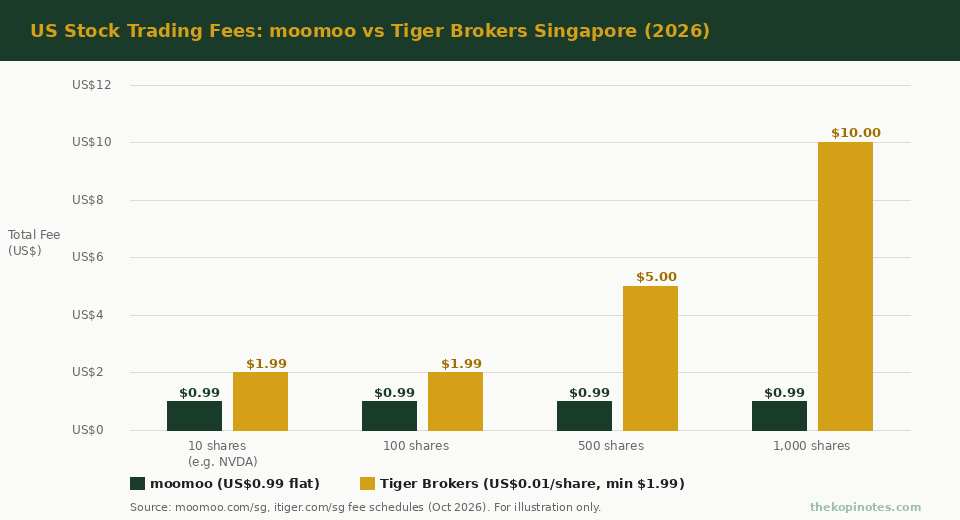
Chart: US stock trading fees at different order sizes — moomoo flat US$0.99 vs Tiger Brokers per-share pricing
Singapore Stock Fees Compared
For investors trading SGX-listed stocks, REITs, or ETFs, both brokers are structurally similar after promotions end — but the promotional period differs significantly.
moomoo waives commission for new users for the first year. After the first year, moomoo charges 0.03% commission (min S$0.99) plus a 0.03% platform fee (min S$0.99) per order — for a total minimum of S$1.98 on small trades.
Tiger Brokers charges 0.03% commission (min S$0.99) plus a 0.03% platform fee (min S$1.00) — making the minimum total S$1.99. Both brokers additionally pass through SGX clearing fees (0.0325%) and SGX trading fees (0.0075%), plus 9% GST on all fees.
| Trade Value (SGD) | moomoo Fee (after yr 1) | Tiger Brokers Fee | Difference |
|---|---|---|---|
| S$1,000 | S$1.98 (min applies) | S$1.99 (min applies) | S$0.01 |
| S$5,000 | S$3.00 | S$3.00 | S$0.00 |
| S$20,000 | S$12.00 | S$12.00 | S$0.00 |
Source: moomoo.com/sg and itiger.com/sg fee schedules, October 2026. Excludes SGX clearing/trading fees and 9% GST. Both figures show combined commission + platform fee only.
After Year 1, the SG stock fees are essentially identical. The key differentiator is that moomoo’s first-year zero-commission period saves meaningful money for active SGX traders — a S$5,000 trade, executed 12 times over the year, saves approximately S$36 in combined fees.
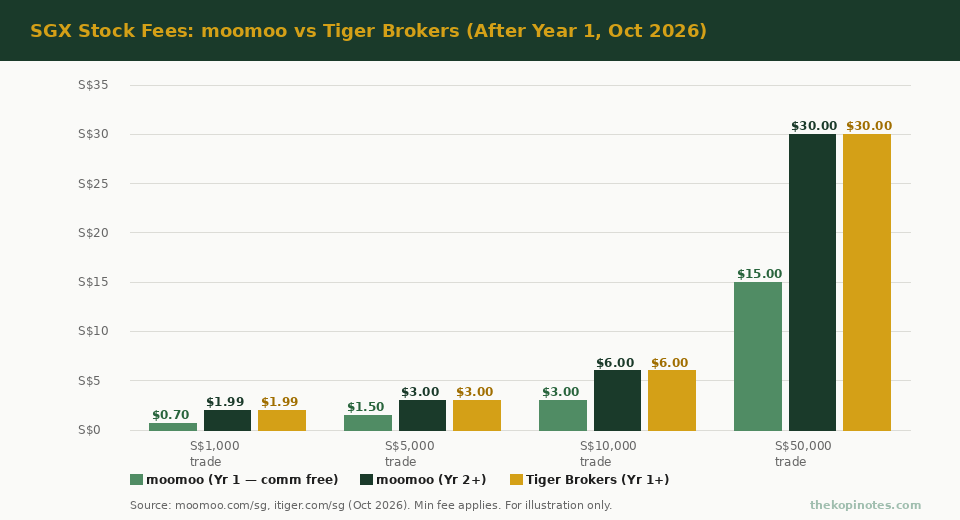
Chart: SGX stock fees — moomoo Year 1 (comm-free) vs moomoo Year 2+ vs Tiger Brokers
Hong Kong Stock Fees Compared
Both brokers offer promotional periods for HK stocks, but the base fee structure diverges more noticeably here.
moomoo offers free HK stock trading for the first 30 days. After the promotion, moomoo charges a flat HK$15 platform fee per order with commission rates separate (not publicly listed on the main fee page for post-promo). For HK warrants and CBBCs, the commission is 0.03% (no minimum stated) plus HK$15 platform fee.
Tiger Brokers charges 0.03% commission (min HKD 7) plus 0.03% platform fee (min HKD 8) on HK stocks, giving a minimum combined cost of HKD 15 per trade. Tiger also passes through HKEX trading fee (0.00565%), SFC transaction levy (0.0027%), AFRC levy (0.00015%), HKSCC settlement fee (0.0042%), and stamp duty (0.1% of trade value, rounded up to minimum HKD 1) on stocks — ETFs and REITs are typically exempt from stamp duty.
For small HK trades, both platforms cost a similar minimum (approximately HKD 15). Tiger’s percentage-based fee becomes relatively expensive for larger trades — a HKD 100,000 position would incur HKD 60 in combined commission and platform fees at Tiger (0.06%) versus moomoo’s HK$15 flat.
Hidden Costs: FX Spread, GST & Other Charges
Beyond headline commission rates, Singapore investors face several pass-through costs that both brokers charge but rarely advertise prominently.
Foreign Exchange (FX) Spread
Both moomoo and Tiger Brokers convert SGD to USD (or HKD) when you fund in SGD and trade foreign markets. Neither broker publishes its exact FX spread — moomoo describes its rates as “competitive” and Tiger calls them “real-time rates.” In practice, both typically apply a 0.3–0.5% spread on FX conversion, though this varies and should be verified in-app before large transfers. For a S$50,000 transfer at a 0.4% spread, you lose approximately S$200 in conversion costs before a single trade.
GST (Goods & Services Tax)
Singapore’s 9% GST (effective from 1 January 2024) applies to all broker fees charged by both moomoo and Tiger Brokers — including commissions, platform fees, and exchange-collected fees. This is automatically added to your fee statement. On a US$0.99 order at moomoo, GST adds approximately US$0.09, making the true cost US$1.08.
Margin Interest Rates
If you trade on margin, moomoo charges 4.80% p.a. for USD and SGD balances and 6.80% p.a. for HKD. Tiger Brokers does not publicly list its margin rates on the main fee page — check their app or support pages before using margin.
Inactivity & Withdrawal Fees
moomoo charges no inactivity fees and no withdrawal fees for SGD transfers under S$200,000 to Singapore banks (above that, only DBS/POSB transfers are free). Tiger Brokers also does not charge inactivity fees — confirm withdrawal terms on their official support page.
Markets & Products Available
Both brokers cover the four markets most Singapore investors care about — US, Singapore, Hong Kong, and China A-shares — but each platform extends to different additional markets.
moomoo adds Japan stocks to its market roster, making it useful for investors with Japan exposure (e.g. through global ETFs or direct holdings in companies like Toyota or Sony). moomoo also offers crypto trading, leveraged FX, structured warrants and DLCs on the SGX, and funds with zero subscription fees.
Tiger Brokers adds Australian stocks — a meaningful differentiator if you want ASX exposure (e.g. Macquarie, BHP, Commonwealth Bank) without routing through a separate account. Tiger also offers commodities trading, which moomoo does not.
| Asset Class / Market | moomoo | Tiger Brokers |
|---|---|---|
| US Stocks & ETFs | ✓ | ✓ |
| SG Stocks, REITs & ETFs | ✓ | ✓ |
| HK Stocks & ETFs | ✓ | ✓ |
| China A-Shares | ✓ | ✓ |
| Japan Stocks | ✓ | ✗ |
| Australia Stocks (ASX) | ✗ | ✓ |
| US Options | ✓ | ✓ |
| Futures | ✓ | ✓ |
| Crypto | ✓ | ✗ |
| Commodities | ✗ | ✓ |
| Funds | ✓ (0 subscription fee) | ✓ |
Source: moomoo.com/sg and itiger.com/sg product pages, October 2026
Platform, Tools & Market Data
Both brokers have invested heavily in their trading platforms, but they cater to slightly different users.
moomoo’s platform is mobile-first and known for its charting capabilities, 60+ technical indicators, and free real-time Level 2 (full order book) data for US stocks. The social/community feed lets you see what other traders are doing and spark ideas. Paper trading (simulated trading with virtual money) is also available free. However, moomoo does not offer a desktop or web-based trading platform — everything must be done through the mobile app.
Tiger Brokers offers mobile, desktop (Tiger Trade), and web platforms — a significant advantage for active traders who prefer larger screens and multi-window setups. Tiger’s TigerGPT AI assistant provides research summaries and financial analysis. Level 2 US data is also free on Tiger. Tiger supports more advanced options strategies and has a wider range of analytical tools for derivatives traders.
For long-term investors doing monthly DCA into S&P 500 ETFs, the platform difference is less material. But for active traders who monitor multiple positions, analyse charts across assets, or trade options — Tiger’s desktop platform is a meaningful advantage.
Sign-Up Bonuses Compared (October 2026)
Both platforms run ongoing welcome promotions that change regularly. The following figures reflect the promotions available as at October 2026 — always verify current offers on each broker’s official site before opening an account.
moomoo runs rotating welcome campaigns that include trading vouchers, free shares, and cash credits. Past campaigns have offered up to S$2,000 in total rewards for qualifying deposits. Check the moomoo Singapore review on The Kopi Notes for the latest sign-up bonus and current terms — these change monthly.
Tiger Brokers typically offers new users up to S$1,000 in rewards, which can include Apple AirPods, cash bonuses, and trading vouchers depending on deposit tiers.
As a general rule, moomoo’s welcome packages have historically been more generous in total value. Tiger’s bonus may suit those who prefer hardware gifts over trading vouchers. Neither promotion should be the sole deciding factor — ongoing fees matter far more over a multi-year investing horizon.
Who Should Pick Which Broker?
Both brokers are legitimate, MAS-regulated, and suitable for most Singapore retail investors. Here’s how to decide based on your profile:
Choose moomoo if you:
- Primarily trade US stocks or ETFs (flat US$0.99 fee is market-leading)
- Value free real-time Level 2 data on a mobile platform
- Want access to crypto or Japan stocks alongside your equity portfolio
- Do DCA into index funds or ETFs — the flat fee model suits small frequent purchases
- Are a first-year SGX investor and want commission-free trades
- Want the higher-value sign-up bonus
Choose Tiger Brokers if you:
- Prefer a desktop or web trading platform for active trading
- Need access to Australian ASX stocks
- Trade commodities or more complex derivatives
- Want TigerGPT AI research tools built into your workflow
- Value platform diversity (mobile + web + desktop) over a single-app experience
Consider using both: Some Singapore investors maintain accounts on both platforms, taking advantage of the sign-up promotions on each and using moomoo for US stocks while keeping Tiger for desktop charting or ASX access. There are no fees for opening or maintaining either account, so dual accounts are a practical option.
For further reading on the platforms involved, see our moomoo Singapore review and the Tiger Brokers Singapore review. If you’re comparing brokers for ETF investing specifically, our guide to building a Singapore ETF portfolio covers how to pick the right broker for index fund investors. You can also use our retirement planning calculator to understand how fee drag affects long-term portfolio growth, and explore the Syfe referral code if you’re also considering a robo-advisor alongside a self-directed broker. For investors building passive income streams, see our guide to passive income in Singapore 2026.
Frequently Asked Questions
Is moomoo cheaper than Tiger Brokers for US stocks?
Are both moomoo and Tiger Brokers regulated in Singapore?
Can I use both moomoo and Tiger Brokers at the same time?
Which broker is better for Singapore (SGX) stock trading?
Does moomoo or Tiger Brokers offer better sign-up bonuses?
Which broker is better for ETF investing in Singapore?
Is there a moomoo referral code I can use?
The Kopi Notes provides financial education content for Singapore investors. This article is not financial advice. All fee data is sourced from official broker websites as at October 2026 and is subject to change without notice. Always verify current fees, T&Cs, and promotions directly with each broker before opening an account or making any investment decision. The Kopi Notes may earn referral fees from some platforms mentioned.
This article was researched with the help of AI. While we strive to keep all information accurate and up to date, there may be errors. If you notice any discrepancies, please contact us.