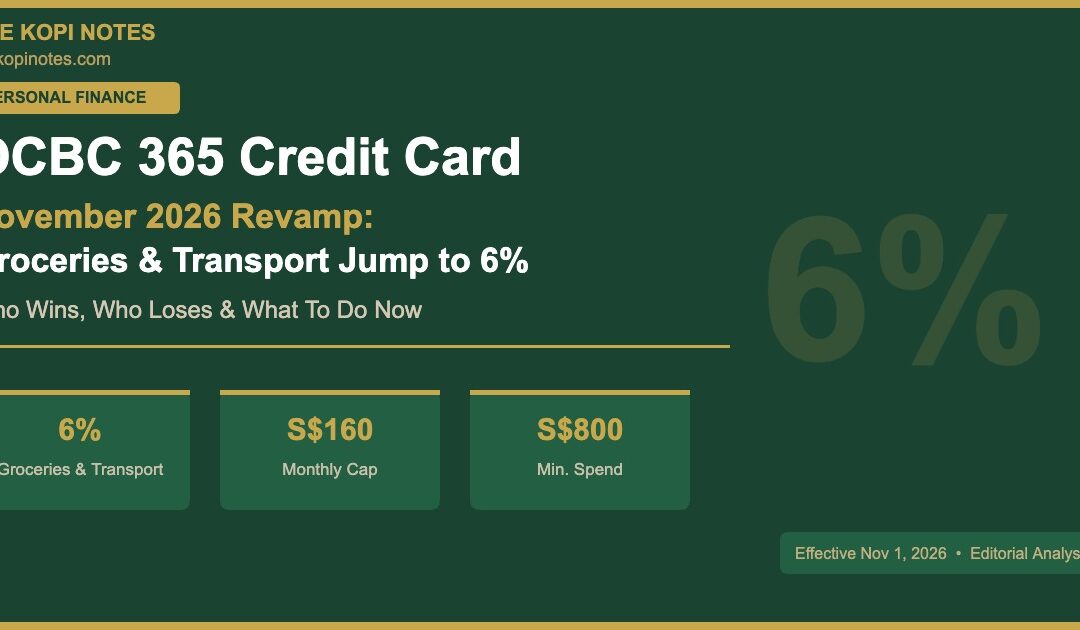
OCBC has announced a significant refresh to its flagship 365 Credit Card, effective November 1, 2026. Groceries and transport cashback double from 3% to 6%, while telco, utilities, streaming and EV charging categories plunge from 3% to just 0.25%. With OCBC saying three in five of its credit cardholders hold the 365 card, this change affects hundreds of thousands of Singapore households — and the implications go well beyond a simple rate bump.
This is an editorial analysis. Not financial advice. Data verified as at October 7, 2026.
What’s Changing: The Full Rate Breakdown
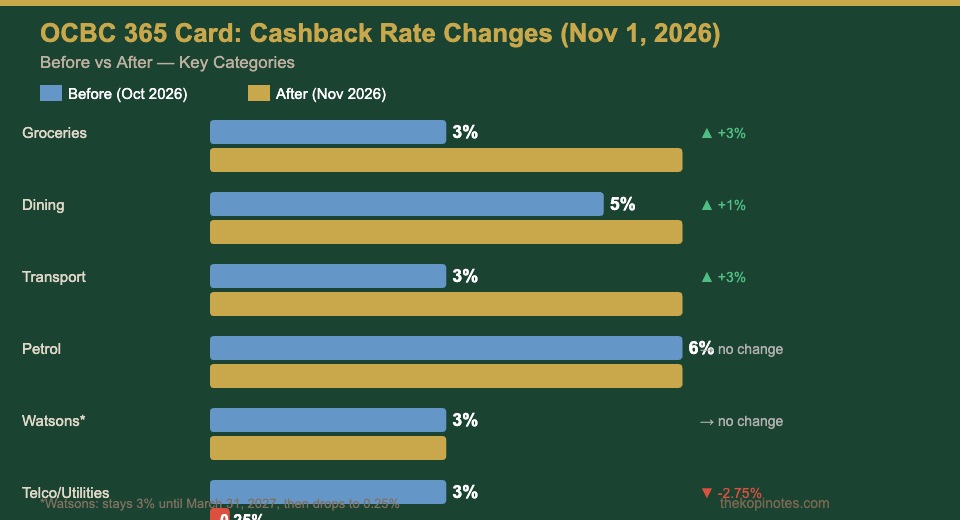
The OCBC 365 Credit Card revamp simplifies the reward structure into a cleaner everyday spending card focused on four core categories. Here’s the complete picture of what’s moving and what isn’t:
| Category | Current Rate (until Oct 31) | New Rate (from Nov 1) | Change |
|---|---|---|---|
| Dining (incl. fast food) | 5% | 6% | ▲ +1pp |
| Groceries | 3% | 6% | ▲ +3pp |
| Land transport / ride-hailing | 3% | 6% | ▲ +3pp |
| Petrol | 6% | 6% | → No change |
| Watsons | 3% | 3% (until Mar 31, 2027) | → Temporary hold |
| Telco / mobile plans | 3% | 0.25% | ▼ -2.75pp |
| Utilities (electricity, gas) | 3% | 0.25% | ▼ -2.75pp |
| EV charging | 3% | 0.25% | ▼ -2.75pp |
| Streaming services | 3% | 0.25% | ▼ -2.75pp |
| Advertising platforms | 0.25% | 1% (uncapped) | ▲ +0.75pp |
| All other spend | 0.25% | 0.25% | → No change |
The minimum spend structure has also been simplified: the previous two-tier system (S$800 for an S$80 cap, or S$1,600 for an S$160 cap) is replaced with a single S$800 threshold that unlocks the full S$160 monthly cashback cap. For cardholders who were already hitting the S$1,600 tier, the simplified structure is a meaningful improvement — you get the same cap with half the required spend.
The Math: Maximising Your S$160 Monthly Cap
Understanding the cap is critical to evaluating this card’s true value. At 6% cashback with a S$160/month cap, you would need to spend approximately S$2,667 per month in qualifying categories to hit the ceiling — dining, groceries, transport, and petrol combined.
For a typical Singapore household, that’s a realistic but ambitious target. The average Singapore household spends roughly S$800–S$1,200/month on food (dining out and groceries combined) and perhaps S$200–S$400 on transport. That puts most households in the S$1,000–S$1,600 range in qualifying spend, yielding S$60–S$96 monthly cashback at 6% — or S$720–S$1,152 annually.
That’s a real number worth optimising for. At S$1,200 in qualifying monthly spend, the OCBC 365 now generates S$72/month — previously, at 3–5%, the same spending would have earned S$36–S$60. The card has measurably improved for high-frequency everyday spenders.
Who This Card Is Now Best For
The 365 card’s new identity is squarely the everyday essentials card — groceries, meals, commuting, and petrol. If that describes the bulk of your monthly spend, this is now one of the most competitive options in Singapore at the S$800 minimum spend tier.
The revised card is particularly well-suited for: Families with high grocery bills who shop across supermarket chains (Cold Storage, NTUC FairPrice, Giant, Sheng Siong — all covered); Frequent diners who now benefit from 6% across all dining including fast food, previously excluded from the 5% tier; Car owners who combine petrol (6%, unchanged) and public transport / Grab / Gojek (6%, newly improved); and Dual cardholders seeking a simple cashback complement to a miles card.
For investors interested in pairing financial products smartly, this card can also be used alongside MariBank’s current October 2026 bonus promotions to capture both cashback on spend and higher returns on savings.
Who Gets Hurt: The Telco and Utilities Cut
The losers are unambiguous. Anyone using the OCBC 365 primarily to earn cashback on telco bills, electricity, streaming subscriptions, or EV charging will see their reward rate collapse from 3% to 0.25% — effectively stripping those categories of any meaningful benefit.
To put this in dollar terms: if you were spending S$200/month on utilities and telco (a realistic figure for a household with multiple mobile lines and an electricity bill), you were previously earning S$6/month. From November 1, that drops to S$0.50/month. Over a year, that’s S$66 less in your pocket.
The practical move for these cardholders is to migrate utility and telco payments to a card that still rewards them. The Trust Cashback Credit Card offers flat cashback with no annual fee, while the Trust Freedom Credit Card has flexible spending-based rewards covering a wide range of categories. Some miles cards like the DBS Altitude or Citi PremierMiles also earn miles on utilities with no category exclusions.
Watsons spend gets a grace period until March 31, 2027 — after which it joins the 0.25% base rate category. If you regularly shop at Watsons for health and beauty, plan your product category rotation ahead of April 2027.
How OCBC 365 Stacks Up Against the Competition
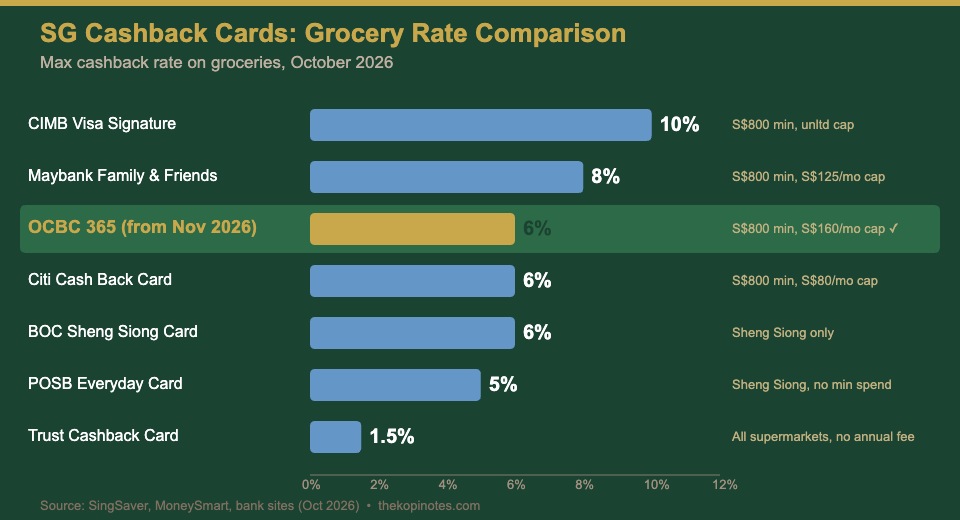
The 6% grocery/dining/transport rate is competitive, but it’s worth understanding where the OCBC 365 sits in the landscape — particularly on caps and minimum spend:
| Card | Grocery Rate | Monthly Cap | Min. Spend | Annual Fee |
|---|---|---|---|---|
| CIMB Visa Signature | 10% | Unlimited | S$800 | Lifetime waiver |
| Maybank Family & Friends | 8% | S$125 | S$800 | S$180 (waived) |
| OCBC 365 (from Nov 1) | 6% | S$160 | S$800 | S$196 (auto-waived) |
| Citi Cash Back Card | 6% | S$80 | S$800 | S$194.40 |
| BOC Sheng Siong Card | 6% (Sheng Siong only) | N/A | None | Waived |
| POSB Everyday Card | 5% (Sheng Siong only) | N/A | None | S$194.40 |
| Trust Cashback Card | 1.5% | Unlimited | None | None |
Key observation: the OCBC 365 now beats the Citi Cash Back Card head-to-head on the same S$800 minimum spend by offering double the monthly cashback cap (S$160 vs S$80) for the same 6% grocery rate. That’s a meaningful structural advantage.
The CIMB Visa Signature at 10% with no monthly cap is genuinely hard to beat on grocery spend alone — but it’s less competitive across dining and transport. For Singapore investors who want a single card covering multiple everyday categories, the OCBC 365 offers broader coverage at a still-competitive 6%.
Compare also with digital bank options: the MariBank vs GXS Bank comparison shows that digital banks are increasingly competing on cashback, but their credit card offerings don’t yet match the 6% across categories that the OCBC 365 will deliver from November.
Key Card Details to Know
For anyone evaluating this card for the first time or reconsidering it after the November 1 changes, here are the essential parameters: Annual fee of S$196.20 for the principal card (waived first 2 years; auto-waived with S$10,000 annual spend thereafter); Minimum annual income of S$30,000 (ages 21–55), S$15,000 (ages 55+), S$45,000 (foreigners); supplementary card at S$98.10 annual fee (waived first 2 years); foreign currency transaction fee of 3.25% (this card is not optimised for overseas spend); and SimplyGo integration — MRT and bus taps via SimplyGo qualify for the 6% transport rate.
At S$10,000 in annual spend — a threshold that S$800/month minimum spenders will naturally clear — the annual fee waiver is essentially automatic. The effective cost of holding this card for consistent users is zero.
For those also maximising bank account interest rates alongside credit card cashback, see our comparison of Singapore’s best fixed deposit rates for October 2026, where several banks are offering competitive short-term returns alongside card bonus interest offers.
What This Means for Singapore Retail Investors
For the TKN audience — people who think carefully about optimising every dollar — the OCBC 365 revamp is a net positive event with some necessary portfolio adjustments required.
If you’re already a cardholder: your day-to-day groceries, meals, and transport have just become more rewarding. Review your card statement to identify any spending on telco, utilities or streaming that should now route to a different card. The adjustment takes 5 minutes and could save you S$50–S$100+ annually.
If you’re not a cardholder: this card has moved firmly into the consideration set for anyone spending S$800–S$2,500/month on everyday essentials. At S$1,200/month in qualifying spend, you’d net approximately S$864 per year in cashback — more than enough to justify any annual fee, which is automatically waived anyway.
Importantly, the card’s focus on dining, groceries, and transport means it stacks well with investment-focused behaviours: money not spent on rewards leakage is money available for dollar-cost averaging into ETFs, topping up CPF, or contributing to SRS.
Bottom Line for SG Investors
The OCBC 365 Credit Card’s November 2026 revamp is a focused bet on where Singapore households actually spend: food, transport, and petrol. The 6% rate across all three is now among the best all-category cashback rates available at the S$800 minimum spend tier, and the doubled monthly cap to S$160 makes it more rewarding for consistent spenders.
The trade-off is real — telco, utilities, streaming, and EV charging users face a 92% rate collapse to 0.25%. If those categories drive significant monthly spend for you, action is needed before November 1: migrate those payments to an alternative card or lose meaningful cashback permanently.
For the majority of Singapore households where dining, groceries, and transport dominate the card statement, the revamped OCBC 365 is now a stronger product than before. It won’t outperform specialist cards like the CIMB Visa Signature on raw grocery rates, but for everyday simplicity across multiple categories with a respectable cap — this card earns its place in the Singapore retail investor’s wallet.
Frequently Asked Questions
When does the OCBC 365 Credit Card cashback change take effect?
The new cashback rates take effect on November 1, 2026. All transactions processed before this date will earn the old rates. From November 1 onwards, the new 6% grocery, dining, and transport rates — and the reduced 0.25% telco/utilities rate — apply automatically to all 365 cardholders.
Do I need to do anything to get the higher cashback rate?
No action is required on the cardholder’s side. The rate changes are applied automatically to all existing OCBC 365 Credit Card accounts from November 1, 2026. There is no opt-in or product switch required.
What is the minimum spend to qualify for 6% cashback?
You need to spend at least S$800 per calendar month to qualify for the 6% promotional cashback rate. Spending below S$800 in any given month earns the base rate of 0.25% on all transactions for that month. The S$800 threshold applies across all categories, not just the 6% categories.
Is the S$160 cashback cap per category or total?
The S$160 monthly cashback cap is a total cap across all cashback earned, not per category. So if you earn S$80 on groceries, S$60 on dining, and S$30 on transport, you hit the S$160 ceiling and no further cashback is earned regardless of additional spend in any category that month.
What happens to Watsons cashback after March 31, 2027?
Watsons spend currently earns 3% cashback under the OCBC 365, and this rate is preserved until March 31, 2027 as a transitional grace period. From April 1, 2027, Watsons spend will drop to the base rate of 0.25%. If you currently use the 365 for Watsons purchases, plan to migrate that spend to an alternative card before April 2027.
Is SimplyGo (public transport) included in the 6% transport cashback?
Yes. SimplyGo taps on MRT and buses count as land transport spending under the OCBC 365 and will earn 6% cashback from November 1, 2026. Grab, Gojek, and other ride-hailing apps also fall under the transport category. This makes the card particularly attractive for daily commuters who combine public transport with occasional ride-hailing.
This article was researched with the help of AI. While we strive to keep all information accurate and up to date, there may be errors. If you notice any discrepancies, please contact us.