Endowment Plan Early Surrender Singapore 2026: How Much You Lose & When to Stay
A data-driven look at surrender value penalties, break-even points, and when cashing out actually makes senseSurrendering an endowment plan early in Singapore almost always means losing money. Most par plans return zero in Year 1 and only recover your total premiums around Year 7–8 for 10-year policies. This guide breaks down exactly how surrender value builds year by year, realistic loss scenarios at each stage, and the rare situations where cashing out early can still be the right call — despite the penalties.
Not financial advice. All figures are for educational reference only and based on typical policy illustrations. Data verified as at October 2026. Always check your specific policy document for exact surrender values.
Table of Contents
What Is Surrender Value?
Surrender value is the cash payout you receive if you terminate your endowment plan before it reaches its maturity date. It is distinctly different from the total premiums you have paid in, and almost always lower — sometimes significantly so, particularly in the early years of the policy.
For a participating (par) endowment plan, the surrender value comprises two components:
- Guaranteed cash value — contractually defined and disclosed in your policy illustration
- Non-guaranteed reversionary bonuses — once declared by the insurer, these become part of the guaranteed surrender value. Future (undeclared) bonuses are forfeited when you surrender.
For a non-participating (non-par) endowment plan, the surrender value is 100% guaranteed from Day 1. You can check the exact amount payable at every policy year in your policy illustration before you even sign up — there are no bonuses involved.
MAS requires all insurers to show policy illustrations at both the 4.25% and 3.00% illustrated investment return scenarios for par plans. This gives you a “best likely” and “conservative” view of projected surrender values at every year.
How Surrender Value Builds Up Year by Year
The pattern is consistent across most Singapore endowment plans: surrender value starts at zero, rises slowly in early years (when insurer costs are highest), and accelerates toward maturity. The chart below shows a typical 10-year par endowment plan with SGD 500/month premiums:
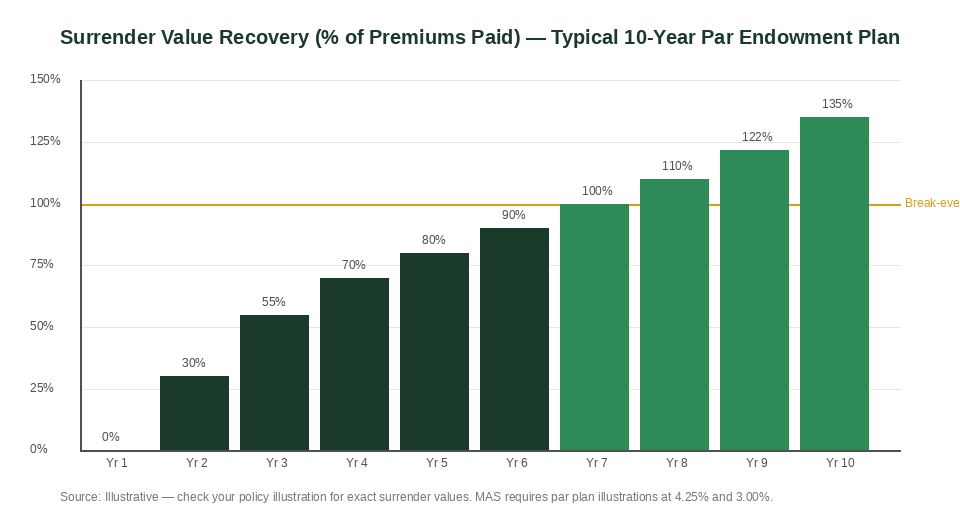
The table below shows illustrative surrender value figures for a typical 10-year par endowment plan with monthly premiums of SGD 500 (total annual SGD 6,000):
| Policy Year | Total Premiums Paid | Illustrative Surrender Value | % Recovery |
|---|---|---|---|
| Year 1 | SGD 6,000 | SGD 0 | 0% |
| Year 2 | SGD 12,000 | SGD 3,600 | 30% |
| Year 3 | SGD 18,000 | SGD 9,900 | 55% |
| Year 5 | SGD 30,000 | SGD 24,000 | 80% |
| Year 7 (break-even) | SGD 42,000 | SGD 42,000 | 100% |
| Year 10 (maturity) | SGD 60,000 | SGD 81,000 | 135% |
Source: Illustrative figures based on typical Singapore par endowment policy structures. Actual surrender values are in your specific policy illustration. MAS requires par plan illustrations at 4.25% (higher scenario) and 3.00% (lower scenario).
Key insight: The steep loss in Years 1–3 reflects insurer acquisition costs (agent commissions, underwriting, admin) that are front-loaded. You’re essentially paying for the policy’s operating costs before your savings component starts accumulating.
How Much You Actually Lose (Realistic Scenarios)
The exact loss depends on three variables: plan type (par vs non-par), tenure (3Y / 5Y / 10Y), and when you surrender. The chart below compares recovery percentages at different stages for three common plan tenures:
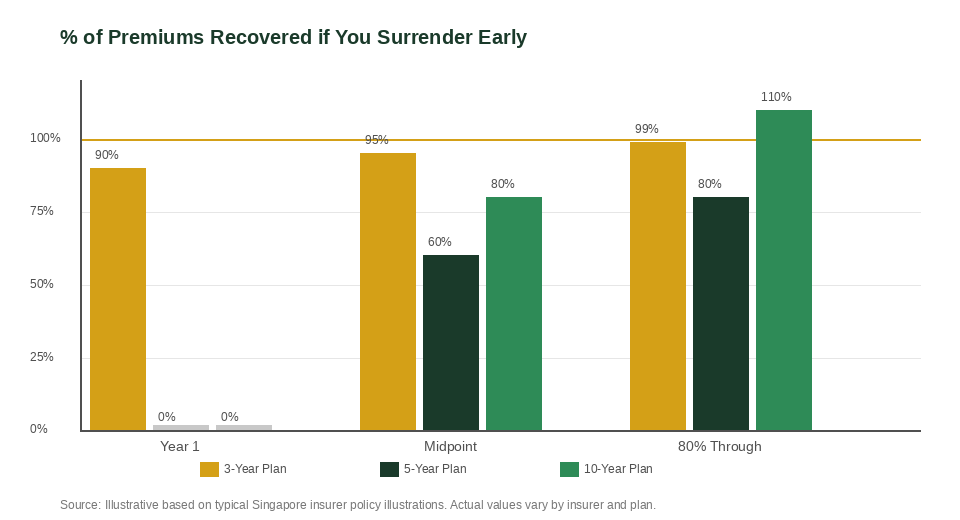
Here’s a practical breakdown for each plan type:
| Scenario | 3-Year Non-Par Plan | 5-Year Par Plan | 10-Year Par Plan |
|---|---|---|---|
| Surrender Year 1 | ~90% recovery | 0% (total loss of yr 1 premiums) | 0% |
| Surrender at Midpoint | ~95% | ~60% | ~80% |
| Surrender at 80% Through | ~99% | ~80% | ~110% |
| Break-Even Point | At/near maturity | Year 4–5 | Year 7–8 |
Source: Illustrative based on typical Singapore insurer policy illustrations. Individual policies vary significantly. Always refer to your specific Policy Illustration document.
The golden rule: If you are within the last 20–25% of your policy term, you have already absorbed the worst of the front-loaded costs. Surrendering at this stage is rarely worth it. The table above shows that a 10-year plan at Year 8 (80% through) already returns more than premiums paid at the 4.25% scenario.
Par vs Non-Par Plans: Who Gets What?
Non-par plans offer complete transparency from Day 1. Because there are no bonuses or investment returns to project, the insurer contractually locks in the surrender value at every policy year — exactly as shown in your policy illustration. You know before you sign what you would receive if you had to exit at Year 1, 2, 3, and so on.
Par plans are more complex. The guaranteed cash value is contractually defined, but reversionary bonuses — once declared — also become part of the surrender value. The catch: future (undeclared) bonuses are forfeited upon surrender. This means the total surrendered amount at any given year depends on:
- The insurer’s par fund investment performance to date
- Which annual bonuses have already been declared
- The terminal bonus (if any) — usually only paid at maturity or death, not on surrender
This is why surrendering a par plan mid-way often feels particularly painful: you lose the terminal bonus entirely, even if the fund has performed well throughout the policy term. For reference on how par fund bonuses work, see our par fund vs non-par endowment comparison.
When Early Surrender Actually Makes Sense
Despite the steep costs, there are genuine scenarios where surrendering an endowment plan before maturity is the rational choice:
1. Genuine financial emergency — If you face sudden unemployment, major medical expenses, or urgent debt obligations and have no other liquid assets, accessing your surrender value — even at a loss — may be necessary. This is what the policy was designed to protect against. (Check alternatives below before proceeding.)
2. The policy was mis-sold — MAS has guidelines on product suitability. If your endowment plan was sold without proper fact-finding (e.g., for a 10-year plan when your known financial commitments required liquidity within 3 years), you may have grounds to seek recourse through the insurer or FIDReC (Financial Industry Disputes Resolution Centre of Singapore) before surrendering.
3. You’re approaching break-even and have a concrete plan — If you are near break-even (e.g., Year 6–7 of a 10-year plan) AND have identified a higher-returning opportunity — such as investing your capital in a Syfe referral-linked equity portfolio or topping up your Endowus CPF/SRS account — the opportunity cost arithmetic might favour exiting, but only if your alternative genuinely outperforms on a risk-adjusted basis.
When it does NOT make sense:
- You want to “time the market” or react to short-term news
- Your plan has less than 2 years to maturity (you have absorbed the penalty years; stay)
- You are in Years 1–3 of a 10-year plan (the loss is disproportionately large)
- Your “alternative investment” is speculative (crypto, single stocks, leveraged products)
After maturity, you will face the question of what to do with the payout — see our guide on the best ways to reinvest your endowment maturity payout for practical options.
Better Alternatives to Early Surrender
Before surrendering, ask your insurer about these options — all preserve the policy without full termination:
1. Policy loan — Most par endowment plans allow you to borrow up to 80–90% of the current surrender value at an interest rate typically 1–2% above CPF OA rates. You get liquidity without surrendering; if you repay the loan, the policy continues to maturity as normal. Interest compounds if unpaid, so this is best for short-term needs only.
2. Premium holiday / deferral — Some plans allow you to pause premium payments for a period (typically 6–24 months) without surrendering. This reduces the policy’s ultimate payout but avoids full termination. Check your policy terms or call your insurer directly.
3. Reduced paid-up (RPU) conversion — You stop paying premiums, and the insurer converts your policy to a smaller sum assured with no further premiums due. The policy remains in force until maturity, just at a reduced benefit. This is ideal if your income has dropped but you don’t need the cash immediately.
If you genuinely need to grow your capital faster, consider directing future premiums (after stopping any new top-ups) into a lower-cost vehicle. Our Singapore retirement calculator can help you model whether a policy loan plus alternative investment makes more sense than surrender. You can also explore Singapore Savings Bonds as a capital-safe alternative for any proceeds you do receive.
How to Surrender an Endowment Plan in Singapore
If you have decided to proceed, the surrender process is straightforward:
- Contact your insurer — Call or visit their customer service centre. Major insurers (AIA, Prudential, Great Eastern, NTUC Income, Manulife, Singlife) all have surrender request processes. Some now allow initiating the request online or via their mobile app.
- Prepare your documents — NRIC/Passport, original policy document (or statutory declaration if lost), and your bank account details for the payout.
- Complete the surrender form — Your insurer will send/provide a Surrender Discharge Voucher. Both the policyholder and life assured (if different) typically need to sign.
- Processing time — Typically 2–4 weeks from receipt of complete documents. Surrender value is credited directly to your bank account.
Important: Once you sign and submit the surrender form, the process is generally irreversible. Confirm the exact surrender value with your insurer in writing before signing.
Frequently Asked Questions
Will I get anything if I surrender my endowment plan in Year 1?
When does a Singapore endowment plan break even on surrender?
Do I lose my declared bonuses when I surrender a par endowment plan?
Is there an explicit early surrender penalty fee charged by Singapore insurers?
Should I surrender my endowment plan to invest in REITs or ETFs?
Can I surrender just part of my endowment plan?
Get Free Insurance Advice
Speak with a licensed insurance advisor. No obligation, no cost.
By submitting this form, you agree to our Privacy Policy.
This article was researched with the help of AI. While we strive to keep all information accurate and up to date, there may be errors. If you notice any discrepancies, please contact us.