New ISP Rider 2026: Your Real Out-of-Pocket Costs vs Legacy Rider (6-Month Review)
Six months after Singapore’s new ISP rider rules took effect — here’s exactly what you pay now vs before, with real bill examples.
Singapore’s new ISP rider rules took effect 1 April 2026, fundamentally changing what policyholders pay when hospitalised. Under the new framework, riders can no longer cover minimum deductibles of $1,500–$3,500 per policy year, and the annual co-payment cap doubled from $3,000 to $6,000. Six months in, here’s exactly what a $10,000 and $125,000 hospital bill now costs you — and a clear framework to decide whether switching from your legacy rider makes financial sense.
Not financial advice. All figures are for educational reference only. Data verified as at 4 October 2026 against official MOH press releases and insurer illustrations unless otherwise noted.
Table of Contents
Contents — Click to expand
What Changed on 1 April 2026?
Before April 2026, many Singaporeans held “full rider” or “max rider” products that covered almost every dollar of their hospital bill — including the entire deductible and most co-payments. These were popular for peace of mind, but MOH data showed policyholders with such riders were 1.4× more likely to claim and had claim sizes 1.4× larger than those without riders — contributing significantly to rising healthcare costs across the system.
The Ministry of Health introduced two structural changes for all new ISP riders sold from 1 April 2026 onwards:
- No deductible coverage: New riders cannot cover the minimum IP deductible that MOH sets for each ISP. This deductible ranges from $1,500 to $3,500 per policy year depending on your ward class — and it now comes entirely out of your own pocket (payable from MediSave or cash).
- Higher co-payment cap: The annual co-payment cap (the maximum you pay in 5% co-payments on top of the deductible) was doubled from $3,000 to $6,000. The 5% co-payment rate itself is unchanged.
Legacy riders purchased before 1 April 2026 remain valid. Insurers must stop selling non-compliant riders from that date, but existing policyholders can keep their legacy product until 2028, when all such riders will be transitioned. If you want to understand the 2028 timeline in detail, the legacy rider transition timeline to 2028 explains the full roadmap.
Legacy Rider vs New Rider: Key Differences at a Glance
| Feature | Legacy Rider (pre-Apr 2026) | New Compliant Rider (Apr 2026+) |
|---|---|---|
| Deductible coverage | ✓ Covered by rider | ✗ Entirely out-of-pocket |
| Deductible amount (private/A) | Covered (you paid $0) | Up to $3,500 per year |
| Co-payment rate | 5% (post-deductible) | 5% (post-deductible) |
| Annual co-payment cap | $3,000 | $6,000 |
| Maximum out-of-pocket (private) | ~$3,000/year | ~$9,500/year |
| Annual premium (private, age 35M) | ~$2,400 | ~$1,800 (save ~$600/year) |
Source: MOH press release, April 2026; insurer illustrative premium rates. Private hospital ward, 35-year-old male, non-smoker. Premiums are indicative.
For a deeper look at how the new co-payment structure works step by step, the new ISP rider co-payment structure article walks through each layer of the calculation.
Real Bill Calculations: New Rider vs Legacy Rider
The figures below assume a private hospital stay (the highest-impact scenario with a $3,500 deductible). MediShield Life covers the base, the ISP covers the remainder up to private hospital limits, and you pay the deductible plus any co-payment.
How the Maths Works (New Rider)
Your out-of-pocket under the new rider = Deductible + (5% × amount above deductible), subject to the $6,000 annual co-payment cap on the second component only.
- $10,000 bill: $3,500 deductible + 5% × $6,500 = $3,500 + $325 = $3,825
- $30,000 bill: $3,500 + 5% × $26,500 = $3,500 + $1,325 = $4,825
- $60,000 bill: $3,500 + 5% × $56,500 = $3,500 + $2,825 = $6,325
- $125,000 bill: $3,500 + min(5% × $121,500, $6,000) = $3,500 + $6,000 = $9,500 (cap hit)
Legacy Rider Comparison
Under a typical pre-2026 full rider: deductible covered by rider, then 5% co-payment on the remainder capped at $3,000.
- $10,000 bill: $0 deductible + 5% × $10,000 = $500
- $30,000 bill: $0 + 5% × $30,000 = $1,500 (below $3,000 cap) = $1,500
- $60,000 bill: $0 + min($3,000, $3,000) = $3,000 (cap hit)
- $125,000 bill: $0 + $3,000 (cap) = $3,000
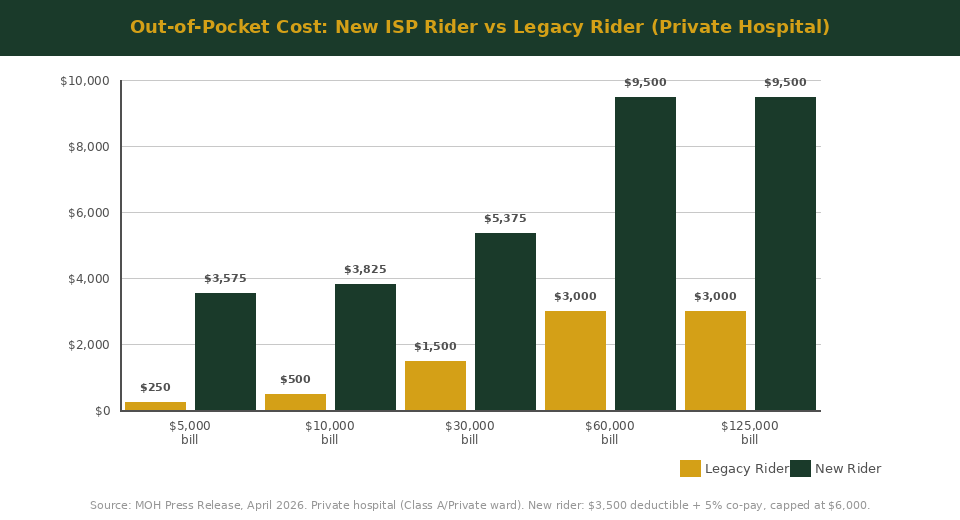
| Hospital Bill | Legacy Rider Out-of-Pocket |
New Rider Out-of-Pocket |
Difference |
|---|---|---|---|
| $5,000 | $250 | $3,575 | +$3,325 |
| $10,000 | $500 | $3,825 | +$3,325 |
| $30,000 | $1,500 | $4,825 | +$3,325 |
| $60,000 | $3,000 | $6,325 | +$3,325 |
| $125,000 | $3,000 | $9,500 | +$6,500 |
Source: The Kopi Notes calculations based on MOH-mandated deductible and co-payment rules (April 2026). Private hospital ward. Deductible = $3,500. Assumes single hospitalisation episode per year.
Key insight: For most hospitalisation events below $60,000, the gap between old and new rider is consistently around $3,325. That’s because the new $3,500 deductible minus the savings on the lower 5% co-payment (since the base is also deductible-reduced) nets out to roughly that figure for small-to-medium bills. For very large bills above $120,000, the gap widens to $6,500 due to the doubled cap.
Premium Savings: What You Save vs What You Risk
The trade-off with a new compliant rider is clear: lower premiums in exchange for higher potential out-of-pocket costs. MOH’s own projections put average annual savings at approximately:
- ~$600/year for those with private hospital ISP coverage
- ~$200/year for those with public hospital ISP coverage
Insurer illustrations have shown the actual premium reductions range from 16% to 84% lower compared to legacy riders, depending on the insurer and ward class. The wider range reflects the fact that some legacy riders had particularly generous coverage that is now structurally prohibited.
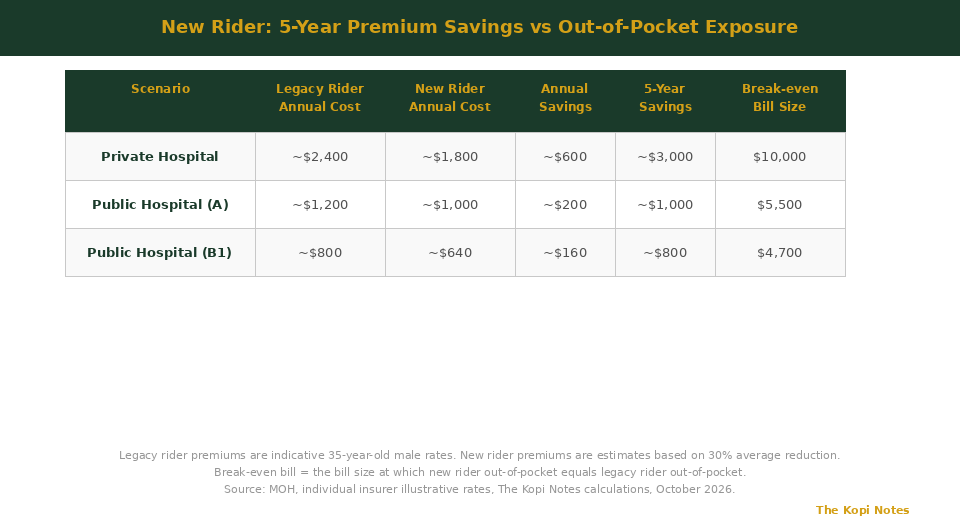
The 5-Year Maths (Private Hospital Example)
Assuming you never claim in 5 years:
- Premium savings over 5 years: ~$600 × 5 = $3,000
- Additional out-of-pocket if you have ONE $10,000 hospitalisation in Year 3: +$3,325
- Net position over 5 years: -$325 (new rider slightly worse if you claim once)
If you stay healthy and claim-free for 5+ years, the new rider wins on pure premium savings. If you have one medium-severity hospitalisation, the gap narrows to near zero. A catastrophic claim above $125,000 (e.g. cancer, major surgery) is where the new rider’s $9,500 cap hurts most — though the premium savings would eventually offset this over a longer horizon of 10+ claim-free years.
The best way to think about it: your MediSave account effectively becomes the buffer for the deductible. Since ISP premiums are paid from MediSave anyway, and the new rider premiums are lower, you should theoretically accumulate more MediSave over time — money that can cover the deductible when a hospitalisation does occur. The hospitalised without an ISP guide shows just how large bills can get without any ISP at all, reinforcing why keeping at least base ISP coverage matters regardless of rider choice.
Should You Switch? A 3-Question Decision Framework
Whether to switch from a legacy rider to a new compliant rider (or to downgrade ISP coverage entirely) comes down to three factors:
Question 1: How Much MediSave Do You Have?
The new rider’s deductible ($1,500–$3,500) must be paid from MediSave or cash. If your MediSave balance is healthy (above $20,000), you can comfortably absorb the deductible without financial disruption. If your MediSave is low, the immediate cash shock from a deductible could be problematic — in which case keeping your legacy rider until the mandatory 2028 transition buys you more time to build up your MediSave balance.
Question 2: What Is Your Claim History and Health Status?
If you’ve had multiple hospitalisations in the past 5 years, the lower out-of-pocket protection of a legacy rider has real value for you. If you’re relatively healthy and have gone claim-free for years, the premium savings from a new rider compound favourably over time. For retirees managing healthcare costs on a fixed income, the best ISP for Singapore retirees article covers the specific considerations after age 60, when premiums and claim risk both rise significantly.
Question 3: Are You on Panel or Seeing Non-Panel Doctors?
If you regularly see specialists outside your ISP’s panel, your bills are likely to be higher — meaning the deductible hits harder on an already elevated bill. The panel vs non-panel doctor impact on your bill article shows how panel choice affects the total bill, and combining that with the new rider deductible is the most important calculation for frequent specialist users.
Decision Summary
| Your Situation | Recommended Action |
|---|---|
| Young, healthy, strong MediSave | Switch to new rider — premium savings compound over time |
| Over 55, frequent claims, low MediSave | Keep legacy rider until 2028 mandatory transition |
| Middle-aged, mixed health history | Run the 5-year break-even maths with your own premium quotes |
| Managing cash flow tightly | Consider downgrading ISP coverage class instead of switching rider |
Source: The Kopi Notes analysis, October 2026. Not financial advice — consult a licensed financial adviser before making changes to your health insurance.
If you’re weighing whether to cancel an old rider entirely rather than switch, the ISP rider cancellation guide walks through the one-way door problem: cancelling a legacy rider means you can only get a new compliant rider if you reapply, which may involve fresh underwriting and potential exclusions.
Who Benefits Most From Each Rider Type
After six months of the new framework being live, a pattern is emerging in who benefits from each option:
New compliant rider suits: People under 45 who are generally healthy, have at least $15,000–$20,000 in MediSave as a buffer, and want to lock in lower premiums now before they age into higher premium bands. The $600/year saving at age 35 becomes increasingly meaningful over a 20-year horizon.
Legacy rider (until 2028) suits: Policyholders over 55 with chronic conditions, family members with known health risks, or anyone whose expected hospitalisation frequency is higher than once every 5 years. The deductible protection is most valuable for those who are statistically more likely to use it.
Downgrading ISP ward class suits: A subset of policyholders who currently have private hospital ISP coverage but realistically would be comfortable in a Class A public hospital. Dropping to Class A ISP can reduce both premiums and deductible exposure (the Class A deductible under new riders may be lower than the private hospital $3,500). If you are in this group, consider reviewing your ISP coverage class as part of the same exercise.
Whatever you decide, keep this in mind: the ISP itself (the base plan without a rider) remains MediSave-payable and protects you against catastrophic bills far beyond what MediShield Life alone covers. Riders are an optional layer above that base. The worst outcome is cancelling the base ISP entirely — something the hospitalisation costs without an ISP data makes viscerally clear.
Frequently Asked Questions
What are the new ISP rider deductibles from April 2026?
From 1 April 2026, new ISP riders cannot cover the minimum IP deductible set by MOH. These deductibles range from $1,500 to $3,500 per policy year depending on ward class — with private hospital stays carrying the highest deductible of $3,500. These amounts must be paid by the policyholder directly, either from MediSave or cash, before the ISP kicks in.
How much more will I pay out of pocket with a new ISP rider vs my old legacy rider?
For a typical private hospital bill of $10,000, your out-of-pocket jumps from approximately $500 under a legacy rider to $3,825 under the new rider — an increase of $3,325. For very large bills above $120,000, the maximum additional exposure is approximately $6,500, since the old co-payment cap was $3,000 and the new cap is $9,500 (deductible $3,500 + co-payment cap $6,000).
Can I keep my old legacy ISP rider after April 2026?
Yes. If you held a legacy rider before 1 April 2026, you can keep it. Insurers were only required to stop selling non-compliant riders from that date — not to cancel existing ones. Legacy riders will remain valid until a mandatory industry-wide transition expected around 2028, at which point all policyholders will be moved to compliant riders. Until then, you pay the higher premiums of your legacy rider but enjoy the lower out-of-pocket protection.
How do I pay the new deductible? Can I use MediSave?
Yes — the ISP deductible can be paid from your MediSave account, subject to MediSave withdrawal limits. Since ISP premiums are also MediSave-payable, the practical effect is that your MediSave now needs to cover both the annual premium and any deductible in a year you are hospitalised. Keeping your MediSave balance healthy is more important than ever under the new framework.
Does the new ISP rider co-payment cap of $6,000 include the deductible?
No. The $6,000 annual co-payment cap applies only to the 5% co-payment component on the post-deductible portion of your bill. The $3,500 deductible is on top of that. So for a catastrophic private hospital bill, your maximum annual out-of-pocket is the deductible ($3,500) plus the co-payment cap ($6,000) = $9,500 per year.
Are the new ISP riders significantly cheaper? By how much?
MOH projections indicate new compliant riders are approximately 30% cheaper on average than legacy riders — translating to annual savings of about $600 for private hospital riders and $200 for public hospital riders. Individual insurer illustrations have shown premium reductions ranging from 16% to 84% lower than legacy products, with the higher end reflecting particularly generous legacy riders that are now structurally prohibited.
What happens if I cancel my legacy rider and want to get a new rider later?
Cancelling your legacy rider is a one-way door for the legacy product — you cannot re-purchase it after April 2026. If you later want a rider again, you would need to apply for a new compliant rider, which may involve fresh underwriting. If your health has changed since your original policy was issued, you could face exclusions or a higher premium. This is why many advisers recommend not cancelling the legacy rider impulsively — keep it until the mandatory 2028 transition unless the premium savings clearly work in your favour.
Review Your ISP Coverage Today
Whether you keep your legacy rider, switch to a new one, or adjust your ward class — the most important thing is making the decision intentionally, not by default. Use our resources to make an informed choice.
Get Free Insurance Advice
Speak with a licensed insurance advisor. No obligation, no cost.
By submitting this form, you agree to our Privacy Policy.
This article was researched with the help of AI. While we strive to keep all information accurate and up to date, there may be errors. If you notice any discrepancies, please contact us.