What Is Term Life Insurance? A Complete Guide for Singapore (2026)
Your plain-English guide to term life insurance meaning, how it works in Singapore, how much cover you need, and how to choose the right policy — verified October 2026.
Term life insurance is a type of life insurance that pays a lump-sum death benefit to your beneficiaries if you pass away within a fixed period — typically 10, 20, or 30 years. Unlike whole life or investment-linked policies, term life has no cash value — you pay for pure protection only. This makes it the most affordable form of life insurance, and the recommended starting point for most Singapore working adults. Data verified as at October 2026.
Not financial advice. All figures are for educational reference only. Please consult a licensed financial adviser for personalised recommendations.
Table of Contents
Contents — Click to expand
- What Is Term Life Insurance?
- How Does Term Life Insurance Work?
- Types of Term Life Insurance in Singapore
- Term Life in Singapore: DPS, DPI, and MAS Oversight
- Term Life vs Whole Life vs ILP: Which Is Right for You?
- What Does Term Life Insurance Cost in Singapore?
- How Much Coverage Do You Actually Need?
- How to Choose the Right Term Life Policy
- Frequently Asked Questions
What Is Term Life Insurance?
Term life insurance is the simplest and purest form of life insurance. You pay a fixed premium for a set period (the “term”) — typically 10, 15, 20, 25, or 30 years. If you die during that term, your insurer pays a pre-agreed lump sum (the “sum assured” or “death benefit”) to the beneficiaries you nominated. If you survive the term, the policy expires and there is no payout.
The word “term” simply refers to the duration of coverage. Because there is no savings or investment component, all your premiums go entirely toward paying for protection. This is the key reason term life insurance premiums are significantly lower than whole life or investment-linked policies (ILPs) for the same coverage amount.
Term life insurance is often described as “renting” protection — you have coverage during your highest-need years (when you have a mortgage, young children, and dependants relying on your income), and the policy ends when your financial obligations reduce.
In Singapore, term life insurance is regulated by the Monetary Authority of Singapore (MAS) and all term life products must be sold by MAS-licensed insurers. These include AIA, Great Eastern, Prudential, NTUC Income (now Income Insurance), Manulife, FWD, and Singlife, among others.
How Does Term Life Insurance Work?
Here is how a typical term life insurance policy works step by step:
- Choose your coverage amount (sum assured): The lump sum your family receives on your death. Common amounts range from SGD 300,000 to SGD 2 million depending on your income, debts, and number of dependants.
- Choose your policy term: The period of coverage — 10, 15, 20, 25, or 30 years. Some insurers also offer coverage until a specific age (e.g., until age 65 or 70).
- Pay your premiums: Premiums can be monthly, quarterly, semi-annual, or annual. Most Singapore term life policies offer level premiums — the same amount throughout the term — making budgeting easy.
- A claim is made: If you pass away during the term (or are diagnosed with terminal illness, as most policies cover this too), your beneficiaries submit a claim to the insurer.
- The death benefit is paid: The insurer pays the sum assured as a lump sum to your nominated beneficiaries, free of tax in Singapore.
- Policy expires if you survive: If you outlive the term, the policy ends with no refund of premiums.
Most Singapore term life policies also include the option to add riders — supplementary benefits such as Total and Permanent Disability (TPD), Critical Illness (CI), and Early Critical Illness (ECI). These riders increase the premium but substantially broaden your protection.
Types of Term Life Insurance in Singapore
Not all term life policies are the same. Understanding the differences helps you pick the most suitable option:
| Type | How It Works | Best For |
|---|---|---|
| Level Term | Fixed premium and fixed sum assured for the entire term | Most people — predictable costs and protection |
| Decreasing Term | Sum assured reduces over time (mirrors a reducing mortgage balance) | Mortgage protection — coverage matches outstanding loan |
| Increasing Term | Sum assured increases annually (usually pegged to CPI or a fixed %) to keep pace with inflation | Long-term planners concerned about inflation eroding coverage |
| Group Term Life | Employer-sponsored term coverage — usually SGD 1–2× annual salary; no medical underwriting | Supplementary base; do NOT rely on it as primary coverage (it ends when you leave your job) |
| Direct Purchase Insurance (DPI) | No-frills term life sold directly without a financial adviser; covered up to SGD 400,000 per insurer | Budget-conscious buyers comfortable comparing policies independently on compareFIRST |
Source: Life Insurance Association Singapore (LIA), October 2026
Term Life in Singapore: DPS, DPI, and MAS Oversight
Singapore has a robust framework for term life insurance that every working adult should understand:
Dependants’ Protection Scheme (DPS): DPS is a compulsory group term life insurance administered by Great Eastern Life on behalf of CPF Board. Every CPF member aged 21–65 who receives a valid CPF contribution is automatically covered for SGD 70,000 (until age 60) and SGD 55,000 (age 60–65), unless they opt out. DPS premiums are deducted from your CPF Ordinary Account. DPS is important as a baseline, but SGD 70,000 is far below what most working adults need — treat it as a base layer, not your full protection. More details are available on the CPF Board website.
Direct Purchase Insurance (DPI): Introduced by MAS, DPI allows Singaporeans to buy term life and whole life products directly from insurers — without a financial adviser — at lower costs. Compare DPI products on compareFIRST.sg, the official comparison portal managed by LIA Singapore. Term DPI covers up to SGD 400,000 per insurer.
MAS Regulation: All life insurers in Singapore are licensed and regulated by MAS. This means insurer solvency requirements, product disclosures, and financial adviser conduct standards are all enforced. Singapore’s insurance sector is considered one of the best-regulated in Asia.
For building long-term wealth alongside your insurance protection, see our guide on CPF investment strategy Singapore — many Singaporeans use CPF-OA to invest in unit trusts while their DPS premium is automatically deducted.
Term Life vs Whole Life vs ILP: Which Is Right for You?
The biggest question most Singapore buyers face is: should I buy term and invest the rest, or get a whole life or ILP policy? The answer depends on your financial goals, discipline, and budget — but for most working adults, term life is the starting point because it provides the highest coverage for the lowest cost.
| Feature | Term Life | Whole Life | ILP |
|---|---|---|---|
| Coverage Period | Fixed term (10–30 yrs) | Lifetime | Until surrender or maturity |
| Cash Value | None | Yes (participating) | Yes (invested in sub-funds) |
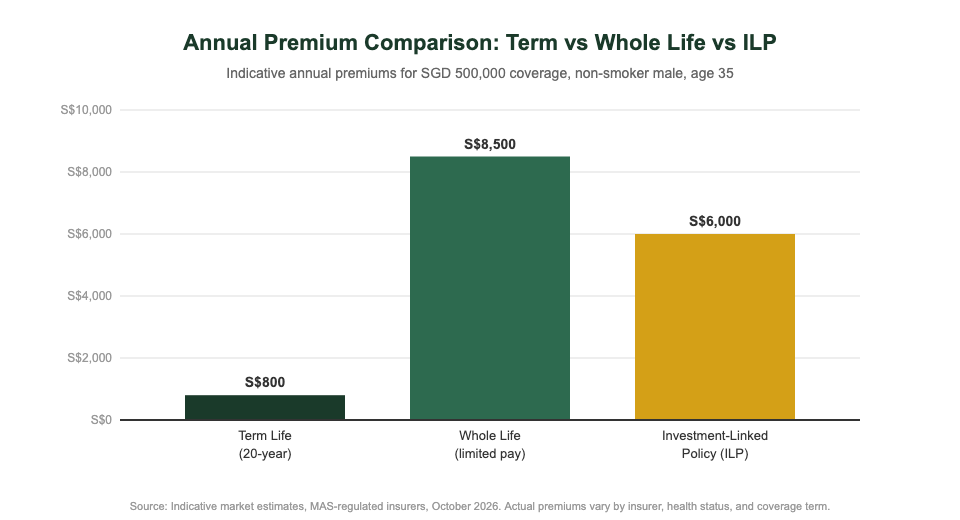
| Annual Premium (SGD 500k cover, male 35) | ~SGD 600–900 | ~SGD 7,000–10,000 | ~SGD 5,000–8,000 |
| Investment Returns | None | 2–4% p.a. (non-guaranteed) | Market-linked (variable) |
| Flexibility | High — adjust or cancel anytime | Low — high surrender penalties early on | Medium — can switch funds |
| Best For | Working adults needing maximum protection affordably | Legacy planning, forced savings | Those who want insurance + investments in one (note: usually suboptimal vs “buy term, invest rest”) |
Source: Indicative market data from MAS-licensed insurers. Premiums vary by insurer, health, gender, smoker status. October 2026.
The “buy term and invest the rest” strategy — buying affordable term life and investing the premium savings in index ETFs or CPF — consistently outperforms ILPs and whole life policies for most Singaporeans over 20+ year horizons. If you’re building a retirement portfolio, use our Singapore retirement calculator to see how much you need to accumulate.
What Does Term Life Insurance Cost in Singapore?
Term life insurance premiums in Singapore depend on several factors: your age at entry, gender, smoker status, health history, coverage amount, and policy term. Here are indicative annual premium ranges for a SGD 500,000 death benefit for a non-smoking male:
| Age at Entry | 20-Year Term (est.) | 30-Year Term (est.) | Note |
|---|---|---|---|
| Age 25 | SGD 500–700 p.a. | SGD 700–1,000 p.a. | Best time to lock in low rates |
| Age 30 | SGD 600–900 p.a. | SGD 900–1,300 p.a. | Sweet spot — still affordable |
| Age 35 | SGD 800–1,200 p.a. | SGD 1,200–1,800 p.a. | Premiums rise notably after 35 |
| Age 40 | SGD 1,200–1,800 p.a. | SGD 1,800–2,800 p.a. | Still much cheaper than whole life |
| Age 45 | SGD 2,000–3,000 p.a. | SGD 3,000–4,500 p.a. | Buy now if you haven’t — rates keep rising |
Source: Indicative market estimates from MAS-licensed term life insurers in Singapore. Actual premiums depend on individual health, insurer, and exact policy features. Compare on compareFIRST.sg. October 2026.
Key insight: a 25-year-old can get SGD 500,000 in term life cover for roughly SGD 500–700 per year — less than SGD 60 per month. This is a fraction of what whole life would cost for the same protection. The longer you wait, the more expensive premiums become — this is why financial advisers in Singapore consistently recommend buying term life insurance as early as possible.
To maximise your passive income Singapore strategy, pairing a lean term life policy with disciplined investing in dividend stocks or REITs is more efficient than locking capital into a whole life policy with modest guaranteed returns.
How Much Coverage Do You Actually Need?
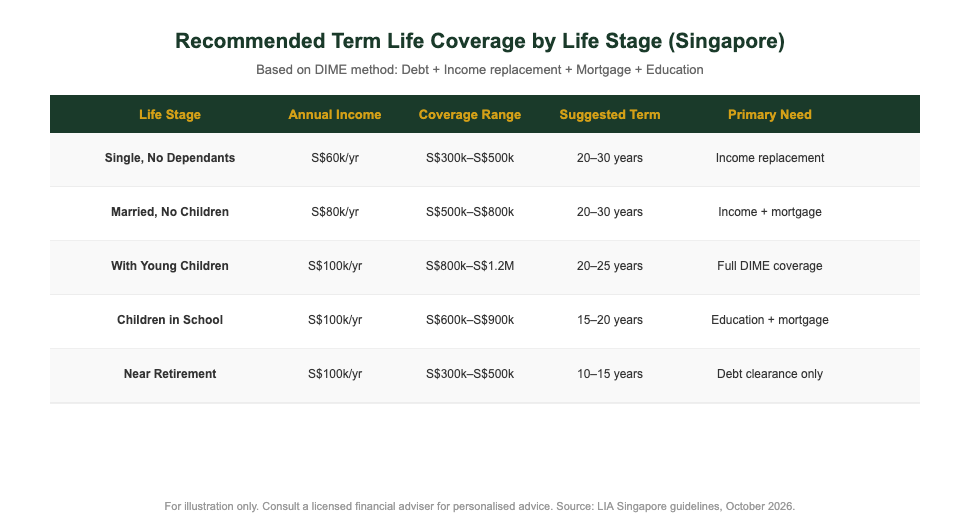
The Life Insurance Association (LIA) Singapore recommends approximately 9–10 times your annual income as a starting benchmark for basic life cover. However, a more precise approach is the DIME method:
- D — Debt: All outstanding debts (personal loans, car loans, credit cards) that your family would need to repay
- I — Income replacement: Your annual income × number of years until dependants are self-sufficient (typically 10–20 years)
- M — Mortgage: Outstanding home loan balance
- E — Education: Estimated cost of children’s tertiary education (SGD 100,000–200,000 per child at a local university by the 2030s)
Add D + I + M + E, then subtract any existing savings, investments, and CPF balance your family could access. The result is your coverage gap — how much additional term life you need.
How to Choose the Right Term Life Policy in Singapore
With dozens of MAS-licensed insurers and hundreds of policy variants, picking the right term life policy can feel overwhelming. Here is a step-by-step framework:
Step 1 — Calculate your coverage need using DIME. Do this before you speak to any adviser. Know your number before anyone tries to sell you something.
Step 2 — Decide your policy term. A good rule of thumb: your term should last until your youngest child is financially independent (typically 21–25 years old) and your mortgage is paid off. For most 30-year-old buyers, a 25–30 year term works well.
Step 3 — Compare on compareFIRST.sg. MAS mandates that all life insurers list their DPI products on this portal. You can filter by age, coverage amount, and term to compare premiums side by side. This is especially useful for Direct Purchase Insurance (DPI) products with no adviser commissions.
Step 4 — Consider riders carefully. The most valuable riders for most Singaporeans are Total and Permanent Disability (TPD) and Early Critical Illness (ECI). TPD pays if you become permanently disabled and can no longer work — arguably more likely than death during your working years. ECI pays out at Stage 1 of a covered illness, not just at terminal stage. Adding these riders increases your premium but significantly broadens your protection. Note that Singapore’s MediShield Life covers hospitalisation, not income replacement on disability — term life with TPD/ECI fills that gap.
Step 5 — Check insurer financial strength. MAS publishes solvency requirements and risk-based capital ratios for all life insurers. You want an insurer who will still be around in 30 years to pay a claim. All major Singapore insurers (AIA, Great Eastern, Prudential, Singlife, Manulife, FWD, NTUC Income) meet MAS capital requirements.
Step 6 — Don’t over-insure. Buying more coverage than you need wastes premium dollars that could be invested. Use Endowus or Syfe to invest those savings efficiently. Check our Endowus referral code or Syfe referral code to get started investing once your insurance foundation is in place.
After locking in your term life protection, review your broader financial position — how much you have in CPF, whether you have enough in Singapore Savings Bonds or T-bills as a liquid emergency buffer, and whether you are on track for retirement. Our Singapore retirement calculator can help you model your numbers.
Frequently Asked Questions About Term Life Insurance in Singapore
What is the term life insurance meaning in simple terms?
Term life insurance means you pay a fixed annual premium to get life insurance protection for a set number of years — for example 20 or 30 years. If you die during that term, a lump sum is paid to your family. If you survive the term, the policy ends with no payout and no cash returned. It is pure protection, with no savings or investment element. This makes it the most affordable type of life insurance.
Is term life insurance worth it in Singapore?
Yes, for most Singapore working adults with dependants, a mortgage, or family financial obligations, term life insurance is an essential foundation of financial planning. A SGD 500,000 policy can cost as little as SGD 500–900 per year for a 25–30 year old — less than SGD 2.50 per day. The LIA Singapore’s Protection Gap Study consistently shows Singaporeans are underinsured relative to their actual financial obligations. If your family would suffer financially if you died tomorrow, you need term life insurance.
What is the difference between term life and whole life insurance?
Term life covers you for a fixed period (e.g., 20 years) with no cash value — you pay only for protection. Whole life covers you for your entire life and builds up a cash value (surrender value) over time, but premiums are 8–12× higher for the same death benefit. For most Singaporeans, buying term life and investing the premium savings in index funds or CPF (the “buy term, invest rest” approach) produces better financial outcomes over the long run.
How much term life insurance do I need in Singapore?
The LIA Singapore recommends starting with 9–10× your annual income as basic life cover. A more precise approach is the DIME method: add up your outstanding Debts, Income replacement needs (annual income × years until dependants are independent), Mortgage balance, and Education costs for your children. Then subtract your existing savings and CPF balance. The remainder is your coverage gap. For a 35-year-old earning SGD 100,000 per year with a SGD 600,000 mortgage and two young children, a total coverage of SGD 1.2–1.5 million is reasonable.
Does Singapore's DPS replace the need for private term life insurance?
No. DPS provides only SGD 70,000 in coverage (or SGD 55,000 from age 60), which covers fewer than one year of expenses for most Singapore families. DPS is a useful baseline but is nowhere near sufficient to replace a breadwinner’s income, pay off a mortgage, or fund children’s education. You should treat DPS as a supplement to, not a replacement for, a private term life policy sized to your actual financial obligations.
Can I use CPF to pay for term life insurance premiums?
DPS premiums are automatically deducted from your CPF Ordinary Account. However, most private term life insurance premiums cannot be paid using CPF OA or SA — you will need to pay with cash. The exception is certain whole life and endowment plans that are CPF-approved. For term life, expect to pay cash premiums, but remember these premiums are very affordable — often less than SGD 100 per month for SGD 500,000 coverage if you buy in your late 20s or 30s.
What happens if I stop paying my term life insurance premiums?
If you stop paying premiums, most Singapore term life policies have a grace period of 30 days during which the policy remains active. After the grace period, the policy lapses — meaning you lose coverage immediately. Unlike whole life policies, there is no cash value to draw down or use to continue premiums. If you need to reinstate a lapsed term life policy, you will need to reapply and potentially undergo medical underwriting again, which may result in higher premiums or coverage exclusions if your health has changed.
Protect Your Family — Then Build Your Wealth
Once your term life foundation is in place, invest your premium savings in S-REITs, ETFs, or CPF-SA to build long-term passive income. Use our tools and referral links to get started.
Get Free Insurance Advice
Speak with a licensed insurance advisor. No obligation, no cost.
By submitting this form, you agree to our Privacy Policy.
This article was researched with the help of AI. While we strive to keep all information accurate and up to date, there may be errors. If you notice any discrepancies, please contact us.