What Is a T-Bill in Singapore? Minimum Sum, How to Apply & 2026 Guide
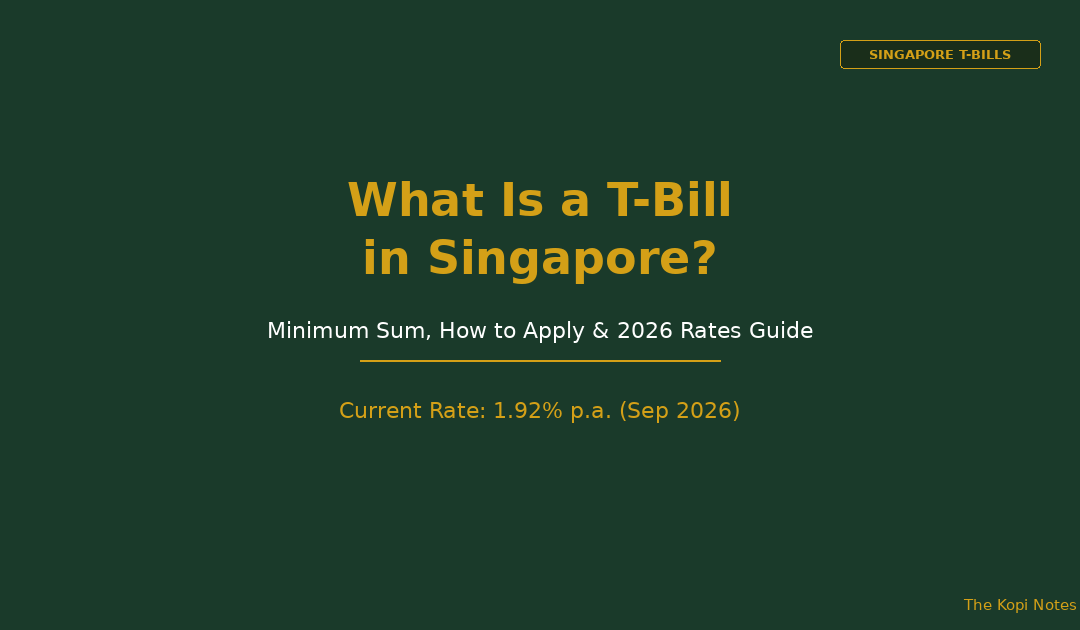
A Singapore Treasury Bill (T-bill) is a short-term debt security issued by the Singapore Government via the Monetary Authority of Singapore (MAS). T-bills come in 6-month and 1-year tenors, require a minimum investment of S$1,000, and pay no coupon — you buy them at a discount and receive the full face value at maturity. The September 2026 6-month T-bill cut-off yield stood at 1.92% per annum.
Not financial advice. All figures are for educational reference only. Data as at September 2026 unless noted.
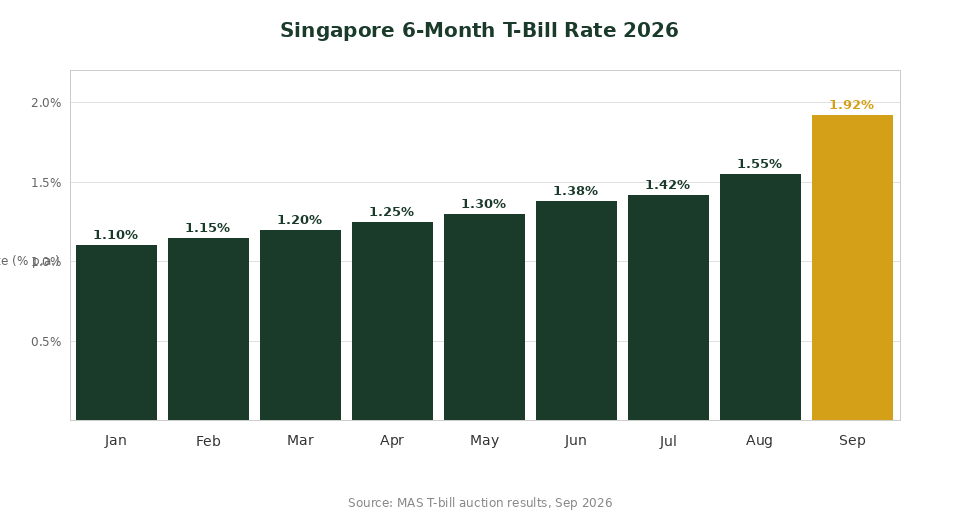
Table of Contents
What Is a Singapore T-Bill?
A Treasury Bill, or T-bill, is a short-term government security. Singapore’s T-bills are issued by the Monetary Authority of Singapore (MAS) on behalf of the Singapore Government. Because they are backed by the Singapore Government, T-bills carry essentially zero default risk — making them one of the safest instruments available to retail investors here.
Unlike a bond, a T-bill does not pay periodic interest coupons. Instead, it is a discount security: you buy it at a price below its face value (S$1 per unit, with a minimum application of S$1,000), and at maturity you receive the full face value. The difference between your purchase price and the face value is your effective return.
For example, if you invest S$10,000 in a 6-month T-bill at a yield of 1.92%, you would receive approximately S$10,095 at maturity (S$10,000 face value minus the discount, then the full face value paid out).
6-Month vs 1-Year T-Bills: Key Differences
MAS issues two tenors. Here is how they compare:
| Feature | 6-Month T-Bill | 1-Year T-Bill |
|---|---|---|
| Tenor | 6 months | 12 months |
| Issuance frequency | ~Weekly | ~Fortnightly |
| Minimum investment | S$1,000 | S$1,000 |
| Maximum per auction | S$1 million (competitive) | S$1 million (competitive) |
| CPF OA/SA eligible? | Yes | Yes |
| SRS eligible? | Yes | Yes |
Source: MAS Singapore, September 2026
Minimum Sum and How Much You Can Invest
The minimum investment for a Singapore T-bill is S$1,000, applied in multiples of S$1,000. There is no upper limit for non-competitive bids (you receive the cut-off yield regardless of the size), though the maximum for competitive bids is S$1 million per auction.
For most retail investors, the non-competitive bid route is simpler: you apply for any amount in S$1,000 multiples, and MAS allocates your investment at the final cut-off yield determined by the auction. You are guaranteed allocation as long as you submit a non-competitive bid and the auction is not oversubscribed at the non-competitive level (which is rare for 6-month T-bills).
You can fund T-bill applications using three sources:
- Cash (bank account) — most common, linked to your CDP Securities account
- CPF Ordinary Account (OA) or Special Account (SA) — subject to CPF Investment Scheme (CPFIS) rules
- Supplementary Retirement Scheme (SRS) — applied through your SRS operator bank
Using your CPF investment strategy to hold T-bills within CPFIS is a common approach for those who want risk-free returns above the CPF OA floor rate of 2.5% — though note that the recent T-bill yield at 1.92% sits below the CPF OA rate, making cash applications more compelling than CPF-funded ones in the current environment.
How to Apply for T-Bills in Singapore
There are three main ways to apply for Singapore T-bills:
1. Internet Banking (Fastest for Most)
DBS/POSB, OCBC, and UOB customers can apply directly via their bank’s internet banking portal. Log in, navigate to the investments section, and look for “T-Bills” or “Singapore Government Securities.” Applications typically open two to three business days before each auction and close one business day before the auction date.
2. ATM Application
DBS/POSB ATMs support T-bill applications under the “Investment” menu. This route is straightforward but requires you to have a CDP (Central Depository) Securities account linked to your DBS/POSB account.
3. CDP Online (For All Banks)
If you do not bank with DBS/POSB/OCBC/UOB, you can apply through the SGX CDP website using your CDP Investor Portal login. This route accepts applications from any Singapore bank account linked to your CDP account.
What You Need Before Applying
- A CDP Securities account (free to open at SGX; required to hold T-bills)
- A bank account linked to your CDP account for cash settlement
- Decide on: tenor (6-month or 1-year), bid type (non-competitive recommended for retail), amount (multiples of S$1,000)
Once applied, the T-bill is credited to your CDP account approximately two business days after the auction, and the corresponding funds are deducted from your bank account. At maturity, the full face value is credited back to your bank account automatically — no action required.
For a full breakdown of T-bill yields, auction schedules, and historical cut-off rates, see our complete Singapore T-bills 2026 guide.
Current T-Bill Rate September 2026
The most recent 6-month T-bill auction (September 24, 2026) settled at a cut-off yield of 1.92% per annum — the highest T-bill yield of 2026 so far, driven by the Federal Reserve’s unexpected September 2026 rate hike and MAS’s corresponding monetary policy tightening.
To put 1.92% in context: at the start of 2026, 6-month T-bills were yielding approximately 1.10% per annum. The rate has climbed steadily throughout the year as global central banks tightened policy in response to persistent core inflation.
The next auction for the 6-month T-bill is expected around October 8, 2026. MAS publishes the full auction calendar on its website. You can also check the latest Singapore T-bill rate versus fixed deposits for the most up-to-date yield comparison.
On a S$10,000 investment held to maturity (6 months), a 1.92% annual yield translates to approximately S$95.60 in returns before any fees. There is no income tax on T-bill returns for individual investors in Singapore.
T-Bills vs Fixed Deposits vs SSB: Which Is Better?
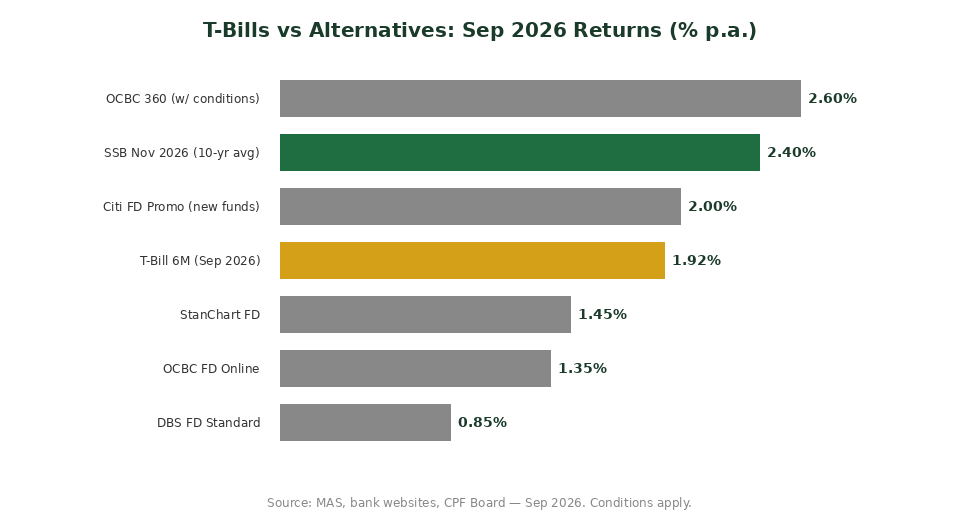
T-bills are not the only risk-free savings option for Singapore investors. Here is how they compare against the main alternatives as at September 2026:
| Product | Rate (Sep 2026) | Liquidity | Risk | Notes |
|---|---|---|---|---|
| T-Bill 6M | 1.92% p.a. | Medium (can sell via CDP) | Zero (gov) | Auction allocation |
| SSB Nov 2026 | ~2.40% p.a. (10-yr avg) | High (redeem monthly) | Zero (gov) | S$200 minimum |
| Citibank FD Promo | 2.00% p.a. | Low (break penalty) | Bank (SDIC insured) | New funds, min S$5k |
| StanChart FD | 1.45% p.a. | Low (break penalty) | Bank (SDIC insured) | Standard promo |
| OCBC FD Online | 1.35% p.a. | Low (break penalty) | Bank (SDIC insured) | Online placement |
| DBS FD Standard | 0.85% p.a. | Low (break penalty) | Bank (SDIC insured) | No promo conditions |
Source: MAS, bank websites, MAS Singapore Savings Bond announcement — September 2026. Rates subject to change.
The key insight: Singapore Savings Bonds (SSB) are currently offering higher returns than T-bills for most holding periods, with better liquidity (monthly redemptions). The SSB November 2026 tranche is projected to yield around 2.40% on a 10-year average basis — significantly above the T-bill’s 1.92%. However, SSB monthly allocations can be limited, so T-bills remain a practical alternative if you cannot secure SSB allocation.
Who Should Buy T-Bills in Singapore?
T-bills make most sense for investors who tick at least one of these boxes:
- Capital preservation is the priority. If you cannot afford to lose any principal — emergency funds, money earmarked for a property downpayment in 6 months — T-bills deliver risk-free returns with no volatility.
- Short investment horizon. Investors parking cash for 6 to 12 months while deciding on a longer-term allocation (equities, REITs, or S-REITs) benefit from T-bill yields without locking into longer-duration instruments.
- SRS account holders seeking low-risk returns. SRS funds can be invested in T-bills, and the tax deferral benefit of SRS means even a 1.92% return is more efficient than it appears pre-tax.
- CPF OA investors when T-bill yields exceed 2.5%. At current rates (1.92%), CPF OA’s guaranteed 2.5% floor is actually higher than T-bills — so CPF-funded T-bill applications do not make sense right now. Watch for this window if rates rise again.
If you are building a passive income portfolio with a longer horizon, you may want to look at dividend-paying assets like the best passive income options in Singapore, including S-REITs and dividend ETFs, alongside a T-bill ladder for your cash reserves. Use our retirement planning calculator to model how different return assumptions affect your long-term goals.
Risks and Limitations to Know
T-bills are extremely safe but not risk-free in all respects:
- Reinvestment risk. When your 6-month T-bill matures, the next auction may offer a lower yield. There is no guarantee you will be able to reinvest at the same or higher rate.
- Liquidity risk (selling early). If you need cash before the T-bill matures, you can sell it in the secondary market via CDP. However, if market yields have risen since you bought, the T-bill’s market price will be lower than par — meaning you could receive less than your original investment. For true capital preservation, hold to maturity.
- Opportunity cost. Money locked in a T-bill is not earning the potentially higher long-term returns of equities or REITs. T-bills are a cash management tool, not a wealth-building vehicle.
- Auction risk. If you submit a non-competitive bid and the non-competitive tranche is oversubscribed, MAS may allocate you less than your full application. This is uncommon for 6-month T-bills but has happened in high-demand periods.
For a deeper dive into placing your savings effectively across T-bills, fixed deposits, and SSBs, see how Endowus and Syfe cash management products compare as hands-off alternatives that auto-roll into high-quality money market instruments.
Frequently Asked Questions
What is the minimum amount to invest in a Singapore T-bill?
How do I buy a T-bill in Singapore?
Is the T-bill yield taxable in Singapore?
What is the current T-bill interest rate in Singapore (2026)?
Can I use CPF to buy Singapore T-bills?
What happens if I need my money before the T-bill matures?
Are T-bills safer than fixed deposits?
This article was researched with the help of AI. While we strive to keep all information accurate and up to date, there may be errors. If you notice any discrepancies, please contact us.