How to Invest in Singapore: Asset Allocation by Life Stage (2026 Guide)
The definitive guide to building a Singapore investment portfolio at every decade — from your 20s to 50s and beyond.
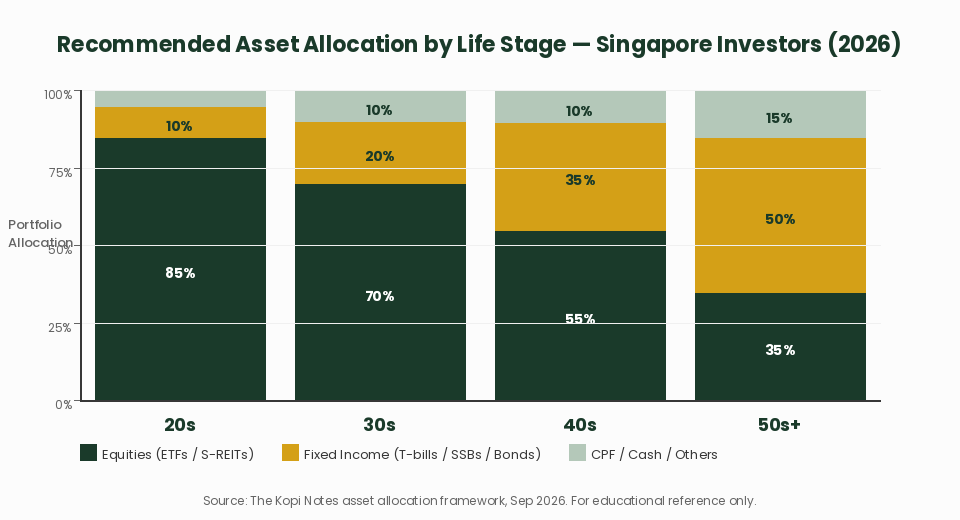
How to invest in Singapore depends significantly on your life stage. In your 20s, an 80–90% equity allocation — primarily through globally diversified ETFs like CSPX or VWRA — maximises long-term compounding. By your 50s, that shifts to 35–40% equities and 50–60% in stable income assets like Singapore T-bills (1.92% as at Sep 2026), SSBs, and REITs. This guide maps the right allocation for every decade, with real SGD examples.
Not financial advice. All figures are for educational reference only. Data as at September 2026 unless noted.
Table of Contents
Contents — Click to expand
- Why Life Stage Determines Your Investment Strategy
- Investing in Singapore in Your 20s: Growth-First
- Investing in Singapore in Your 30s: Building Wealth
- Investing in Singapore in Your 40s: Balanced Accumulation
- Investing in Singapore in Your 50s and Beyond: Capital Preservation
- The CPF and SRS Dimension Across Every Life Stage
- Choosing the Right Investment Platform for Your Life Stage
- Frequently Asked Questions
Why Life Stage Determines Your Investment Strategy
There is no single correct way to invest in Singapore. The optimal strategy depends on three variables that change dramatically with age: your investment time horizon, your income stability, and your obligations (mortgage, dependants, retirement provisions). A 25-year-old with 35–40 years until retirement can absorb years of equity volatility and benefit from long-term compounding. A 57-year-old with a pension shortfall cannot afford a 40% portfolio drawdown in a market crash just before retirement.
The concept behind life-stage investing — sometimes called the “glide path” approach — is simple: hold more growth assets (equities, REITs) when you’re young and have time to recover from losses, and gradually shift towards income-generating, capital-stable assets (T-bills, SSBs, bonds) as you approach and enter retirement. This is the same principle underpinning CPF’s own structure: your CPF Ordinary Account (OA), Special Account (SA), and Retirement Account (RA) each serve a different function based on your life stage.
Two key metrics define your life-stage allocation strategy:
- Time horizon: The number of years before you need to draw on investments. Longer = more equities.
- Risk capacity: Your ability to absorb portfolio losses without being forced to sell at a low. Higher income stability = higher risk capacity.
The allocation ranges in this guide are evidence-based starting points, not prescriptions. Use the Singapore retirement calculator to model your specific scenario with real CPF projections and savings rates.
Investing in Singapore in Your 20s: Growth-First (80–90% Equities)
In your 20s, time is your most powerful asset. With 35–40 years before a typical retirement age of 65, you can afford to ride out multiple market cycles. Historical data from the MSCI World Index shows that, over any 20-year rolling window from 1969 to 2024, a globally diversified equity portfolio has never produced a negative return — even accounting for the 2008 financial crisis and the COVID crash.
For a Singapore investor in their 20s, a practical portfolio looks like this:
| Asset Class | Target Allocation | Example Instruments |
|---|---|---|
| Global Equities (LSE ETFs) | 70–80% | CSPX (S&P 500), VWRA (All-World) |
| Singapore REITs | 10–15% | Lion-Phillip S-REIT ETF, CSOP iEdge S-REIT |
| Fixed Income / T-bills | 5–10% | 6-month T-bills (1.92%), SSBs (2.32% 10Y avg) |
| Cash / Emergency Fund | 3–6 months expenses | High-yield savings, money market fund |
Source: The Kopi Notes framework, Sep 2026. T-bill rate from MAS auction results 24 Sep 2026. SSB rate from MAS Oct 2026 issuance.
A worked example: A 27-year-old with SGD 30,000 in investable savings (outside emergency fund) might hold SGD 23,000 in VWRA (accumulating all-world ETF) on Interactive Brokers, SGD 4,500 in S-REIT ETF, and SGD 2,500 in T-bills. Annual portfolio cost: approximately SGD 20 in IBKR trading commissions plus the VWRA TER of 0.22% (about SGD 50/year). Total drag: under 0.25% p.a.
At this stage, the primary focus is contribution rate, not returns optimisation. Every additional SGD 500/month invested at 25 rather than 30 adds roughly SGD 45,000–60,000 to your portfolio by age 65 (at 6% annualised growth). Maximise your CPF Special Account contributions via Voluntary CPF Top-Ups — SA earns a guaranteed 4% p.a., and contributions reduce taxable income.
Investing in Singapore in Your 30s: Building Wealth (65–75% Equities)
Your 30s typically bring higher income — but also higher obligations: mortgage payments, marriage, children, and parents who may need support. The equity allocation shifts down slightly to 65–75% as you take on more fixed liabilities that reduce your practical risk capacity, even if your theoretical time horizon remains long.
The most important decision in your 30s is whether to use CPF for investing or leave it in the OA at 2.5% p.a. (3.5% on the first SGD 20,000). For most Singapore investors in their 30s, the math favours leaving the CPF OA untouched — it functions as the fixed income component of your portfolio, earning a guaranteed 2.5–3.5% risk-free return. This means your investable cash outside CPF can stay aggressively invested.
The SGD 500,000 portfolio test at age 38: If you have accumulated SGD 500,000 across CPF and investment accounts by 38, a reasonable split might be SGD 180,000 in CPF (OA + SA), SGD 270,000 in LSE ETFs (CSPX/VWRA via IBKR), and SGD 50,000 in S-REITs for passive income. Your CPF position already provides 36% in low-risk assets — allowing your investment portfolio to remain 100% equities without over-weighting risk on a whole-of-portfolio basis.
In your 30s, open a Supplementary Retirement Scheme (SRS) account and contribute up to the SGD 15,300 annual cap. SRS contributions reduce your taxable income at your marginal rate, and investments within SRS grow tax-deferred. For someone in the 15% tax bracket, the SGD 15,300 SRS contribution saves SGD 2,295 in income tax annually — an immediate 15% guaranteed return before any investment gain.
Investing in Singapore in Your 40s: Balanced Accumulation (50–60% Equities)
By your 40s, retirement is 20–25 years away — no longer an abstraction. A 40% portfolio drawdown that takes 3–5 years to recover is now a genuine threat to retirement timing, not merely a paper loss. The equity allocation steps down to 50–60%, with fixed income and income-producing assets taking a growing share.
Singapore Savings Bonds deserve a more prominent role in your 40s. Unlike T-bills (which must be rolled every 6 months at prevailing rates), SSBs lock in a 10-year average yield — currently 2.32% for the October 2026 issue — and can be redeemed any month at face value with no penalty. A SSB ladder (buying SGD 10,000–15,000 monthly) builds up a growing income buffer that acts as the stabiliser for a more volatile equity portfolio. Learn more about this strategy in the Singapore Savings Bonds guide.
The 40s are also the decade to right-size your life insurance coverage. A portfolio worth SGD 600,000–800,000 with dependants still at home requires an adequate term life buffer — something that protects your investment portfolio from being liquidated at a bad time to cover unexpected costs.
Investing in Singapore in Your 50s and Beyond: Capital Preservation (30–40% Equities)
In your 50s, sequence-of-returns risk becomes the dominant concern. A market crash in the first two years of retirement is far more damaging than one in the middle of retirement — because early drawdowns reduce the capital base before it has time to recover. Research by William Bengen (the “4% rule” study) and Morningstar’s 2023 safe withdrawal rate analysis both find that the allocation in the decade before and immediately after retirement has an outsized impact on portfolio longevity.
For Singapore investors, the 50s allocation looks like this:
| Asset Class | Allocation | Purpose | Singapore Instruments |
|---|---|---|---|
| Global equities (ETFs) | 25–35% | Long-term growth | VWRA, CSPX (LSE) |
| Singapore REITs | 10–15% | SGD income stream | S-REIT ETF, direct S-REITs |
| SSBs / T-bills | 25–30% | Capital stability, income | T-bills (1.92%), SSBs (2.32%) |
| CPF (OA + SA/RA) | 15–20% | Retirement base, CPF Life | CPF OA (2.5%), SA (4%), RA (4%) |
| Cash / Fixed Deposits | 5–10% | Liquidity buffer | HY savings, FD |
Source: The Kopi Notes framework. CPF interest rates from CPF Board, Sep 2026. T-bill and SSB rates from MAS Sep–Oct 2026 issuances.
At 55, Singapore residents can access their CPF Retirement Account. At 65 (or later), CPF Life begins payouts — a life-long annuity that forms the foundation of retirement income. Running the Singapore retirement calculator will show you how large a CPF Life monthly payout you are on track for, and how much gap your investment portfolio needs to fill.
A key consideration for those approaching the CPF withdrawal age: making a Retirement Sum Top-Up (RSTU) to the SA or RA can lock in the 4% p.a. CPF return on amounts up to the Enhanced Retirement Sum. This is particularly powerful for investors in their early-to-mid 50s who have excess savings — the guaranteed 4% beats current T-bill and SSB rates with a better risk profile.
The CPF and SRS Dimension Across Every Life Stage
No guide on how to invest in Singapore is complete without addressing CPF and SRS — two tax-advantaged structures that dramatically affect the optimal allocation at every stage.
CPF as your fixed income layer: Treat your CPF balances as the “bonds” component of your overall portfolio. CPF OA earns 2.5% p.a. (3.5% on the first SGD 20,000), and CPF SA earns 4% p.a. (5% on the first SGD 40,000 combined OA+SA+MediSave). These guaranteed, risk-free returns mean that for most Singapore investors, there is limited value in buying bonds or fixed deposits outside CPF — the CPF already functions as the safe anchor in the whole-of-portfolio view.
SRS for tax-deferred compounding: The SRS annual cap of SGD 15,300 allows you to invest in ETFs, REITs, unit trusts, and Singapore government bonds within a tax-sheltered wrapper. SRS balances grow without annual income tax on dividends or interest, and withdrawals after age 62 are taxed at 50% of the amount — effectively halving your marginal rate on retirement withdrawals. For someone paying 11.5% effective tax today, the SRS strategy means paying 5.75% effective tax on withdrawals — a meaningful long-term advantage.
The optimal SRS strategy: max out the SGD 15,300 annual contribution as early as possible in the financial year (January–February), invest it immediately into VWRA or a globally diversified ETF via FSMOne or Endowus, and repeat annually. Over a 25-year working life, a Singapore investor who maxes SRS from age 30 to 55 and invests in a portfolio returning 7% p.a. would accumulate approximately SGD 1.0–1.2 million in SRS — entirely within a tax-sheltered structure. For a detailed breakdown of this, visit our guide on CPF investment strategy Singapore which covers the interplay between CPF SA, SRS, and taxable accounts.
Choosing the Right Investment Platform for Your Life Stage
The right platform depends on portfolio size, investment style, and the asset classes you are targeting. For a Singapore investor building a life-stage portfolio, three scenarios cover most situations:
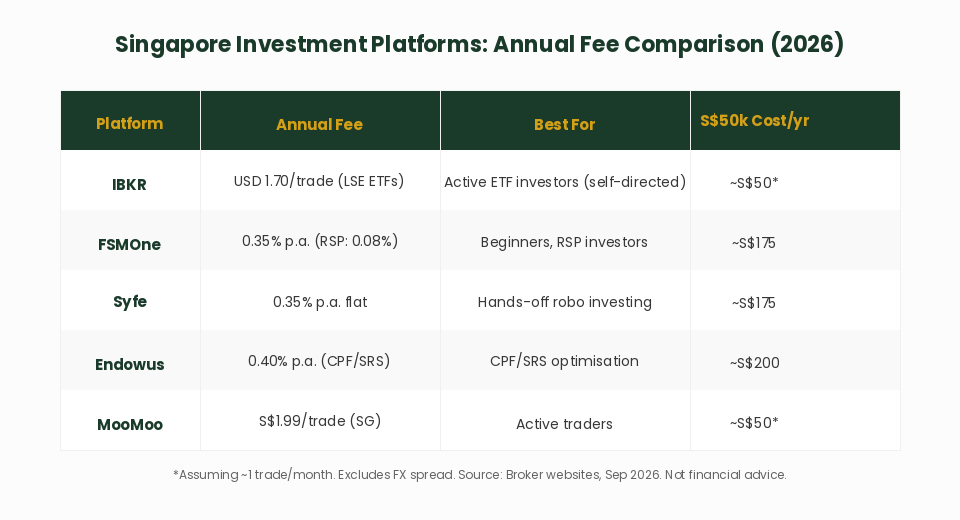
Beginners and small portfolios (under SGD 30,000): Start with a robo-advisor — either Syfe (referral code SRPRFFFCD) at 0.35% p.a. or Endowus (referral code 2V343) at 0.40% p.a. Both offer globally diversified portfolios, automatic rebalancing, and SRS-compatibility. The fixed annual fee matters less at small portfolio sizes, and the simplicity reduces the risk of behavioural errors (panic selling, market timing) that cost most investors far more than fees.
Intermediate portfolios (SGD 30,000–150,000): Transition to a hybrid approach — buy core ETF positions (CSPX, VWRA) directly on the London Stock Exchange via Interactive Brokers (IBKR referral jianxiong368) at USD 1.70 per trade minimum, and keep S-REIT exposure through a diversified S-REIT ETF. For RSP (regular savings plan) amounts, FSMOne offers a 0.08% commission (min SGD 1) which is the most cost-efficient RSP structure in Singapore. The best S-REITs for this portfolio tier are explored in our best S-REITs in Singapore 2026 guide.
Larger portfolios (SGD 150,000+): IBKR becomes the dominant platform for LSE ETF buys, with the percentage of costs dropping to well under 0.02% per transaction at this size. Add Endowus for CPF and SRS portions, and maintain SSB and T-bill ladders outside investment accounts for liquidity and capital stability. Portfolios of this size should also use passive income strategies in Singapore to offset portfolio drawdown risk with regular income flows.
Putting It All Together: A Life-Stage Roadmap
Life-stage investing is not about hitting exact percentages every month — it is about maintaining a direction of travel as you age. The practical implementation follows three simple rules:
Rule 1 — Set your target allocation and rebalance annually. Choose a target equity percentage based on the decade range above. Each January, check your actual allocation. If equities have grown from your 70% target to 80% due to a bull run, sell enough to rebalance back to target and deploy the proceeds into T-bills or SSBs. This is mechanical — not a market call.
Rule 2 — Use each life stage transition to step down equity allocation. Moving from your 30s to 40s? Reduce equity target from 70% to 60%. Do not make this change all at once — step down 2–3% per year over 3–5 years to avoid being exposed to a sequence-of-returns risk at the exact moment you make the shift.
Rule 3 — Always maintain 3–6 months of expenses in cash outside your investment portfolio. This emergency fund is not part of your investment allocation — it is a separate cash buffer held in a high-yield savings account or money market fund. Without it, a job loss or medical emergency forces you to sell investments at a potentially terrible time, locking in losses that undermine years of compounding.
Singapore investors have one structural advantage that global investors do not: CPF. By treating CPF balances as the fixed income component of your overall wealth, most Singapore residents in their 30s and 40s naturally hold a more conservative whole-of-portfolio allocation than their investable-account allocation suggests. A 40-year-old with SGD 200,000 in CPF and SGD 200,000 in equity ETFs is holding a 50/50 whole-of-portfolio split — a more conservative allocation than the “100% equity ETFs” label might suggest.
Data verified as at 26 September 2026. T-bill rate: 1.92% (MAS auction, 24 Sep 2026). SSB 10-year average: 2.32% (MAS Oct 2026 issue). CPF interest rates from CPF Board as at Sep 2026. Broker fees from respective broker websites as at Sep 2026. All examples are illustrative only. Not financial advice.
Frequently Asked Questions
What is the best asset allocation for a 30-year-old Singapore investor?
For a 30-year-old Singapore investor, a target allocation of 65–75% in globally diversified equities (via LSE ETFs like CSPX or VWRA), 15–20% in fixed income (T-bills at 1.92%, SSBs at 2.32% 10-year average, or CPF balances), and 10% in REITs or cash is a reasonable starting point as at September 2026. The key is treating CPF OA and SA balances as part of your whole-of-portfolio fixed income — not investing them separately unless you have a clear reason to do so. Your equity allocation outside CPF can therefore be higher, since CPF already provides the stability anchor.
How do I invest in Singapore if I'm in my 20s with limited capital?
Start with a Regular Savings Plan (RSP) via FSMOne (0.08% commission, min SGD 1) or Syfe (0.35% p.a. all-in) to invest as little as SGD 100–500/month into a globally diversified ETF. FSMOne’s RSP covers CSPX, VWRA, IWDA, and Nikko AM STI ETF, among others. At small portfolio sizes, the main priority is developing the habit of consistent investing — the specific platform matters less than actually starting. As your portfolio grows past SGD 20,000–30,000, consider adding an IBKR account for direct LSE ETF purchases at lower per-trade costs.
Should I invest in equities or pay off my HDB mortgage first?
For most Singapore homeowners using CPF OA for mortgage repayments, continuing to invest (rather than making excess mortgage repayments) is typically the better financial decision if your investment portfolio earns more than the HDB loan rate of 2.6% p.a. Long-term equity returns have historically averaged 6–8% p.a. globally, well above mortgage costs. However, this depends on your risk tolerance and job stability — for someone with uncertain income or a high debt-to-income ratio, reducing the mortgage first provides a guaranteed risk-free return equal to the loan rate.
Can I use CPF or SRS to invest in the asset allocations recommended here?
CPF-OA funds can be invested in approved instruments via the CPF Investment Scheme (CPFIS): SGX-listed ETFs (e.g., Nikko AM STI ETF), unit trusts, and Singapore government bonds qualify, but London Stock Exchange-listed ETFs like CSPX and VWRA do not. SRS funds offer broader flexibility — you can invest in LSE-listed ETFs, SGX shares, unit trusts, and SSBs through SRS-compatible brokers like Endowus, FSMOne, and Standard Chartered. Endowus specifically allows SRS investors to hold globally diversified funds at 0.40% p.a. platform fee, which is one of the most cost-efficient SRS options available.
How often should I rebalance my Singapore investment portfolio?
Annual rebalancing is sufficient for most Singapore investors — typically in January after year-end bonuses and CPF annual interest crediting. Rebalance when your actual allocation drifts more than 5 percentage points from your target (e.g., target 70% equity, actual 76% after a bull run → sell equities and buy fixed income). Avoid rebalancing more frequently than quarterly, as transaction costs and the psychological toll of frequent trading outweigh the marginal allocation benefit. For ETF portfolios held at IBKR, set a calendar reminder in January and spend no more than 60 minutes reviewing and rebalancing.
Is there a 'right' time to switch from a growth to a conservative portfolio as I age?
Do not wait until you cross a decade threshold to begin adjusting. A 39-year-old approaching 40 should start gradually reducing their equity allocation — 2–3 percentage points per year — rather than making a large shift on a birthday. The risk is not the asset allocation on a single day but the sequence of returns: if a major market correction happens precisely as you shift from aggressive to conservative, you lock in losses before the defensive assets provide stability. A slow, gradual glide path reduces this transition risk significantly.
Start Investing for Your Life Stage Today
Whether you are 25 or 55, the best time to align your portfolio to your life stage is now. Use our referral links for exclusive sign-up bonuses.
This article was researched with the help of AI. While we strive to keep all information accurate and up to date, there may be errors. If you notice any discrepancies, please contact us.