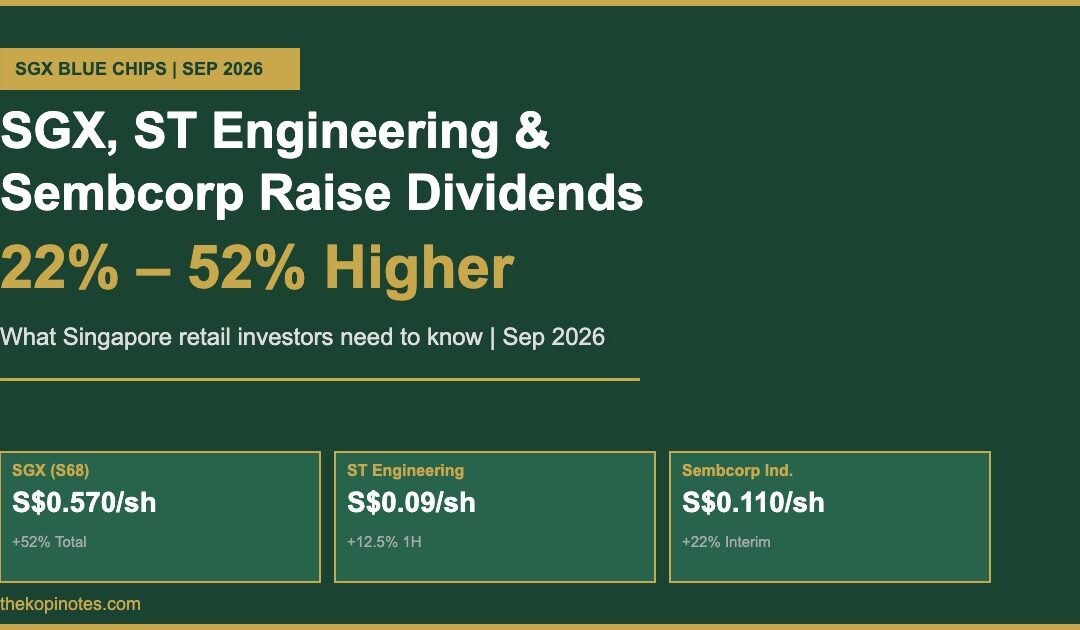
Three of Singapore’s most prominent Temasek-backed blue chips — Singapore Exchange (SGX), ST Engineering and Sembcorp Industries — have raised their dividends by between 12.5% and 52% based on their latest financial results. The moves reflect strong underlying earnings for two of the three, while raising important cash-flow questions about the third. Here is what Singapore retail investors need to know, verified as at 24 September 2026.
This is an editorial analysis. Not financial advice. Data verified as at 24 September 2026.
Three Temasek Blue Chips in Focus
Temasek Holdings, Singapore’s state-owned investment company, has significant stakes in all three businesses: a 23.3% stake in Singapore Exchange (SGX: S68) through SEL Holdings, approximately 51% of ST Engineering (SGX: S63), and roughly 50% of Sembcorp Industries (SGX: U96).
When dividend hikes are announced simultaneously across three major index constituents like these, it tends to generate significant attention among Singapore retail investors — and for good reason. But as with any payout announcement, the critical question is always whether the free cash flow actually supports the raise.
Let’s examine each company in turn.
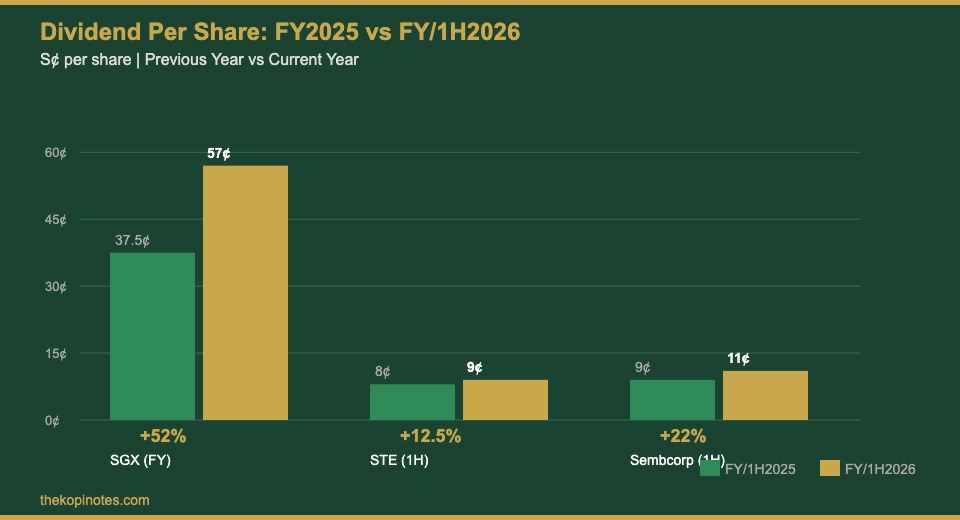
Chart: Dividend per share (S¢) — Previous year vs FY/1H2026. Source: Company filings.
SGX (S68): A Record Year for Singapore’s Exchange
Singapore Exchange reported its results for the full fiscal year ending 30 June 2026 (FY2026), and the headline numbers were impressive. Net revenue climbed 13.9% year on year to more than S$1.5 billion. Adjusted net profit (excluding a S$53.4 million goodwill impairment on Scientific Beta) rose 24.6% to S$759.5 million.
The Equities – Cash division was the standout performer, growing 28.1% to S$502.9 million as daily average traded value for securities reached S$1.8 billion — a 34.9% increase on the prior year. FICC revenue also rose a healthy 17.0% to S$376.2 million, driven by record currency and commodity derivatives volumes.
The total dividend declared for FY2026 is S$0.570 per share, up significantly from S$0.375 in FY2025 — representing a 52% jump in total payout. This breaks down into an ordinary dividend of S$0.445 per share and a one-off special dividend of S$0.125 per share. The special component was funded partly by proceeds from a Trading Technologies investment exit via 7RIDGE Investments.
Importantly, SGX generated S$788.8 million in free cash flow for FY2026 and held S$1.8 billion in cash against S$628.2 million in borrowings — a comfortable net cash position. Management has also guided for quarterly ordinary dividend increases of 0.25 cents per share through FY2028 and medium-term revenue growth of 6% to 8%.
Verdict: Of the three blue chips highlighted here, SGX’s dividend raise looks the most durable, backed by strong free cash flow and a clear multi-year payout commitment.
Investors tracking the broader market context may also want to read our analysis of how Singapore banks are responding to the Q4 2026 rate environment.
ST Engineering (S63): Order Book Powerhouse Raises Quarterly Dividend 25%
ST Engineering bumped up its 2Q2026 interim dividend to S$0.05 per share, a 25% increase from S$0.04 in 2Q2025. Total 1H2026 dividends came to S$0.09 per share, up from S$0.08 — a 12.5% increase. The board has also approved a further S$0.05 interim dividend for 3Q2026.
The earnings backdrop is strong. Revenue rose 11.1% year on year to S$6.6 billion for 1H2026, while net profit grew 27.1% to S$512.1 million — with earnings growth outpacing revenue across all three operating segments. Free cash flow improved to S$591.6 million, up from S$484.6 million a year earlier. Net finance costs also fell 14.9%, a reflection of disciplined debt management.
By segment: Commercial Aerospace revenue jumped 15% year on year, supported by higher engine MRO, nacelles and spares sales. Urban Solutions & Satcom saw operating profit rise fourfold as rail and tolling project deliveries accelerated. Defence revenue held steady, anchored by long-term government contracts.
Perhaps most significantly, ST Engineering’s order book hit a record S$35.7 billion, with roughly S$5.7 billion expected to be delivered over the remainder of 2026. That kind of revenue visibility matters: it provides a solid foundation for continued dividend payments even if near-term market conditions turn choppy.
Verdict: ST Engineering’s dividend raise is well-supported by earnings growth, strong free cash flow, and multi-year contracted revenue. The order book is the key metric to watch.
If you’re assessing dividend-paying equities in a rising rate environment, see our guide on investing in Singapore during a rate hike cycle.
Sembcorp Industries (U96): Ambitious Growth, But Watch the Cash Flow
Sembcorp raised its interim dividend by 22% year on year to S$0.11 per share, up from S$0.09. At first glance, this looks like strong management confidence. But the underlying numbers require more careful scrutiny.
Revenue rose 28% to S$3.8 billion for 1H2026, partly because these results included one month of contribution from Alinta Energy, which Sembcorp acquired on 1 June 2026 for S$5.1 billion. Net profit, however, fell 72% year on year to S$150 million — largely due to S$155 million in Alinta transaction costs and the absence of prior-year divestment gains. Stripping out one-offs, underlying net profit still declined 25% to S$369 million.
The cash flow picture raises additional questions. Free cash flow turned negative at -S$39 million, compared with a positive S$241 million in the same period a year ago. Total borrowings climbed from S$9.0 billion at end-2025 to S$15.2 billion following the Alinta acquisition. The group held S$1.3 billion in cash as of 30 June 2026.
Management has flagged several drivers for a stronger 2H2026: a new 600 MW hydrogen-ready power plant coming online in Singapore, and a full six months of Alinta contributions (vs one month in 1H). Renewable output was also hampered in 1H by weaker wind and solar resources in China and India — factors that management expects to normalise.
Verdict: While Sembcorp’s long-term renewable energy thesis remains intact, the dividend raise outpaces what free cash flow currently supports. Investors should treat this as a signal of management confidence in the Alinta integration rather than confirmation that the payout is already fully covered.
To understand how S-REITs and infrastructure stocks are navigating the current capital cycle, see our coverage of S-REIT equity fundraising in 2026.
Side-by-Side Comparison: The Key Numbers
| Metric | SGX (S68) | ST Engineering (S63) | Sembcorp (U96) |
|---|---|---|---|
| Reporting Period | FY2026 (Jul–Jun) | 1H2026 (Jan–Jun) | 1H2026 (Jan–Jun) |
| Revenue Growth | +13.9% to S$1.5B | +11.1% to S$6.6B | +28.0% to S$3.8B |
| Net Profit Growth | +24.6%* to S$760M | +27.1% to S$512M | −72.0%** to S$150M |
| Free Cash Flow | S$789M | S$592M | −S$39M |
| Dividend per Share | S$0.570 (FY) | S$0.09 (1H) | S$0.11 (1H interim) |
| Dividend Increase | +52% (total) | +12.5% | +22% |
| FCF Covers Dividend? | ✓ Yes | ✓ Yes | ⚠ Not yet |
| Order Book / Backlog | — | S$35.7B (record) | Alinta integration ongoing |
* Adjusted, excl. S$53.4M goodwill impairment. ** Includes S$155M one-off Alinta acquisition costs.
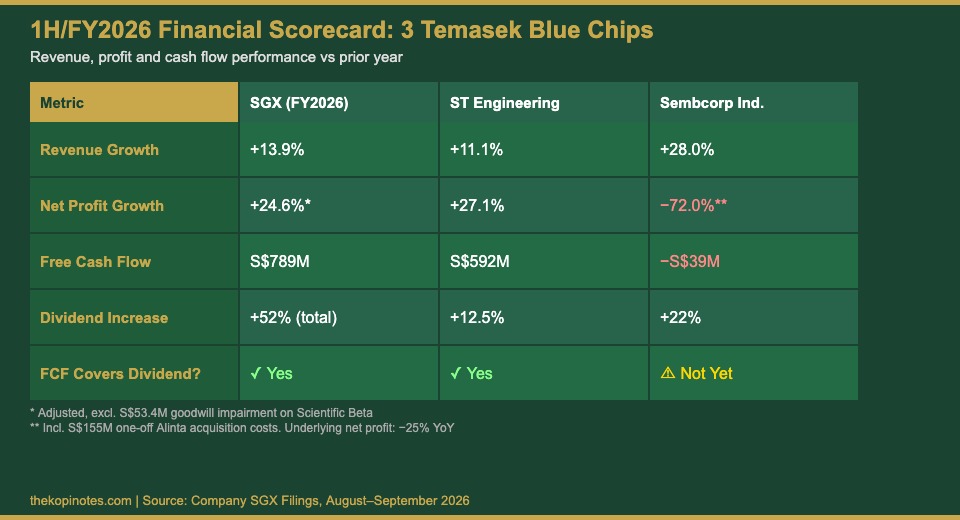
Chart: Side-by-side financial scorecard across the three Temasek blue chips. Source: Company filings, Aug–Sep 2026.
What This Means for Singapore Retail Investors
For dividend investors on SGX, these announcements carry several implications.
Income visibility matters. SGX and ST Engineering have both demonstrated that their dividend raises are supported by strong free cash flow and recurring earnings. For income-focused portfolios, these are the kinds of characteristics that justify paying attention to payout sustainability — not just the headline percentage increase.
Big acquisitions create short-term noise. Sembcorp’s case is a classic example of what happens when a transformative acquisition — Alinta at S$5.1 billion — temporarily depresses earnings and cash flow. Management’s confidence in raising the dividend may prove well-founded if Alinta integrates smoothly and contributes meaningfully from 2H2026 onward. But until free cash flow turns positive again, dividend coverage remains an open question.
Context: the broader rate environment. The September 2026 FOMC rate hike and MAS’s twin tightening moves in April and July 2026 have made the cost of capital environment more challenging for leveraged companies. Sembcorp’s S$15.2 billion total borrowings post-Alinta will be more costly to service in this environment — a factor income investors should weigh carefully.
CPF and T-bill context. With CPF SMRA rates locked at 4% through end-2027 and T-bill yields still elevated post-FOMC, Singapore retail investors have more risk-free options than at any point in recent years. Blue chip equities still offer growth potential that fixed-income instruments cannot, but the bar for justifying equity risk has risen.
The Free Cash Flow Test Every Dividend Investor Must Apply
A dividend raise is always welcome news for income investors. But as the Sembcorp example illustrates, the key question is not whether a company can declare a higher dividend — it is whether the business generates sufficient free cash flow to actually sustain it.
The calculation is straightforward. Take total dividends paid out and compare them to free cash flow generated. If free cash flow comfortably exceeds dividend payments, the payout is built on a solid foundation. If free cash flow is negative — as is currently the case at Sembcorp — the company is effectively borrowing to pay dividends, at least in the short term.
SGX generated S$789 million in free cash flow while paying out roughly S$859 million in total dividends for FY2026 (including the special payout). That’s very close to coverage, and management has indicated the special dividend was a one-off. Ordinary dividends going forward should be more comfortably covered.
ST Engineering’s S$592 million in FCF against 1H dividend payments makes coverage even clearer on a run-rate basis.
For Sembcorp, the key catalyst to watch in coming quarters is whether Alinta begins contributing meaningful operating cash flows — and whether renewable generation recovers in China and India. If so, the dividend raise may look prescient. If integration drags on, dividend coverage could become a concern.
Bottom Line for SG Investors
SGX and ST Engineering have raised their dividends on the back of genuine earnings growth and robust free cash flow. Both raises look durable. SGX in particular has provided multi-year dividend guidance that gives investors unusual visibility.
Sembcorp’s 22% dividend hike reflects management’s long-term confidence in the Alinta acquisition and the company’s renewable energy pivot. But the short-term cash flow picture requires monitoring. Investors considering Sembcorp for an income portfolio should apply a higher margin of safety and revisit the stock when 2H2026 results are published.
For Singapore retail investors building a dividend income portfolio, the broader message is clear: follow the cash flow, not just the headline payout number. A higher dividend is only as reliable as the business generating the cash behind it.
Frequently Asked Questions
Which Temasek blue chip raised its dividend the most in 2026?
SGX raised its total FY2026 dividend by 52% to S$0.570 per share, which includes an ordinary dividend of S$0.445 and a one-off special dividend of S$0.125. In terms of ordinary dividend growth, SGX guided for ongoing quarterly increases of 0.25 cents per share through FY2028.
Is Sembcorp Industries’ dividend safe?
Sembcorp raised its interim dividend by 22% to S$0.11 per share, but its free cash flow turned negative in 1H2026 (−S$39M) due to the S$5.1 billion Alinta acquisition. The dividend is not immediately at risk, but it is not yet fully covered by operating cash flow. Management expects a stronger 2H2026 performance as Alinta contributes for the full six months.
What is ST Engineering’s record order book worth?
ST Engineering’s order book hit a record S$35.7 billion as of 1H2026, with approximately S$5.7 billion scheduled for delivery in the second half of 2026 alone. This provides multi-year revenue visibility and underpins the group’s continued dividend-raising capacity.
Does SGX’s special dividend affect the recurring yield?
Yes. Of SGX’s S$0.570 total FY2026 dividend, S$0.125 was a one-off special dividend linked to an investment exit. Investors calculating recurring yield should use the ordinary dividend of S$0.445 per share. Management has guided for quarterly increases to the ordinary dividend through FY2028, which provides a clearer picture of the base yield going forward.
How does Temasek’s ownership affect these dividend decisions?
Temasek’s large stakes in all three companies (23.3% in SGX, ~51% in ST Engineering, ~50% in Sembcorp) mean it is a major beneficiary of every dividend raise. While this doesn’t guarantee dividend increases, Temasek’s ownership generally provides strategic stability and long-term orientation — characteristics that tend to support consistent dividend policies.
Should I buy SGX, ST Engineering or Sembcorp for dividend income?
This article is not financial advice. That said, from a free-cash-flow perspective, both SGX and ST Engineering have demonstrated stronger dividend coverage in their latest results than Sembcorp. Investors should assess each company’s earnings trajectory, payout ratio, and their own risk tolerance before making any investment decision. Consider consulting a licensed financial adviser.
This article was researched with the help of AI. While we strive to keep all information accurate and up to date, there may be errors. If you notice any discrepancies, please contact us.