Floating Rate Bond ETFs Singapore: How to Profit From the Fed Rate Hike (2026 Guide)
A practical guide for Singapore investors on floating rate bond ETFs, how they work after the September 2026 Fed rate hike, and how to buy the LSE-listed version tax-efficiently.
Floating rate bond ETFs hold bonds whose coupons reset every 30 to 90 days off short-term interest rates, so your income rises when the Fed hikes instead of falling like a normal bond fund. Singapore investors can access them through iShares $ Floating Rate Bond UCITS ETF (FLOT) on the London Stock Exchange, an Ireland-domiciled fund that avoids the 30% US dividend withholding tax and US estate tax exposure that US-listed alternatives like FLOT (US), TFLO and USFR carry.
Not financial advice. All figures are for educational reference only. Data as at September 2026 unless noted.
- The Fed hiked rates in September 2026 for the first time since 2023. Floating rate bond ETFs reset their coupons up automatically, so they gain from this instead of losing value like ordinary bonds.
- The LSE-listed FLOT (Ireland-domiciled, TER 0.10%) is the tax-efficient pick for Singapore investors — no US estate tax, lower withholding tax than the US-listed version.
- Use floating rate ETFs as a parking spot for cash you might otherwise leave in a low-yield savings account, not as your core bond allocation.
Table of Contents
Contents — Click to expand
- What Is a Floating Rate Bond ETF?
- Why Floating Rate ETFs Matter After the September 2026 Fed Hike
- FLOT, TFLO, USFR and FLRN Compared
- Why Singapore Investors Should Use the LSE-Listed FLOT
- How to Buy FLOT in Singapore (Step-by-Step)
- Who Should Buy Floating Rate Bond ETFs?
- Risks and Limitations
- Frequently Asked Questions
What Is a Floating Rate Bond ETF?
A floating rate bond, also called a floating rate note (FRN), pays a coupon that resets on a schedule, usually every 30 to 90 days, based on a short-term reference rate. Older FRNs used LIBOR; most new US Treasury and corporate FRNs now reset off the 13-week Treasury bill auction or SOFR (Secured Overnight Financing Rate).
This matters because a normal fixed-rate bond loses value when interest rates rise. Its coupon is locked in at the old, lower rate, so the bond has to trade down in price to offer a competitive yield. A floating rate bond does not have this problem. Its coupon moves up automatically, so the bond price barely moves even when the Fed hikes.
A floating rate bond ETF simply holds a basket of these notes, usually issued by the US Treasury or investment-grade corporates like banks and supranationals, and passes the reset coupon income to you as distributions, typically monthly.
Why Floating Rate ETFs Matter After the September 2026 Fed Hike
The Fed raised its policy rate in September 2026, its first hike since 2023, after inflation proved stickier than expected. For a Singapore investor, this changes the calculus for anything bond-related.
Long-duration bond funds tend to fall in this environment because their fixed coupons look less attractive next to the new, higher rate on cash and short-term instruments. Floating rate ETFs sidestep that. The WisdomTree Floating Rate Treasury Fund (USFR), for example, has seen its monthly distribution climb from roughly USD 0.145 per share in February 2026 to about USD 0.160 in August 2026 as its underlying Treasury bill resets tracked the rising rate environment in real time.
That is the core appeal. Rather than trying to time when the Fed stops hiking, you hold an instrument that adjusts with the market. If you were planning to sit in cash while the tightening cycle plays out, a floating rate ETF gives you a similar risk profile with a better yield than most bank savings rates.
FLOT, TFLO, USFR and FLRN Compared
There are four floating rate ETFs a Singapore investor is likely to come across. Three are US Treasury or investment-grade corporate funds listed in the US. One, FLOT, also has an Ireland-domiciled version listed on the London Stock Exchange.
| ETF | Underlying | Domicile / Exchange | TER | AUM |
|---|---|---|---|---|
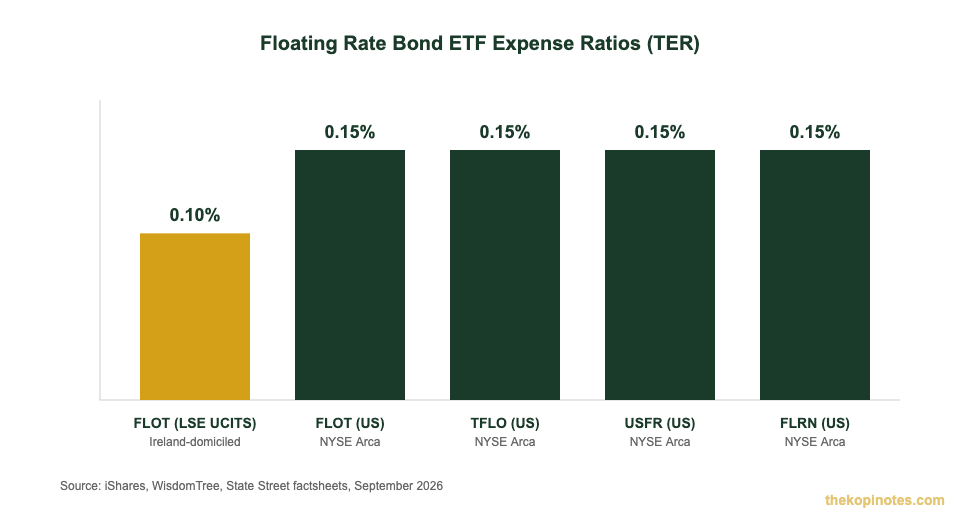
| FLOT (LSE) | USD investment-grade FRNs | Ireland / LSE | 0.10% | USD 523m |
| FLOT (US) | USD investment-grade FRNs | USA / NYSE Arca | 0.15% | USD 9.5bn |
| TFLO | US Treasury FRNs | USA / NYSE Arca | 0.15% | USD 6.7bn |
| USFR | US Treasury FRNs | USA / NYSE Arca | 0.15% | USD 18.8bn |
| FLRN | USD investment-grade FRNs | USA / NYSE Arca | 0.15% | USD 2.8bn |
Source: iShares FLOT factsheet, WisdomTree USFR factsheet, September 2026
FLOT and FLRN hold investment-grade corporate floating rate notes, which pick up a small credit spread over Treasuries. TFLO and USFR hold only US Treasury FRNs, so they carry effectively no credit risk beyond the US government itself. For most Singapore investors parking cash defensively, the Treasury versions are the simpler, lower-risk choice, but only FLOT has a Singapore-friendly LSE listing.
Why Singapore Investors Should Use the LSE-Listed FLOT
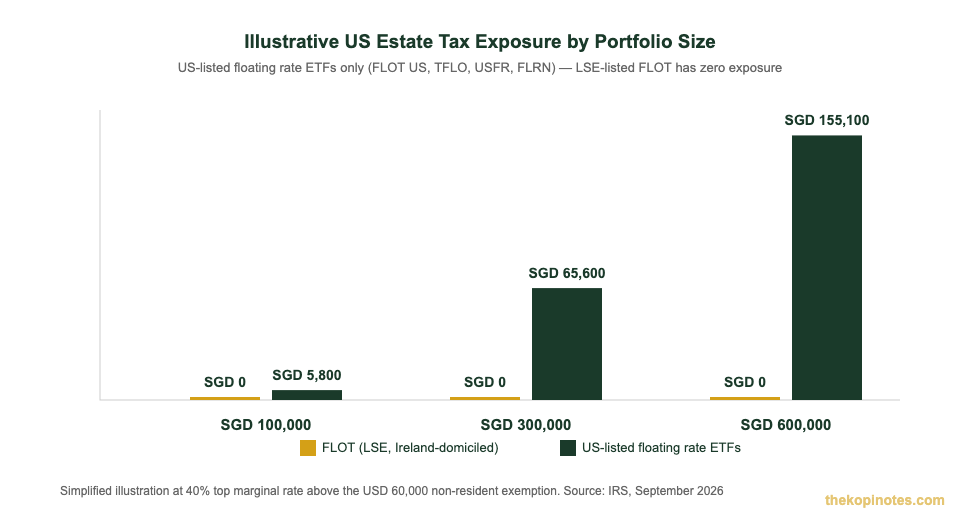
This is the part most floating rate ETF articles skip, and it is the single biggest cost for a Singapore investor. The US-listed versions of these funds, FLOT (US), TFLO, USFR and FLRN, are US-situs assets. If you hold them and pass away while still holding US assets above USD 60,000, your estate can be liable for US estate tax at rates of up to 40% on the amount above that exemption. There is no such exposure with an Ireland-domiciled UCITS ETF like the LSE-listed FLOT.
The withholding tax picture also favours the LSE version. Interest income from US Treasury and Treasury-adjacent instruments is generally exempt from US withholding tax for foreign holders under the IRS portfolio interest exemption, so this gap is smaller for pure FRN funds than it is for equity ETFs like CSPX versus VOO. Even so, the Ireland-domiciled structure of FLOT (LSE) benefits from a lower headline TER (0.10% versus 0.15% for FLOT US) and removes the estate tax question entirely, which is the more expensive risk for a Singapore investor with a meaningful position.
| ETF | Domicile | TER | US Estate Tax Risk |
|---|---|---|---|
| FLOT (LSE) | Ireland | 0.10% | None |
| FLOT / TFLO / USFR / FLRN (US) | USA | 0.15% | Yes (above USD 60k) |
For a Singapore investor holding SGD 300,000 in a US-listed floating rate ETF, the illustrative estate tax exposure at the top 40% marginal rate on the amount above the USD 60,000 exemption works out to roughly SGD 65,600. That is not a small number, and it exists purely because of where the fund is domiciled, not because of anything you did wrong with the investment itself.
How to Buy FLOT in Singapore (Step-by-Step)
Buying the LSE-listed FLOT works the same way as buying any other LSE UCITS ETF such as CSPX or VWRA. Here is how to do it through the main brokers Singapore investors use.
Interactive Brokers (IBKR)
Fund your account, then search for FLOT and make sure you select the London Stock Exchange listing with ISIN IE00BZ048462, not the US-listed FLOT with a different ISIN. Place a limit order in USD. IBKR is the most cost-effective option for larger positions because of its low per-trade commission and tight FX spread.
Saxo Markets
Saxo lists FLOT under its LSE-listed ETF universe. Search by ISIN to avoid confusion with the US-listed ticker of the same name, and confirm the currency of your order before submitting.
MooMoo Singapore
MooMoo’s LSE access has expanded over 2026. Check under UK-listed ETFs in the app, again verifying by ISIN. Commissions here are competitive for smaller, more frequent purchases.
Syfe Brokerage
Syfe offers a simpler flat-fee structure that suits investors making one or two purchases per month rather than active traders. Use the Syfe referral code and sign-up bonus if you are opening a new account.
Whichever broker you use, always double-check the ISIN before you place an order. FLOT exists as both a US-listed ticker and an LSE-listed ticker, and mixing them up defeats the entire tax-efficiency argument for choosing the LSE version.
Who Should Buy Floating Rate Bond ETFs?
Floating rate bond ETFs are ideal if you want a place to park cash that would otherwise sit in a low-yield savings account, you are worried about further Fed hikes hurting a fixed-rate bond allocation, or you want short-duration exposure without the reinvestment hassle of rolling Singapore T-bills every few months.
Consider alternatives if you are investing for a long-term retirement horizon, where broad equity ETFs like VWRA historically deliver stronger real returns over 10 to 20 years, or if you want the full capital guarantee of a Singapore Savings Bond, which floating rate ETFs, as market-traded funds, do not offer. These ETFs also sit outside CPF and SRS schemes when bought on the LSE, so they are best used with cash you have already set aside for investing, not funds you are managing as part of your CPF investment strategy.
Risks and Limitations
Floating rate bond ETFs are not risk-free. If the Fed starts cutting rates again, the coupon on these funds resets down just as quickly as it reset up, so the yield advantage can disappear within a few months. They also carry currency risk for a Singapore investor, since returns are in USD and will move with the SGD/USD exchange rate regardless of what the underlying bonds do. Corporate-note versions like FLOT and FLRN carry a small amount of credit risk that Treasury-only funds like TFLO and USFR do not. None of these funds are principal-guaranteed the way a bank fixed deposit or a Singapore Savings Bond is.
Disclaimer: This article is for educational purposes only and does not constitute financial advice. The Kopi Notes is not a licensed financial advisor. All figures are illustrative and accurate as at September 2026 unless otherwise stated. Consult a licensed advisor before making investment decisions.
Frequently Asked Questions
What is a floating rate bond ETF and why do Singapore investors buy it?
A floating rate bond ETF holds bonds whose coupons reset every 30 to 90 days against a short-term reference rate, so the income adjusts as interest rates move. Singapore investors buy them to park cash defensively while earning more than a typical savings account, especially during a Fed hiking cycle like September 2026.
Is the LSE-listed FLOT the same fund as the US-listed FLOT?
No. They share a ticker but are different funds with different ISINs. The LSE-listed FLOT (ISIN IE00BZ048462) is Ireland-domiciled with a 0.10% TER and no US estate tax exposure. The US-listed FLOT is domiciled in the US, has a 0.15% TER, and carries US estate tax risk for non-resident holders above USD 60,000.
Can I buy FLOT using my CPF or SRS funds?
FLOT bought on the London Stock Exchange is not on the CPF Investment Scheme list of approved instruments. It may be accessible through SRS funds depending on your broker’s SRS-linked trading arrangements, so check with your specific broker before assuming SRS compatibility.
Which broker is best for buying FLOT in Singapore?
Interactive Brokers tends to be the most cost-effective for larger positions due to low commissions and tight FX spreads. Syfe Brokerage offers a simpler flat-fee structure better suited to smaller, less frequent purchases. Always verify you are buying the LSE-listed ISIN, not the US-listed one, regardless of broker.
What happens to floating rate ETFs if the Fed starts cutting rates?
Their coupons reset down along with short-term rates, so the yield advantage shrinks or disappears within a few reset cycles, typically one to three months. Unlike a fixed-rate bond fund, you will not see the same capital appreciation that longer-duration bonds get when rates fall, since floating rate notes are priced close to par throughout.
Are floating rate bond ETFs safer than Singapore T-bills?
They serve a similar defensive purpose but are not directly comparable. Singapore T-bills are backed by the Singapore government and settle in SGD with no currency risk. Treasury floating rate ETFs like TFLO and USFR are backed by the US government but expose you to SGD/USD currency movements and are traded on an exchange rather than held to maturity.
Ready to Start Investing in ETFs?
Open a brokerage account and buy your first ETF today. Use our referral links for exclusive sign-up bonuses.
This article was researched with the help of AI. While we strive to keep all information accurate and up to date, there may be errors. If you notice any discrepancies, please contact us.