181,800 Singaporeans Cancelled Their ISP Rider in 2025 — Should You?
A plain-English decision guide for Singapore policyholders (2026)
According to MOH data released in September 2026, 181,800 policyholders cancelled or downgraded their Integrated Shield Plan (ISP) rider in 2025 — a 76% jump from 103,400 in 2024. The main trigger: new April 2026 rules that stop ISP riders from covering your deductible. Riders got cheaper (about 30% lower premiums), but they now leave more of the bill in your hands. So should you cancel too? It depends on your age, health, and how much hospital risk you can absorb.
Not financial advice. All figures are for educational reference only. Data verified as at 19 September 2026 unless noted.
- 181,800 people cancelled their ISP rider in 2025 — mostly because of rising premiums and the April 2026 rule changes.
- New 2026 riders are 30% cheaper but leave the deductible ($1,500–$3,500 for private wards) in your hands.
- Whether to cancel depends on your age, MediSave balance, and how often you’re hospitalised — see the decision framework below.
Why 181,800 Singaporeans Cancelled Their Rider
Two things drove the mass rider cancellations in 2025.
First: premiums were getting painful. Across a three-year period from 2021 to 2024, private hospital ISP rider premiums rose at an average of 17.2% per year. If you’re 50, that means your rider cost might have doubled in four years — without your coverage changing at all.
Second: in November 2025, MOH announced a major rule change. From 1 April 2026, any new ISP rider can no longer cover the minimum deductible. That announcement triggered a wave of cancellations — people decided to drop the old rider before it lapsed, rather than wait to see if the new, cheaper riders were worth it.
According to TKN’s breakdown of the MOH downgrade statistics, the 181,800 rider cancellations in 2025 represent a 76% jump from the 103,400 who cancelled in 2024. That’s a huge shift in a single year.
Were they right to cancel? The answer depends on what they replaced it with — and what their actual hospital risk is.
What the April 2026 ISP Rider Changes Actually Mean
Here’s what changed from 1 April 2026:
- New ISP riders can no longer cover the minimum deductible MOH sets for your ward type.
- The annual co-payment cap has been raised from $3,000 to $6,000.
- In return, new rider premiums dropped by approximately 30% on average.
- Some insurers (like Singlife) cut premiums even more aggressively — up to 84% for certain plans.
Your existing rider is not affected — you can keep it. But if you cancel and want to buy a new rider, you’ll be on the new terms.
To understand what the $6,000 co-pay cap means in practice, read our full guide on ISP co-payment rules and the new $6,000 cap.
Your Hospital Bill Without an ISP Rider
If you cancel your ISP rider and only keep the base ISP (or just MediShield Life), here’s what your hospital bill looks like.
The bill split works in layers. For a full walkthrough, see our guide on how MediShield Life, your ISP, and you each pay your hospital bill.
| Scenario | $5K Bill | $15K Bill | $30K Bill | $50K Bill |
|---|---|---|---|---|
| No rider (MediShield Life only) | ~$3,800 | ~$4,500 | ~$5,800 | ~$7,000 |
| With old ISP rider (max coverage) | $0 | $0 | $0 | $0 |
| With new 2026 ISP rider | ~$3,500 | ~$3,500 | ~$3,600 | ~$4,000 |
Source: MOH, insurer product summaries. Estimates for private hospital Class A ward (non-MediSave deductible). Actual amounts vary by insurer and ward class. For illustration only.
The key insight from this table: even with a new rider, you still pay the deductible (roughly $3,500 for a private ward). The rider’s job now is to cap your total co-payment at $6,000 — not to eliminate it.
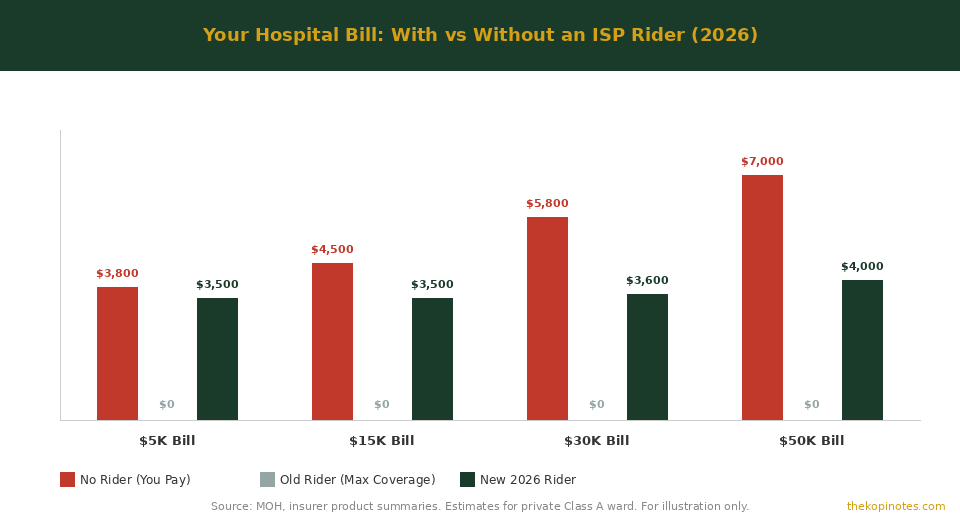
Out-of-pocket hospital costs with and without an ISP rider (2026). Source: MOH, insurer product summaries. For illustration only.
New 2026 Riders vs Old Riders: Side-by-Side
Here’s how the old and new riders compare on the features that matter most:
| Feature | Old Rider (Legacy) | New 2026 Rider |
|---|---|---|
| Deductible covered? | ✅ Yes (fully) | ❌ No |
| Co-payment cap | $3,000/year | $6,000/year |
| Annual premium (age 40, est.) | ~$1,800/year | ~$1,260/year |
| Premium trend | Rising fast (+17% avg/year) | Stable (lower base) |
| Can you still buy old rider? | No (discontinued Apr 2026) | New riders only |
Source: MOH, insurer product summaries. Premiums are indicative for private Class A ward, Singapore Citizen. Data as at September 2026.
The trade-off is clear. Old riders cost more but covered everything. New riders are cheaper, but you carry more of the hospital bill yourself — specifically the deductible every year you’re admitted.
For insurer-specific comparisons, see our reviews of PRUShield 2026, NTUC Enhanced IncomeShield, and Singlife Shield Plan.
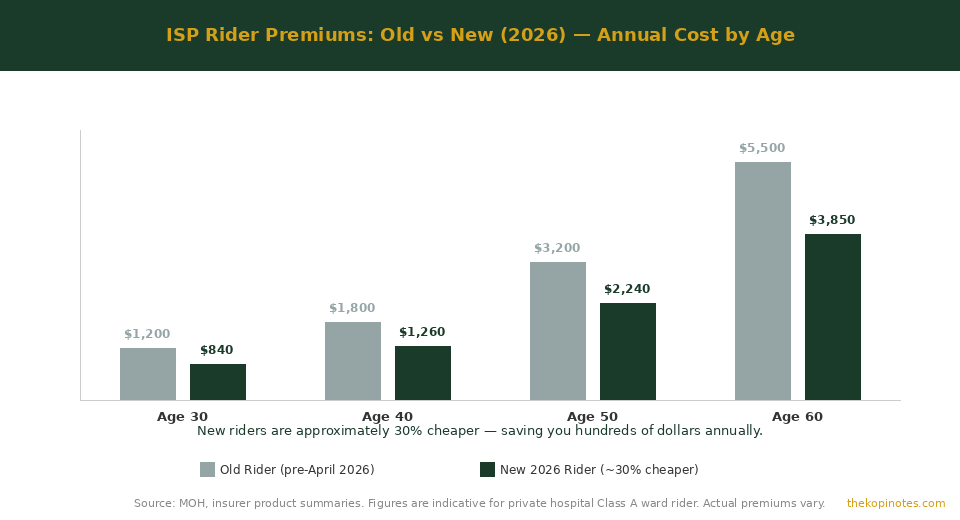
ISP rider premiums: old vs new 2026, by age group. New riders average ~30% cheaper. Source: MOH, insurer estimates. For illustration only.
How MediSave Fits Into the Picture
Here’s something many people miss: the deductible and co-payment you owe — whether you have a new rider or no rider — can be paid from your MediSave account. You don’t have to pay cash.
This matters because MediSave earns a guaranteed 4% interest per year. If you have a healthy MediSave balance, you can self-insure part of your hospital bill cost. That changes the maths on whether you need a rider at all.
However, there’s a catch. MediSave can only be used up to approved limits. And MediShield Life premiums are paid from MediSave automatically. So you need to balance: using MediSave for premiums vs keeping a buffer for potential hospital bills.
The practical impact for ISP decisions:
- If you drop your rider: You pay the deductible ($1,500–$3,500 for private ward) and co-insurance from MediSave or cash when hospitalised.
- If you keep or buy a new rider: Your rider premium is paid from MediSave (within the Additional Withdrawal Limit). Your out-of-pocket is capped at the deductible + up to $6,000 co-pay.
- If you downgrade to a B1 or B2 ISP ward tier: Lower deductibles and lower premiums — a middle path if the private hospital costs feel too high.
For a full walkthrough of what MediShield Life covers as your base layer, see our guide to MediShield Life benefits in Singapore (2026).
Should YOU Cancel? A Decision Framework
Here’s a simple way to think through whether you should cancel, keep, or switch your ISP rider.
Step 1: Check your current rider type.
If you have an old legacy rider (bought before April 2026), you can keep it for now. Ask yourself: am I paying over $2,000 per year for it? If yes, jump to step 2.
Step 2: Estimate your hospitalisation frequency.
If you’ve been hospitalised 0 times in the past 5 years and are under 45, your risk is relatively low. If you have a chronic condition, are over 60, or have a family history of serious illness, your risk is higher.
Step 3: Check your MediSave balance.
If you have $30,000+ in MediSave, you can absorb a $3,500 deductible without panic. If your MediSave is close to empty (common if you’ve been drawing it for premiums), losing your rider exposes you more.
Step 4: Apply this rule of thumb:
- Keep an old legacy rider if you’re 55+, have a chronic condition, or your MediSave is low. The extra coverage is worth the higher premium.
- Switch to a new 2026 rider if you’re 30–54, generally healthy, and want lower premiums with some backstop protection against large bills.
- Cancel the rider entirely only if you’re young (under 40), have strong MediSave savings, and are comfortable with B1/B2 ward class coverage (lower deductibles).
- Downgrade your ISP ward tier (from private to B1) as a middle path — lower premiums, lower deductibles, still meaningfully better than MediShield Life alone.
For a deeper dive on whether downgrading your plan (not just the rider) makes sense, read our guide: should you downgrade your Integrated Shield Plan rider in 2026?
Frequently Asked Questions
How many Singaporeans cancelled their ISP rider in 2025?
What changed for ISP riders in April 2026?
If I cancel my ISP rider, what do I pay for a hospital bill?
Can I use MediSave to pay the deductible if I have no rider?
Should I switch from my old rider to a new 2026 rider?
What happens if I cancel my rider but then get sick?
This article is for general educational purposes only and does not constitute financial, medical, or insurance advice. Premium figures, deductible amounts, and co-payment estimates are illustrative and may differ from your actual plan. Always refer to your insurer’s policy documents and consult a MAS-licensed financial adviser before making any changes to your insurance coverage. Data as at 19 September 2026.
Get Free Insurance Advice
Speak with a licensed insurance advisor. No obligation, no cost.
By submitting this form, you agree to our Privacy Policy.
This article was researched with the help of AI. While we strive to keep all information accurate and up to date, there may be errors. If you notice any discrepancies, please contact us.