CapitaLand Ascendas REIT (A17U): Share Price Impact After the Sep 2026 Fed Rate Hike
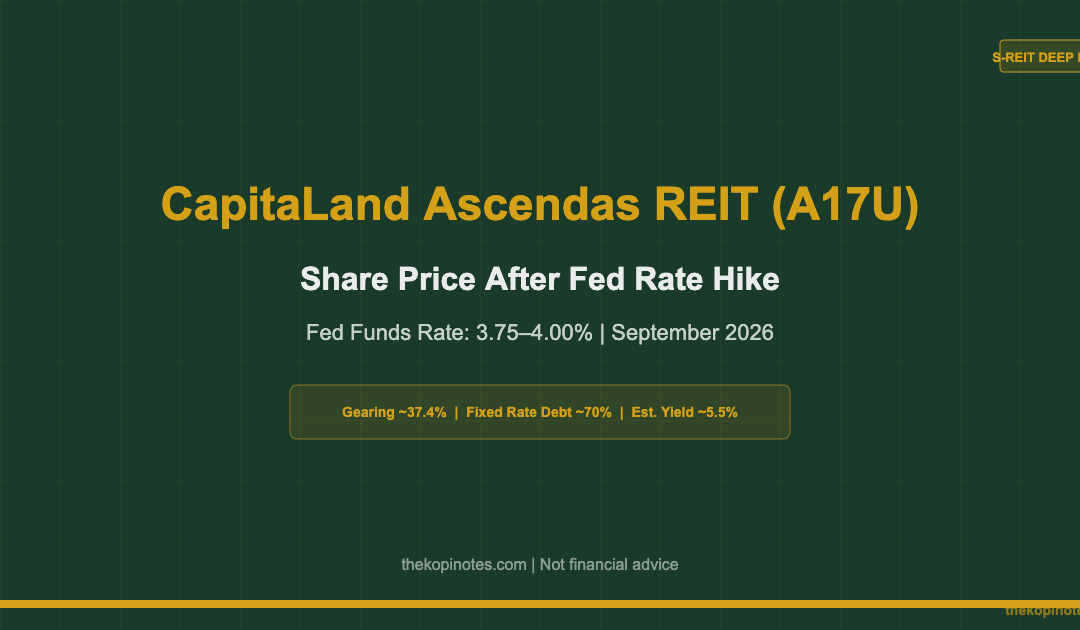
What the Fed’s move to 3.75–4.00% means for CLAR’s DPU and your portfolioCapitaLand Ascendas REIT (SGX: A17U) is Singapore’s largest industrial REIT, owning over 220 properties across Singapore, Australia, the US, and the UK. When the Federal Reserve hiked rates by 25 basis points on 17 September 2026 — pushing the Fed funds rate to 3.75–4.00% — CLAR felt the pressure alongside all high-gearing S-REITs. Here’s what it means for share price, DPU, and whether now is a buy.
Not financial advice. All figures are for educational reference only. Data as at September 2026 unless noted.
- The Fed’s Sep 2026 hike to 3.75–4.00% raises CLAR’s borrowing cost when debt matures — but ~70% of its debt is fixed-rate, capping near-term DPU damage.
- CLAR’s data centre portfolio (~11% of AUM) provides long-WALE, inflation-linked leases that partially offset rate headwinds.
- At current gearing of ~37%, CLAR has limited headroom — but remains well within MAS’s 50% cap.
What Happened at the Sep 2026 FOMC?
On 17 September 2026, the Federal Open Market Committee voted to raise the Fed funds rate by 25 basis points — from 3.50–3.75% to 3.75–4.00%. This marks the Fed’s first rate hike in over a year, reversing the brief easing cycle that began in late 2025.
The decision surprised some market participants who had priced in a hold. Fed Chair guidance cited persistent services inflation and a still-tight US labour market as the drivers. For Singapore REIT investors, the implications are direct: higher US rates push up global borrowing costs, increase CLAR’s refinancing burden, and typically weigh on REIT valuations via a higher risk-free rate benchmark.
You can read the full macro breakdown in our passive income Singapore guide for 2026, which covers how rate environments affect dividend-paying assets. The key point: when rates rise, fixed-income alternatives like Singapore Savings Bonds become more attractive relative to REITs, compressing valuation multiples.
CLAR Fundamentals: Gearing, Debt Profile, DPU Sensitivity
CapitaLand Ascendas REIT enters this rate cycle with gearing of approximately 37.4% — comfortably below the MAS 50% cap, but elevated versus some industrial peers. The REIT has ~S$7.5 billion in total debt, with roughly 70% on fixed-rate terms. That fixed-rate buffer limits immediate DPU damage, but maturing tranches will need refinancing at higher rates over the next 12–24 months.
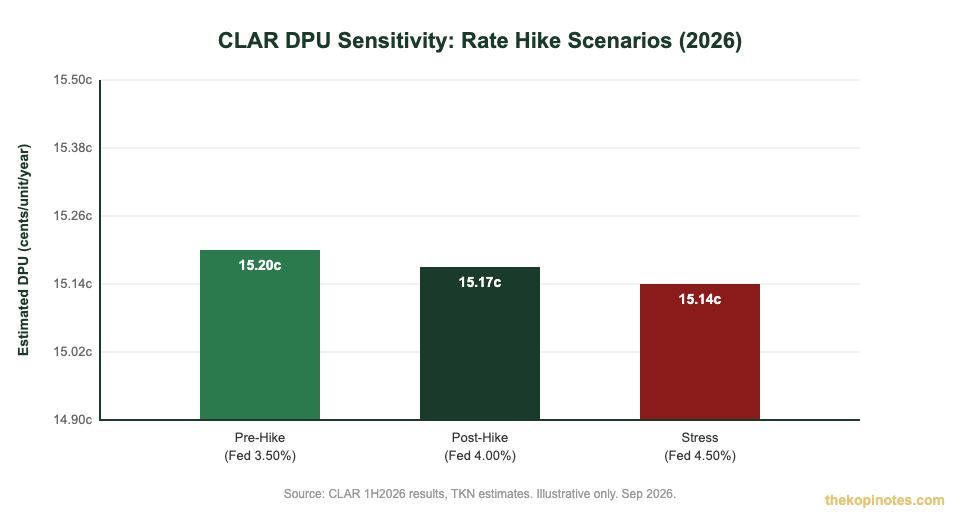
CLAR’s weighted average cost of debt was approximately 3.65% as of the 1H2026 results. Each 25bp rise in refinancing rates on its floating-rate tranche (~S$2.25B) reduces net property income by roughly S$5–6 million per year — translating to approximately 0.02–0.03 cents DPU per half-year, or about 0.1% of annualised DPU.
Here is the DPU sensitivity across different refinancing rate scenarios for CLAR’s floating-rate debt:
| Scenario | Floating Rate Assumed | Est. Annual Interest Cost (S$M) | Est. DPU Impact (cents/unit) |
|---|---|---|---|
| Pre-hike (Fed 3.50%) | ~4.0% | ~90 | Baseline |
| Post-hike Sep 2026 (Fed 4.00%) | ~4.25% | ~96 | –0.02 to –0.03 |
| Stress scenario (Fed 4.50%) | ~4.75% | ~107 | –0.05 to –0.06 |
| Base case FY2026 DPU | — | — | ~15.2 cents |
Source: CLAR 1H2026 results, TKN estimates. Figures are illustrative and not guaranteed.
The bottom line: a 25bp hike shaves a small amount off CLAR’s DPU via the floating-rate tranche. The bigger risk comes if the Fed hikes again in November 2026 — and if CLAR needs to refinance significant fixed-rate tranches at maturity in 2027.
Data Centres: CLAR’s Buffer Against Rate Hikes
About 11% of CLAR’s portfolio by AUM sits in data centres — primarily in Singapore and the US. This segment is important to understand when stress-testing CLAR under a rate-hike scenario.
Data centre leases are typically long-term (10–20 year terms) with built-in annual escalations of 2–3%. This means:
- Stable, predictable income that doesn’t reset with market rents
- Built-in inflation protection (the escalations often track CPI or fixed rates)
- A hedge against the revenue volatility you might see in shorter-WALE office or logistics leases
With AI infrastructure demand driving data centre occupancy to record highs, CLAR’s data centre tenants — hyperscalers and co-location providers — show very low default risk. This part of the portfolio actually benefits from the same macro environment (AI capex boom) that is partly driving the Fed to keep rates higher.
By contrast, CLAR’s Singapore business park and suburban office segment (~28% of AUM) faces softer leasing demand. If refinancing costs push up management expenses while office income stagnates, the net property income (NPI) margin could compress in 2027. That is the risk to watch, not the data centre segment.
For more context on how S-REITs are navigating 2026, see our guide to the best S-REITs in Singapore 2026 — it ranks CLAR alongside peers by yield, gearing, and portfolio quality.
Share Price Reaction and Peer Comparison
CLAR’s A17U units typically trade at a distribution yield of 5.2–5.8%. Following the Sep 2026 rate hike, you can expect near-term share price pressure as the market reprices the risk-free rate higher. The 10-year Singapore Government Securities (SGS) yield moved up alongside US Treasuries — historically, CLAR’s share price has a strong inverse relationship with SGS yields.
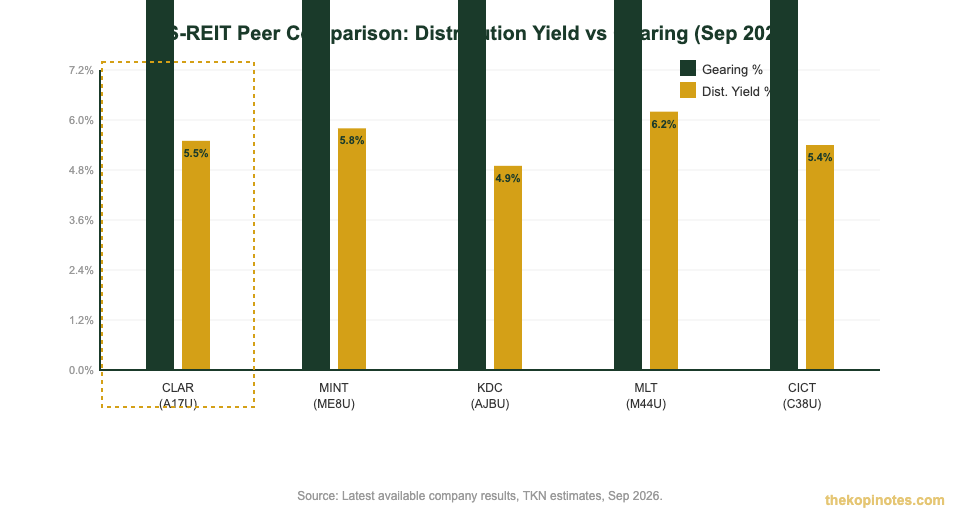
Here is how CLAR compares to its S-REIT peers on the key metrics that matter post-rate hike:
| REIT | Ticker | Est. Distribution Yield | Gearing | Fixed-Rate Debt % |
|---|---|---|---|---|
| CapitaLand Ascendas REIT | A17U | ~5.5% | ~37.4% | ~70% |
| Mapletree Industrial Trust | ME8U | ~5.8% | ~38.5% | ~72% |
| Keppel DC REIT | AJBU | ~4.9% | ~36.0% | ~65% |
| Mapletree Logistics Trust | M44U | ~6.2% | ~40.1% | ~68% |
| CapitaLand Integrated Commercial Trust | C38U | ~5.4% | ~42.0% | ~75% |
Source: TKN estimates based on latest available results, Sep 2026. Figures are approximate and for comparison only.
CLAR sits in the middle of the pack on gearing — not the most rate-sensitive, but not the most defensive either. Keppel DC REIT has lower gearing but also a lower yield, meaning you give up income for defensiveness. MLT has a higher yield but also higher gearing and more FX risk from its overseas portfolio.
If you’re using a broker like Syfe (use referral code SRPRFFFCD) to buy S-REITs fractionally, CLAR is often included in Syfe’s REIT+ portfolio. Alternatively, FSMOne (referral code P0544985) lets you buy A17U directly with low commissions.
CLAR Through Past Rate Cycles
CLAR has been listed since 2002, which means it has navigated multiple rate cycles. A useful reference is 2022–2023, when the Fed hiked aggressively from 0.25% to 5.25%. During that period:
- A17U share price fell from ~S$3.50 in early 2022 to ~S$2.60 by end 2023 — a 26% decline
- DPU held relatively stable at S$0.145–0.152 annually despite the rate pressure
- Gearing peaked at ~37.7% but never breached the danger zone
The lesson: CLAR’s income held up better than its share price during aggressive rate hikes. The unit price recovered as rates peaked and pivoted lower. Investors who accumulated during the 2022–2023 drawdown were rewarded with both a higher yield-on-cost and capital gains when rates began falling in 2024–2025.
The current situation is different — rates are rising from a lower base after a brief easing cycle, not from near-zero. But the pattern of income resilience vs share price volatility is likely to repeat. If the Fed hikes again at the November 2026 FOMC, expect further near-term share price pressure. If it holds or pivots, expect a re-rating.
You can track your retirement income projections using our Singapore retirement calculator — it lets you model different yield scenarios for your S-REIT holdings.
Should You Accumulate CLAR Now?
This is not financial advice — but here are the key factors to weigh on both sides.
The case for accumulating: At a 5.4–5.6% distribution yield, CLAR offers reasonable compensation for the rate risk. Its fixed-rate debt buffer (70%) limits near-term DPU damage. The data centre segment provides long-WALE income resilience. And CLAR’s diversified portfolio across geographies means it is not a single-country bet.
The case for waiting: If the Fed hikes again at November 2026’s FOMC, CLAR’s share price could dip further as SGS yields rise. Higher financing costs will weigh on FY2027 DPU when more fixed-rate debt matures for refinancing. And if US office/business park vacancy continues rising, the non-data-centre portion of CLAR’s US portfolio faces NPI headwinds.
A common approach for Singapore investors is to dollar-cost average (DCA) into CLAR across multiple price points rather than trying to time the bottom. If you are already holding CLAR, the income continues — and the DPU is only modestly affected by a single 25bp hike. See our CapitaLand Ascendas REIT share price guide for the longer-term DPU history and valuation framework.
For context on how this rate hike episode compares to the last one in 2022–2023, the earlier article on CLAR’s rate cut analysis covers the pivot scenario in detail — useful background for understanding the reversal now underway.
Frequently Asked Questions
How does the Sep 2026 Fed rate hike affect CapitaLand Ascendas REIT (A17U)?
What is CLAR’s current gearing after the rate hike?
Does CLAR’s data centre portfolio protect against rate hikes?
What DPU can I expect from CLAR in FY2026?
How do I buy CapitaLand Ascendas REIT (A17U) in Singapore?
Will CLAR’s share price recover after the rate hike?
This article was researched with the help of AI. While we strive to keep all information accurate and up to date, there may be errors. If you notice any discrepancies, please contact us.