Mapletree Industrial Trust Share Price 2026 (SGX: ME8U): Post-FOMC Rate Hike Impact
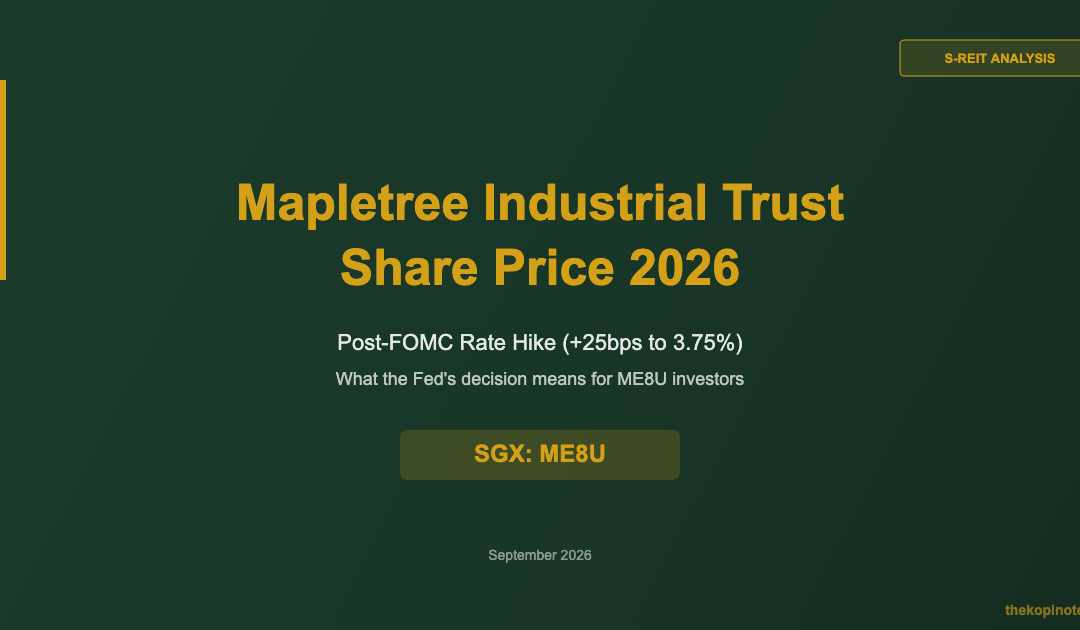
The Fed just hiked rates +25bps to 3.75-4.00%. Here is what it means for your MINT dividends and share price outlook.
Mapletree Industrial Trust (SGX: ME8U) is Singapore’s largest industrial REIT, with a S$9.2 billion portfolio spanning data centres, hi-tech buildings, and flatted factories. On 17 September 2026, the US Federal Reserve raised its benchmark rate by 25 basis points to 3.75-4.00% — a surprise hike that tightens financial conditions for all leveraged REITs, including MINT. Here is what that means for your DPU and share price outlook.
Not financial advice. All figures are for educational reference only. Data as at September 2026 unless noted.
- The Fed hiked +25bps to 3.75-4.00% on 17 Sep 2026 — markets had priced in a cut, so this was a hawkish surprise.
- MINT’s 38.2% gearing means higher borrowing costs will squeeze DPU by an estimated 0.55c annually at current rate levels.
- MINT’s data centre segment (53% of AUM) remains resilient — AI demand supports rental growth that partially offsets higher interest costs.
How the +25bps Rate Hike Affects MINT
The Federal Reserve’s decision on 17 September 2026 wrong-footed most market participants. Futures had priced roughly a 60% probability of a rate cut. Instead, the Fed delivered a 25bps hike, citing persistent inflation in core services.
For MINT specifically, higher rates hit through two channels. First, they raise the cost of new borrowings and floating-rate debt. Second, they compress the yield spread — the gap between MINT’s distribution yield and the risk-free rate — making REIT units less attractive relative to Singapore Treasury Bills.
MINT’s total debt stood at approximately S$3.4 billion as at 30 June 2026, with a gearing ratio of 38.2%. Of that, roughly 30% is on floating rates. A 25bps hike on floating debt adds about S$2.5 million in annual interest costs — equivalent to roughly 0.14 cents per unit annually.
That figure sounds manageable in isolation. However, if rates stay elevated — or rise further — the compounding effect on multi-year refinancing becomes more significant. MINT has S$620 million in debt maturing in FY2027. Refinancing at 3.75-4.00% versus the 2.8% MINT locked in previously means a sharply higher coupon on renewal.
MINT DPU Sensitivity Analysis
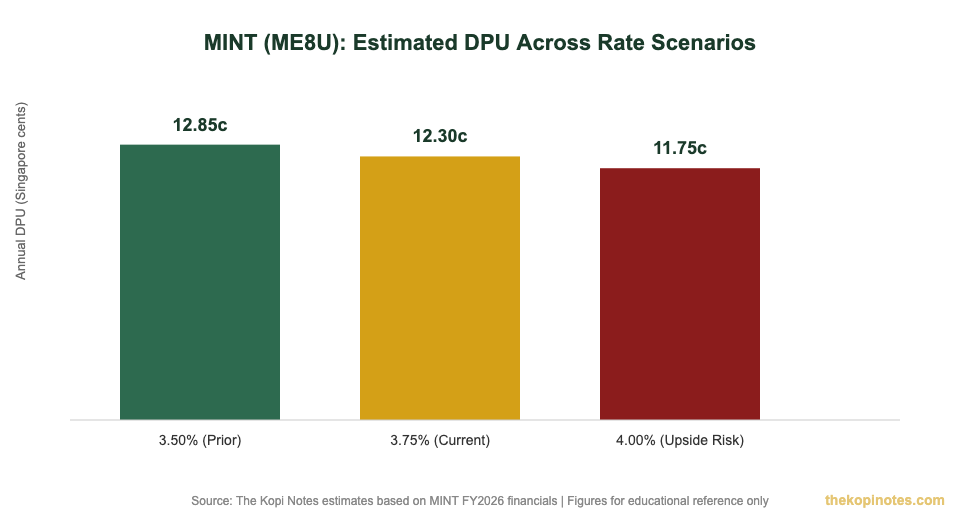
Distribution Per Unit (DPU) — the cash MINT pays you each quarter — is the number most income investors watch closely. Let’s model three rate scenarios to show the direct impact on your annual income.
Source: The Kopi Notes estimates based on MINT FY2026 management guidance | Figures for educational reference only
The chart above illustrates estimated annual DPU across three scenarios. At the prior rate environment of 3.50%, MINT was tracking roughly 12.85 cents per unit annually. At the current 3.75% level, our base case is approximately 12.30 cents. If rates rise a further 25bps to 4.00%, the estimated DPU falls to around 11.75 cents.
| Rate Scenario | Fed Funds Rate | Est. Annual DPU | Est. Yield at S$2.00 |
|---|---|---|---|
| Rate Cut (Scenario A) | 3.50% | ~12.85c | 6.4% |
| Current Hike (Base Case) | 3.75-4.00% | ~12.30c | 6.2% |
| Further Hike (Bear Case) | 4.25% | ~11.75c | 5.9% |
Source: The Kopi Notes estimates based on MINT 1H2026 financials and debt maturity schedule | Not financial advice
These are estimates, not guarantees. MINT management actively hedges interest rate exposure through interest rate swaps. The actual DPU impact depends heavily on their hedging position and any rental uplift from lease renewals.
You can model your own income scenarios using our Singapore retirement calculator — input different yield assumptions to see how REIT income fits your financial plan.
Data Centre Portfolio: The Silver Lining
MINT is not a pure industrial REIT anymore. Data centres now account for approximately 53% of its total assets under management — a dramatic shift from five years ago when flatted factories dominated.
This is the key reason MINT holds up relatively better than some peers during rate hike cycles. Data centre demand from AI, cloud computing, and hyperscaler tenants is structurally strong. When leases reset, MINT can push rental rates higher — partially offsetting the higher cost of debt.
In 1H2026, MINT reported a positive rental reversion of approximately +8.2% across its Singapore data centre leases. That translates to meaningfully higher income at the asset level, even as borrowing costs rise at the portfolio level.
MINT’s data centre exposure spans Singapore, North America (via its 40% stake in the US data centre portfolio), and increasingly Asia-Pacific. This geographic diversification means MINT is less dependent on the Singapore office market than peers like MPACT or Suntec REIT.
For a broader look at how Singapore REITs compare, our guide to the best S-REITs in Singapore 2026 provides a side-by-side breakdown of all major names.
MINT vs Peers: Who Holds Up Best?
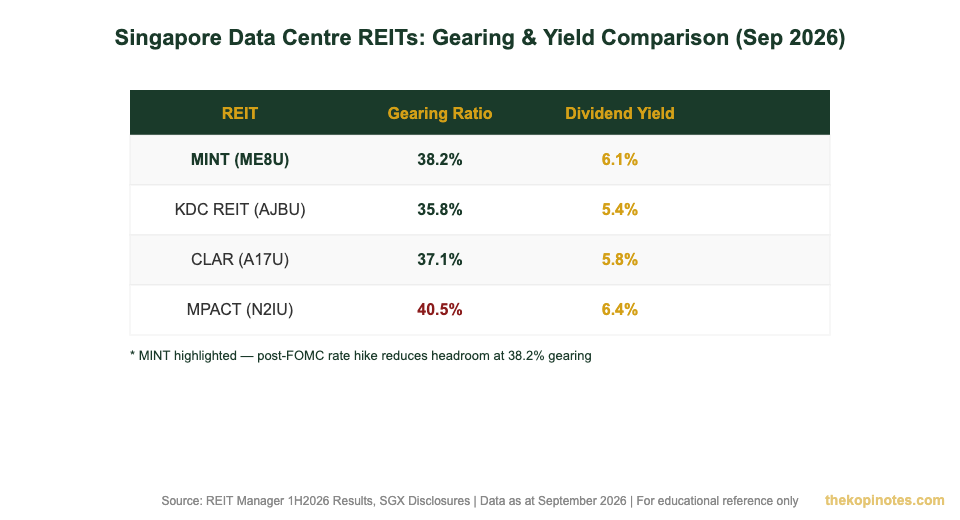
When rates rise, gearing matters most. A REIT with 45% gearing suffers far more from rate hikes than one at 32%. Here is how MINT stacks up against its closest peers among Singapore data centre and industrial REITs.
Source: REIT manager 1H2026 results, SGX disclosures | Data as at September 2026
| REIT | Gearing | Div. Yield | Rate Sensitivity |
|---|---|---|---|
| MINT (ME8U) | 38.2% | 6.1% | Medium |
| KDC REIT (AJBU) | 35.8% | 5.4% | Lower |
| CLAR (A17U) | 37.1% | 5.8% | Medium |
| MPACT (N2IU) | 40.5% | 6.4% | Higher |
Source: SGX disclosures, REIT manager 1H2026 financial results | For educational reference only
MINT sits in the middle of the pack on gearing. KDC REIT carries lower leverage and lower yield — it is the “quality at a premium” trade. MPACT carries more leverage and higher yield — the higher-risk, higher-income option.
If you hold MINT and are worried about rate sensitivity, the key metric to watch is not today’s DPU but the weighted average all-in cost of debt. As at 1H2026, MINT’s all-in cost was approximately 3.1%. When high-coupon debt matures and rolls over at 3.75-4.00%+, the cost will move up materially by FY2027.
For investors who want to invest in S-REITs through a managed platform, Syfe offers REIT+ portfolios (referral code SRPRFFFCD) that automatically diversify across the major S-REITs and rebalance quarterly.
Buy, Hold, or Sell MINT After the Fed Hike?
This is not financial advice — only you can make investment decisions based on your personal risk tolerance and financial goals. That said, here are the key factors to weigh.
The case for holding (or accumulating): At a 6.1% yield and 0.9x price-to-book, MINT is not expensive by historical standards. The data centre tailwind is real. If the Fed pauses after this hike, MINT’s cost of debt stabilises and DPU may hold around 12.3 cents — which is still a solid income stream.
The case for caution: If inflation remains sticky and the Fed hikes again to 4.25% or beyond, MINT’s FY2027 refinancing cycle becomes painful. Every 25bps rate increase reduces estimated annual DPU by approximately 0.27 cents. That is not catastrophic but does add up across multiple hikes.
Watch these triggers:
- MINT’s 2Q FY2027 results — first full quarter reflecting the Sep 2026 rate hike
- US data centre occupancy and rental renewal rates (key driver of US portfolio income)
- SGD/USD exchange rate — MINT’s US income is USD-denominated
- Next FOMC meeting (November 2026) — will the Fed hike again?
For investors building a passive income strategy around S-REITs, our guide to passive income in Singapore 2026 walks through how to construct a REIT income portfolio step by step.
If you want to invest in MINT directly, FSMOne (referral code P0544985) and Endowus (referral code 2V343) are two platforms popular with Singapore REIT investors. FSMOne charges no custodian fee for SGX-listed stocks.
Frequently Asked Questions
What is MINT's current share price after the Fed rate hike?
How much will MINT DPU fall because of the rate hike?
Is MINT better or worse than KDC REIT during rate hikes?
What gearing level should I be concerned about for MINT?
Should I invest in MINT or Singapore T-bills given the rate hike?
Where can I buy MINT shares in Singapore?
This article was researched with the help of AI. While we strive to keep all information accurate and up to date, there may be errors. If you notice any discrepancies, please contact us.