Unit Trusts vs ETFs Singapore: Which Is Better for You? (2026)
How to Invest in Singapore | Updated September 2026
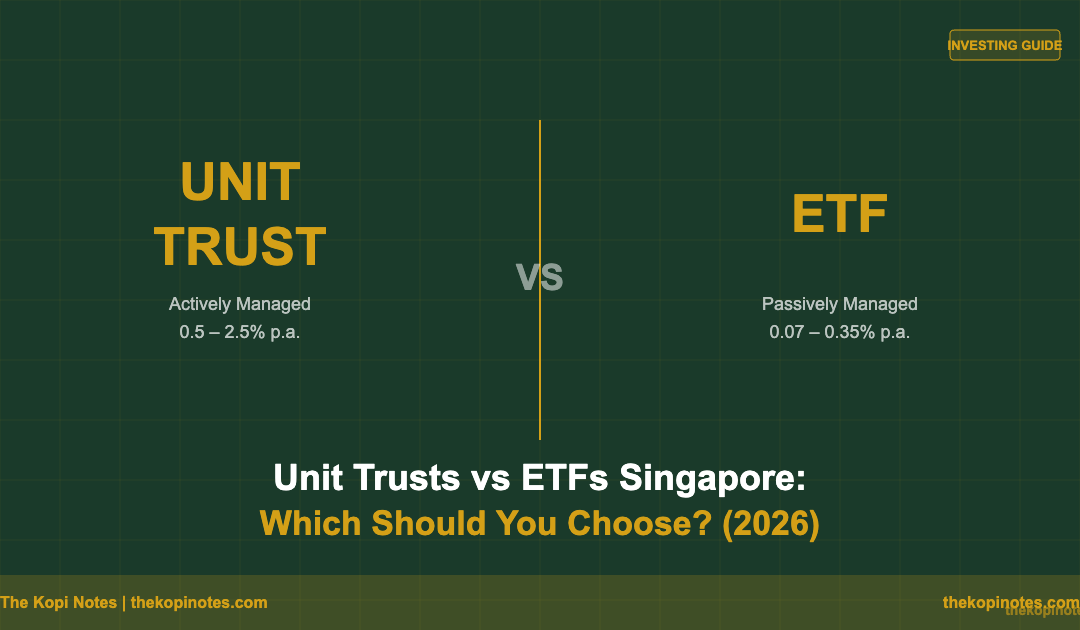
Unit trusts and ETFs are both diversified investment funds available to Singapore investors — but they differ hugely on cost, control, and convenience. Unit trusts are actively managed by a fund manager (annual fees: 0.5–2.5%), while ETFs passively track an index (annual fees: 0.07–0.35%). For most long-term investors in Singapore, ETFs win on cost. But unit trusts can work if you want a hands-off approach or access via CPFIS without a brokerage account.
Not financial advice. All figures are for educational reference only. Data verified as at September 2026.
- Unit trusts cost 10–30x more in annual fees than ETFs — this compounds into a massive gap over 20 years.
- ETFs require a brokerage account; unit trusts can be bought via banks or online platforms with no broker needed.
- Both are available under CPFIS (OA and SA) and the Supplementary Retirement Scheme (SRS).
What Is a Unit Trust in Singapore?
A unit trust is a pooled investment fund regulated by the Monetary Authority of Singapore (MAS). When you buy units in a unit trust, your money is combined with other investors’ money and managed by a professional fund manager.
The fund manager decides what to buy and sell — typically shares, bonds, or a mix of both — with the goal of beating a benchmark index. This active management is why you pay higher fees.
In Singapore, unit trusts are sold as “authorised” (locally constituted) or “recognised” (foreign) funds. Both types are listed on MAS’s electronic register, OPERA. You can buy them through banks (DBS, OCBC, UOB), online fund platforms like FSMOne or Endowus, or via your CPF Investment Scheme (CPFIS) account.
Key features of unit trusts
Unit trusts are priced once a day at their Net Asset Value (NAV) — you cannot trade them on the stock exchange intraday. They are actively managed, meaning the fund manager makes deliberate choices about which assets to hold. They typically come with a sales charge (front-end load) of 1–5%, though online platforms often reduce or waive this entirely.
What Is an ETF?
An ETF (Exchange-Traded Fund) is a basket of securities that trades on a stock exchange like a regular share. Instead of trying to beat the market, most ETFs simply track an index — for example, the S&P 500 (via CSPX or VWRA) or the Straits Times Index (via the SPDR STI ETF).
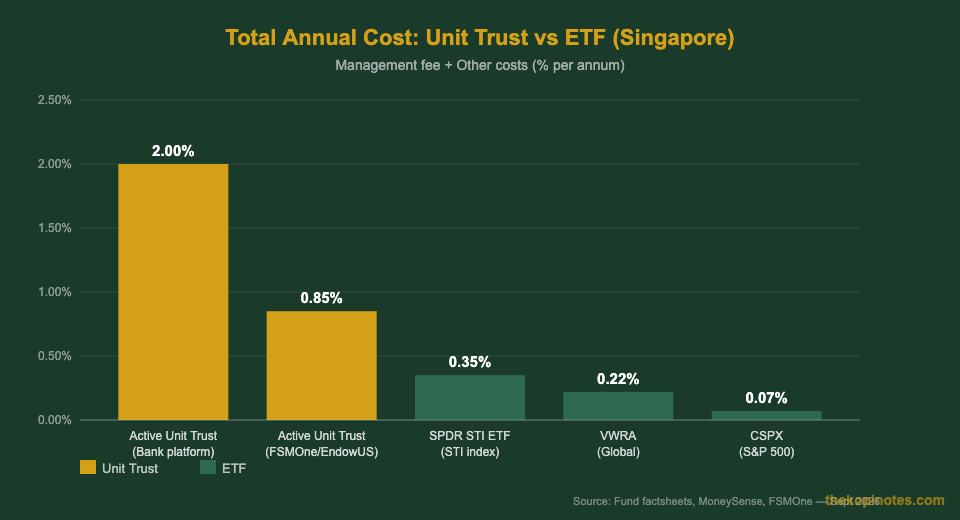
Because ETFs are passively managed — they just replicate what’s in the index — they have very low fees. The iShares CSPX ETF, for example, has a Total Expense Ratio (TER) of just 0.07% per year. That’s roughly 20–30 times cheaper than the average actively managed unit trust.
Singapore investors typically buy LSE-listed ETFs (like CSPX or VWRA) through platforms like Interactive Brokers, Syfe Trade, or FSMOne. You can also buy the locally-listed SPDR STI ETF directly through the SGX.
Unit Trust vs ETF: Key Differences
The table below summarises the main differences between unit trusts and ETFs for a Singapore investor:
| Feature | Unit Trust | ETF |
|---|---|---|
| Management style | Active (fund manager decides) | Passive (tracks an index) |
| Annual management fee | 0.5% – 2.5% p.a. | 0.07% – 0.35% p.a. |
| Sales charge | 1% – 5% (often waived online) | Brokerage commission (SGD 2–10) |
| Where to buy | Bank, online fund platform | Stock exchange (via broker) |
| Pricing | Once daily (NAV) | Real-time (market hours) |
| Minimum investment | SGD 100 – SGD 1,000 | 1 share (CSPX ~USD 550) |
| CPFIS eligible | Yes (approved list) | Yes (approved ETFs only) |
| SRS eligible | Yes | Yes (via SRS broker) |
| Brokerage account needed? | No | Yes |
Source: MAS OPERA, CPF Board, MoneySense Singapore — September 2026
The Cost Question: Fee Breakdown
The single biggest difference between unit trusts and ETFs is cost. And when you’re investing for 10–20 years, fees compound just as much as returns do — working against you.
Here’s a realistic fee breakdown for a Singapore investor in 2026:
| Product | Annual Fee | Sales Charge | Platform |
|---|---|---|---|
| Active Unit Trust (bank) | 1.5 – 2.5% | 2 – 5% | DBS/OCBC/UOB |
| Active Unit Trust (platform) | 0.5 – 1.5% + 0%–0.4% platform | 0% (waived online) | FSMOne, Endowus |
| SPDR STI ETF (ES3) | 0.35% | Brokerage SGD 2–8 | Any SGX broker |
| VWRA (Global ETF, LSE) | 0.22% | IBKR from USD 1 | IBKR, FSMOne |
| CSPX (S&P 500, LSE) | 0.07% | IBKR from USD 1 | IBKR, Syfe Trade |
Source: iShares, Vanguard, SSGA factsheets; FSMOne, Endowus fee schedules — September 2026
20-Year Fee Drag on a SGD 50,000 Portfolio
Here’s where it gets real. Imagine you invest SGD 50,000 and earn 7% per year before fees. Over 20 years, here’s what different fee levels do to your ending balance:
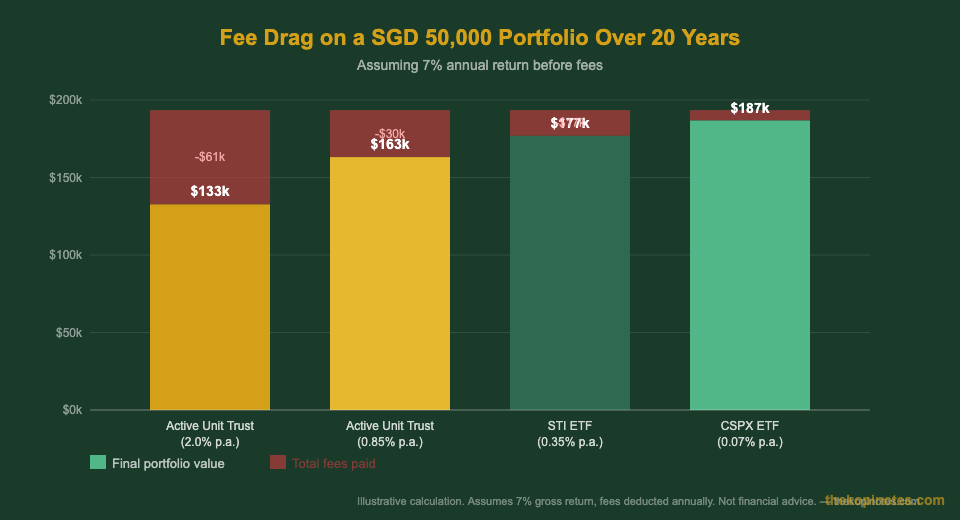
If you bought a unit trust through your bank at 2.0% annual fees, you’d end up with roughly SGD 132,000 after 20 years. The same money in CSPX at 0.07% would give you SGD 187,000. That’s a SGD 55,000 difference — purely from fees.
This doesn’t mean unit trusts are always bad. But it means you need a strong reason to pay more. Active management would need to consistently outperform the index by more than the fee difference — and research shows most active funds fail to do this over the long run.
CPFIS & SRS Eligibility
Both unit trusts and ETFs can be used within Singapore’s tax-advantaged accounts — good news if you want to invest your CPF or SRS savings.
CPFIS (CPF Investment Scheme)
Under CPFIS, you can invest both your Ordinary Account (OA) and Special Account (SA) savings. For unit trusts, only those on the CPF Board’s approved CPFIS unit trust list qualify. This list includes funds from major managers like Fullerton, Lion Global, and Nikko AM. You can buy them through CPFIS-included platforms such as DBS, OCBC, or UOB. A good foundation is to review your CPF investment strategy before committing.
For ETFs, CPFIS allows certain approved ETFs — including the SPDR STI ETF (ES3) and Nikko AM STI ETF. Notably, CPFIS does not allow LSE-listed ETFs like CSPX or VWRA, as these are not on the approved list.
SRS (Supplementary Retirement Scheme)
With your SRS account (opened at DBS, OCBC, or UOB), you can invest in both unit trusts and most ETFs. SRS offers an income tax deduction on contributions (up to SGD 15,300 p.a. for Singaporeans) and deferred taxation on withdrawals. Use a Singapore retirement calculator to see how much SRS investing could save you in taxes.
Which Is Right for You?
Neither unit trusts nor ETFs are universally better. The right choice depends on your situation:
| Your Situation | Better Choice |
|---|---|
| You want lowest fees, happy to open a brokerage account | ETF (CSPX, VWRA via IBKR) |
| You want hands-off investing, no brokerage needed | Unit Trust via Endowus or FSMOne |
| You want to invest via CPFIS for global exposure | Unit Trust (CPFIS-approved global funds) |
| You want to invest via CPFIS for Singapore equity exposure | ETF (SPDR STI ETF via CPFIS) |
| You want to invest small amounts monthly (Regular Savings Plan) | Unit Trust RSP or ETF RSP via Syfe/FSMOne |
| You want to invest via SRS with institutional-class fees | Unit Trust via Endowus SRS |
For illustrative purposes only. Speak to a licensed financial adviser for personalised advice.
How to Buy Unit Trusts in Singapore
You have three main channels for buying unit trusts in Singapore.
Via your bank — DBS, OCBC, and UOB all offer unit trusts through their online banking portals. This is the most accessible route but typically has the highest sales charges (2–5%). No brokerage account needed.
Via an online fund platform — Platforms like FSMOne (referral code P0544985) or Endowus (referral code 2V343) offer zero sales charges and access to institutional-class fund units with much lower annual fees. This is the smarter way to buy unit trusts in Singapore.
Via CPFIS or SRS — If you’re investing retirement savings, both FSMOne and Endowus support CPFIS and SRS investing. Endowus is particularly popular for CPFIS because it rebates all trailer fees back to you, further reducing your effective cost.
How to Buy ETFs in Singapore
Buying ETFs requires a brokerage account. Here are your main options for Singapore investors:
Interactive Brokers (IBKR) — The most cost-effective platform for buying LSE-listed ETFs like CSPX and VWRA. Commission from USD 1 per trade, no custody fee for smaller accounts. Sign up with referral code jianxiong368.
Syfe Trade — Great for beginners. Offers access to both LSE and SGX ETFs. Use Syfe referral code SRPRFFFCD for a bonus on sign-up.
FSMOne — Supports both ETFs and unit trusts, plus CPFIS and SRS investing. Commission as low as SGD 8.80 per trade or 0.08%, whichever is higher. See the FSMOne referral code page for current promotions (referral code P0544985).
For SGX-listed ETFs like the SPDR STI ETF (ES3), you can also use any local bank broker — DBS Vickers, OCBC Securities, or UOB Kay Hian. For more ways to generate passive income in Singapore, explore TKN’s investing guides.
Frequently Asked Questions
Is it better to invest in unit trusts or ETFs in Singapore?
For most long-term investors, ETFs are better due to significantly lower fees. An ETF like CSPX has a TER of 0.07% p.a., while the average actively managed unit trust charges 1–2.5% p.a. Over 20 years on a SGD 50,000 portfolio, this difference can amount to SGD 50,000 or more in lost returns. That said, unit trusts can be a better fit if you want to invest via CPFIS for global exposure, or if you prefer not to open a brokerage account.
Can I buy unit trusts with my CPF (CPFIS)?
Yes. The CPF Investment Scheme (CPFIS) allows you to invest OA and SA savings in approved unit trusts. The approved list is published on the CPF Board website. Not all unit trusts qualify — only those on the CPFIS inclusion list. You can invest via CPFIS through platforms like DBS, OCBC, UOB, or FSMOne. Note that CPFIS-SA has stricter risk restrictions than CPFIS-OA.
Are there ETFs available under CPFIS?
Yes, but only a small number. CPFIS-approved ETFs include the SPDR STI ETF (ES3) and the Nikko AM STI ETF (G3B). Notably, popular LSE-listed ETFs like CSPX (S&P 500) and VWRA (global) are NOT on the CPFIS approved list, so you cannot use CPFIS funds to buy them directly.
What is the minimum amount to invest in a unit trust in Singapore?
Most unit trusts in Singapore have a minimum lump sum of SGD 1,000, or as low as SGD 100 per month for a Regular Savings Plan (RSP). Online platforms like FSMOne and Endowus often have lower minimums than bank branches. RSPs let you dollar-cost average into a fund monthly without needing a large sum upfront.
Do unit trusts or ETFs pay dividends in Singapore?
Both can pay dividends, depending on the specific product. Most unit trusts offer accumulation (reinvests income) or distribution (pays out income) share classes. For ETFs, accumulating ETFs like CSPX reinvest dividends automatically, while distributing ETFs like VWRD pay them out. For Singapore investors, accumulating ETFs are generally more convenient since you avoid the friction of manually reinvesting distributions.
Can I invest using SRS (Supplementary Retirement Scheme)?
Yes. Both unit trusts and ETFs can be purchased using your SRS account (opened at DBS, OCBC, or UOB). SRS contributions get income tax relief, and gains are only taxed upon withdrawal at a 50% concessionary rate. Endowus SRS is popular for unit trusts, offering institutional-class funds at lower fees. For ETFs via SRS, use your SRS account at any operator bank to buy SGX-listed ETFs like the STI ETF.
Are unit trust fees deducted from returns or charged separately?
Management fees for both unit trusts and ETFs are deducted from the fund’s Net Asset Value (NAV) — they reduce the fund’s daily value rather than appearing as a separate charge on your statement. This is why it’s easy to overlook fees: you never see a bill, but your returns are quietly reduced every day. A 2% annual fee on SGD 100,000 is SGD 2,000 per year silently leaving your portfolio.
The Kopi Notes is an independent personal finance blog for Singapore investors. Content is for educational purposes only and does not constitute financial advice. Please consult a licensed financial adviser before making investment decisions. All fees and rates cited are approximate and subject to change — verify with respective institutions before investing. Data verified as at September 2026.
This article was researched with the help of AI. While we strive to keep all information accurate and up to date, there may be errors. If you notice any discrepancies, please contact us.