SRS Account Singapore 2026: Complete Guide to Tax Savings, Investments & Withdrawal
Updated September 2026 • 12 min read
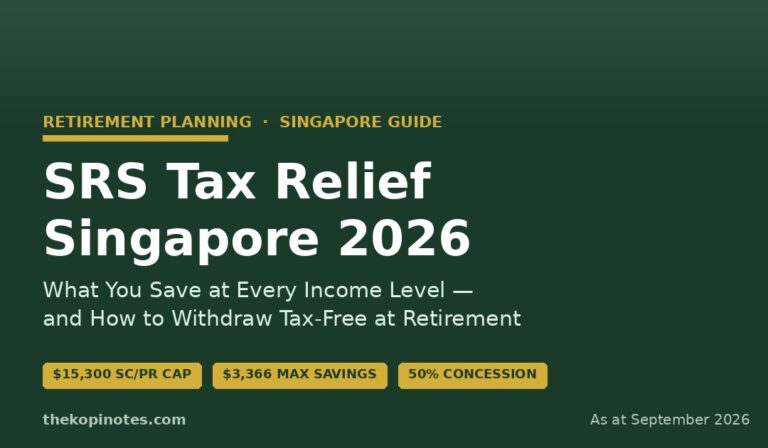
An SRS account (Supplementary Retirement Scheme) lets Singapore Citizens, PRs, and foreigners save for retirement beyond CPF — and get a dollar-for-dollar tax deduction on contributions. In 2026, you can contribute up to S$15,300 per year (SC/PR) and invest those funds in stocks, ETFs, and bonds. At retirement age 63, only 50% of withdrawals are taxable.
Not financial advice. All figures are for educational reference only. Data as at September 2026 unless noted.
- SRS contributions reduce your taxable income dollar-for-dollar — someone earning $120k–$160k saves up to S$2,295/yr in tax
- You can invest SRS funds in SGX stocks, ETFs, unit trusts, bonds, endowments — idle funds earn only 0.05% p.a.
- Withdraw from age 63: only 50% is taxable. Withdraw early: 100% taxable + 5% penalty
What Is an SRS Account?
The Supplementary Retirement Scheme (SRS) is a voluntary government-backed savings scheme run by the Ministry of Finance (MOF). It lets you save money specifically for retirement — on top of your CPF contributions — and get an immediate tax deduction for every dollar you put in.
Three banks operate the SRS in Singapore: DBS (and POSB), UOB, and OCBC. You can only hold one SRS account in total, regardless of which bank you choose.
The key idea is simple. You contribute cash. You get a tax break now. Your money grows (if you invest it). When you retire, you withdraw it — and only 50% counts as taxable income.
SRS Contribution Limits 2026
Your maximum SRS contribution per calendar year depends on your residency status.
| Residency Status | Annual SRS Cap (2026) |
|---|---|
| Singapore Citizen | S$15,300 |
| Permanent Resident (PR) | S$15,300 |
| Foreigner (EP/S Pass holders) | S$35,700 |
Source: Ministry of Finance Singapore, 2026
You do not have to contribute the maximum. You can contribute any amount from S$1 up to the cap. There is no minimum contribution requirement, and you can choose to contribute monthly or in one lump sum before 31 December each year.
Important: contributions count toward your income tax for the year of assessment — so you must contribute by 31 December to get the deduction for that tax year.
How Much Tax Relief Does SRS Give You?
SRS contributions reduce your chargeable income dollar for dollar. That means if you earn S$130,000 and contribute S$15,300, your taxable income drops to S$114,700.
The actual saving depends on your marginal tax rate. Here is a breakdown for common income bands in 2026:
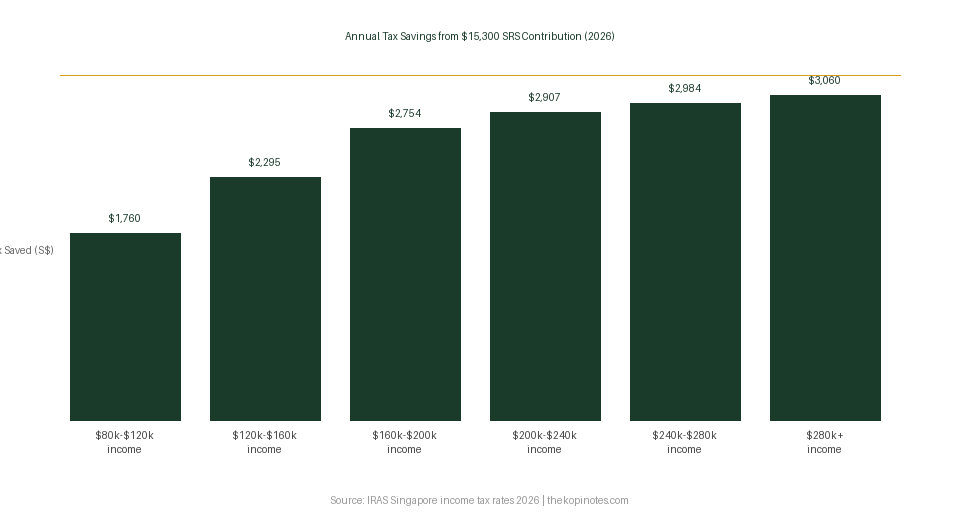
Tax savings from a S$15,300 SRS contribution at different income levels. Source: IRAS 2026 tax rates.
| Chargeable Income | Marginal Tax Rate | Tax Saved (S$15,300 SRS) |
|---|---|---|
| $80,001 – $120,000 | 11.5% | S$1,760 |
| $120,001 – $160,000 | 15% | S$2,295 |
| $160,001 – $200,000 | 18% | S$2,754 |
| $200,001 – $240,000 | 19% | S$2,907 |
| $240,001 – $280,000 | 19.5% | S$2,984 |
Source: IRAS Singapore, September 2026. Figures are estimates for illustration only.
For someone earning S$150,000, the annual tax saving from maxing out SRS is around S$2,295. Over 20 years, that is S$45,900 in tax savings — before investment returns.
What Can You Invest in with SRS?
Your SRS funds do not grow automatically. If you leave them as cash in your account, they earn just 0.05% per year — roughly S$8 on S$15,300. That is far below inflation.
The smart move is to invest your SRS funds. You can use them to buy:
- SGX-listed stocks and REITs (S-REITs)
- ETFs listed on SGX, NYSE, NASDAQ, LSE
- Unit trusts and managed funds
- Singapore Government Securities (SGS bonds)
- Endowment insurance plans
- Fixed deposits (via your SRS bank)
For most long-term investors, low-cost ETFs are the most popular SRS investment. ETFs like CSPX (iShares S&P 500 UCITS) or VWRA (Vanguard FTSE All-World) can be bought via your SRS brokerage account with no cash out of pocket — just use SRS funds to settle trades.
You can also use SRS to buy best S-REITs in Singapore 2026 that pay 5–7% distribution yields — effectively a tax-sheltered dividend stream.
DBS vs UOB vs OCBC SRS — Which Bank to Choose?
All three banks offer the same SRS scheme with the same government rules. The differences come down to brokerage platform, fees, and which bank you already use.
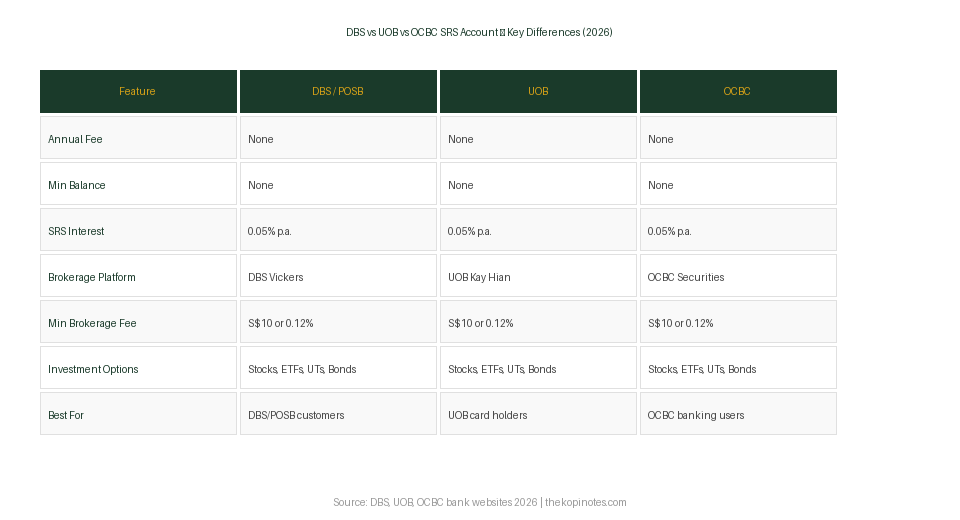
SRS account comparison across the three operators. Source: DBS, UOB, OCBC 2026.
The honest answer: the bank does not matter much. Pick the one where you already bank — it is easiest to transfer funds. Most Singapore investors choose DBS if they are POSB/DBS account holders, since the DBS Vickers platform is the most widely used for SGX and international stocks.
For SRS-linked robo-investing, Syfe and Endowus both accept SRS funds — Endowus is especially popular for SRS because it offers fund-based portfolios optimised for retirement.
Use Endowus referral code 2V343 for a fee waiver, or Syfe referral code SRPRFFFCD for a bonus.
SRS Withdrawal Rules 2026
This is where SRS gets most of its power — and most of its complexity.
At the statutory retirement age (63 in 2026) or after:
- Only 50% of each withdrawal is added to your taxable income
- You can spread withdrawals over up to 10 years from the date of your first withdrawal
- If you withdraw in small annual amounts, you can stay within the S$20,000 personal tax relief — meaning the withdrawal is effectively tax-free
Before statutory retirement age:
- 100% of the withdrawal is taxable (not 50%)
- You pay an additional 5% penalty on the withdrawn amount
- Exception: terminal illness, bankruptcy, or becoming a foreigner moving out permanently
Here is a worked example. You withdraw S$40,000 from SRS at age 65. Only S$20,000 counts as income. If you have no other income that year, your tax is zero (within personal relief). That means you got the full tax deduction when you contributed — and paid nothing on the way out.
Who Should Open an SRS Account?
SRS works best if you meet a few conditions:
- You pay income tax (i.e., chargeable income above S$20,000)
- You will not need the money before age 63
- You plan to invest the SRS funds (not leave them as cash)
If you earn below S$40,000, your marginal tax rate is 3.5% or less — the tax benefit is small. In that case, you may be better off focusing on CPF top-ups or building an emergency fund first.
If you earn above S$80,000 and have no immediate need for liquidity, SRS is one of the most tax-efficient retirement tools available in Singapore.
How to Open an SRS Account in Singapore
Opening an SRS account takes about 10 minutes online. There is no minimum deposit to open. Here is the process for each bank:
DBS/POSB: Log in to DBS digibank → “Invest” → “Supplementary Retirement Scheme” → Apply. Funds transfer from your DBS/POSB account instantly.
UOB: Log in to UOB TMRW or Personal Internet Banking → “Investments” → “SRS” → Open Account.
OCBC: Log in to OCBC Digital → “Invest” → “SRS Account” → Apply online.
Once open, fund your SRS account before 31 December to claim the tax relief for that year. The contribution is not automatic — you must transfer cash from your bank account into your SRS account each year.
Once funded, log in to your SRS-linked brokerage (DBS Vickers, UOB Kay Hian, or OCBC Securities) and invest your SRS balance. Check Singapore REIT ETF guide and CPF investment strategy for ideas on pairing SRS with a full retirement portfolio.
Frequently Asked Questions
What is the SRS contribution limit for 2026?
Is SRS better than CPF top-up for tax relief?
Can I withdraw SRS funds before retirement?
What happens to my SRS account if I leave Singapore permanently?
Can I use SRS to invest in ETFs like CSPX or VWRA?
What is the SRS withdrawal period?
Start Building Your Retirement Portfolio
Open your SRS account today and invest with platforms that support SRS funds:
- Endowus — code 2V343 | Best for SRS-linked fund portfolios
- Syfe — code SRPRFFFCD | Robo-portfolios including S-REITs and global ETFs
- FSMOne — code P0544985 | Unit trusts and ETFs with SRS settlement
This is not financial advice. SRS is a long-term retirement vehicle — assess your own financial situation before contributing. Referral links may earn The Kopi Notes a commission at no cost to you.
This article was researched with the help of AI. While we strive to keep all information accurate and up to date, there may be errors. If you notice any discrepancies, please contact us.