MediShield Life Deductible: What It Is & How It Works in 2026
Official deductible table • April 2026 IP rider changes • Worked examples
Table of Contents
- What is the MediShield Life deductible?
- Official deductible table 2026 (by ward class & age)
- How the deductible works in practice — a worked example
- ISP deductible vs MediShield Life deductible: the difference
- April 2026 IP rider changes — what changed for deductibles
- How to pay your deductible (MediSave vs cash)
- Should you switch to the new IP rider?
- Frequently asked questions
The MediShield Life deductible is the fixed amount you pay each policy year before MediShield Life starts paying out. As at June 2026, it ranges from $500 (outpatient) to $4,500 (Class A ward, age 81 and above), depending on your ward class and age. From April 2026, new Integrated Shield Plan (ISP) riders can no longer cover this deductible — which means higher out-of-pocket costs for some Singaporeans.
Not financial advice. All figures are for educational reference only. Data verified as at 4 September 2026 unless noted. Always check the latest figures at CPF Board and MOH.
- The MediShield Life deductible ranges from $1,500 to $4,500/year for hospitalisation — you pay it once per year, before insurance kicks in.
- From 1 April 2026, new IP riders cannot cover the minimum IP deductible ($1,500–$3,500 depending on ward). You must pay this yourself — in cash or MediSave.
- A new $500/year outpatient deductible also applies from 1 June 2026 for outpatient MediShield Life claims.
What Is the MediShield Life Deductible?
When you get hospitalised in Singapore, you don’t go straight to MediShield Life for payment. You pay a fixed amount first — the deductible. Only after you’ve paid that amount does MediShield Life start covering the rest (up to its claim limits).
Think of the deductible like an annual excess on a car insurance policy. You absorb the first portion of every hospital stay; the insurer handles the bigger bill on top.
Three things make the MediShield Life deductible unique:
- Paid once per policy year. Even if you’re admitted three times in a year, you only pay the deductible once. Multiple claims in the same year accumulate towards it.
- Varies by ward class and age. Staying in Class C costs you a smaller deductible than Class A. Once you turn 81, the deductible steps up further.
- Can be paid using MediSave. You don’t have to dip into cash — your MediSave account can cover the deductible, within the applicable withdrawal limits.
If you have an Integrated Shield Plan, the ISP sets its own (higher) deductible that supersedes the MediShield Life deductible. We’ll cover that distinction in detail below.
Official MediShield Life Deductible Table 2026
The table below shows the official MediShield Life deductible amounts, effective from 1 June 2026, sourced from the CPF Board.
| Ward Class / Treatment | Age 80 and Below | Age 81 and Above |
|---|---|---|
| Class C | $2,000 | $2,750 |
| Class B2 / B2+ / B1 | $2,500 | $3,500 |
| Class A (incl. private hospitals) | $3,500 | $4,500 |
| Day Surgery | $1,500 | $2,000 |
| Community Hospital (Subsidised C/B2/B2+) | $2,000 | $2,750 |
| Community Hospital (Non-subsidised B1/A) | $2,500 | $3,500 |
| Outpatient Treatments (new from June 2026) | $500 | $500 |
Source: CPF Board (ask.gov.sg), effective 1 June 2026. Figures verified 4 September 2026.
The outpatient deductible of $500 per year is new as of June 2026. It applies before MediShield Life covers outpatient claims such as dialysis, chemotherapy, or radiotherapy. Inpatient and outpatient deductibles are cross-counted — so if you’ve already paid your inpatient deductible, you don’t pay the outpatient deductible again in the same policy year.
How the Deductible Works in Practice — A Worked Example
Let’s say you’re 55 years old and you check into a Class B2 ward at a public hospital for an appendix operation. Your total claimable bill comes to $8,000.
Here’s how MediShield Life processes the claim:
- Step 1 — Deductible: You pay the first $2,500 (Class B2/B1, age ≤80). This is your deductible for the policy year.
- Step 2 — Claimable amount: The remaining $5,500 is your claimable amount (assuming it’s within MediShield Life’s claim limits for ward and surgical fees).
- Step 3 — Co-insurance: MediShield Life doesn’t pay 100% of the $5,500. You pay a percentage — the co-insurance — which starts at 10% and decreases as your bill grows. For a $5,500 claim, your co-insurance might be around $440.
- Step 4 — MediShield Life pays: MediShield Life covers the remaining ~$5,060.
Your total out-of-pocket: $2,500 (deductible) + $440 (co-insurance) = $2,940. You can pay both using MediSave, within the MediSave hospitalisation withdrawal limits.
This example is based on MediShield Life alone (no ISP). If you have an ISP and rider, the ISP covers the claimable amount above what MediShield Life pays — and a rider historically covered your deductible and co-insurance too. That rider landscape changed in April 2026.
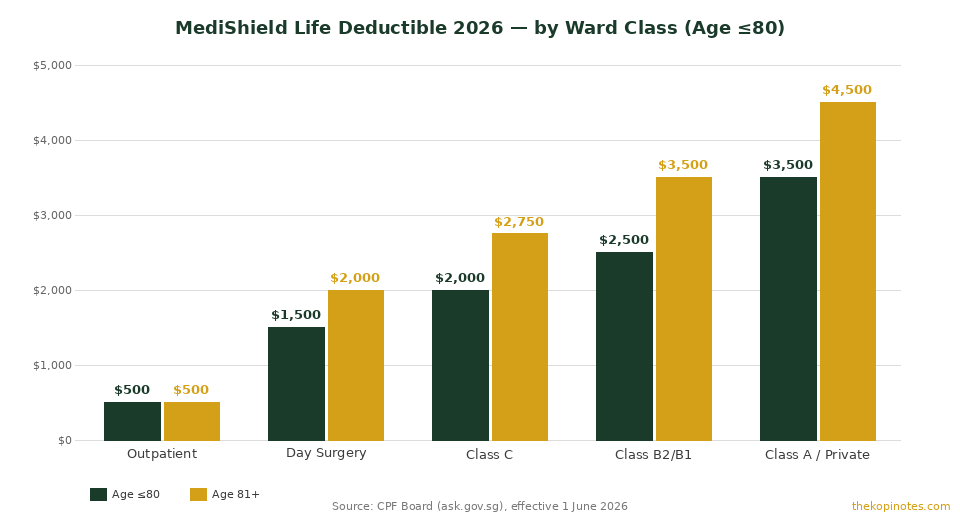
MediShield Life deductible 2026 — by ward class (age ≤80 vs age 81+). Source: CPF Board, June 2026.
ISP Deductible vs MediShield Life Deductible: What’s the Difference?
If you hold an Integrated Shield Plan (ISP), you deal with the IP deductible, not the MediShield Life deductible directly. Here’s the key difference:
- MediShield Life deductible: Applies if you only have MediShield Life (no ISP). Set by CPF Board based on ward class and age.
- IP deductible: Set by your ISP insurer, but must meet MOH’s minimum IP deductible requirements. If you use a ward class within your IP’s coverage, the IP deductible applies — and it’s the same or higher than the MediShield Life deductible.
| IP Coverage Target | Ward Class Used | Minimum IP Deductible (from Apr 2026) |
|---|---|---|
| Class A / Private Hospital IP | Class A / Private | $3,500 |
| Class B1 IP | Class B1 | $2,500 |
| Class B1 IP | Class B2 | $2,000 |
| Class B1 IP | Class C | $1,500 |
| Any IP | Day Surgery (non-subsidised) | $2,000 |
| Any IP | Day Surgery (subsidised) | $1,500 |
Source: MOH press release, 26 November 2025. Effective from 1 April 2026.
Notice that the minimum IP deductible is the lower of the target IP coverage amount or the actual ward class used. So if your IP targets Class A but you end up in a Class B2 ward, your minimum IP deductible is only $2,000 — not $3,500.
To understand how your specific ISP is structured, check our complete Integrated Shield Plan guide and the MediShield Life benefits overview.
April 2026 IP Rider Changes: What Changed for Deductibles
This is the change that affects most ISP holders. On 1 April 2026, MOH introduced new design requirements for IP riders. The key change: new riders sold from April 2026 can no longer cover the minimum IP deductible.
Previously, if you had a comprehensive rider, your deductible was effectively zero. You’d walk out of a private hospital having paid almost nothing upfront. MOH found that this was driving over-consumption — policyholders with full riders were 1.4× more likely to claim, with 1.4× larger average claims, pushing premiums ever higher.
What’s New From April 2026
- Deductible — must pay yourself: New riders cannot cover the minimum IP deductible. For private hospital IPs, you’ll pay $3,500 before coverage kicks in.
- Co-payment cap raised to $6,000/year (previously $3,000): The rider still protects you against catastrophic bills, but only after a higher threshold.
- 5% minimum co-payment unchanged: You still pay at least 5% of any claimable amount.
- New riders are ~30% cheaper: The trade-off is meaningfully lower premiums. Private hospital rider holders save roughly $600/year on average; public hospital rider holders save around $200/year.
Who Is Affected Immediately?
If you bought your rider before 27 November 2025, your existing policy is unchanged for now. Insurers may eventually transition existing policyholders, but your contract terms protect you until at least your next renewal after 1 April 2028.
If you bought a new rider on or after 1 April 2026, the new rules apply immediately. Your rider will not cover the deductible.
For a deeper look at how these changes affect your premiums and coverage, see our MediShield Life explainer.
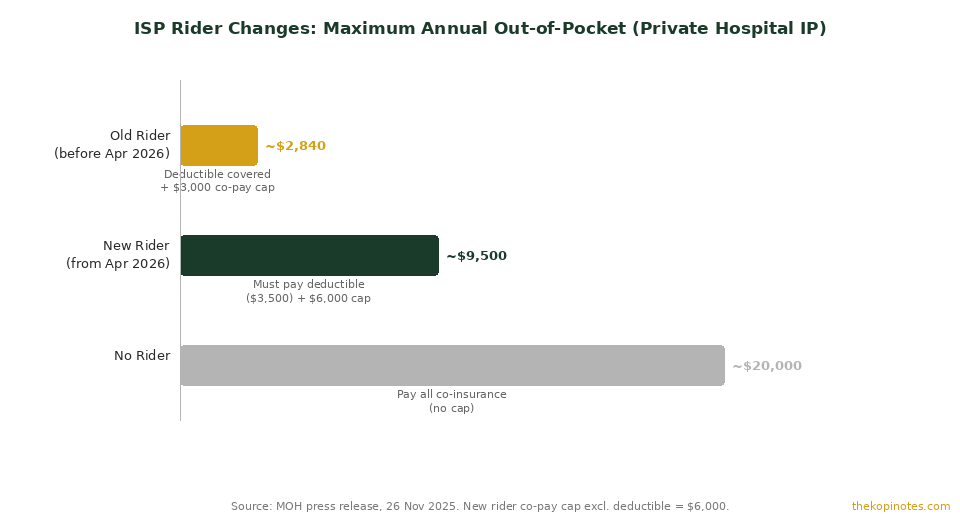
Maximum annual out-of-pocket under old rider vs new rider (from April 2026) for private hospital IP. Source: MOH press release, Nov 2025.
How to Pay Your MediShield Life Deductible
Good news: you don’t have to pay the deductible purely in cash. You have three options:
1. MediSave
This is the most common approach. Your MediSave account can cover the deductible directly, within the applicable MediSave hospitalisation withdrawal limits. For most Singaporeans with stable employment, your MediSave balance accumulates faster than you spend it, so the deductible is rarely a cash burden.
2. Cash or MediShield Life / IP payout balance
If your MediSave balance is low, you can pay the deductible in cash. In practice, this is rare for younger Singaporeans but more common for self-employed individuals or those with disrupted CPF contributions.
3. Co-payment via rider (partially, for old riders)
If you hold an older rider (purchased before 27 November 2025), your rider may currently cover the deductible. This benefit continues until your policy is migrated to the new framework (at the latest, by your next renewal after April 2028).
For reference on how MediSave accumulates and what you can withdraw, see the MediShield Life premium table and check if your MediSave balance is growing fast enough to cover these out-of-pocket amounts.
Should You Switch to the New IP Rider?
This is the key decision for existing rider holders. The answer depends on your health profile, age, and financial cushion.
| Factor | Keep Old Rider | Switch to New Rider |
|---|---|---|
| Annual premium | Higher (~$600–$800 more/yr for private hospital) | Lower (~30% saving) |
| Deductible covered? | Yes (old rider still covers it) | No — you pay $1,500–$3,500 |
| Co-payment cap | $3,000/yr | $6,000/yr |
| Best for | Frequent hospitalisations, older age groups | Younger / healthier with cash buffer |
Source: MOH press release, Nov 2025. Premiums are estimates; actual amounts vary by insurer and age.
For a 60-year-old private hospital IP holder, MOH estimates switching to the new rider saves $1,600/year in premiums. Even if hospitalised once in three years for a major procedure (paying an extra ~$3,330 in MediSave vs the old rider), the cumulative premium savings of $4,800 over three years still come out ahead.
However, if you’re in poor health and expect multiple hospitalisations per year, keeping the old rider may make more financial sense. Talk to your financial advisor before switching.
Bottom line: if you’re healthy and in your 30s–50s, the new rider’s 30% premium savings likely outweigh the higher deductible over time.
Frequently Asked Questions
What is the MediShield Life deductible for 2026?
As at June 2026, the MediShield Life deductible ranges from $500 (outpatient treatments) to $4,500 (Class A ward, age 81 and above) per policy year. For the most common scenario — a Singaporean aged 80 or below staying in a Class B2/B1 ward — the deductible is $2,500. Outpatient claims now carry a new $500 deductible from 1 June 2026. You only pay the deductible once per policy year, regardless of how many claims you make.
Can MediSave pay the MediShield Life deductible?
Yes. You can use your MediSave account to pay the deductible, subject to the prevailing MediSave hospitalisation withdrawal limits. For most Singaporeans with regular CPF contributions, your MediSave balance is sufficient to cover the deductible without touching cash savings.
What changed about the ISP deductible in April 2026?
From 1 April 2026, new IP riders sold can no longer cover the minimum IP deductible set by MOH. This minimum ranges from $1,500 (Class C ward) to $3,500 (Class A / private hospital). Before this change, comprehensive riders could pay the deductible for you, leaving you with near-zero out-of-pocket costs. That is no longer allowed for new riders. In exchange, new riders are roughly 30% cheaper in premiums.
Does the April 2026 rider change affect my existing rider?
If you purchased your rider before 27 November 2025, your existing policy terms are unchanged for now. Your insurer must inform you when your policy will be transitioned to the new framework — at the latest, at your next renewal after 1 April 2028. If you bought a new rider on or after 1 April 2026, the new rules apply from day one: your rider will not cover the minimum IP deductible.
How is the MediShield Life deductible different from the ISP deductible?
The MediShield Life deductible is set by CPF Board and applies to claims under the base MediShield Life scheme. If you hold an Integrated Shield Plan (ISP), your ISP sets its own deductible — which must meet MOH’s minimum IP deductible requirements. For most ISP holders, the relevant deductible is the IP deductible, which is equal to or higher than the MediShield Life deductible. If you downgrade to a lower ward class than your IP covers, the IP deductible applies at the lower ward class amount.
If I'm hospitalised twice in a year, do I pay the deductible twice?
No. The deductible is payable only once per policy year. Multiple claims within the same policy year all accumulate towards the single deductible. Once you’ve hit your deductible for the year — even across multiple hospital stays — MediShield Life (or your ISP) starts covering eligible claims from there onwards, subject to co-insurance.
What is the co-insurance rate under MediShield Life in 2026?
After paying the deductible, you also pay co-insurance — a percentage of the remaining claimable amount. The rate starts at 10% and decreases as the claimable amount grows, down to 3% for larger bills. For most standard admissions, you’ll pay 10% co-insurance on the first portion above the deductible. If you have a rider, the rider covers the co-insurance component — subject to the new $6,000 annual cap from April 2026.
Get Free Insurance Advice
Speak with a licensed insurance advisor. No obligation, no cost.
By submitting this form, you agree to our Privacy Policy.
This article was researched with the help of AI. While we strive to keep all information accurate and up to date, there may be errors. If you notice any discrepancies, please contact us.