Dividend Aristocrats ETF Singapore: How to Buy GBDV & USDV (2026 Guide)
A Singapore investor’s guide to Ireland-domiciled dividend growth ETFs — tax advantages, broker steps, and 2026 data.
Dividend Aristocrats ETFs like GBDV and USDV hold companies that have raised their dividend every year for 10 to 20-plus years straight. Both are Ireland-domiciled UCITS ETFs listed on the London Stock Exchange (LSE), so Singapore investors pay just 15% US withholding tax instead of 30%, with no US estate tax exposure — a real edge over buying the US-listed dividend aristocrat funds directly.
Not financial advice. All figures are for educational reference only. Data verified as at September 2026 unless otherwise noted.
- GBDV (global) and USDV (US) are the two flagship LSE-listed Dividend Aristocrats UCITS ETFs — both Ireland-domiciled, so you pay 15% US withholding tax, not 30%
- USDV has a lower TER (0.35%) but a lower yield (~2%) than GBDV (0.45% TER, ~3.8% yield), because it prioritises 20+ years of consistent dividend growth over high current income
- Buy either through IBKR, Saxo, moomoo, or Syfe Brokerage; not CPF-investable, but SRS-compatible via eligible brokers
Table of Contents
Contents — Click to expand
- What Is a Dividend Aristocrats ETF?
- Key Facts: GBDV vs USDV at a Glance
- Why Singapore Investors Buy Dividend ETFs on the LSE
- Expense Ratio and Total Costs
- How to Buy GBDV or USDV in Singapore
- Dividend Aristocrats ETFs vs Alternatives
- Who Should Buy a Dividend Aristocrats ETF?
- Frequently Asked Questions
What Is a Dividend Aristocrats ETF?
A Dividend Aristocrat is a company that has raised its dividend every year for a long stretch. No cuts. No freezes. Just steady increases, year after year — through recessions, rate hikes, and downturns.
The exact bar depends on the index. GBDV tracks the S&P Global Dividend Aristocrats index, which needs at least 10 consecutive years of dividend growth from companies worldwide. USDV tracks the S&P High Yield Dividend Aristocrats index, which requires 20 straight years of increases from US-listed companies in the S&P Composite 1500.
Why does the streak matter? A company that keeps raising its payout through tough cycles is usually financially disciplined, with durable cash flow. That is the quality screen behind these ETFs — they are not simply chasing whichever stock has the highest yield today. In fact, USDV’s yield (around 2%) is lower than GBDV’s (around 3.8%), because it prioritises consistency over current income. You will see why that matters in the fees section below.
Both GBDV and USDV are Ireland-domiciled UCITS ETFs. Both use full physical replication — they buy the actual underlying shares rather than tracking through swaps. GBDV holds around 90 companies worldwide; USDV holds around 155 US companies, including names like Verizon, Realty Income, and PepsiCo. Both pay dividends out quarterly instead of automatically reinvesting them.
Performance-wise, GBDV returned about 18% over the past year and roughly 46% over five years, in EUR terms as at July 2026. USDV’s five-year return is similar at around 42%, though its short-term numbers have been choppier — it was down nearly 5% in 2025 alone. Past performance does not predict future returns, but it shows both funds have kept pace reasonably well despite their more defensive tilt.
Key Facts: GBDV vs USDV at a Glance
Here is how the two funds stack up side by side.
| Metric | GBDV (Global) | USDV (US) |
|---|---|---|
| Full Name | SPDR S&P Global Dividend Aristocrats UCITS ETF | SPDR S&P US Dividend Aristocrats UCITS ETF |
| Ticker (LSE, GBP) | GBDV | USDV |
| Ticker (LSE, USD) | GLDV | UDVD |
| Index Tracked | S&P Global Dividend Aristocrats | S&P High Yield Dividend Aristocrats |
| Domicile | Ireland | Ireland |
| Structure | Distributing (quarterly) | Distributing (quarterly) |
| TER | 0.45% p.a. | 0.35% p.a. |
| Fund Size (AUM) | ~EUR 1.53 billion | ~EUR 3.35 billion |
| Number of Holdings | ~92 | ~155 |
| Dividend Yield | ~3.8% | ~2.0% |
| Inception Date | 14 May 2013 | 14 October 2011 |
| Currency | USD | USD |
Source: justETF fund data (ISIN IE00B9CQXS71 / IE00B6YX5D40), as at 31 July 2026.
Why Singapore Investors Buy Dividend Aristocrats ETFs on the LSE
You could buy a US-listed dividend aristocrats ETF directly — like NOBL, the ProShares S&P 500 Dividend Aristocrats ETF. But for a Singapore investor, that is usually the more expensive route.
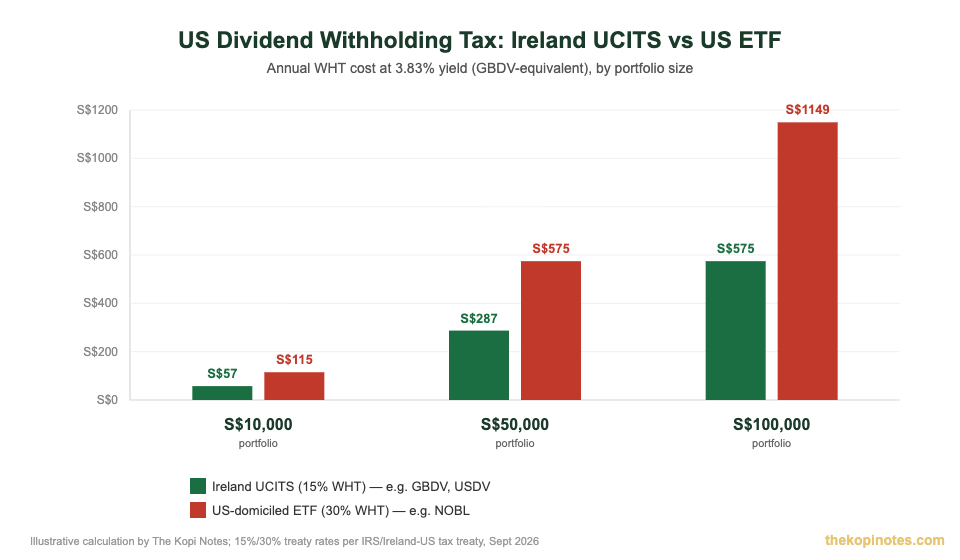
Here is why. The US withholds tax on dividends paid to non-resident investors. For a US-domiciled ETF, that rate is 30%. GBDV and USDV are domiciled in Ireland, which has a tax treaty with the US. Under that treaty, the withholding rate drops to 15% on US-source dividends flowing into the fund. That is a straightforward, permanent cost saving — every single year you hold the ETF.
There is a second, bigger risk with US-domiciled funds: US estate tax. If you hold more than USD 60,000 in US-situs assets — which includes US-domiciled ETFs — at the time of your death, your estate can be taxed at rates up to 40% on the excess. This applies to non-US citizens and non-residents, including Singaporeans. Ireland-domiciled UCITS ETFs like GBDV and USDV fall outside this rule entirely.
On top of that, Singapore has no capital gains tax and no tax on dividend income received by individuals. So once the 15% US withholding is deducted at source, that is the end of the tax drag — you do not owe Singapore any further tax on your GBDV or USDV dividends.
| ETF Type | Domicile | US Dividend WHT | US Estate Tax Risk |
|---|---|---|---|
| GBDV / USDV (LSE) | Ireland | 15% | None |
| NOBL (NYSE Arca) | USA | 30% | Yes (above USD 60k) |
Source: IRS estate tax rules for non-resident aliens; Ireland-US double tax treaty, Sept 2026.
Expense Ratio and Total Costs
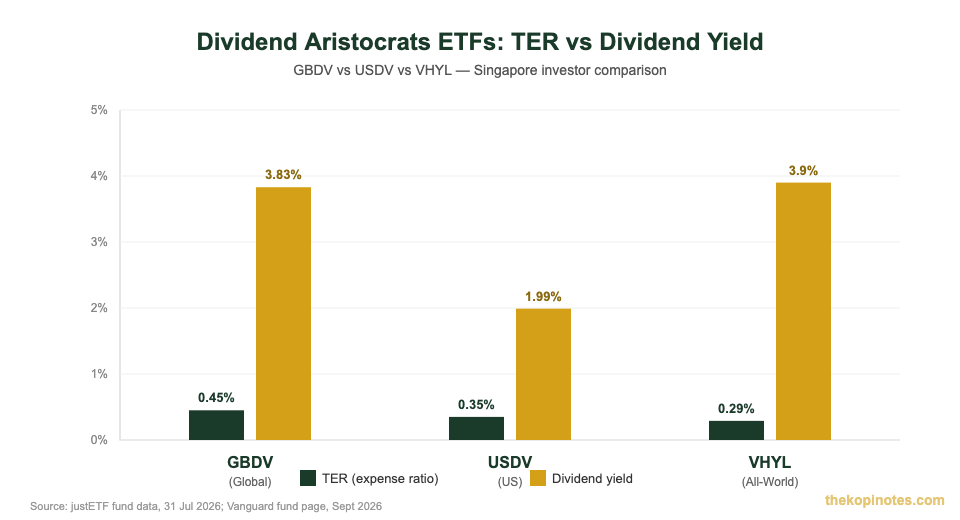
USDV’s TER is 0.35% a year. GBDV’s is 0.45%. That difference reflects the narrower US-only holding set versus GBDV’s global reach, plus GBDV’s smaller fund size.
To put this in dollar terms: on a SGD 50,000 position, USDV costs you about SGD 175 a year in fund fees. GBDV costs about SGD 225 a year. That is on top of your broker’s commission and any FX spread when you convert SGD to USD or GBP to buy the shares.
Compare that to VHYL, the Vanguard FTSE All-World High Dividend Yield UCITS ETF, which charges just 0.29% — the cheapest of the three. VHYL is not a strict “dividend aristocrats” fund since it screens for high current yield rather than a multi-year growth streak, but it is a common alternative worth knowing about. We cover it in the comparison table below.
Here is the thing though: the 15% vs 30% withholding tax difference usually matters more than the TER gap between these funds. A 0.10% TER difference on a SGD 50,000 portfolio is about SGD 50 a year. The WHT saving from choosing an Ireland-domiciled fund over a US-domiciled one, at a 3.8% yield, is roughly SGD 287 a year on the same portfolio size. The chart below breaks this down across three portfolio sizes.
How to Buy GBDV or USDV in Singapore (Step-by-Step)
Both ETFs trade on the London Stock Exchange. GBDV and USDV are the GBP-denominated tickers; GLDV and UDVD are the USD-denominated versions of the same funds on the same exchange. Pick whichever currency line matches how you plan to fund your account.
Interactive Brokers (IBKR)
IBKR gives you direct LSE access and typically the lowest total cost for larger portfolios, thanks to tight commissions and competitive FX rates. Fund your account, search “GBDV” or “USDV” in the search bar, confirm you have selected the London Stock Exchange listing, and place a limit order. IBKR is the most cost-effective choice once your position size grows past a few thousand SGD.
Saxo Markets
Saxo also offers direct LSE access with a clean interface, though its FX conversion fee tends to run higher than IBKR’s for smaller trade sizes. It is a solid middle-ground option if you want a slightly more beginner-friendly platform without going through a robo-advisor.
moomoo Singapore
moomoo offers access to LSE-listed ETFs including GBDV and USDV, alongside its usual US and SG market coverage. If you are already using moomoo for US stocks, adding LSE-listed dividend aristocrat ETFs to the same account keeps things simple. Read our moomoo Singapore review for a full breakdown of its fees and platform features.
Syfe Brokerage
Syfe Brokerage supports LSE-listed ETFs too, and it is arguably the simplest on-ramp if you are new to investing — one app, no separate currency wallets to manage manually. Check the Syfe referral code and sign-up bonus if you are opening a new account.
Whichever broker you use, the process is the same: fund your account, search the ticker, confirm the LSE listing rather than a similarly-named fund on another exchange, and place your order. Because both ETFs distribute dividends quarterly, expect a payout roughly every three months once you hold shares.
Dividend Aristocrats ETFs vs Alternatives
GBDV and USDV are not the only way to get dividend-focused exposure on the LSE. Here is how they stack up against three common alternatives.
| ETF | TER | Index | Structure | AUM | Best For |
|---|---|---|---|---|---|
| GBDV | 0.45% | S&P Global Div. Aristocrats | Distributing | ~€1.5bn | Global dividend growth, quality tilt |
| USDV | 0.35% | S&P High Yield Div. Aristocrats | Distributing | ~€3.4bn | US-only, lower yield / higher quality |
| VHYL | 0.29% | FTSE All-World High Div. Yield | Distributing | ~€9.8bn | Cheapest, highest current yield |
| NOBL (US) | ~0.35% | S&P 500 Dividend Aristocrats | US-domiciled | — | Avoid for SG investors — 30% WHT + estate tax risk |
| CSPX | 0.07% | S&P 500 | Accumulating | Large | Broad market growth, not dividend-focused |
Source: justETF fund data, 31 Jul 2026; SPDR/State Street factsheets.
VHYL is the cheapest and has the broadest spread of holdings, but it screens purely on current yield rather than a multi-year growth streak. That means it can hold companies whose dividends are high today but not necessarily sustainable. NOBL tracks the same US Dividend Aristocrats concept as USDV, but because it is US-domiciled, Singapore investors face the 30% withholding tax and US estate tax exposure discussed above — it is rarely the better choice for an SG-based portfolio. CSPX and VWRA remain the default broad-market building blocks; if you are prioritising total return over income, our CSPX buying guide covers that path in full. If you would rather stay in the S-REIT space for income, see our best S-REITs in Singapore 2026 roundup, and our VWRA dividend guide explains why that broad-market fund pays no direct dividend at all.
Who Should Buy a Dividend Aristocrats ETF?
A dividend aristocrats ETF fits you if: you want a steadily growing income stream rather than the highest yield available today. You are building a portfolio for retirement income and value consistency over a bumpy high-yield ride. You already hold a core broad-market ETF like CSPX or VWRA and want to add a quality-income tilt alongside it, not instead of it.
Consider alternatives if: you want maximum current yield and can tolerate more volatility — VHYL or an S-REIT-focused approach may suit you better. You are still in the accumulation phase and do not need income payouts yet — an accumulating fund like CSPX compounds more efficiently since there is no dividend leakage to reinvest manually.
One planning note: GBDV and USDV are not CPFIS-approved, so you cannot buy them with your CPF Ordinary Account funds. They are typically purchasable with Supplementary Retirement Scheme (SRS) funds through brokers that support SRS trading — check with your broker first, as not all of them do. If you are mapping out how ETFs like these fit into your broader retirement plan, our CPF investment strategy guide and Singapore retirement calculator are good next stops.
Frequently Asked Questions
What is a Dividend Aristocrats ETF?
It is an ETF that holds only companies with a long streak of annual dividend increases — 10 or more years for GBDV’s global index, 20 or more years for USDV’s US index. The goal is to capture financially disciplined, quality companies rather than simply the highest current yield.
Is GBDV the same as USDV?
No. GBDV tracks the S&P Global Dividend Aristocrats index and holds around 90 companies worldwide, with a current yield near 3.8% and a 0.45% TER. USDV tracks the S&P High Yield Dividend Aristocrats index and holds around 155 US-only companies, with a lower yield near 2% and a cheaper 0.35% TER.
Can I buy GBDV or USDV using my CPF or SRS funds?
They are not CPFIS-approved, so CPF Ordinary Account funds cannot be used. Some brokers support buying LSE-listed ETFs with SRS funds — confirm this with your broker before assuming it is available.
Which broker is best for buying dividend aristocrats ETFs in Singapore?
Interactive Brokers is usually the most cost-effective for larger portfolios thanks to low commissions and tight FX spreads. Saxo and moomoo both offer straightforward LSE access, and Syfe Brokerage is a simple option if you are new to investing.
Why is USDV's dividend yield lower than GBDV's, given it is called high yield?
The name refers to the underlying index category, not the fund’s current payout. USDV’s 20-year consecutive-increase requirement filters out high-yield-but-risky stocks in favour of steady growers like Verizon and PepsiCo, which naturally have lower starting yields than deep-value, high-yield names.
What are the risks of dividend aristocrats ETFs?
They can underperform in strong growth-led bull markets, since they tilt toward defensive, mature companies rather than fast-growing ones. They are also not immune to market-wide drawdowns — GBDV fell around 18.8% from peak to trough over the past five years despite its quality screen. Currency risk applies too, since both funds are USD-denominated.
Ready to Start Investing in Dividend Aristocrats ETFs?
Open a brokerage account and buy GBDV or USDV today. Use our referral links for exclusive sign-up bonuses.
This article was researched with the help of AI. While we strive to keep all information accurate and up to date, there may be errors. If you notice any discrepancies, please contact us.