Japan REIT ETF Singapore: How to Buy 1343, 1476 & 1345 (2026 Guide)
A Singapore investor’s guide to buying Tokyo-listed J-REIT ETFs — costs, withholding tax, broker access and 2026 data.
1343 (NEXT FUNDS TSE REIT Index ETF) is the most liquid way for Singapore investors to buy a basket of Japanese REITs on the Tokyo Stock Exchange, with a 0.21% total expense ratio and a 4.78% distribution yield as at 1 September 2026. Unlike S-REITs, J-REIT ETFs give you exposure to Tokyo and Osaka office, retail and logistics property — but distributions face a 15.315% Japanese withholding tax at source.
Not financial advice. All figures are for educational reference only. Data verified as at 2 September 2026 unless otherwise noted.
- 1343 is the largest and most liquid Japan REIT ETF — ¥537.6 billion in net assets, 0.21% TER, 4.78% yield — the default pick for most Singapore investors.
- You need a broker with direct Tokyo Stock Exchange access. Interactive Brokers offers this; many Singapore retail brokers don’t, so check before you assume you can buy a specific TSE ticker.
- Distributions are withheld at 15.315% in Japan before they reach you, with no further tax in Singapore — factor this into your net yield calculation.
What Is a Japan REIT ETF?
A J-REIT is a Japanese Real Estate Investment Trust — the same basic structure as a Singapore S-REIT, but from a much older and larger market. Japan launched the world’s second REIT regime back in 2001, and today around 58 J-REITs trade on the Tokyo Stock Exchange (TSE), holding everything from Tokyo office towers and Osaka shopping malls to logistics warehouses and residential blocks.
A Japan REIT ETF is simply a fund that buys all (or most) of those J-REITs in proportion to the Tokyo Stock Exchange REIT Index, so you get diversified exposure to the entire J-REIT market in one trade instead of picking individual REITs. You still need a brokerage account that can trade Tokyo-listed securities, because these ETFs are not listed in Singapore.
Three main options exist for Singapore investors: 1343 (NEXT FUNDS TSE REIT Index ETF, managed by Nomura), 1476 (iShares Core Japan REIT ETF, managed by BlackRock), and 1345 (Listed Index Fund J-REIT, managed by Amova Asset Management, formerly Nikko Asset Management). All three track the same underlying index but differ in cost, size and distribution schedule — covered in the comparison table below.
1343 Key Facts at a Glance
| Metric | Detail |
|---|---|
| Full Name | NEXT FUNDS Tokyo Stock Exchange REIT Index Exchange Traded Fund |
| Ticker (TSE) | 1343 (Bloomberg: 1343 JP) |
| Index Tracked | Tokyo Stock Exchange REIT Total Return Index |
| Domicile / Manager | Japan — Nomura Asset Management |
| Structure | Distributing, quarterly (Feb / May / Aug / Nov, 10th) |
| Total Expense Ratio | 0.21% p.a. (trust fee 0.1705%, period Nov 2025–May 2026) |
| Net Assets (AUM) | ¥537.56 billion (as at 1 Sep 2026) |
| Distribution Yield | 4.78% (trailing 12 months, as at 1 Sep 2026) |
| Listed Since | 18 September 2008 |
| ISIN | JP3047010008 |
Source: NEXT FUNDS official fund page, Nomura Asset Management, as at 1 September 2026.
Why Japan REITs in 2026
Japan spent decades with near-zero interest rates, which kept J-REIT borrowing costs low and valuations rich. That changed when the Bank of Japan (BOJ) exited negative rates in 2024 and has since raised rates gradually. Higher rates mean higher borrowing costs for REITs and higher yields on “risk-free” Japanese government bonds — both work against REIT prices in the short term.
You can see this in the numbers. iShares’ own data for 1476 shows a net asset value total return of roughly −7.7% year-to-date as at 25 August 2026, even though the fund’s 1-year total return to end-June 2026 was still positive at around 4.2%. In other words, 2026 has been a bumpy year for J-REIT prices — but the underlying cash distributions have kept climbing regardless. 1343’s per-unit payout rose from ¥1,880 in August 2020 to ¥2,060 in August 2026, even through the rate-normalisation period.
For a Singapore investor, the case for Japan REITs isn’t about timing the BOJ perfectly — it’s diversification. Most local portfolios are already concentrated in Singapore REIT ETFs and individual S-REITs, all exposed to the same small property market and the same SGX. Japan’s real estate market is many times larger, moves on a different interest rate cycle, and the current weak yen means Singapore dollars stretch further when converted into JPY-denominated assets.
That said, currency risk cuts both ways. If the yen strengthens back toward its historical average against the SGD, your JPY-denominated returns get a boost when converted home. If it weakens further, the opposite happens. Don’t buy a Japan REIT ETF purely as a currency bet — treat the FX exposure as a side effect of the property exposure, not the main reason to buy.
Market Access & Withholding Tax
Japan REIT ETFs trade only on the Tokyo Stock Exchange, in Japanese yen, under numeric tickers — not letter tickers like US or LSE-listed ETFs. That means two things you need to check before you buy: whether your broker gives you direct TSE market access, and how much tax gets withheld from your distributions before they reach you.
Broker access. Interactive Brokers offers direct Tokyo Stock Exchange market access to Singapore account holders, which makes it the most reliably confirmed route to buy 1343, 1476 or 1345 directly. Not every Singapore broker lists Japan-listed REIT ETFs for retail trading — some platforms cover Japan only for a handful of large-cap Nikkei names, if at all. Robo-advisors and thematic investing apps like Syfe are not built for picking individual Tokyo-listed tickers either. Always search the exact 4-digit code inside your broker’s platform first, rather than assuming a specific TSE ETF is available.
Withholding tax. Japan withholds tax at source on distributions paid to non-resident individual investors. For listed investment-trust distributions — which is how J-REIT ETFs like 1343, 1476 and 1345 are categorised — the standard non-treaty rate is 15.315%. Ordinary equity dividends can sometimes qualify for a reduced rate under the Japan–Singapore tax treaty, but that reduced treaty rate does not automatically extend to investment-trust distributions in the same way, and few retail brokers file the paperwork to claim treaty relief on ETF distributions. In practice, plan for the full 15.315% to be withheld at source. Singapore does not tax foreign-sourced dividend income received by individuals and has no capital gains tax, so there is no further Singapore-side tax on top — but there is also no mechanism to reclaim the Japanese withholding. Tax treaty positions can change, so confirm the current treatment with your broker or a tax advisor before relying on this for a large position.
| Factor | Japan REIT ETF (1343) | Singapore REIT ETF |
|---|---|---|
| Exchange | Tokyo Stock Exchange | SGX |
| Trading Currency | JPY | SGD |
| Withholding Tax on Distributions | 15.315% (Japan, at source) | 0% for SG individual investors |
| CPF-OA Eligible | No | Some — check the CPFIS list |
| Minimum Trade Size (approx.) | ¥19,400 (≈ SGD 155) for 1343 | 1 board lot (100 units) |
Source: NEXT FUNDS fund page, PwC Japan Tax Summaries (withholding taxes), as at 1–2 September 2026. Consult a tax advisor for your specific situation.
1343 vs 1476 vs 1345: Which Japan REIT ETF Should You Buy?
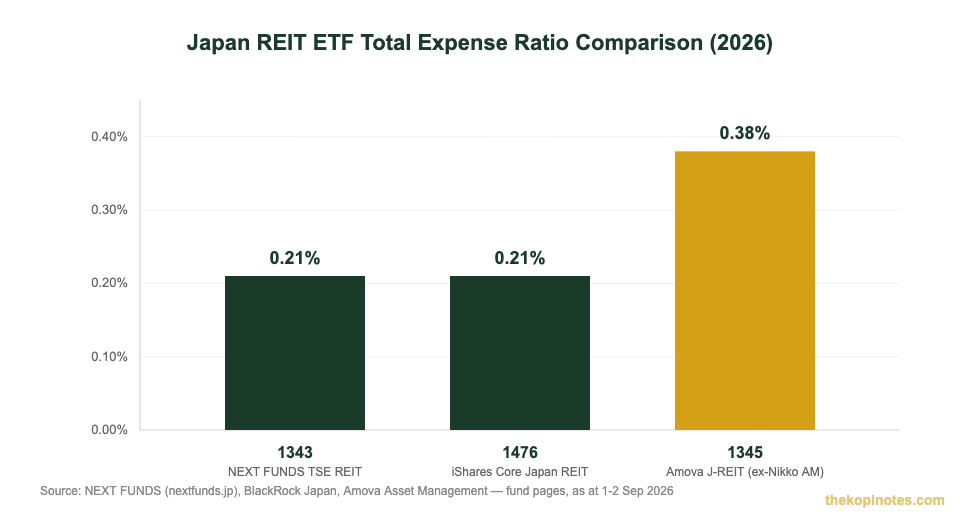
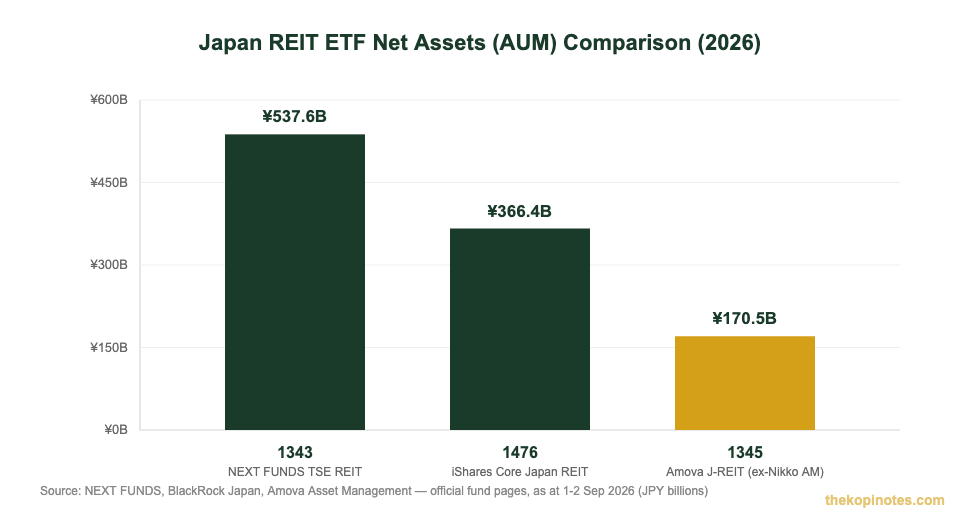
All three ETFs track the same benchmark — the Tokyo Stock Exchange REIT Index — so the differences come down to cost, size, liquidity and how often they pay out. For most Singapore investors, 1343 is the simplest default: it’s the largest, has the tightest bid-ask spreads, and its 0.21% TER is tied for the lowest of the three.
| ETF | Ticker | TER | AUM | Yield | Distributions | Best For |
|---|---|---|---|---|---|---|
| NEXT FUNDS TSE REIT Index ETF | 1343 | 0.21% | ¥537.6B | 4.78% | Quarterly | Most Singapore investors — largest & most liquid |
| iShares Core Japan REIT ETF | 1476 | ≈0.21% | ¥366.4B | 4.83% | Quarterly | Investors who prefer the BlackRock/iShares brand and single-unit trading |
| Amova Listed Index Fund J-REIT | 1345 | 0.38% | ¥170.5B | n/a | Bi-monthly (6x/yr) | Investors who want more frequent, smaller payouts |
Source: NEXT FUNDS, BlackRock Japan, Amova Asset Management — official fund pages, as at 1–2 September 2026. TER = total expense ratio; AUM in JPY billions.
1476’s slightly higher trailing yield and near-identical TER make it a reasonable substitute for 1343, and its 1-unit minimum trade size (versus 1343’s 10-unit lot) makes it marginally more accessible for smaller portfolios. 1345 costs more (0.38% TER) for the same underlying index exposure, but its bi-monthly payout schedule may suit investors who want cash flow every two months rather than quarterly.
How to Buy a Japan REIT ETF in Singapore
Here’s the practical, step-by-step process:
1. Open or fund a broker account with Tokyo Stock Exchange access. Interactive Brokers is the most reliably confirmed option for Singapore residents who want to trade Japan-listed securities directly. Before funding, log into your broker’s platform and search the numeric ticker (1343, 1476 or 1345) to confirm it’s actually tradable — don’t assume every broker that lists Japan covers REIT ETFs specifically.
2. Convert SGD to JPY. Most brokers let you fund in SGD and convert to JPY at the point of trade, or hold a JPY sub-account. Compare your broker’s FX spread against a standalone converter — on a SGD 5,000 trade, even a 0.5 percentage point difference in FX spread works out to about SGD 25.
3. Place your order in JPY, in board lots. 1343 trades in lots of 10 units, so at a share price of ¥1,940 (1 September 2026), one lot costs roughly ¥19,400 — about SGD 155 at current rates. 1476 trades in single units, making it accessible from around SGD 15 per unit.
4. Decide what to do with JPY distributions. Distributions land in your JPY sub-account. You can leave them in JPY to reinvest without paying FX spread twice, or convert back to SGD if you want the cash at home. Either way, remember the 15.315% Japanese withholding tax has already been deducted before the distribution reaches your account.
5. Track your total cost, not just the TER. Between the TER (0.21% for 1343), the FX spread on conversion, and the 15.315% withholding drag on distributions, your effective annual cost is higher than the headline expense ratio suggests. Build that into your comparison against a Singapore S-REIT holding, which carries no such withholding tax.
Who Should Buy a Japan REIT ETF?
A Japan REIT ETF is a fit if: you already hold a concentrated position in S-REITs or the Singapore REIT ETF and want geographic diversification into a larger, more liquid property market; you have a brokerage account with confirmed TSE access and are comfortable trading in JPY; and you can look past near-term price volatility from BOJ rate hikes toward the underlying distributable income, which has kept growing.
Consider alternatives if: you specifically want CPF-OA eligible instruments — J-REIT ETFs are not on the CPFIS list, so check our CPF investment strategy guide for what qualifies; you want to avoid the 15.315% withholding drag entirely, in which case an SGX-listed S-REIT ETF is more tax-efficient for a Singapore individual investor; or you’re not ready to take on additional JPY currency risk on top of your existing SGD and USD exposure. If you’re building a broader retirement portfolio and want to see how a Japan REIT allocation fits your numbers, our retirement planning calculator can help you model different allocations.
Frequently Asked Questions
What is a Japan REIT ETF and how does it work?
A Japan REIT ETF is a fund that buys a basket of Japanese Real Estate Investment Trusts (J-REITs) listed on the Tokyo Stock Exchange, tracking the Tokyo Stock Exchange REIT Index. Instead of picking individual J-REITs, you buy one ticker — such as 1343 — and get proportional exposure to around 58 underlying REITs covering office, retail, logistics and residential property across Japan.
Is 1343 the best Japan REIT ETF for Singapore investors?
1343 is the largest and most liquid option, with ¥537.6 billion in net assets and a 0.21% expense ratio as at September 2026, which makes it the simplest default choice. 1476 (iShares) is a close alternative with a similar cost and a slightly higher trailing yield, while 1345 (Amova) costs more but pays out six times a year instead of quarterly.
Can I buy 1343 or 1476 using my CPF or SRS funds?
No, Japan REIT ETFs listed on the Tokyo Stock Exchange are not on the CPFIS list, so you cannot use CPF Ordinary Account funds to buy them. SRS funds can sometimes be used for foreign-listed securities depending on your SRS operator bank and linked brokerage, but this is uncommon for Japan-listed tickers — check with your SRS bank before assuming it’s possible.
How much withholding tax do I pay on Japan REIT ETF distributions?
Japan withholds tax at source on investment-trust distributions paid to non-resident individual investors, and the standard rate for J-REIT ETFs like 1343, 1476 and 1345 is 15.315%. This is deducted before the distribution reaches your brokerage account. Singapore does not tax foreign-sourced dividends for individuals and has no capital gains tax, so there is no additional Singapore-side tax, but there is also no straightforward way to reclaim the Japanese withholding as a retail investor.
Which broker can Singapore investors use to buy Japan REIT ETFs?
Interactive Brokers offers confirmed direct access to the Tokyo Stock Exchange for Singapore account holders. Not all Singapore brokers support TSE trading, and even fewer support niche REIT ETFs specifically, so search the exact 4-digit ticker inside your broker’s platform before assuming it’s available.
How is a Japan REIT ETF different from a Singapore REIT ETF?
A Singapore REIT ETF, such as the Lion-Phillip S-REIT ETF, trades on SGX in SGD with no withholding tax for Singapore individual investors and can be CPF-OA eligible. A Japan REIT ETF trades on the TSE in JPY, carries a 15.315% withholding tax on distributions, and gives you exposure to a much larger property market with a different interest rate cycle — useful for diversification, but with extra currency and tax friction.
Ready to Diversify Beyond Singapore REITs?
Open a brokerage account and start building a globally diversified income portfolio. Use our referral links for exclusive sign-up bonuses.
This article was researched with the help of AI. While we strive to keep all information accurate and up to date, there may be errors. If you notice any discrepancies, please contact us.