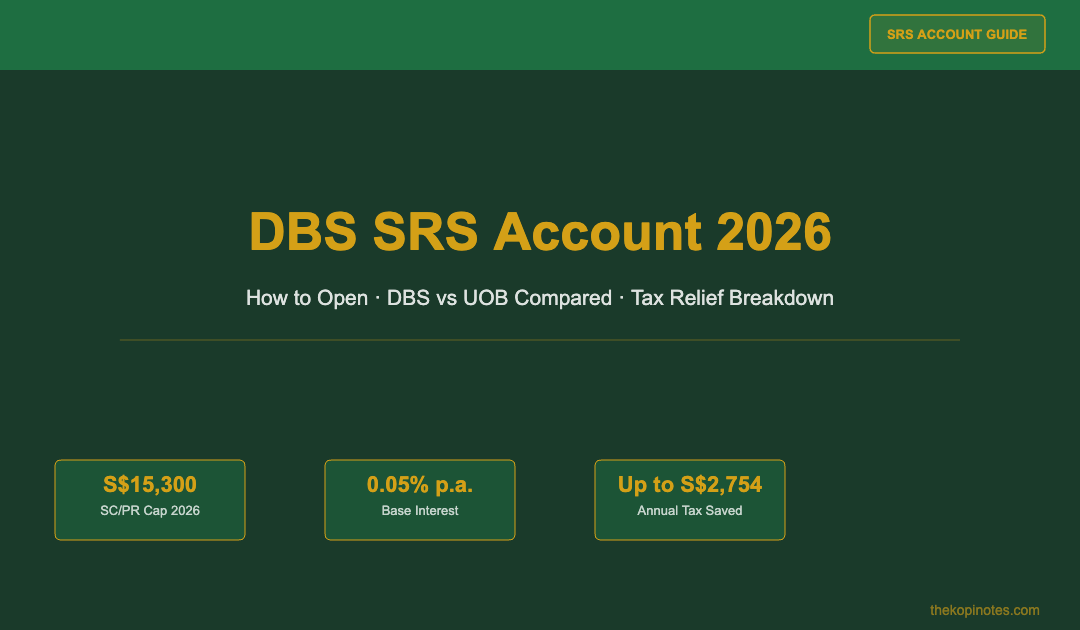
DBS SRS Account 2026: How to Open, Benefits & DBS vs UOB Compared
Tax relief up to S$2,754/year · Open in 5 minutes online · Full DBS vs UOB breakdown
A DBS SRS (Supplementary Retirement Scheme) account lets Singapore residents save for retirement while cutting their income tax bill. For 2026, SC/PR contributors can put in up to S$15,300 per year and receive a full tax deduction on every dollar — saving up to S$2,754 in taxes at the S$200,000 income level. Opening takes under 5 minutes via DBS digibank, and you can immediately invest your SRS funds in stocks, ETFs, SSBs, and unit trusts.
Not financial advice. All figures are for educational reference only and based on data as at September 2026 unless noted.
- SRS contributions are fully tax-deductible — the higher your income, the more you save
- DBS and UOB offer virtually identical SRS accounts; your existing bank relationship usually decides
- Top up before 31 Dec each year to claim the tax relief in that Year of Assessment
Free download: The Singapore Money Playbook — 7 money mindset shifts written for Singapore, with the CPF-adjusted retirement number most guides get wrong (PDF + Notion).
What Is an SRS Account?
The Supplementary Retirement Scheme (SRS) is a voluntary savings scheme managed by the Ministry of Finance and offered through three banks: DBS, OCBC, and UOB. It works alongside your CPF — but unlike CPF, you choose how much to contribute and when, and the funds are yours to invest freely.
You hold one SRS account with one bank. That bank holds your cash SRS balance and pays 0.05% per annum — essentially a placeholder rate. The real value is in what you do with the money after depositing it.
Every dollar you contribute is deducted from your chargeable income for that Year of Assessment. If you pay tax at a 15% marginal rate and contribute S$15,300, you instantly save S$2,295 in income tax. Foreigners working in Singapore get a higher cap of S$35,700 per year.
You can model how SRS fits into your overall retirement number using the Singapore retirement calculator on this site.
Key Benefits of SRS in 2026
Three things make SRS genuinely useful for most working Singaporeans.
1. Upfront tax relief. Contributions reduce your chargeable income in the year you deposit. Top up before 31 December and you claim the relief in the following Year of Assessment. No deferral, no hoops.
2. Tax-free compounding during accumulation. Any gains your SRS investments make — dividends from stocks, distributions from unit trusts, interest from SSBs — are not taxed while the money sits in the SRS account. You only pay tax on withdrawal.
3. 50% withdrawal concession at retirement. When you withdraw at or after your statutory retirement age, only 50% of each withdrawal is added to your taxable income. Spread withdrawals over 10 years and most retirees pay zero tax on SRS — because their income stays below the S$20,000 tax-free threshold.
| Feature | SRS | CPF OA |
|---|---|---|
| Contribution | Voluntary (up to S$15,300/yr SC/PR) | Mandatory (employer + employee) |
| Tax deductible? | Yes — full deduction | Yes (employee portion) |
| Interest on cash | 0.05% p.a. | 2.5% p.a. (floor) |
| Investment options | SGX stocks, ETFs, unit trusts, SSBs, T-bills | CPF-approved unit trusts & stocks only |
| Withdrawal tax | 50% of withdrawal taxable | Not taxable |
Source: CPF Board, Ministry of Finance, September 2026
How to Open a DBS SRS Account
Opening a DBS SRS account takes about 5 minutes if you already have a DBS/POSB savings account. Here is the exact process.
Step 1: Log in to DBS digibank. Open the DBS digibank app or visit dbs.com.sg. Log in with your ibanking credentials.
Step 2: Navigate to Invest → SRS. In the app, tap More → Wealth → SRS. On desktop, go to Invest → Supplementary Retirement Scheme.
Step 3: Apply online. DBS pre-fills your NRIC, name, and contact details. Review, agree to the terms, and confirm. No physical form needed.
Step 4: Receive your SRS account number. Your 10-digit SRS account number appears instantly. It looks like a regular DBS account number.
Step 5: Make your first contribution. Transfer from your DBS savings or current account to your SRS account. The transfer is instant and appears in digibank immediately.
Foreigners working in Singapore: S$35,700 / year
Important: you can only hold one SRS account across all three banks. Once you open with DBS, you cannot open another with UOB or OCBC. Choose based on where your main savings account is held.
For context on how SRS fits into your broader CPF and investment strategy, see the CPF investment strategy guide.
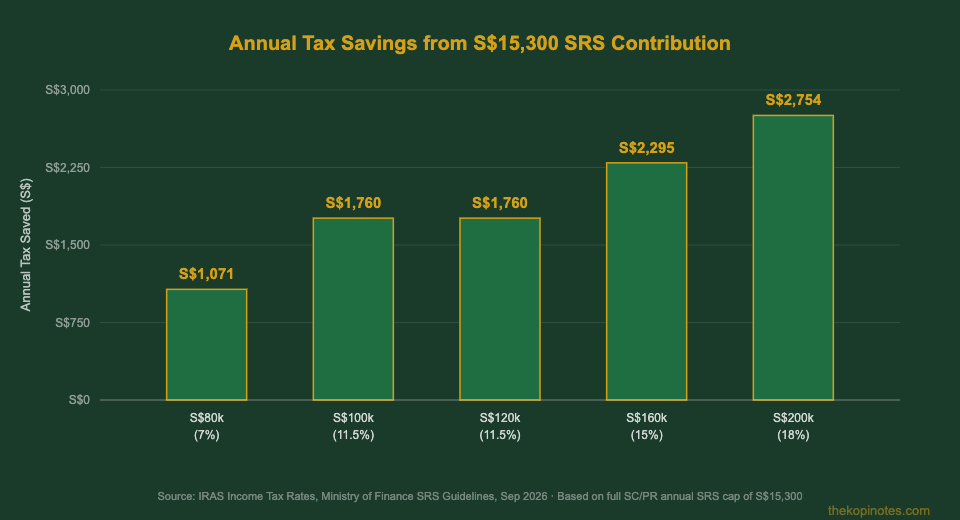
SRS Tax Relief: How Much Do You Actually Save?
The tax savings depend on your marginal tax rate — the rate applied to your top slice of income. Here is what a full S$15,300 SC/PR contribution saves at different income levels.
| Chargeable Income | Marginal Rate | Annual Tax Saved | 10-Year Cumulative |
|---|---|---|---|
| S$80,000 | 7.0% | S$1,071 | S$10,710 |
| S$100,000 | 11.5% | S$1,760 | S$17,595 |
| S$120,000 | 11.5% | S$1,760 | S$17,595 |
| S$160,000 | 15.0% | S$2,295 | S$22,950 |
| S$200,000 | 18.0% | S$2,754 | S$27,540 |
Source: IRAS income tax rates, Ministry of Finance SRS guidelines, September 2026. Based on full S$15,300 SC/PR annual contribution.
At S$100,000 chargeable income, contributing S$15,300 saves S$1,760 immediately — that is an instant 11.5% return on day one, before you have even invested the SRS funds. Layer investment returns on top and the compounding effect over 20 years is substantial.
DBS vs UOB SRS Account: Which Should You Pick?
Both banks offer the same government-mandated SRS product. The contribution limits, interest rate (0.05% p.a.), and tax rules are identical. The difference comes down to your investment platform and existing banking relationship.
| Feature | DBS SRS | UOB SRS |
|---|---|---|
| Interest Rate | 0.05% p.a. | 0.05% p.a. |
| Online Opening | DBS digibank app & web | UOB TMRW app or UOB PIB |
| Stock/ETF Trading | DBS Vickers (0.18%, min S$10) | UOB Kay Hian (0.18%, min S$10) |
| Unit Trusts | DBS Wealth / iFAST via DBS | UOB Asset Management / iFAST via UOB |
| Robo-Advisory | digiPortfolio (SRS eligible) | Not directly integrated |
| T-Bills / SSBs via SRS | Yes | Yes |
| External Robo Platforms | Endowus, Syfe (link SRS) | Endowus, Syfe (link SRS) |
Source: DBS, UOB product pages, September 2026. Commission rates may vary — check directly with each bank before trading.
Bottom line: if you bank with DBS, open SRS with DBS. UOB customer? Go UOB. The brokerage commissions are the same, the interest rate is identical, and both connect to Endowus (referral code 2V343) and Syfe (code SRPRFFFCD) for lower-cost investment options.
The one edge DBS has is digiPortfolio — a simple robo-advisor that accepts SRS funds directly within the DBS app. UOB does not offer a comparable integrated option, pushing UOB SRS holders to external platforms for robo-advisory.
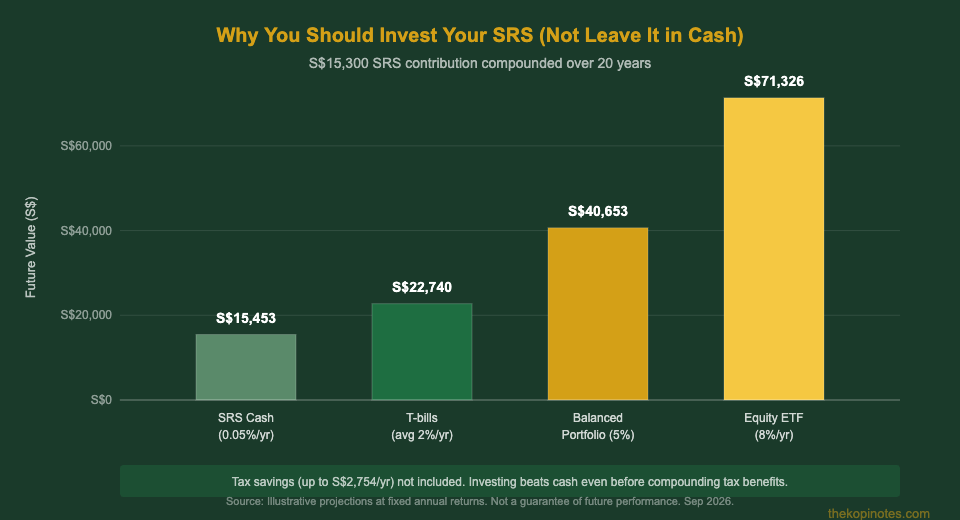
What Can You Invest in With Your DBS SRS?
Leaving SRS funds in cash earns just 0.05% — effectively zero in real terms. The point is to invest them. DBS SRS-eligible investments include the following options.
SGX stocks and S-REITs. Buy Singapore-listed shares and S-REITs via DBS Vickers using SRS funds. Many investors build a dividend portfolio inside their SRS account to generate tax-sheltered income. For ideas, see the guide to the best S-REITs in Singapore 2026.
ETFs. CSPX, VWRA, the STI ETF, and other SGX-listed ETFs are eligible. Buying growth ETFs inside SRS is smart for the long term because all unrealised gains compound tax-free until withdrawal.
Singapore Savings Bonds and T-bills. Apply for SSBs and T-bills using your SRS funds directly. The interest earned stays inside the SRS wrapper. Read the Singapore T-bills 2026 guide for current yields.
Robo-advisors (Endowus, Syfe). Both platforms accept SRS funds and offer globally diversified portfolios. Endowus (code 2V343) and Syfe (code SRPRFFFCD) both have dedicated SRS options and charge lower fees than bank-branded unit trusts.
Fixed deposits and insurance products. DBS fixed deposits can be funded with SRS cash for capital preservation near withdrawal age. Certain endowment plans are also SRS-eligible.
SRS Withdrawal: Rules & How to Minimise Tax
Understanding withdrawal is as important as understanding contribution. Get this wrong and you could trigger an unnecessary tax bill.
Penalty-free withdrawals begin at your statutory retirement age — the prevailing retirement age at the time you first contributed to SRS. For most accounts opened in recent years, this is age 62. Singapore is raising the retirement age incrementally, so accounts opened later may have a higher preserved age.
Only 50% of each withdrawal is taxable. If you withdraw S$40,000 in a year, only S$20,000 counts as chargeable income.
The 10-year withdrawal strategy. You have up to 10 years to withdraw after reaching retirement age. Spreading withdrawals — say S$40,000 per year for 10 years — adds only S$20,000 to your annual chargeable income, keeping most retirees under the tax-free S$20,000 threshold.
Premature withdrawal penalty. Withdrawing before your retirement age triggers a 5% penalty on the full amount, and 100% of the withdrawal (not the usual 50%) is added to your chargeable income. Avoid this unless absolutely necessary.
Use the retirement planning calculator to model your SRS withdrawal strategy alongside CPF LIFE payouts and investment income.
Invest Your SRS Smarter
Don’t leave SRS funds earning 0.05%. Move them into a diversified portfolio via Endowus or Syfe — both accept SRS funds directly and offer globally diversified options at low fees.
Frequently Asked Questions
Can I open a DBS SRS account if I already have a UOB or OCBC account?
What is the SRS contribution limit for 2026?
Can I use SRS funds to buy Singapore T-bills and SSBs?
What happens if I withdraw from SRS before retirement age?
Is Endowus or Syfe better for investing SRS funds?
Can I invest in global ETFs like VWRA via my SRS account?
This article was researched with the help of AI. While we strive to keep all information accurate and up to date, there may be errors. If you notice any discrepancies, please contact us.