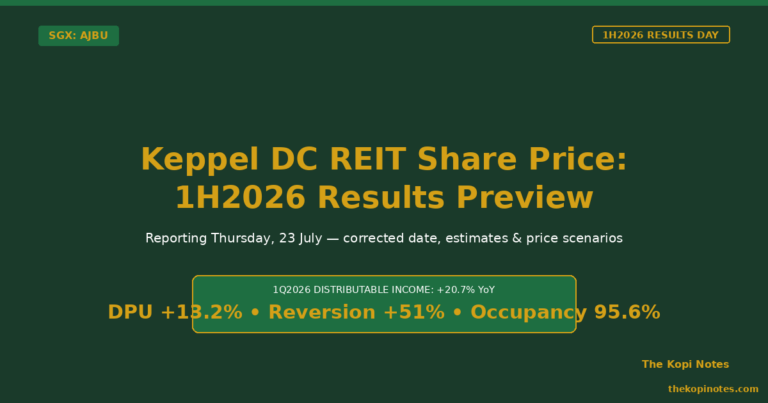
KDC REIT Share Price 2027: DPU Forecast, Target Price & Buy/Sell Verdict
KDC REIT (SGX: AJBU) is Singapore’s premier pure-play data centre REIT, owning a portfolio of 23 data centres across eight countries with a combined AUM of approximately S$3.9 billion as at Q3 2026. Backed by AI-driven hyperscaler demand and Singapore’s constrained data centre supply, KDC REIT is well-positioned for stronger rental reversions heading into 2027. This guide covers its current share price, DPU trajectory, key catalysts, and our buy/hold/sell investor verdict.
Not financial advice. All figures are for educational reference only. Data as at October 2026 unless noted.
What Is KDC REIT (AJBU)?
KDC REIT (Keppel DC REIT) was listed on the Singapore Exchange (SGX) in December 2014, becoming Asia’s first pure-play data centre REIT. Managed by Keppel DC REIT Management Pte Ltd — a subsidiary of Keppel Corporation — the REIT gives retail and institutional investors direct exposure to the fast-growing digital infrastructure sector.
As at Q3 2026, KDC REIT operates 23 data centres spanning Singapore, Australia, Germany, the Netherlands, Italy, the United Kingdom, Ireland, and Malaysia. Singapore assets account for approximately 30% of AUM by value — among the most strategically important colocation facilities in Southeast Asia, benefiting from Singapore’s position as a regional data hub and the government’s active push to attract AI workloads.
The REIT’s tenant base includes hyperscalers (major cloud providers), telecommunications companies, and large enterprise clients. Long weighted average lease expiries (WALE) of approximately 7.5 years reduce near-term income volatility.
For investors building a broader S-REIT income portfolio, see our guide on the best S-REITs in Singapore 2026 and how KDC REIT compares with industrial and office peers.
KDC REIT Portfolio Snapshot (Q3 2026)
| Metric | Value |
|---|---|
| Number of assets | 23 data centres |
| Countries | 8 (SG, AU, DE, NL, IT, UK, IE, MY) |
| Total lettable area | ~850,000 sqm |
| Portfolio occupancy | ~97% |
| WALE | ~7.5 years |
| AUM | ~S$3.9 billion |
| Gearing ratio | ~36% |
Source: KDC REIT Q3 2026 investor presentation. Figures are approximate.
KDC REIT Share Price & Valuation 2026
KDC REIT’s share price (SGX: AJBU) has traded between approximately SGD 1.75 and SGD 2.30 over the past 12 months, reflecting investor sentiment around interest rates, AI data centre demand, and broader S-REIT market conditions. As at October 2026, the unit price is approximately SGD 2.05 — implying a modest premium to net asset value (NAV) of around 1.11x.
At a P/NAV of ~1.11x, KDC REIT trades at a premium to many other S-REITs. This premium reflects: (1) data centre scarcity in Singapore post-2019 moratorium; (2) long WALE reducing income risk; (3) above-market rental reversions from AI/cloud demand; and (4) a visible acquisition pipeline from Keppel Corporation via the right of first refusal (ROFR) arrangement.
KDC REIT Key Valuation Metrics (October 2026)
| Metric | Value (Approx.) |
|---|---|
| Unit price (SGX: AJBU) | SGD 2.05 |
| NAV per unit | ~SGD 1.85 |
| P/NAV | ~1.11x |
| Distribution yield (annualised) | ~4.7% |
| Market capitalisation | ~SGD 3.7 billion |
| 52-week price range | SGD 1.75 – SGD 2.30 |
| Interest coverage ratio | ~4.5x |
| Gearing ratio | ~36% |
Source: SGX announcements, KDC REIT investor presentations, The Kopi Notes estimates. October 2026. All figures approximate — verify with current SGX filings before investing.
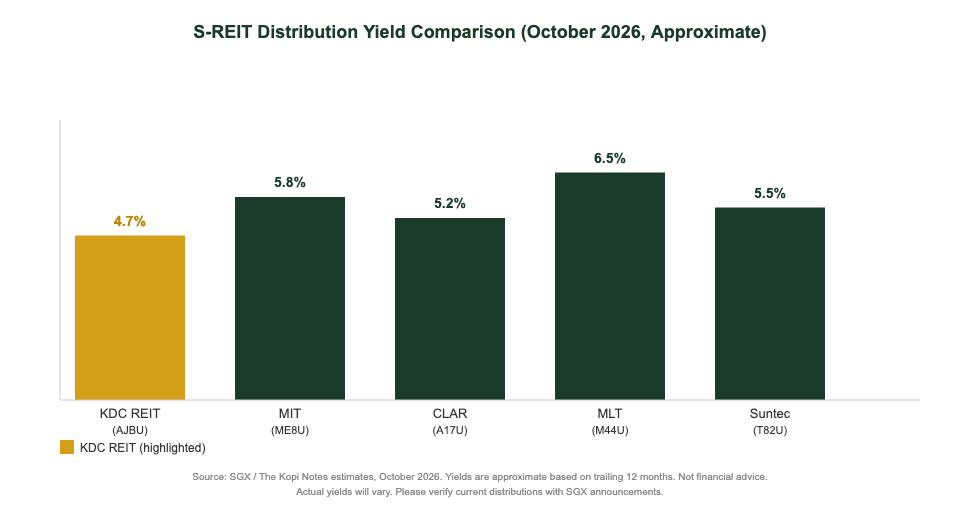
The ~4.7% distribution yield is lower than many traditional S-REITs (industrial, retail, office), but this is offset by KDC REIT’s stronger capital appreciation potential from AI infrastructure demand. For investors seeking higher yields, exploring passive income Singapore strategies that combine KDC REIT with higher-yielding S-REITs and Singapore Savings Bonds may provide a better risk-adjusted income profile.
KDC REIT DPU History & 2027 Forecast
KDC REIT’s distribution per unit (DPU) history reflects the tension between robust data centre demand and the headwind of rising borrowing costs over 2022–2024. With the US Federal Reserve having cut rates through 2025, the financing cost headwind is now easing — providing a meaningful tailwind for DPU recovery in 2026 and 2027.
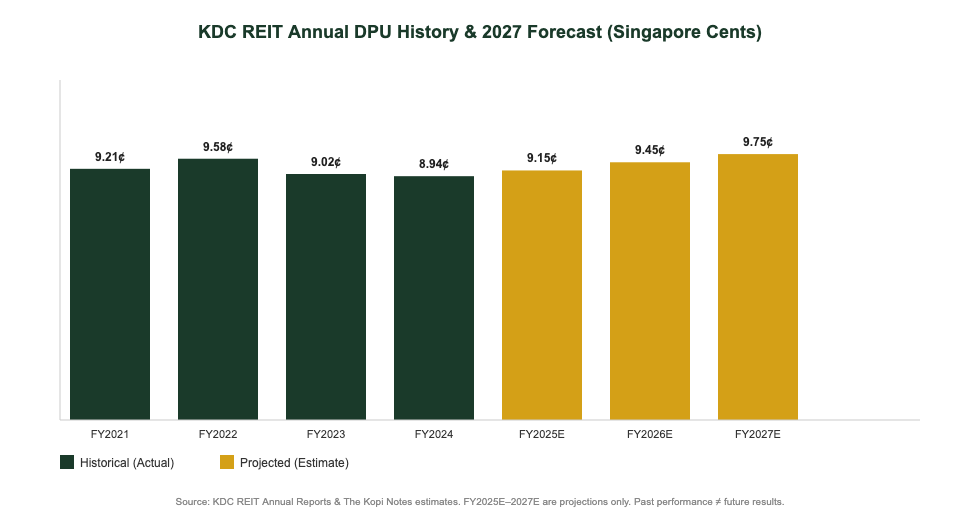
KDC REIT DPU History & Projections
| Financial Year | DPU (SG Cents) | YoY Change | Notes |
|---|---|---|---|
| FY2021 | 9.21¢ | +7.9% | Post-COVID recovery |
| FY2022 | 9.58¢ | +4.0% | Strong demand; rate hikes begin |
| FY2023 | 9.02¢ | -5.8% | Higher borrowing costs pressure DPU |
| FY2024 | 8.94¢ | -0.9% | Rate headwinds persist |
| FY2025E | 9.15¢ | +2.3% | Rate cuts begin; demand recovery |
| FY2026E | 9.45¢ | +3.3% | AI demand drives rental growth |
| FY2027E | 9.75¢ | +3.2% | Full rate-cut tailwind; renewal uplifts |
Source: KDC REIT Annual Reports (FY2021–FY2024 actual); FY2025E–FY2027E are analyst estimates compiled by The Kopi Notes. Projections are not guarantees. Actual DPU depends on distributable income, occupancy, forex, and interest rates.
Key 2027 DPU drivers include: (1) AI hyperscaler demand driving 15–25% rental reversions on Singapore lease renewals; (2) easing financing costs as SORA declines with Fed rate cuts — each 50bps cut reduces interest expense by approximately S$6–8 million annually (~0.3–0.4 cents DPU impact); (3) built-in lease escalators (1.5–3% annual CPI or fixed escalation) providing DPU growth even without new acquisitions; and (4) potential DPU-accretive acquisitions from the Keppel sponsor ROFR pipeline.
Investors using platforms like FSMOne referral code for regular savings plans can dollar-cost average into KDC REIT units, reducing entry price risk over the 2026–2027 rate normalisation period.
Key Catalysts Driving KDC REIT Upside in 2027
1. AI Infrastructure Demand
The global AI compute buildout — from large language model training to real-time inference workloads — requires massive GPU clusters housed in purpose-built, high-power-density data centres. Singapore’s strategic location, political stability, submarine cable connectivity, and financial regulatory environment make it the preferred data hub for Southeast Asian AI deployments. KDC REIT’s Singapore colocation assets are seeing rental enquiry premiums of 15–25% on upcoming lease renewals, according to industry research (CBRE Data Centre Global Market Research, Q3 2026, cbre.com).
2. Singapore Supply Constraints
Singapore implemented a data centre licensing moratorium from 2019–2022 and now requires new facilities to meet strict Power Usage Effectiveness (PUE) targets and green certification. This structural supply constraint means existing operators like KDC REIT face minimal competition from new supply for the foreseeable future — a significant pricing-power advantage that underpins above-market rental reversions.
3. Keppel Corporation Sponsor Pipeline
Keppel holds data centre assets globally through various fund structures. KDC REIT’s right of first refusal (ROFR) on sponsor assets provides a visible, pre-screened acquisition pipeline. A single accretive acquisition at a 5.5–6.0% NPI yield (above the REIT’s current cost of capital) would be approximately 3–5% DPU-accretive for unitholders.
4. Rate Cut Tailwinds
With the US Fed funds rate declining through 2025–2026, KDC REIT’s floating-rate debt is repricing lower. Management guided that each 50bps rate reduction reduces financing costs by S$6–8 million annually — equivalent to approximately 0.3–0.4 Singapore cents per unit in incremental DPU. Investors comparing REIT yields against T-bills and savings bonds should also note that lower rates improve REITs’ relative attractiveness — see our Singapore T-bills 2026 guide for the current rate environment context.
5. Digital Sovereignty in Europe
EU member states are increasingly requiring that government and financial data be hosted within national borders. This regulatory tailwind benefits KDC REIT’s European assets in Germany, the Netherlands, and Ireland, where demand for compliant, sovereign-grade colocation is rising.
Key Risks & Headwinds for KDC REIT
Balanced investing requires understanding the downside scenarios. Here are the key risks for KDC REIT investors heading into 2027:
1. Refinancing Risk
KDC REIT has approximately S$600–700 million in debt maturing in 2026–2027. If inflation re-accelerates and rates reverse course, refinancing at higher rates would compress DPU. Management has partially mitigated this by locking in fixed-rate interest rate swaps on a portion of borrowings, but residual floating-rate exposure remains.
2. Tenant Concentration Risk
A significant portion of KDC REIT’s revenue derives from a small number of hyperscaler and telco anchor tenants. Loss of a major tenant — or a tenant downscaling its data centre footprint — could meaningfully impact occupancy and DPU, even if the WALE cushion provides near-term protection.
3. Regulatory / ESG Compliance Costs
Singapore and the European Union are tightening data centre energy efficiency standards. Capital expenditure to upgrade older facilities to meet evolving PUE requirements or green certification thresholds could reduce near-term distributable income.
4. Currency Risk
Only approximately 30% of KDC REIT’s portfolio revenue is denominated in SGD. The remainder is in AUD, EUR, GBP, and MYR. While management hedges a portion of FX exposure, a strengthening SGD against these currencies reduces translated income and DPU.
5. Market Re-rating Risk
At ~1.11x P/NAV, KDC REIT carries a valuation premium that is sensitive to rate expectations. A shift in market sentiment (e.g. rates staying higher for longer) could de-rate the REIT to 0.95x P/NAV — implying a unit price of approximately SGD 1.75, or about 15% below current levels, before factoring in distributions received.
Investor Verdict: Should You Buy, Hold or Sell KDC REIT in 2027?
Based on our analysis of KDC REIT’s fundamentals, current valuation, DPU trajectory, catalysts, and risks, here is our October 2026 investor verdict:
🌲 Bull Case (Target: SGD 2.40–2.60)
AI demand drives 20%+ rental reversions on upcoming Singapore lease renewals; FY2027 DPU reaches 9.75 cents or higher; the market re-rates KDC REIT to 1.25–1.3x P/NAV on data centre scarcity premium. An investor entering at SGD 2.05 could see total returns of 25–30% over 12–18 months (capital gain + distributions).
🔵 Base Case (Target: SGD 2.10–2.25)
Steady DPU recovery to ~9.45–9.60 cents in FY2026; lower rates improve valuation; yield-based fair value at ~4.5% yield implies SGD 2.10–2.20. Total return of approximately 8–12% over 12 months (capital + distributions). This is the most likely scenario given current macro conditions.
🔴 Bear Case (Target: SGD 1.60–1.80)
Rate reversal, major tenant non-renewal, or large ESG-compliance capex requirement compresses DPU to ~8.5 cents; market de-rates to 0.9x P/NAV. Total return could be -10 to -15% including distributions received.
Our Verdict: MODERATE BUY / HOLD
KDC REIT is a quality data centre REIT with strong AI infrastructure tailwinds and a credible DPU recovery story through 2027. The ~4.7% distribution yield is modest by S-REIT standards, but it is underpinned by long leases and sector demand that few other REITs can match. We rate KDC REIT a Moderate Buy / Hold for investors with a 2–3 year horizon who: (1) already have a core income portfolio (e.g., industrial REITs + SSBs + T-bills); (2) want digital infrastructure exposure in Singapore; and (3) are comfortable holding through near-term rate volatility.
To build a KDC REIT position cost-effectively, consider using a platform with low S-REIT commissions. The Syfe referral code and sign-up bonus offers exposure to REITs through their REIT+ portfolio, while for direct SGX purchases, Singapore REIT ETF guide covers low-cost options. To model how KDC REIT fits your retirement income goal, use our Singapore retirement calculator.
Frequently Asked Questions About KDC REIT
Is KDC REIT a good buy in 2027?
KDC REIT (SGX: AJBU) is broadly considered a quality data centre REIT for 2027. At approximately SGD 2.05 and a ~4.7% distribution yield (October 2026), it offers moderate income with capital upside from AI data centre demand and rate cuts. It is better suited as a growth-income hybrid than a pure yield play — investors seeking higher yields (6%+) may prefer industrial or retail S-REITs alongside KDC REIT.
What is KDC REIT’s dividend yield?
As at October 2026, KDC REIT (AJBU) has an approximate annualised distribution yield of ~4.7% based on trailing distributions and a unit price of approximately SGD 2.05. Distributions are paid semi-annually. Actual yield at time of purchase will depend on the prevailing unit price and the REIT’s declared DPU for that period.
What is KDC REIT’s DPU forecast for 2027?
Analysts project KDC REIT’s FY2027 distribution per unit (DPU) at approximately 9.60–9.80 Singapore cents, driven by AI-led rental reversions on Singapore lease renewals, lower financing costs from Fed rate cuts, and built-in lease escalators. These are consensus estimates only and are not guaranteed — actual DPU depends on distributable income, occupancy levels, forex movements, and interest rates.
How does KDC REIT compare to Mapletree Industrial Trust (MIT)?
Both KDC REIT and MIT (SGX: ME8U) offer data centre and industrial exposure, but they differ in portfolio composition. MIT has a more diversified portfolio spanning standard industrial, hi-tech industrial, business parks, and data centres. MIT typically offers a higher distribution yield (~5.5–6%) than KDC REIT (~4.7%). KDC REIT’s pure-play data centre focus may provide stronger capital appreciation in an AI-driven market, while MIT offers a higher current income. Many Singapore investors hold both as complementary S-REIT positions.
Where can I buy KDC REIT in Singapore?
KDC REIT (SGX ticker: AJBU) can be purchased through any SGX-licensed broker, including Interactive Brokers (IBKR), Syfe Trade, moomoo Singapore, FSMOne, and traditional bank brokerages (DBS Vickers, OCBC Securities, UOB Kay Hian). IBKR typically offers the lowest per-trade commission for S-REIT investors. FSMOne is popular for its Regular Savings Plan (RSP) which allows monthly dollar-cost averaging into KDC REIT.
Does KDC REIT pay monthly or quarterly dividends?
KDC REIT distributes income semi-annually — twice per year. The first distribution covers January to June, and the second covers July to December. Distributions are paid in Singapore dollars to unitholders’ CDP (Central Depository Pte Ltd) or brokerage accounts within approximately two months of each half-year period end.
This article was researched with the help of AI. While we strive to keep all information accurate and up to date, there may be errors. If you notice any discrepancies, please contact us.