What Is MediSave? Singapore’s CPF Healthcare Account Explained (2026)
Your complete guide to Singapore’s mandatory healthcare savings account — how it works, what it covers, and how it connects to your Integrated Shield Plan.
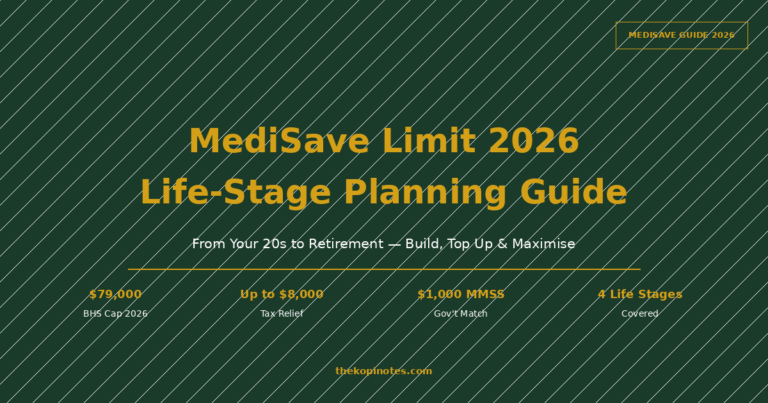
MediSave is Singapore’s mandatory healthcare savings account — one of the four CPF accounts every working Singaporean and Permanent Resident contributes to. It funds MediShield Life premiums, Integrated Shield Plan premiums, hospitalisation bills, and select outpatient treatments. In 2026, Singaporeans contribute between 8% and 10.5% of their wages to MediSave depending on age, with savings capped at the Basic Healthcare Sum of S$75,500.
Not financial advice. All figures are for educational reference only. Data as at November 2026 unless noted.
What Is MediSave?
MediSave is a ring-fenced savings account within the Central Provident Fund (CPF) system, set aside exclusively for healthcare expenses. Unlike your Ordinary Account (OA) or Special Account (SA), you cannot withdraw MediSave freely — the government restricts it to approved medical uses so your healthcare nest egg stays intact when you need it most.
Every employee in Singapore contributes a portion of their monthly wages to MediSave automatically, and their employer makes a separate contribution on top. The account earns a guaranteed interest rate of 4% per annum, making it one of the higher-yielding components of your CPF portfolio.
Singapore’s healthcare financing framework rests on three “M”s: MediSave (personal savings), MediShield Life (national insurance), and MediFund (safety net for those who cannot afford care). MediSave sits at the base of this system — it’s your first line of defence when a hospital bill lands on your desk.
The Four CPF Accounts at a Glance
| CPF Account | Primary Use | Interest Rate (2026) |
|---|---|---|
| Ordinary Account (OA) | Housing, education, investments | 2.5% p.a. |
| Special Account (SA) | Retirement (long-term savings) | 4% p.a. |
| MediSave Account (MA) | Healthcare expenses | 4% p.a. |
| Retirement Account (RA) | CPF LIFE payouts from age 65 | 4% p.a. |
Source: CPF Board (cpf.gov.sg), 2026. The RA is created at age 55 by combining OA and SA savings.
How MediSave Contributions Work
MediSave contributions are automatically deducted from your monthly wages and employer CPF contributions, so most Singaporeans never need to actively manage them. The contribution percentage scales up with age, reflecting the higher healthcare needs that come later in life.
For 2026, the MediSave contribution rates (as a percentage of your total CPF contribution, up to the ordinary wage ceiling of S$8,000/month) are:
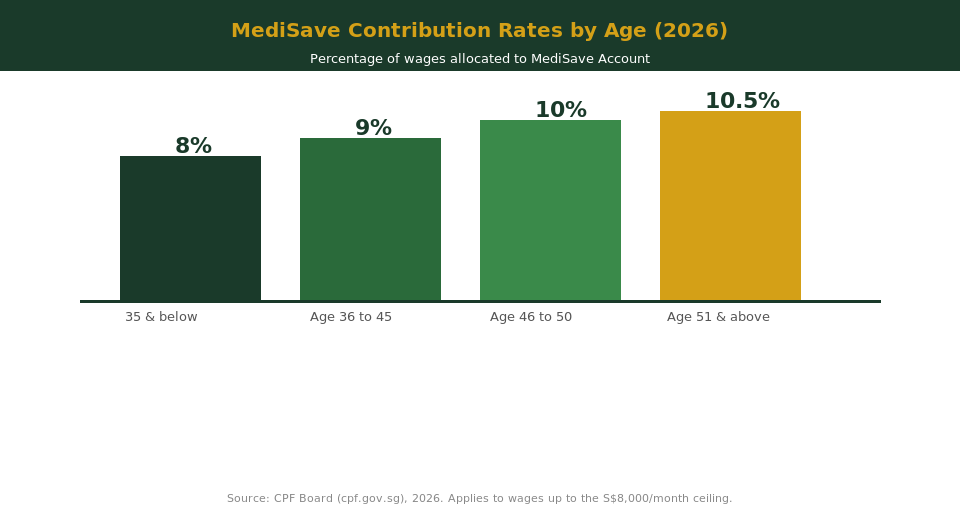
To put this in concrete terms: a 32-year-old earning S$5,000 per month contributes S$400 to MediSave each month (8% of S$5,000). A 52-year-old at the same salary contributes S$525/month (10.5%). Over a 30-year career, these contributions can add up to well over S$100,000 in healthcare savings.
MediSave vs Total CPF Contributions
Your total CPF contribution rate (employee + employer) is higher than just the MediSave slice. For a Singaporean aged 35 and below earning S$6,000/month, the combined employee and employer CPF contribution is 37% of wages — and MediSave’s 8% is just one component of that broader retirement and healthcare system.
This matters if you’re thinking about your CPF investment strategy: you cannot invest your MediSave balance the way you can with your OA or SA funds. MediSave stays in the account earning 4% and can only be deployed for approved healthcare uses — which brings us to the most important question most Singaporeans ask.
What Can You Use MediSave For?
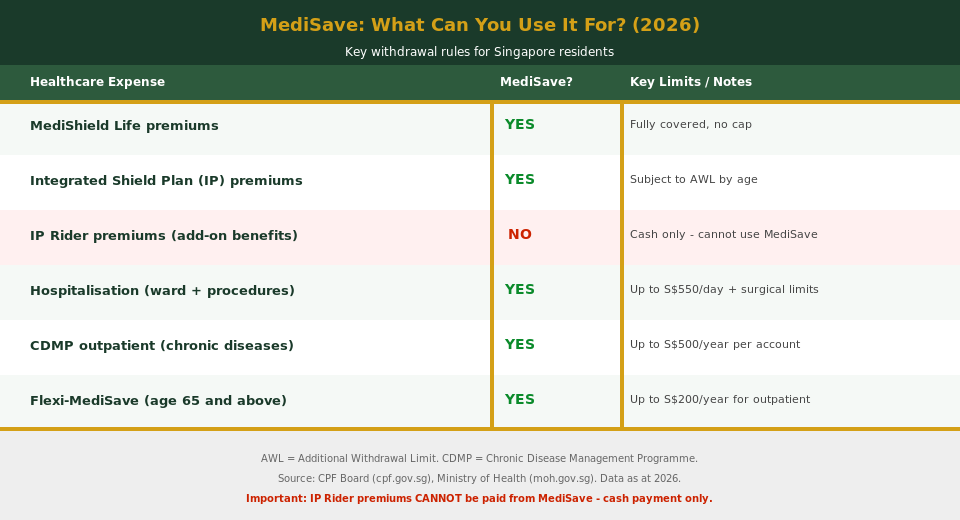
MediSave’s withdrawal rules are governed by the Ministry of Health (MOH) and updated periodically. Here is a comprehensive overview of what you can and cannot use it for in 2026:
Hospitalisation
For inpatient hospital stays, MediSave can be used to pay for ward and treatment charges, subject to per-day withdrawal limits. For a normal ward (B2 class and above) in a public hospital, the MediSave limit is S$550 per day for the hospitalisation component, with additional limits for surgical procedures under the Table of Surgical Procedures (TOSP) published by MOH.
Outpatient Treatments (CDMP)
Under the Chronic Disease Management Programme (CDMP), Singaporeans managing approved chronic conditions — including diabetes, hypertension, high cholesterol, and asthma — can use MediSave for outpatient treatments at participating CHAS GP clinics and polyclinics. The limit is up to S$500 per calendar year per MediSave account, extendable to S$700 when covering a spouse or dependant.
Flexi-MediSave (Age 65 and Above)
Singaporeans aged 65 and above can use up to S$200 per year from their MediSave for a broader range of outpatient treatments, even those not covered under CDMP. This is particularly helpful for managing day-to-day healthcare costs in retirement.
What MediSave Cannot Pay For
MediSave has strict limitations. It cannot be used for general outpatient GP visits (unless under an approved programme), dental treatments (with narrow exceptions for surgery), cosmetic procedures, or over-the-counter medications. We cover dental specifically in our companion article on Integrated Shield Plans and what they cover.
MediSave and Your Integrated Shield Plan
For most Singaporeans, the most financially significant use of MediSave is paying for their Integrated Shield Plan (IP) premiums. This is where understanding the rules is crucial — because getting it wrong could mean an unexpected cash outflow.
What Is an Integrated Shield Plan?
An Integrated Shield Plan is a private health insurance plan that “integrates” with MediShield Life (the national basic insurance scheme) to provide enhanced coverage — typically covering A-class wards, private hospitals, or private specialist care. Major insurers offering IPs in Singapore include AIA, Great Eastern, Income, NTUC Income, Prudential, and Raffles Health Insurance.
Can You Pay IP Premiums with MediSave?
Yes — but only the basic IP premium component. Here’s how it breaks down:
| Premium Component | Pay with MediSave? | Details |
|---|---|---|
| MediShield Life portion | YES ✔ | Fully covered by MediSave |
| IP basic premium (above MediShield Life) | YES ✔ | Up to AWL limits by age |
| IP Rider premiums (add-on benefits) | NO ✘ | Cash only — cannot use MediSave |
Source: CPF Board (cpf.gov.sg), MOH (moh.gov.sg). AWL = Additional Withdrawal Limit.
The critical point that trips up many policyholders: IP rider premiums cannot be paid from MediSave under any circumstances. Riders are the add-on components that typically cover co-payment, deductibles, or additional ward benefits. These must be paid in cash. When you are budgeting for your IP, factor in this cash outflow for the rider component separately.
The Additional Withdrawal Limit (AWL)
The AWL is the annual cap on how much MediSave you can use toward your IP’s basic premium (on top of the MediShield Life component). The AWL varies by the insured person’s age. As you age and your IP premiums naturally increase, the AWL also increases to reflect this — though for many older policyholders on comprehensive private plans, a cash top-up may still be required to cover the full basic premium.
Always check your insurer’s premium notice to see the exact split between the MediShield Life portion, the IP basic premium, and any rider premiums — this tells you precisely how much cash you need to set aside each year.
The Basic Healthcare Sum (BHS) Explained
Your MediSave balance cannot grow indefinitely. The government sets a cap called the Basic Healthcare Sum (BHS) — once your MediSave balance hits this cap, any further MediSave contributions are diverted to your Special Account (below age 55) or Retirement Account (from age 55 onwards) instead.
For 2026, the BHS is S$75,500. This is reviewed and typically revised upward each year to keep pace with healthcare cost inflation in Singapore.
Why the BHS Matters for Your Retirement Planning
Once you’ve accumulated S$75,500 in MediSave, your healthcare savings are considered sufficiently funded for typical retirement healthcare needs. Any overflow goes toward your retirement pot instead — which is actually a useful nudge for those who are otherwise behind on CPF LIFE savings.
The BHS is also relevant when assessing how to structure your CPF contributions strategically. If your MediSave is already near the cap, voluntary top-ups to CPF will automatically flow to your OA and SA — potentially giving a boost to your retirement savings as calculated by our Singapore retirement planning calculator.
For Singaporeans approaching retirement, it’s worth reviewing whether your MediSave balance — alongside a well-chosen Integrated Shield Plan — gives you adequate healthcare coverage heading into the years when medical bills are most likely to spike.
Frequently Asked Questions About MediSave
What is MediSave used for?
How much do I contribute to MediSave each month?
Can I use MediSave to pay for my Integrated Shield Plan?
Can I use MediSave for dental treatment?
What happens when my MediSave reaches the Basic Healthcare Sum?
What is the difference between MediSave and MediShield Life?
Can I use MediSave to pay for my parents' or children's medical bills?
The Bottom Line on MediSave
MediSave is the bedrock of Singapore’s healthcare financing system. Most Singaporeans interact with it passively — contributions come in automatically every month, and the balance grows quietly at 4% p.a. But understanding MediSave’s rules — especially around Integrated Shield Plan premiums and the rider cash-only restriction — can prevent budget surprises and help you plan your annual healthcare costs with clarity.
The key takeaways for 2026:
- MediSave contributions range from 8%–10.5% of wages depending on your age
- The Basic Healthcare Sum cap is S$75,500 — overflow funds your retirement savings
- IP basic premiums are MediSave-eligible; rider premiums are cash only
- MediShield Life premiums are fully covered by MediSave with no cap
- MediSave earns a guaranteed 4% p.a. — among the highest risk-free rates available to Singaporeans
If you’re reviewing your Integrated Shield Plan coverage and want to understand how your MediSave flows to your premiums, our Integrated Shield Plan comparison guides walk through each major insurer’s offerings and premium structures in detail. For context on other safe, CPF-adjacent savings tools, see our Singapore Savings Bonds guide.
This article is for educational purposes only and does not constitute financial or insurance advice. Always consult a licensed financial adviser before making changes to your insurance or CPF planning strategy.
Get Free Insurance Advice
Speak with a licensed insurance advisor. No obligation, no cost.
By submitting this form, you agree to our Privacy Policy.
This article was researched with the help of AI. While we strive to keep all information accurate and up to date, there may be errors. If you notice any discrepancies, please contact us.