Best USD Fixed Deposit Rates Singapore 2026: GXS, MariBank & Beyond
A guide to the best USD fixed deposit rates in Singapore — comparing digital banks, traditional banks, and what to watch out for before you lock in your US dollars.
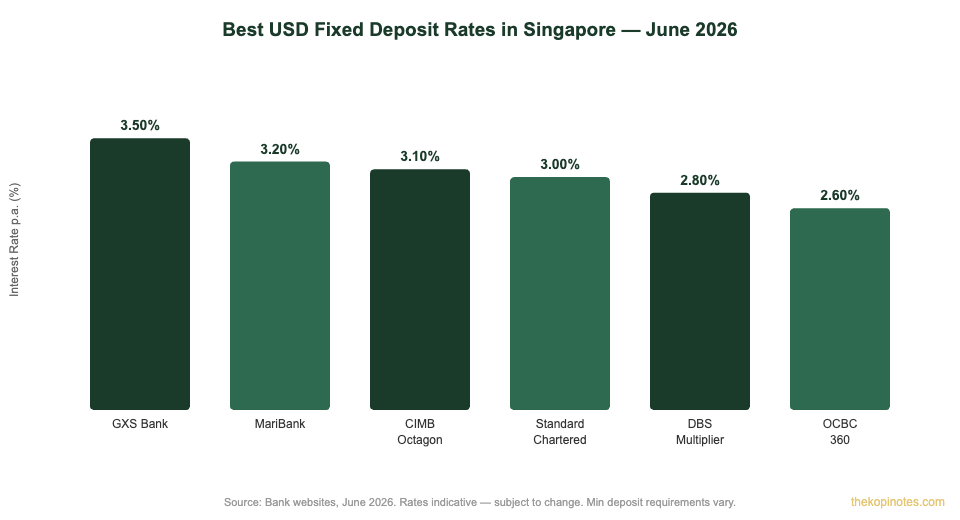
The best USD fixed deposit rates in Singapore as at June 2026 come from digital banks — GXS Bank offers up to 3.50% p.a. and MariBank up to 3.20% p.a. on USD deposits, both significantly above the 2.50–2.80% available at traditional banks like DBS and OCBC. Minimum deposits range from USD 1,000 to USD 5,000. All banks covered here are SDIC-insured up to SGD 100,000 equivalent per depositor.
Not financial advice. All figures are for educational reference only. Rates are subject to change — verify directly with each bank before placing a deposit. Data as at June 2026.
- Digital banks (GXS, MariBank) offer the highest USD FD rates in Singapore — typically 0.5–1.0% above traditional banks.
- Minimum deposits are accessible (from USD 1,000) and all are covered by SDIC insurance up to SGD 100,000.
- USD FDs make sense if you earn, spend, or invest in USD — or want to diversify away from SGD interest rate cycles.
Table of Contents
Contents — Click to expand
- Best USD FD Rates in Singapore (June 2026)
- Digital Banks: GXS and MariBank USD FD
- Traditional Banks: DBS, OCBC, Standard Chartered
- USD FD vs SGD FD: Which Is Better?
- How to Open a USD Fixed Deposit in Singapore
- Risks to Know Before You Deposit
- Who Should Consider a USD Fixed Deposit?
- Frequently Asked Questions
Best USD FD Rates in Singapore (June 2026)
USD fixed deposit rates in Singapore have been elevated since 2023, tracking US Federal Reserve interest rate policy. As the Fed held rates higher for longer, Singapore banks — especially digital challengers — passed on strong USD rates to depositors.
Here are the best USD fixed deposit rates available in Singapore as at June 2026:
| Bank | Rate p.a. | Min Deposit | Tenure | SDIC |
|---|---|---|---|---|
| GXS Bank | Up to 3.50% | USD 1,000 | 1–12 months | Yes |
| MariBank | Up to 3.20% | USD 1,000 | 1–12 months | Yes |
| CIMB Octagon | Up to 3.10% | USD 5,000 | 1–12 months | Yes |
| Standard Chartered | Up to 3.00% | USD 5,000 | 1–24 months | Yes |
| DBS | Up to 2.80% | USD 1,000 | 1–24 months | Yes |
| OCBC | Up to 2.60% | USD 5,000 | 1–12 months | Yes |
Source: Bank websites, June 2026. Rates are promotional and subject to change. Best rates typically apply to 6–12 month tenures for new funds. Verify directly with each bank before depositing.
Digital Banks: GXS and MariBank USD Fixed Deposits
Singapore’s two digital banks — GXS Bank and MariBank — have consistently offered above-market rates on both SGD and USD deposits since their launches. They’re able to do this partly because they have lower overhead costs than branch-heavy traditional banks, and partly as a deliberate strategy to attract depositors.
GXS Bank USD Fixed Deposit
GXS Bank is the digital bank backed by Grab and Singtel. It offers USD fixed deposits with tenures from 1 to 12 months. Rates are tiered by tenure — typically, a 6-month or 12-month USD FD earns the highest headline rate. You need a GXS Savings Account to place an FD. Opening the app and account takes around 10 minutes.
To use GXS Bank, you’ll need a Singpass and a Singapore phone number. The referral code YONG477 may be used during signup. Minimum deposit is USD 1,000, which is low compared to traditional banks that typically require USD 5,000 or more.
MariBank USD Fixed Deposit
MariBank is Sea Group’s digital bank in Singapore, accessible via the Shopee or MariBank app. It has gained a strong reputation for high savings account rates and competitive FD offers — including USD deposits. MariBank’s USD FD rates as at June 2026 reach up to 3.20% p.a.
MariBank is well-reviewed for its ease of use and transparency. The referral code 2DCT80WQ gives you a bonus on signup. Like GXS, MariBank is SDIC-insured up to SGD 100,000 per depositor — covering both SGD and foreign currency deposits combined.
Both GXS and MariBank allow you to hold USD deposits without conversion. Your USD goes in as USD and comes back as USD at maturity — you only take on FX risk if you choose to convert to SGD at some point.
Traditional Banks: DBS, OCBC, Standard Chartered
Traditional banks offer more tenure flexibility and sometimes better rates for very large deposits. They also offer multi-currency accounts that make it seamless to switch between SGD, USD, and other currencies.
DBS USD Fixed Deposit
DBS offers USD FDs via its internet banking portal and digibank app. Rates vary by tenure, and DBS occasionally runs promotions for new-to-bank funds. The minimum deposit is USD 1,000, which is competitive. DBS Multiplier account holders may access preferential rates if they meet income crediting and spending requirements.
Standard Chartered USD Fixed Deposit
Standard Chartered has consistently offered some of the more competitive traditional bank USD FD rates in Singapore. It also offers longer tenures of up to 24 months — useful if you want to lock in a rate for longer. Minimum deposit is typically USD 5,000. Priority Banking clients may receive higher rates.
OCBC USD Fixed Deposit
OCBC’s USD FD rates are at the lower end among major banks as at June 2026. However, OCBC’s 360 Account ecosystem makes it convenient for existing OCBC customers who want to park USD savings without opening a new account elsewhere.
USD FD vs SGD FD: Which Is Better?
This depends on two things: your currency exposure and the interest rate differential. Here’s how to think through it.
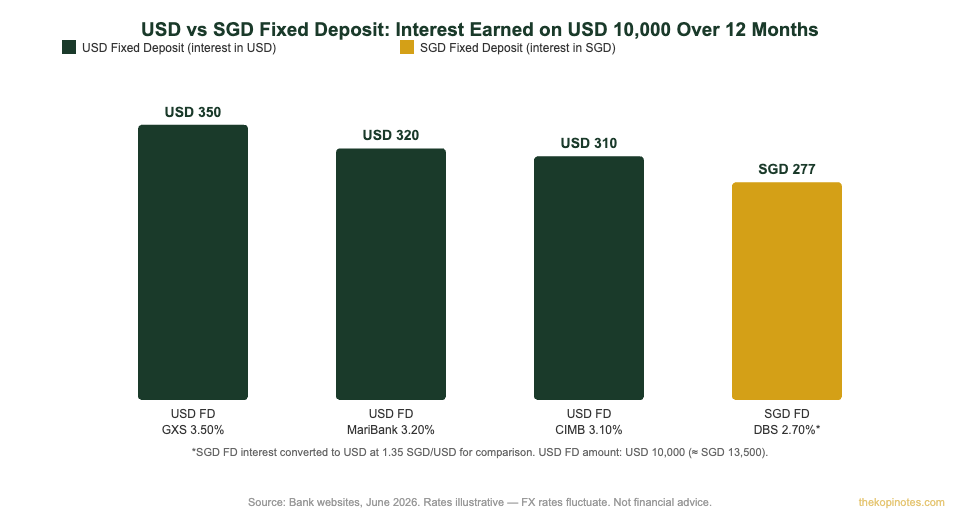
If you earn in SGD and have no natural USD exposure, placing a USD FD introduces foreign exchange risk. When your FD matures, you’ll need to convert the USD back to SGD. If SGD has strengthened against USD during that period, your effective return in SGD terms could be lower than the headline USD rate — or even negative.
Historically, the SGD has appreciated against the USD over long periods, partly because MAS uses exchange rate policy (not interest rates) as its primary monetary tool. For a Singapore resident earning and spending in SGD, a USD FD that earns 3.50% p.a. might actually underperform a SGD FD earning 2.70% p.a. — if the USD depreciates by even 1% against the SGD during the tenure.
That said, the USD FD makes clear sense if you:
- Already hold USD from salary, investments, or overseas expenses
- Plan to spend in USD (travel, overseas study, USD-denominated investments)
- Want to diversify your deposit currency away from SGD
- Invest in global ETFs on the London Stock Exchange (priced in USD) and want a holding place for idle USD
For Singapore investors who use brokers like Interactive Brokers (IBKR) to buy global ETFs, a USD FD is an excellent place to park USD that’s waiting to be deployed. You can find more on building your overall investment allocation in our passive income Singapore guide.
| Factor | USD FD | SGD FD |
|---|---|---|
| Best rate (June 2026) | Up to 3.50% p.a. | Up to 3.20% p.a. |
| FX Risk | Yes — USD/SGD moves matter | None for SGD earners |
| SDIC Coverage | Yes (combined limit) | Yes |
| Best for | USD holders, global investors | SGD earners & spenders |
| Linked to | US Federal Reserve rates | MAS SGD rate cycle |
Source: Bank websites, MAS, June 2026. SDIC coverage: SGD and foreign currency deposits combined up to SGD 100,000 per depositor per bank.
How to Open a USD Fixed Deposit in Singapore
The process varies by bank, but broadly follows these steps:
For digital banks (GXS, MariBank): Download the app, complete eKYC with your Singpass, open a savings account, then navigate to the FD section and place your deposit. You’ll need to fund the account first — most digital banks accept transfers from local banks via PayNow or FAST. The whole process takes 15–30 minutes for first-time users.
For traditional banks (DBS, OCBC, Standard Chartered): If you’re an existing customer, you can place a USD FD via internet banking or the bank’s app. You’ll need a multi-currency account or foreign currency account first — this may require a branch visit if you haven’t set one up. Funding is via a telegraphic transfer or an in-branch deposit of physical USD cash or a cheque.
A practical note: if you’re converting SGD to USD to fund a USD FD, check the FX rate your bank charges. A 0.5–1.0% FX spread can significantly eat into the rate advantage. For large conversions, compare rates across platforms — some digital banks and remittance services like Wise offer tighter USD/SGD spreads than traditional banks.
Risks to Know Before You Deposit
USD fixed deposits are low-risk savings instruments — but not entirely risk-free. Here’s what to watch:
FX risk: If you convert SGD to USD, you’re exposed to currency movements. A 1% rise in the SGD against the USD over 12 months would offset a 1% interest rate advantage. SGD has historically trended stronger against USD over multi-year periods.
Early withdrawal penalties: Most fixed deposits do not allow partial early withdrawal. If you break a USD FD early, you typically forfeit the interest earned — or receive a significantly reduced rate. Make sure you won’t need the funds during the tenure before locking in.
SDIC insurance limits: SDIC insures SGD and foreign currency deposits combined up to SGD 100,000 per depositor per bank. If you hold SGD 80,000 in DBS savings accounts and place a USD 30,000 FD (≈ SGD 40,500) at DBS, only SGD 100,000 is protected in total. Deposits above this are unprotected in a bank failure. Spread large deposits across multiple banks to maximise coverage.
Rate risk on rollover: USD FD rates are tied to the US interest rate cycle. If the Fed cuts rates, renewal rates at maturity will likely be lower. If you’re placing a 3-month FD today expecting to roll over repeatedly, factor in the possibility that rates could be 0.5–1.0% lower in a year’s time.
For investors looking at the broader picture of cash management and investing, our Singapore T-bills 2026 guide covers another USD-adjacent option — T-bills are SGD-denominated but track global rate movements and are fully backed by the Singapore government with no SDIC cap. You can also compare across cash instruments using our Singapore retirement calculator to model how your savings grow over time.
Who Should Consider a USD Fixed Deposit?
A USD fixed deposit is well-suited for you if you naturally hold or earn USD — for example, you receive USD salary, freelance income, or dividends from USD-denominated investments. It’s also ideal if you’re accumulating USD to deploy into global ETFs or stocks via brokers like Interactive Brokers, and want your idle cash to work harder. Those with USD expenses — overseas education, US property, frequent US travel — also benefit from keeping USD in a high-yield FD rather than a zero-interest multi-currency account.
On the other hand, a USD FD is less suitable if your income and expenses are entirely in SGD and you have no existing USD holdings. The FX conversion costs and currency risk would likely outweigh the rate advantage over a well-priced SGD FD or Singapore Savings Bonds.
If you’re undecided between building a USD savings buffer and investing in SGD-denominated income assets, our CPF investment strategy Singapore guide covers the full picture of how to allocate across different asset classes and currencies as a Singapore resident. For maximising your digital bank returns specifically, check out our detailed MariBank Singapore review.
Not financial advice. All figures are for educational reference only. Exchange rates and interest rates change frequently. Consult a licensed financial adviser before making deposit or investment decisions. Data as at June 2026.
Frequently Asked Questions
What is the best USD fixed deposit rate in Singapore right now?
As at June 2026, GXS Bank offers the highest USD fixed deposit rate in Singapore at up to 3.50% p.a., followed by MariBank at up to 3.20% p.a. Traditional banks like Standard Chartered offer up to 3.00% p.a. and DBS up to 2.80% p.a. Rates are promotional and change frequently — always verify directly with the bank before placing a deposit.
Is a USD fixed deposit in Singapore safe?
Yes — USD fixed deposits at MAS-licensed banks in Singapore are covered by the Singapore Deposit Insurance Corporation (SDIC) for up to SGD 100,000 per depositor per bank (combining both SGD and foreign currency deposits). GXS Bank, MariBank, DBS, OCBC, and Standard Chartered are all SDIC member banks. Deposits above SGD 100,000 per bank are not protected under SDIC, so large depositors should spread funds across multiple institutions.
Should I convert SGD to USD for a higher FD rate?
Only if you have natural USD exposure or don’t need to convert back to SGD. Converting SGD to USD to capture a higher USD FD rate introduces FX risk — if SGD strengthens against USD during your deposit tenure, your effective SGD return could be lower than what you’d earn from a comparable SGD FD. The math works in your favour if the USD FD rate is at least 1–2% higher than the SGD FD rate AND you believe the USD won’t weaken significantly. For most Singapore residents earning and spending in SGD, a high-yield SGD FD or Singapore Savings Bond is simpler and risk-free from an FX perspective.
What is the minimum deposit for a USD FD in Singapore?
Minimum deposit requirements vary by bank. Digital banks GXS and MariBank both accept deposits from USD 1,000 — the most accessible entry point. CIMB and Standard Chartered typically require USD 5,000. DBS requires USD 1,000. Traditional banks may also require you to hold a foreign currency account before you can place a USD FD, which could require an additional minimum balance.
Can I break a USD fixed deposit early in Singapore?
Most Singapore banks do not allow partial early withdrawal of a fixed deposit. If you need to break the FD before maturity, you typically forfeit all interest earned (or receive a significantly reduced breakage rate). Some banks may allow full early withdrawal with a penalty. Before placing a USD FD, ensure you won’t need the funds until the stated maturity date. If you might need liquidity, consider a shorter tenure (e.g. 1 or 3 months) rather than a 12-month lock-in.
How does GXS Bank compare to MariBank for USD fixed deposits?
Both are MAS-licensed digital banks in Singapore offering competitive USD FD rates above traditional banks. GXS Bank (backed by Grab and Singtel) offers up to 3.50% p.a. and is accessible via the GXS app with Singpass eKYC. MariBank (backed by Sea Group / Shopee) offers up to 3.20% p.a. and is accessible via the Shopee or MariBank app. Both have USD 1,000 minimums and are SDIC-insured. GXS offers the higher headline rate; MariBank has a larger existing user base from Shopee. Both are reliable — the choice often comes down to which app ecosystem you prefer.
Are USD fixed deposit interest earnings taxable in Singapore?
Interest earned on bank deposits — including USD fixed deposits — is exempt from Singapore income tax for resident individuals. Singapore does not tax bank interest income. There is also no withholding tax on deposit interest in Singapore. This makes fixed deposits — whether in SGD or USD — fully tax-efficient for Singapore tax residents. If you are a foreign national with tax obligations in another country (e.g. US citizens who must report worldwide income to the IRS), consult a tax adviser about your specific obligations.
Maximise Your Savings with Digital Banks
Open a GXS or MariBank account today and start earning higher rates on your USD savings.
This article was researched with the help of AI. While we strive to keep all information accurate and up to date, there may be errors. If you notice any discrepancies, please contact us.