Best Investments in Singapore 2026: Ranked by Return, Risk & Tax Efficiency
8 options compared — CPF • SSB • T-bills • S-REITs • ETFs
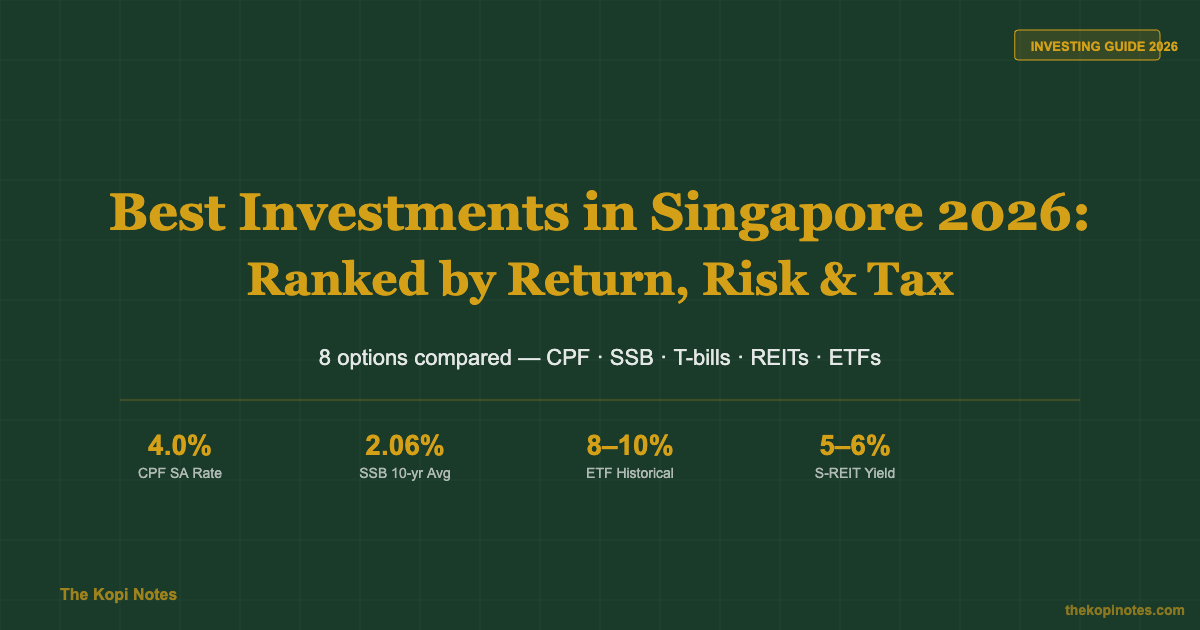
For most Singaporeans, the best investment in Singapore depends on three things: expected return, how much risk you can stomach, and how tax-efficiently you hold it. This guide compares eight popular options — from CPF top-ups and T-bills to global ETFs and S-REITs — across all three dimensions, so you can match the right investment to your situation in 2026.
Not financial advice. All figures are for educational reference only. Data verified as at 30 August 2026 unless noted.
- CPF SA remains the highest risk-free return at 4% p.a. — but your money is locked until retirement
- Global ETFs like VWRA offer the best long-run growth (~8–10% historical), with zero capital gains tax in Singapore
- S-REITs split the difference: 5–6% yield, SGX liquidity, and moderate risk — good for income investors
Table of Contents
The Master Comparison Table
Before diving deep, here’s the big picture. Every major investment option in Singapore, side by side — returns, risk, liquidity, and minimum investment.
| Investment | Expected Return (p.a.) | Risk Level | Liquidity | Min. Investment |
|---|---|---|---|---|
| CPF SA Top-Up | 4.0% (guaranteed) | Very Low | Locked (retirement) | $1 |
| CPF OA | 2.5% (guaranteed) | Very Low | Limited (housing/CPFIS) | – |
| Singapore Savings Bond | 2.06% (10-yr avg) | Very Low | Monthly redemption | $500 |
| T-bills (6M/1Y) | ~1.60–1.68% | Very Low | On maturity | $1,000 |
| Fixed Deposits | 1.20–1.65% | Very Low | On maturity (penalty early) | $10,000–$20,000 |
| S-REITs (SGX) | 5–6% yield + cap. gains | Medium | T+2 (SGX) | ~$300 (1 lot) |
| Robo-Advisor | 4–8% (portfolio-dependent) | Low–Medium | 3–5 business days | $1 |
| Global ETFs (VWRA/CSPX) | 8–10% (long-run historical) | Medium–High | T+2 (LSE) | ~USD 100 |
Source: CPF Board (Aug 2026), MAS, fund factsheets. Expected returns for ETFs are long-run historical estimates — past performance is not a guarantee of future results.
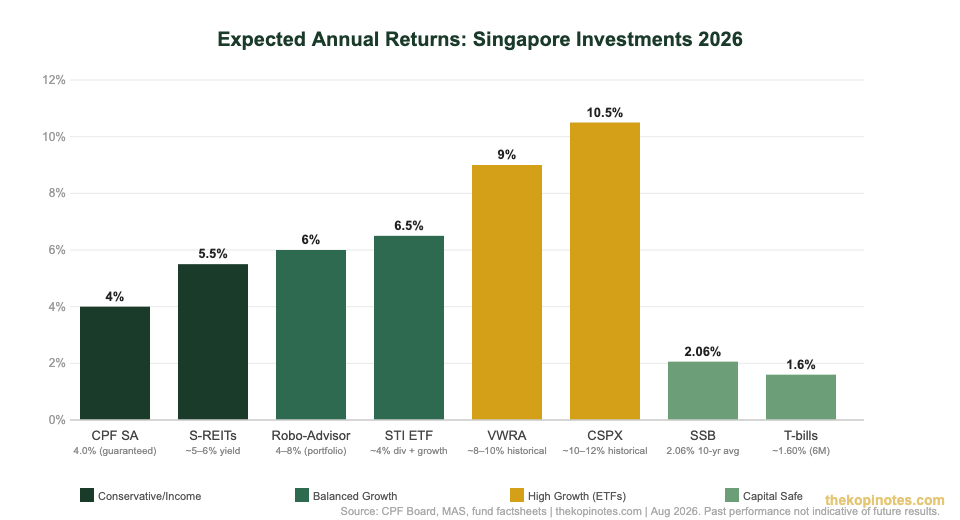
Chart: Expected annual returns by investment type. ETF figures are long-run historical estimates. Source: CPF Board, MAS, fund factsheets | Aug 2026.
Conservative Picks: Guaranteed Returns
If your top priority is capital preservation — you want your money back, guaranteed, with a known return — these options are for you. Singapore offers some of the best capital-safe options in Asia.
CPF SA Top-Up — The Best Guaranteed Rate
The CPF Special Account (SA) earns 4.0% per annum, a guaranteed floor extended by the CPF Board until 31 December 2026. That makes it the highest risk-free return available to Singaporeans — better than any bank deposit, SSB, or T-bill.
There’s a catch, though. Your money is locked until retirement. CPF SA funds can only be withdrawn as part of your Retirement Account (RA) after you reach the retirement age. So this works best if you’re topping up voluntarily and you’re comfortable leaving the money there for the long term.
Members below 55 also earn an extra 1% on the first $60,000 of combined CPF balances. That takes the effective rate on your first $20,000 OA to 3.5% — not bad for a “savings account”.
For more on using CPF as an investment vehicle, see our detailed CPF investment strategy guide.
Singapore Savings Bonds (SSB)
SSBs are the most flexible low-risk option. The August 2026 issue pays 1.46% in year one, stepping up to a 10-year average of 2.06% p.a. You can redeem any month with no penalty — unlike a fixed deposit, where early withdrawal costs you interest.
Maximum holding per person: $200,000. Minimum: $500. Apply via DBS, OCBC, or UOB internet banking or ATM. Read our full Singapore Savings Bonds 2026 guide for step-by-step instructions.
T-bills
Singapore T-bills are short-term government securities issued by MAS. The latest 6-month T-bill (issued 18 Aug 2026) cleared at 1.56% p.a., while the 1-year T-bill came in at ~1.68% p.a.
T-bills are auctioned every two weeks. You apply via CDP or your bank, and the full capital is returned at maturity. They’re not as liquid as SSBs (you can’t exit early without a haircut on the secondary market), but they offer a slightly better short-term yield than most fixed deposits. See our Singapore T-bills 2026 guide for how to apply.
Fixed Deposits
Fixed deposits from DBS, OCBC, and UOB are currently offering up to 1.20–1.65% p.a. for 12-month placements (August 2026). Minimum placement for promotional rates is typically $10,000–$20,000. Covered under SDIC up to $75,000 per depositor per bank.
Unless you need a very specific maturity date, SSBs and T-bills generally offer better terms with more flexibility. Fixed deposits still make sense for lump sums that you’re certain you won’t need to touch.
Balanced Picks: Income + Some Growth
These options offer meaningful income (dividends or distributions), with some exposure to capital gains or losses depending on market conditions. They’re not guaranteed, but the income component makes them predictable enough for planning purposes.
S-REITs (Singapore Real Estate Investment Trusts)
S-REITs are required by law to distribute at least 90% of their taxable income as dividends. That structure delivers consistent yields — the Singapore REIT market averages roughly 5–6% per year in distributions as of mid-2026.
You buy them like any SGX stock, through a brokerage like FSMOne or IBKR. Popular names include CapitaLand Integrated Commercial Trust (CICT), Mapletree Pan Asia Commercial Trust (MPACT), and Parkway Life REIT (a healthcare REIT known for consistency).
The risk: S-REITs are sensitive to interest rates and property market cycles. When rates rise sharply (as they did in 2022–2023), REIT prices tend to fall even if their income stays stable. For passive income Singapore investors who can hold through volatility, they’re a solid income layer. See our passive income Singapore guide for REIT income strategies.
REIT ETF (Syfe REIT+ or Lion-Phillip S-REIT ETF)
Rather than picking individual REITs, you can hold a basket of 20+ Singapore REITs through a single fund. Options include:
- Syfe REIT+: actively managed basket of S-REITs; fee 0.35–0.65% p.a.; minimum $1
- Lion-Phillip S-REIT ETF (CLR): SGX-listed ETF; TER ~0.60%; buy via any broker
A REIT ETF is better diversified than owning one or two REITs directly and rebalances automatically. If you use Syfe REIT+, you can start with just $1. For more, see our Singapore REIT ETF guide.
Robo-Advisor Portfolios
Robo-advisors like Endowus and Syfe offer ready-made portfolios blending bonds, REITs, and equities. You pick a risk level and the platform handles everything. Fees:
- Endowus: 0.60% p.a. for cash portfolios; 0.40% for CPF/SRS; 0.15% for Cash Smart
- Syfe: 0.65% (below $50k), 0.55% ($50k–$100k)
Both platforms are SRS-eligible, which is important for the tax layer below. If you’re contributing to SRS and want a hands-off approach, a robo-advisor is one of the smartest places to put that money.
Growth Picks: Long-Term Compounding
If you have a 10+ year horizon and can stomach short-term price swings, growth-oriented investments are where real wealth-building happens. Singapore’s zero capital gains tax environment makes this uniquely powerful.
VWRA — Vanguard FTSE All-World ETF
VWRA is listed on the London Stock Exchange (LSE) and tracks 3,900+ stocks across 49 countries. It’s the go-to global index fund for Singapore investors who want genuine diversification in a single ticker.
- TER (Total Expense Ratio): 0.22% per year — charged automatically within the fund
- Historical return: ~8–10% p.a. over 10+ year periods (past performance not guaranteed)
- Withholding tax: 15% on US dividends (UCITS structure reduces standard 30% US WHT)
- Capital gains: Zero tax in Singapore — your price appreciation is entirely yours
- Best broker: IBKR for lowest fees ($1 per trade; FX conversion ~0.03%)
For example: a Singapore investor who put $50,000 into VWRA 10 years ago and held through every market dip would be sitting on roughly $100,000–$130,000 today (based on historical performance). Every dollar of that growth is tax-free in Singapore.
CSPX — iShares Core S&P 500 ETF
CSPX tracks the 500 largest US companies and is also listed on the LSE. Its TER is just 0.07% per year — among the cheapest equity ETFs in the world. Historical returns are slightly higher than VWRA (~10–12% p.a.) because it’s US-concentrated, but that cuts both ways: when the US market corrects, CSPX corrects more sharply than the globally diversified VWRA.
CSPX suits investors who are bullish on US equities long-term and are comfortable with single-country concentration. For most beginners, VWRA is the safer starting point.
STI ETF (ES3 / G3B)
The STI ETF tracks Singapore’s top 30 companies (DBS, OCBC, Singtel, Keppel, etc.). It pays a dividend yield of roughly 4% p.a. and trades on SGX — no currency conversion needed, no foreign brokerage required. TER is ~0.30%.
The trade-off: Singapore’s market is small and concentrated (heavily weighted in banks and property). Long-run growth has lagged the global market. The STI ETF works well as an income-plus-stability play for older investors, but for younger investors with a long horizon, a global ETF delivers better growth potential.
The Tax Layer: CPFIS, SRS & Cash
The same investment can generate very different after-tax results depending on which “wrapper” account you use. Singapore gives you three main options:
CPF Investment Scheme (CPFIS)
Once you have at least $20,000 in your CPF OA, you can invest the excess in approved ETFs, unit trusts, and Singapore stocks via CPFIS. Restrictions apply: maximum 35% in stocks, 10% in gold.
The key consideration: if your CPFIS investment returns less than 2.5% p.a., you’d have been better off leaving the money in OA earning the guaranteed 2.5%. Endowus accepts CPFIS money and puts it into low-cost globally diversified funds.
Supplementary Retirement Scheme (SRS)
SRS is Singapore’s voluntary retirement scheme with a built-in tax benefit. Citizens and PRs can contribute up to $15,300 per year; foreigners up to $35,700. Your SRS contributions are deducted from your taxable income — so if you’re in the 11.5% marginal tax bracket, a $15,300 contribution saves you roughly $1,760 in income tax that year.
Inside SRS, you can invest in almost anything — robo-advisors, ETFs, REITs, unit trusts. Money is locked until the statutory retirement age (now 64 in Singapore, following the July 2026 change). If you withdraw early, a 5% penalty applies plus 100% of the withdrawal is taxable. After retirement age, only 50% of withdrawals are taxable, spread over 10 years.
Cash (Taxable) Account
Your regular brokerage or robo account. The upside: total flexibility. The downside: no tax deduction on contributions. However, Singapore’s investor-friendly tax regime means the cash account is still excellent for most people:
- Dividends from Singapore companies: generally tax-exempt for individual investors
- Capital gains on any investment: zero tax
- Dividends from foreign holdings (via VWRA/CSPX): 15% WHT already deducted at source before you receive them — no further Singapore tax
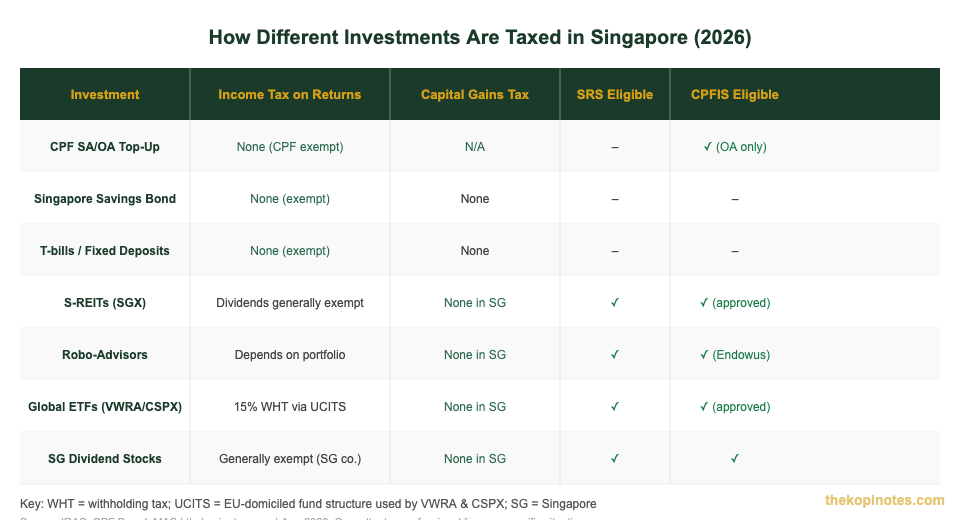
Chart: How different investments are taxed in Singapore. Source: IRAS, CPF Board, MAS | Aug 2026.
How to Build a Portfolio for Your Budget
There’s no one-size-fits-all portfolio. Here’s a practical starting point based on how much capital you have to invest, based on Singapore-specific scenarios.
| Budget | Suggested Mix | Rationale |
|---|---|---|
| $5,000 | $3k SSB or T-bill + $2k robo-advisor (Endowus/Syfe) | Capital safe base + start growing the habit. No brokerage fees. |
| $20,000 | $10k VWRA (IBKR) + $5k Syfe REIT+ + $5k SSB | Long-run compounder + income layer + liquidity buffer. |
| $50,000+ | 60% VWRA + 20% S-REITs/REIT ETF + 10% SSB + 10% SRS (into Endowus) | Diversified across growth, income, safety, and tax efficiency. |
| Near Retirement | Max CPF SA top-up + SSB + STI ETF for dividends | Guaranteed income + capital preservation + familiar SGX exposure. |
These are illustrative portfolios, not financial advice. Adjust based on your income, risk tolerance, and investment timeline.
Use our Singapore retirement calculator to work backwards from your retirement goal and figure out how much you need to invest each month to get there.
Best Platforms to Start Investing in Singapore
Choosing the right platform matters — fees compound over time just as your returns do. Here’s a quick breakdown of the platforms TKN recommends for each use case.
| Platform | Best For | Annual Fee | Referral Code |
|---|---|---|---|
| Endowus | CPF/SRS investing, income funds, low-cost global portfolios | 0.40% CPF/SRS; 0.60% cash | 2V343 |
| Syfe | REIT+, equity portfolios, cash management | 0.35–0.65% | SRPRFFFCD |
| FSMOne | SSB, T-bills, ETFs, CPF investing (0% platform fee) | 0% CPF; 0.08% min/trade | P0544985 |
| IBKR | Direct ETF buying (VWRA, CSPX on LSE) — lowest trade cost | ~$1/trade; 0.03% FX | jianxiong368 |
Sign up via the Endowus referral code, Syfe referral code, or FSMOne referral code pages for current welcome bonuses. TKN may earn a referral fee at no extra cost to you.
Disclaimer: This article is for educational purposes only and does not constitute financial advice. Singapore tax laws, CPF rules, and SRS regulations are subject to change. Verify current rates from official sources: CPF Board (cpf.gov.sg), MAS (mas.gov.sg), and IRAS (iras.gov.sg). Data verified as at 30 August 2026.
Frequently Asked Questions
What is the best investment in Singapore for beginners?
For most beginners, a robo-advisor like Endowus or Syfe is the easiest starting point. You can begin with as little as $1, choose your risk level, and the platform handles diversification automatically. If you want zero risk, a CPF SA top-up (4.0% guaranteed) or Singapore Savings Bond (2.06% 10-year average) is your next best option. The key is to start early — even $200 a month compounded over 20 years makes a significant difference.
Is VWRA or CSPX better for Singapore investors?
VWRA is better for most investors because it gives global diversification across 49 countries and roughly 3,900 stocks. CSPX is US-only — historically higher returns (~10–12% vs ~8–10% for VWRA), but more concentration risk. For long-term wealth building with lower volatility, VWRA wins for most Singaporeans. If you’re comfortable with US market swings and want simpler tracking, CSPX is a solid option. You pay 0.07% TER for CSPX vs 0.22% for VWRA.
What are the best low-risk investments in Singapore in 2026?
In order of safety and current returns: (1) CPF SA top-up at 4.0% p.a. — guaranteed floor; (2) Singapore Savings Bond at 2.06% 10-year average — government-backed, redeem any month; (3) T-bills at ~1.56–1.68% — short-term, government-backed; (4) Fixed deposits at up to 1.65% — SDIC-insured up to $75,000 per bank. All four carry essentially zero default risk. The trade-off between them is liquidity vs return.
Should I use my SRS account for investments in Singapore?
Yes, if you’re in a taxable income bracket. A $15,300 SRS contribution (max for citizens/PRs in 2026) reduces your taxable income by that amount. At a 7% marginal tax rate, that’s over $1,000 in tax savings upfront. Your SRS money is then invested — ideally in a low-cost global ETF or robo-advisor portfolio. The main catch: money is locked until the statutory retirement age (64 in 2026), with a 5% penalty plus full taxability if you withdraw early. If you’re 5+ years from retirement, SRS is almost always worth it.
Is there capital gains tax on ETFs or stocks in Singapore?
No. Singapore does not impose capital gains tax. Any profit from selling VWRA, CSPX, STI ETF, S-REITs, or individual stocks is entirely yours — tax-free. This is one of the biggest advantages of investing in Singapore. The only “tax” you’ll encounter is the 15% withholding tax on dividends paid by US-domiciled stocks (which UCITS ETFs like VWRA and CSPX already handle by reducing the US WHT from 30% to 15%).
How does S-REIT dividend income get taxed in Singapore?
Dividends distributed by Singapore REITs are generally tax-exempt for individual investors in Singapore — you don’t pay income tax on REIT distributions. This is because REITs distribute income that has already been taxed at the trust level (or qualifies for distribution tax transparency). Check the specific REIT’s distribution announcement for confirmation, but for most major S-REITs, dividends are paid gross to individual investors.
What is the difference between CPF CPFIS and SRS investing?
CPFIS uses your existing CPF OA balance — money you’ve already earned and contributed. You’re not getting a new tax deduction; you’re just deciding how that CPF money grows (investing it vs leaving it at 2.5%). SRS is a voluntary scheme where you contribute fresh cash from your take-home pay, and those contributions reduce your taxable income. Think of CPFIS as “investing money already in CPF” and SRS as “getting a tax deduction to invest for retirement.”
This article was researched with the help of AI. While we strive to keep all information accurate and up to date, there may be errors. If you notice any discrepancies, please contact us.