Core-Satellite Investing: How to Build a Singapore Portfolio That Actually Works (2026)
Grow globally. Earn locally. Build a portfolio that does both — without overcomplicating it.
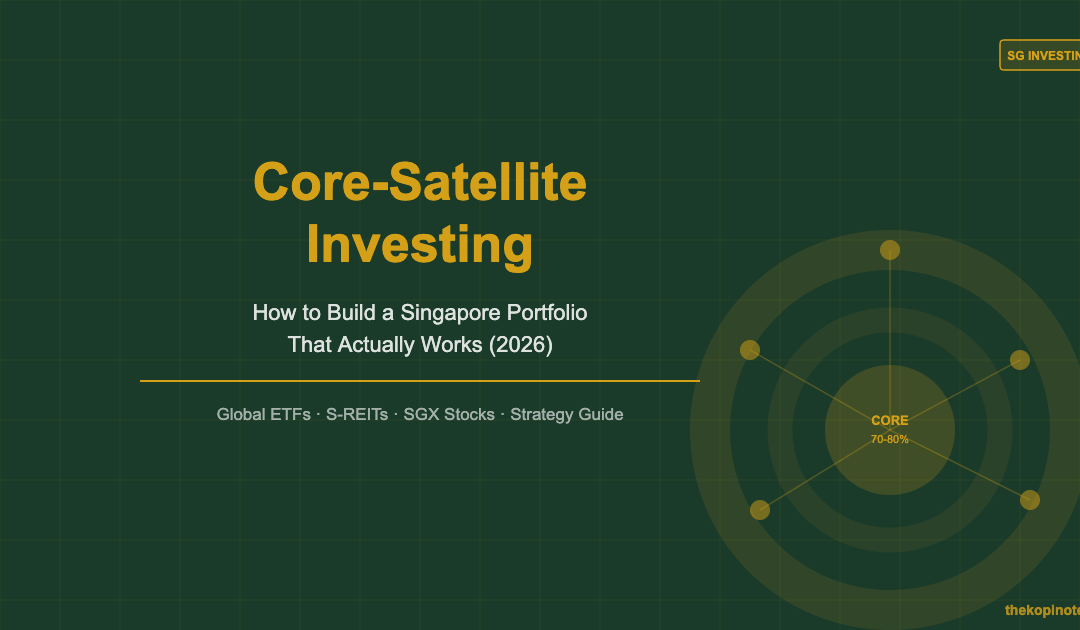
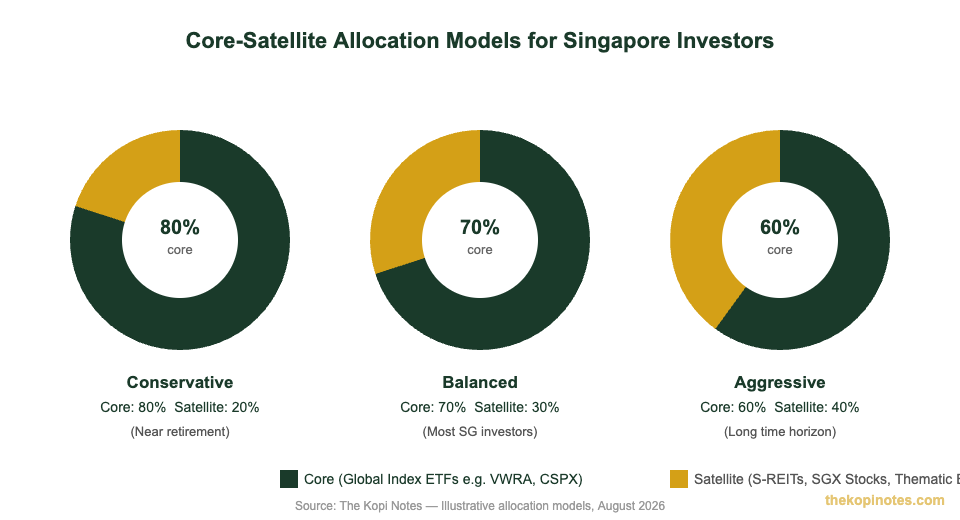
The core-satellite strategy splits your Singapore portfolio into two parts: a large “core” of low-cost global index ETFs (like VWRA or CSPX) for broad market returns, and a smaller “satellite” of Singapore-focused assets like S-REITs or dividend stocks for local income. Most Singapore investors use a 70–80% core and 20–30% satellite split — growing globally while earning locally. Data verified as at 29 August 2026.
Not financial advice. All figures are for educational reference only. Data as at August 2026 unless noted.
- Core (70–80%): Low-cost global index ETFs like VWRA (0.22% TER) or CSPX (0.07% TER) — listed on the London Stock Exchange to avoid US estate tax
- Satellite (20–30%): S-REITs, SGX blue-chip stocks, or thematic ETFs for Singapore income and local exposure
- Implement across CPF OA (SGX ETFs), SRS (robo-advisors), and Cash (IBKR/Syfe for LSE ETFs)
Table of Contents
Contents — Click to expand
- What Is Core-Satellite Investing?
- Why This Strategy Works for Singapore Investors
- Building Your Core: Global Index ETFs
- Building Your Satellite: S-REITs, Stocks & Thematic ETFs
- How to Split Your Portfolio
- Implementing Across CPF, SRS, and Cash
- Step-by-Step: Build Your Core-Satellite Portfolio
- Frequently Asked Questions
What Is Core-Satellite Investing?
Core-satellite investing is a portfolio construction method that divides your money into two distinct buckets. The “core” is the foundation — a large, stable allocation to low-cost, diversified investments that track the broad market. The “satellite” is a smaller allocation to more targeted positions that can boost income or return in specific areas.
Think of it like a solar system. Your core is the sun — stable, central, and doing most of the heavy lifting. Your satellites orbit it — adding different flavours of return without destabilising the whole portfolio.
For Singapore investors, the core-satellite approach is especially powerful. You get global diversification (through your core) combined with Singapore-specific income (through your satellite). You do not have to choose between “invest globally” and “invest locally” — you do both, deliberately.
This strategy is used by institutional investors worldwide. But it is equally effective for everyday Singaporeans starting with just $1,000 a month.
Why This Strategy Works for Singapore Investors
Singapore has a unique investing environment. You have CPF, SRS, and cash as three separate investment buckets. You have access to both the SGX and international exchanges. And you have no capital gains tax — meaning you can rebalance freely without a tax penalty.
| Challenge | How Core-Satellite Solves It |
|---|---|
| Should I invest globally or in Singapore? | Do both — core for global growth, satellite for SG income |
| I want passive income (dividends/distributions) | Satellite handles income via S-REITs and dividend stocks |
| My CPF OA can only buy SGX-listed ETFs | Use CPF for satellite; SRS and cash for your global core |
| I want to invest in specific themes (AI, gold) | Satellite can include thematic ETFs up to 5–10% |
| I am worried about market timing | Core index ETFs remove the need to time the market |
Source: The Kopi Notes analysis, August 2026
There is no capital gains tax in Singapore. So when you sell your satellite positions to rebalance into the core, you keep every dollar of your gain. That makes this strategy more effective here than in most other countries.
Building Your Core: Global Index ETFs
Your core should be boring. That is the point. You want a low-cost, globally diversified fund that tracks the world’s stock markets — and then you leave it alone.
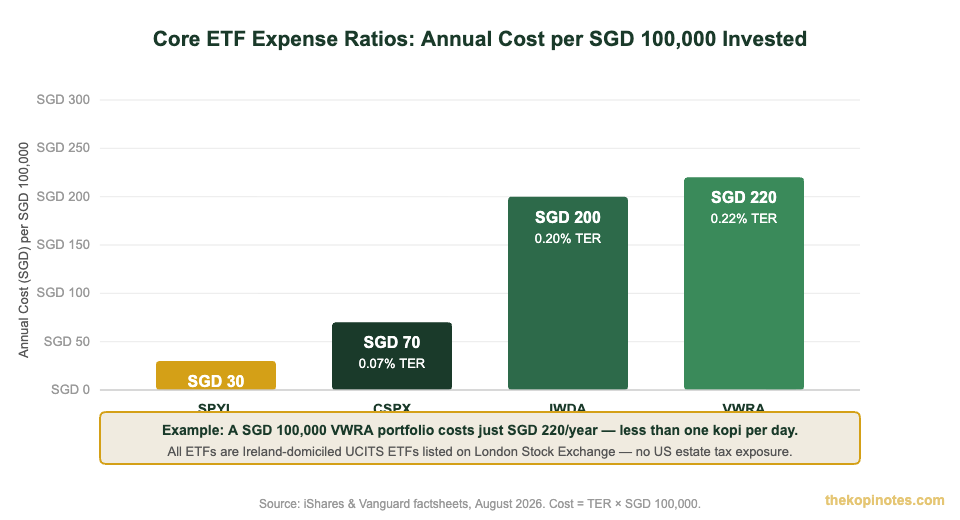
The best core ETFs for Singapore investors are Ireland-domiciled UCITS ETFs listed on the London Stock Exchange (LSE). These funds are not subject to US estate tax (which kicks in above USD 60,000 for non-US persons holding US-domiciled funds). They also benefit from a 15% withholding tax on US dividends — versus 30% for US-domiciled ETFs. Your CPF investment strategy may also influence your ETF choice, since CPF OA funds can only be used for SGX-listed ETFs.
| ETF | Ticker (LSE) | Index Tracked | TER | Structure |
|---|---|---|---|---|
| Vanguard FTSE All-World UCITS ETF | VWRA | FTSE All-World (4,000+ stocks) | 0.22% | Accumulating |
| iShares Core S&P 500 UCITS ETF | CSPX | S&P 500 (500 US stocks) | 0.07% | Accumulating |
| iShares Core MSCI World UCITS ETF | IWDA | MSCI World (23 developed markets) | 0.20% | Accumulating |
| SPDR S&P 500 UCITS ETF | SPYL | S&P 500 (500 US stocks) | 0.03% | Accumulating |
Source: Vanguard and iShares fund factsheets, August 2026. TER = Total Expense Ratio (annual fee charged by the fund).
Which core ETF should you pick? If you want maximum diversification including emerging markets (China, India, Brazil), go with VWRA. If you want lower cost and US-only exposure, CSPX or SPYL are excellent. Most beginners start with VWRA for its simplicity — one ETF, 4,000+ stocks, the whole world covered.
Building Your Satellite: S-REITs, SGX Stocks & Thematic ETFs
Your satellite is where you customise the portfolio. It is a smaller allocation (20–30%) that targets higher income, Singapore-specific opportunities, or themes you believe in. The satellite does not replace your core — it complements it.
1. S-REITs (Singapore Real Estate Investment Trusts)
S-REITs are legally required to distribute at least 90% of taxable income as dividends, which means consistent quarterly income. Singapore residents pay no withholding tax on S-REIT distributions. A diversified approach is to hold the Singapore REIT ETF instead of individual REITs, which gives you broad S-REIT exposure without stock-picking risk. For individual picks, see our guide to best S-REITs in Singapore 2026.
2. SGX Blue-Chip Stocks
DBS, OCBC, and UOB — Singapore’s three local banks — are perennial satellite favourites. They have consistently paid dividends above 4% per year and are deeply tied to Singapore’s economic growth. The key advantage: they are CPF OA-eligible. You can use your CPF OA funds (above the $20,000 set-aside) to buy them — keeping your cash for the global core on the LSE.
3. Thematic ETFs
If you believe in a long-term trend — artificial intelligence, gold, clean energy — a thematic ETF lets you express that view without concentrating too much in a single stock. Keep thematic ETFs at 5–10% of your total portfolio. They carry higher risk and can underperform for years before a theme plays out.
For Singapore investors looking to build passive income in Singapore, the S-REIT satellite is the most practical starting point — predictable quarterly distributions, Singapore-dollar income, and no currency risk.
How to Split Your Portfolio
Your allocation depends on your age, income stability, and income needs. Never let your satellite exceed 40% — beyond that, you are essentially stock-picking with most of your money.
| Investor Profile | Core % | Satellite % | Core ETF Pick |
|---|---|---|---|
| Young professional (20s–30s) | 80% | 20% | VWRA or CSPX |
| Mid-career (40s, building income) | 70% | 30% | VWRA or IWDA |
| Pre-retirement (50s, needs income) | 60% | 40% | IWDA or VWRA |
| Retirement phase | 50% | 50% | VWRA + S-REITs heavy |
Source: The Kopi Notes, August 2026. Illustrative only — not financial advice.
Use our Singapore retirement calculator to model how different core-satellite splits affect your projected retirement balance.
Implementing Across CPF, SRS, and Cash
| Account | Best For | What to Buy | Platform |
|---|---|---|---|
| CPF OA | Satellite (SGX-listed) | STI ETF, bank stocks, S-REIT ETF | POEMS, DBS Vickers |
| SRS | Core (LSE ETFs via robo) | VWRA, CSPX via Endowus or Syfe | Endowus or Syfe |
| Cash | Core (LSE ETFs direct) | VWRA, CSPX, SPYL on LSE | IBKR (referral: jianxiong368), MooMoo |
Source: The Kopi Notes, August 2026. LSE = London Stock Exchange. CPF OA eligibility rules as at July 2026.
CPF OA funds above $20,000 can be invested via CPFIS. Many investors use their CPF OA as a natural satellite — buying SGX-listed ETFs or blue chips — while keeping their global core for cash and SRS. SRS is ideal for your global core — you get dollar-for-dollar tax relief on top-ups up to $15,300/year (citizens/PRs, as at 2026), and the SRS investment compounds tax-free. Cash via IBKR gives you the most flexibility and lowest commissions for LSE ETFs.
Step-by-Step: Build Your Core-Satellite Portfolio
Here is a concrete action plan. Say you are 35 with $2,000/month to invest.
Step 1: Define your split. At 35, a 75% core / 25% satellite split makes sense. Of $2,000/month, that is $1,500 to core and $500 to satellite.
Step 2: Choose your core ETF. Open an IBKR or Syfe account. Pick VWRA for global coverage or CSPX/SPYL for US-only at lower TER. Set up a monthly recurring buy — the same amount, every month, regardless of market conditions. This is dollar-cost averaging (DCA): you buy more units when prices are low, fewer when high.
Step 3: Set up your satellite. If you have CPF OA funds above $20,000, use them to buy an S-REIT ETF or bank stocks through POEMS. Alternatively, set aside your $500/month cash for individual S-REITs or blue chips. Keep any single satellite position below 5% of your total portfolio.
Step 4: Max out SRS. Top up SRS to $15,300/year (citizens/PRs). Deploy into your core via Endowus or Syfe. The tax relief effectively gives you an instant return boost in year one.
Step 5: Rebalance annually. Once a year, check if your core/satellite split has drifted. If satellite grew to 35%, trim back to 25% and add proceeds to core. No capital gains tax — so rebalancing is free.
Step 6: Review quarterly, not daily. Your core ETF is designed to hold for decades. Checking daily and making changes based on short-term news is the number one way to destroy long-term returns.
Frequently Asked Questions
What is the core-satellite investing strategy?
The core-satellite strategy divides your portfolio into two parts. The core (70–80%) holds low-cost, globally diversified index ETFs like VWRA or CSPX for broad market returns. The satellite (20–30%) holds more targeted investments like S-REITs, SGX stocks, or thematic ETFs for income and specific exposure. Together they deliver global growth and local income without the complexity of full stock-picking.
How to invest in Singapore using the core-satellite approach?
Start by opening a brokerage account (IBKR or Syfe for LSE ETFs) and buying a global index ETF like VWRA or CSPX for your core. Then use CPF OA or a separate cash allocation for your satellite — S-REITs, SGX blue chips, or a Singapore REIT ETF. Max out your SRS top-up ($15,300/year for citizens/PRs as at 2026) and invest it into your core for immediate tax relief. Review and rebalance once a year.
Is VWRA or CSPX better as a core ETF for Singapore investors?
Both are excellent choices. VWRA tracks 4,000+ stocks across 49 countries including emerging markets, with a TER of 0.22%. CSPX tracks just the 500 largest US companies at a lower TER of 0.07%. For total global diversification in one ETF, VWRA is the simpler choice. For US-only exposure at lower cost, CSPX (or the even cheaper SPYL at 0.03%) works well. Both are Ireland-domiciled UCITS ETFs — no US estate tax, 15% withholding tax on US dividends.
Can I buy VWRA or CSPX using my CPF?
No. VWRA and CSPX are listed on the London Stock Exchange and are not CPF OA-eligible. CPFIS allows only SGX-listed ETFs, approved unit trusts, and certain stocks. However, you can use SRS funds to buy VWRA and CSPX through Endowus or Syfe. Many Singapore investors use CPF OA for their satellite (SGX-listed ETFs or bank stocks) and cash or SRS for their global core.
How large should my satellite allocation be?
Keep your satellite at 20–30% of your total portfolio. Younger investors with a 20+ year horizon can go as low as 15–20% satellite — the core does the heavy lifting. Investors in their 50s approaching retirement who need income can go up to 40% satellite (weighted to S-REITs). Never exceed 50% satellite — at that point you are essentially stock-picking with a small diversification buffer.
Do I pay tax when rebalancing my core-satellite portfolio in Singapore?
No. Singapore has no capital gains tax. When you sell satellite positions to rebalance into your core (or vice versa), you keep 100% of the profit. This is one of the biggest advantages of core-satellite investing for Singapore investors — you can rebalance as often as needed without any tax drag. The only costs are brokerage commissions, which are minimal on IBKR (from USD 1 per trade).
What are the best S-REITs for a satellite portfolio?
Popular S-REIT satellite picks include CapitaLand Integrated Commercial Trust (retail and office), Mapletree Industrial Trust (industrial and data centres), and Keppel DC REIT (pure-play data centres). For a simpler approach, a Singapore REIT ETF gives you diversified exposure across 30+ S-REITs without individual stock selection. Singapore residents pay no withholding tax on S-REIT distributions, making them especially tax-efficient as a satellite income source.
Ready to Build Your Core-Satellite Portfolio?
Open a brokerage account and start buying your core ETF today. Use our referral links for sign-up bonuses.
This article was researched with the help of AI. While we strive to keep all information accurate and up to date, there may be errors. If you notice any discrepancies, please contact us.