Mapletree Industrial Trust Share Price 2026: Rate Cut Tailwinds & Tech Park Recovery
Mapletree Industrial Trust (SGX: ME8U) is a Singapore-listed industrial REIT with over S$9 billion in assets spanning hi-tech buildings, business parks, flatted factories, and US data centres. As at August 2026, MIT trades at around S$2.08, offering an estimated yield of 6.2%. With the US Federal Reserve signalling two rate cuts at Jackson Hole 2026, MIT is positioned to benefit from lower borrowing costs and a recovering Singapore tech park sector.
Not financial advice. All figures are for educational reference only. Data as at August 2026 unless noted.
- MIT share price (~S$2.08) sits ~10% below its 52-week high — rate cut expectations are the key re-rating catalyst.
- ~75% of MIT’s debt is fixed-rate; the remaining 25% floating means a 50bps rate cut could add ~0.10¢ to DPU annually.
- Singapore tech park demand is recovering post-pandemic — MIT’s hi-tech buildings are showing improving occupancy in 2026.
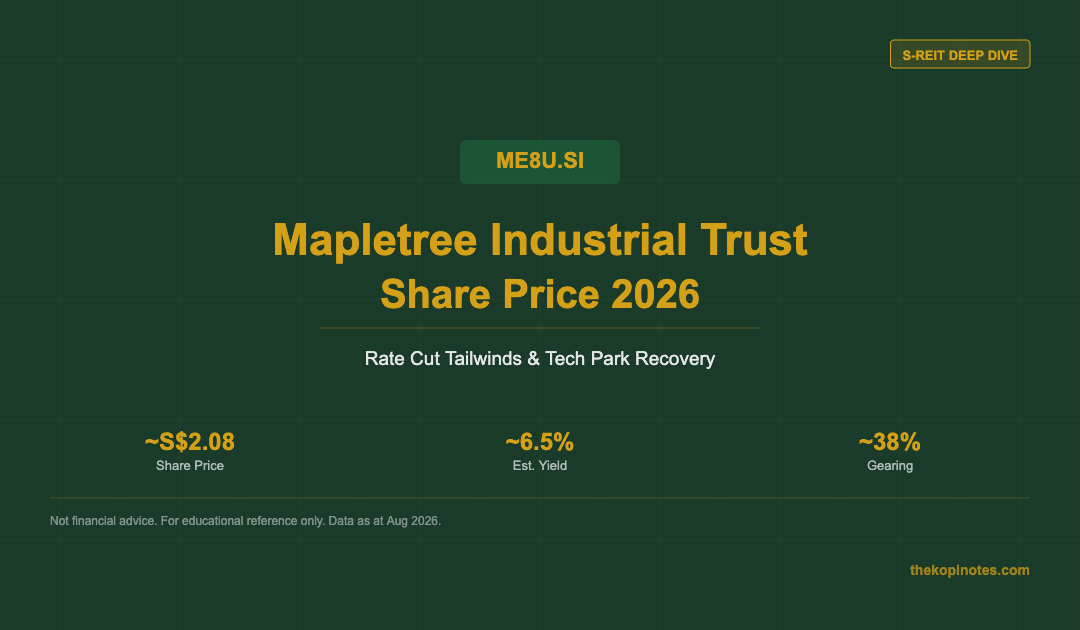
Table of Contents
Table of Contents
- What Is Mapletree Industrial Trust?
- MIT Share Price Performance in 2026
- Rate Cut Tailwinds: How Fed Cuts Impact MIT
- MIT’s Debt Structure & Interest Rate Sensitivity
- Singapore Tech Park Demand Recovery
- MIT DPU Outlook for 2H2026
- MIT vs Peer Industrial REITs
- How to Buy MIT Shares in Singapore
- Frequently Asked Questions
What Is Mapletree Industrial Trust?
Mapletree Industrial Trust (ME8U) launched on the Singapore Exchange in October 2010. It is sponsored by Mapletree Investments, a wholly-owned subsidiary of Temasek Holdings. That blue-chip parentage gives MIT strong credit standing and regular pipeline access — two things that matter a lot when you are running a real estate portfolio through rate cycles.
MIT’s portfolio spans two major geographies: Singapore and the United States. In Singapore, you get a mix of hi-tech buildings (which house tech and biomedical tenants), business parks, flatted factories, and stack-up industrial properties. In the US, MIT holds a stake in a portfolio of data centres through a 50:50 joint venture.
As at August 2026, MIT’s total assets under management are approximately S$9 billion across roughly 160 properties. The REIT is structured as a real estate investment trust listed on SGX-ST, distributing at least 90% of its distributable income as dividends (called Distribution Per Unit, or DPU) to unitholders twice a year.
If you are building a passive income Singapore portfolio, MIT has historically been one of the core industrial REIT holdings for Singapore retail investors — with a track record of consistent distributions spanning over a decade.
MIT Share Price Performance in 2026
After a difficult 2023–2024 period when rising US interest rates pressured all S-REITs, MIT’s share price has been gradually recovering. As at August 2026, MIT trades at approximately S$2.08, which is still about 8–10% below its 2022 highs but around 15% above the 52-week lows seen in late 2025.
The key driver behind the 2026 recovery? Rate cut expectations. When the US Fed signalled at its March 2026 meeting that the tightening cycle was firmly over, S-REIT prices started grinding higher. MIT specifically benefited from renewed interest in industrial REITs with data centre exposure — a theme that is only getting stronger as AI demand drives data centre construction globally.
It is worth noting that MIT’s current price still implies a significant discount to its net asset value (NAV). Most analyst estimates put MIT’s NAV at around S$2.20–2.30 per unit, which means you are buying assets at roughly 90 cents on the dollar at current prices. That is a meaningful margin of safety for a REIT with investment-grade credit and a Temasek-linked sponsor.
Rate Cut Tailwinds: How Fed Cuts Impact MIT
The Jackson Hole Economic Symposium in late August 2026 was the moment most S-REIT investors had been waiting for. Fed Chair comments signalled two cuts of 25 basis points each in the second half of 2026 — translating to a 50bps total reduction by December 2026.
For MIT, rate cuts matter in three interconnected ways.
First, lower floating-rate borrowing costs. Approximately 25% of MIT’s total debt (~S$800 million out of ~S$3.2 billion) is on floating rates. A 50bps reduction translates to roughly S$4 million in annual interest savings. That might sound modest, but spread across approximately 4 billion units outstanding, it adds around 0.10 Singapore cents per unit to annual DPU — a meaningful uplift on a base DPU of ~12.85¢.
Second, share price re-rating. REITs are essentially perpetual dividend instruments — their fair value is heavily influenced by discount rates. When rates fall, the discount rate used to value future income streams also falls, pushing valuations higher. In the 2019 rate-cut cycle, MIT rallied approximately 20–25% over 12 months as the Fed pivoted from hiking to cutting. A similar dynamic is plausible in 2H2026.
Third, refinancing at lower rates. MIT has approximately S$600–800 million in debt maturing in FY2026/27. As these facilities roll over, the new borrowing costs will likely be lower than the rates locked in during 2022–2023. This mechanical improvement in financing cost has a direct, predictable positive impact on DPU over the next 12–18 months.
Of course, rate cuts are not a silver bullet. Tenant demand, occupancy rates, and asset quality all matter more in the long run. But right now, the macro tailwind is real and MIT’s balance sheet is positioned to capture it. For more context on how rate changes affect S-REITs broadly, see our guide to the best S-REITs in Singapore 2026.
MIT’s Debt Structure & Interest Rate Sensitivity
One of the most important things to understand about MIT as an investment is its debt profile. Here is how the numbers look as at mid-2026:
| Metric | Value (est. Aug 2026) | Implication |
|---|---|---|
| Gearing Ratio | ~38% | Well below 45% MAS soft ceiling |
| Fixed-Rate Debt | ~75% | Shields most DPU from rate moves |
| Floating-Rate Debt | ~25% (~S$800m) | +50bps cut = ~S$4m savings/yr |
| Avg. All-In Borrowing Cost | ~3.4% | Set to improve on refinancing |
| WALE (Debt) | ~2.8 years | Near-term refinancing opportunity |
| Interest Cover Ratio | ~4.2× | Comfortable headroom above 1.5× minimum |
Source: MIT quarterly filings, analyst estimates, Aug 2026.
The 75% fixed-rate hedge is a double-edged sword. It means MIT will not fully benefit from rate cuts immediately — only the floating 25% reprices quickly. However, it also means MIT was relatively protected during the 2022–2024 tightening cycle compared to REITs with higher floating rate exposure. That defensiveness preserved the DPU better than many peers during the tough years.
To put the DPU sensitivity in concrete terms: every 25 basis point cut on MIT’s floating rate debt saves approximately S$2 million annually, or about 0.05¢ per unit per year. Two cuts of 25bps = 0.10¢ annual uplift. That is not massive on a 12.85¢ base DPU, but in an environment of flat organic growth, every additional cent of DPU matters for yield-hungry investors. If you want to model your own income target from MIT, try the Singapore retirement calculator at TKN.
Singapore Tech Park Demand Recovery
Beyond interest rates, the other key story for MIT in 2H2026 is what is happening to occupancy in its Singapore business parks and hi-tech buildings. This is the portfolio segment that faced the most headwinds in 2023–2024 as tech companies globally downsized office and R&D footprints.
The picture is improving. Singapore’s tech sector has stabilised after the mass layoff wave of 2023, and demand from AI, semiconductor, and biomedical companies is picking up. MIT’s hi-tech buildings — which are designed for research, product development, and high-specification manufacturing — are seeing enquiries strengthen in 2026 as companies tied to the AI supply chain (chip design, hardware testing, data analytics) look for purpose-built space in Singapore.
MIT’s overall portfolio occupancy sits at approximately 91% as at mid-2026, with hi-tech buildings at around 93–95% and legacy flatted factories at around 88–89%. The WALE (weighted average lease expiry by NLA) of the Singapore portfolio is approximately 3.5 years, providing near-term income visibility even if occupancy dips temporarily on lease renewals.
What is particularly encouraging is the rental reversion trend. MIT’s business park and hi-tech building leases are being renewed at positive spreads of approximately 2–5% above expiring rents as at recent quarters — a sign that landlord pricing power is returning after a period of softness. In practical terms, this means MIT’s top-line revenue should edge modestly higher in FY2026/27 even without any new acquisitions.
The US data centre JV, which contributes approximately 25–30% of MIT’s total DPU, continues to perform strongly. Hyperscaler demand (from the big cloud providers) remains robust as AI workloads drive data centre utilisation rates above 95% across MIT’s US portfolio. This segment effectively cross-subsidises any short-term softness in Singapore industrial markets.
MIT DPU Outlook for 2H2026
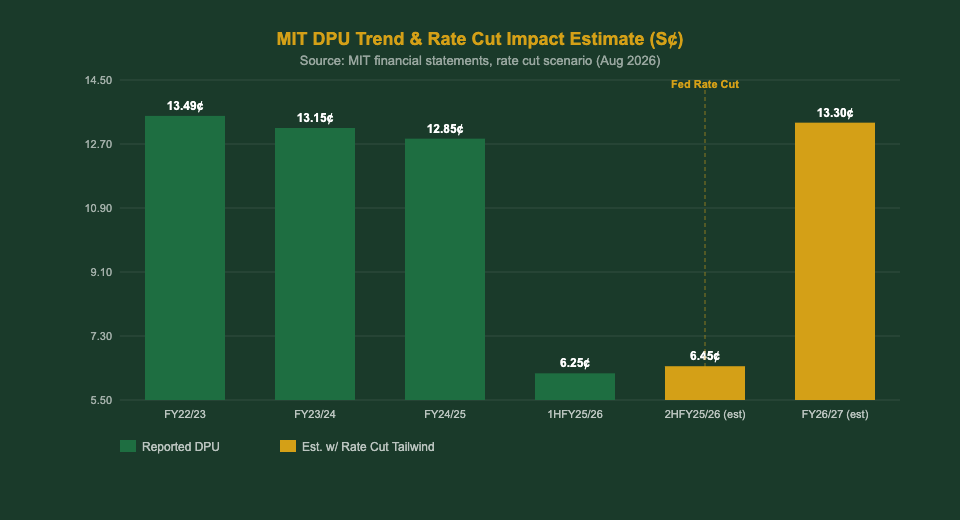
MIT reports results on a semi-annual basis. Here is a summary of recent and projected DPU performance:
| Period | DPU (S¢) | YoY Change | Notes |
|---|---|---|---|
| FY2022/23 | 13.49¢ | +1.2% | Peak pre-rate headwind |
| FY2023/24 | 13.15¢ | -2.5% | Rising financing cost impact |
| FY2024/25 | 12.85¢ | -2.3% | Stabilised occupancy |
| 1H FY2025/26 (rpted) | 6.25¢ | +2.1% | Recovery beginning |
| 2H FY2025/26 (est) | ~6.45¢ | +3.2% | Rate cut + reversion tailwind |
| FY2026/27 (est) | ~13.30¢ | +2.0% est | Full 50bps cut benefit |
Source: MIT financial statements, analyst consensus estimates, Aug 2026. Estimates are not a guarantee of future performance.
At an estimated forward DPU of approximately 13.30¢ and a current price of ~S$2.08, MIT’s forward yield works out to roughly 6.4%. That is attractive compared to the 10-year Singapore government bond yield of approximately 3.1% as at August 2026 — implying a yield spread of around 330 basis points. Historically, MIT has traded at yield spreads of 200–280bps above risk-free rates. The current spread suggests modest undervaluation.
The key risk to watch is tenant concentration and lease renewal success in the Singapore business parks. If the tech sector recovery stalls, positive rental reversions could turn negative, capping DPU growth. Monitoring MIT’s quarterly updates for occupancy and reversion data is therefore essential for any holder of this REIT.
MIT vs Peer Industrial REITs: Quick Comparison
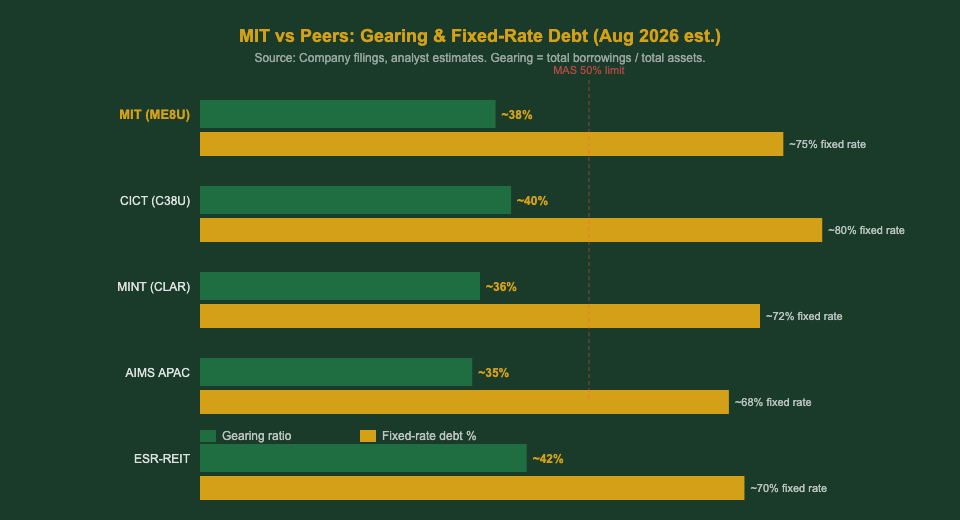
How does MIT stack up against other Singapore industrial REITs? Here is a side-by-side comparison to help you decide where MIT fits in a diversified S-REIT portfolio. For a broader look across all REIT sectors, see our best S-REITs in Singapore 2026 guide.
| REIT (SGX Code) | Price (Aug 26) | Est. Yield | Gearing | Fixed Rate % |
|---|---|---|---|---|
| MIT (ME8U) | ~S$2.08 | ~6.2% | ~38% | ~75% |
| CICT (C38U) | ~S$2.15 | ~5.8% | ~40% | ~80% |
| AIMS APAC (O5RU) | ~S$1.48 | ~7.1% | ~35% | ~68% |
| ESR-REIT (J91U) | ~S$0.38 | ~7.8% | ~42% | ~70% |
Source: SGX, company filings, analyst estimates as at August 2026. All data is estimated and for educational reference only.
MIT offers the best balance of sponsor quality (Temasek-linked), portfolio diversification (SG + US data centres), and balance sheet strength (lowest gearing, highest fixed-rate hedge) among this peer group. The trade-off is a lower starting yield than AIMS APAC or ESR-REIT. If you prioritise yield, AIMS APAC or ESR-REIT may be worth researching further. If you prioritise sponsor quality and balance sheet resilience, MIT is the standout.
How to Buy Mapletree Industrial Trust Shares in Singapore
MIT is listed on the Singapore Exchange (SGX) under ticker ME8U. You can buy it through any Singapore brokerage with SGX access. Here are the most popular platforms among Singapore retail investors, along with approximate costs as at 2026:
FSMOne — One of the cheapest options for SGX trades. Charges a minimum commission of S$8.80 per trade (or 0.08% of trade value, whichever is higher). The platform also offers a regular savings plan feature, which is useful if you want to dollar-cost average into MIT monthly. Use our FSMOne referral code (P0544985) to get started.
Syfe Trade — A mobile-first platform with a minimum commission of S$1.98 per SGX trade. Good for smaller position sizes. You can sign up with our Syfe referral code (SRPRFFFCD) for a welcome bonus on eligible deposits.
IBKR (Interactive Brokers) — Best for investors who also want access to US-listed REITs or ETFs. SGX commissions start at S$2.50 per trade. Suitable for more active investors managing multi-currency portfolios. Use referral code jianxiong368 when signing up.
Whichever platform you choose, MIT is denominated in SGD, so there is no FX conversion needed for Singapore investors. Distributions are paid directly to your brokerage account or CDP account twice a year (typically in February and August). If you are planning for retirement, see how MIT could fit into your income plan using the Singapore retirement calculator.
One practical note: if you are comparing MIT against fixed income alternatives like T-bills or Singapore Savings Bonds, the current spread (~330bps above the risk-free rate) is historically wide. T-bills currently yield approximately 3.1–3.2% — MIT’s estimated 6.2% yield implies roughly double the income for the additional risk of equity ownership. See our Singapore T-bills 2026 guide for the full comparison.
Frequently Asked Questions
What is the current Mapletree Industrial Trust share price?
What is MIT's current dividend yield?
How does a US Federal Reserve rate cut affect MIT's DPU?
Is MIT's gearing ratio safe?
What are the main risks of investing in Mapletree Industrial Trust?
How can I buy Mapletree Industrial Trust shares in Singapore?
This article was researched with the help of AI. While we strive to keep all information accurate and up to date, there may be errors. If you notice any discrepancies, please contact us.