TribeCar + Syfe: Skip Car Ownership, Invest the Savings (Singapore 2026)
Skipping car ownership in Singapore and using TribeCar instead can free up roughly $1,250 a month once you account for COE, insurance, parking and petrol. Parked in Syfe’s Cash+ Flexi, that difference grows to about $155,000 over 10 years — invested in a diversified growth portfolio, closer to $197,000, though growth returns are never guaranteed.
Not financial advice. All figures are for educational reference only. Data as at August 2026 unless noted.
- Full car ownership in Singapore now costs roughly $1,673/month for a light user, driven mainly by COE (Cat A hit $128,501 in the 2nd August 2026 bidding)
- A comparable TribeCar usage pattern (about 8 hours + 100km a week) costs closer to $394/month — a gap of roughly $1,250/month
- Parking that gap in Syfe (Cash+ Flexi for safety, or a growth portfolio for the long run) turns an expense into a second income stream over time
Contents — Click to expand
2. How TribeCar Pricing Actually Works
3. Side-by-Side: Ownership vs TribeCar
4. Where the Savings Go — Investing via Syfe
5. The Math: What $1,250/Month Could Grow Into
6. Who This Strategy Actually Suits
7. How to Get Started
8. Frequently Asked Questions
The Real Cost of Car Ownership in Singapore (2026)
Car Category A Certificate of Entitlement (COE) — basically the government-issued permit you need before you’re allowed to register a car — closed at $128,501 in the second August 2026 bidding exercise, up from $123,890 in the first. That’s before you’ve even paid for the car itself.
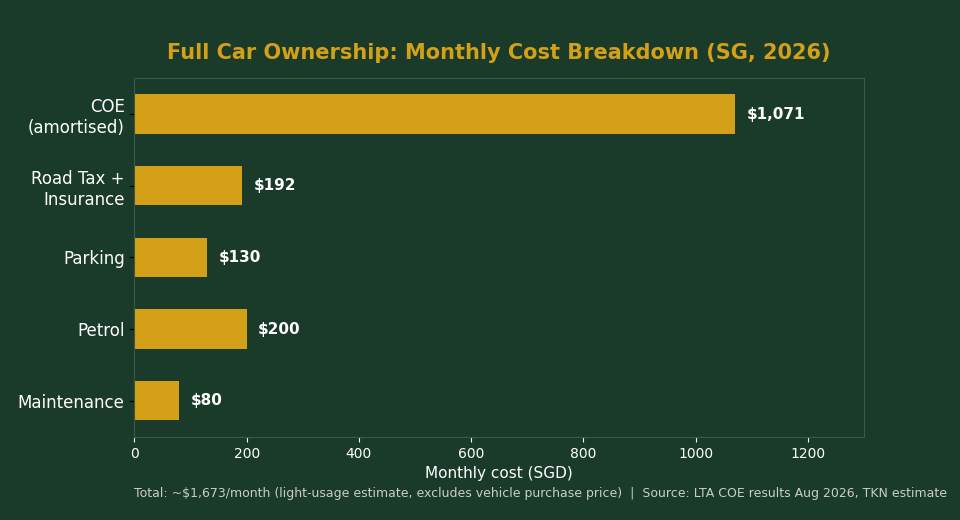
Spread that COE over a typical 10-year lifespan, and you’re already looking at roughly $1,071 a month. Add road tax and insurance, season parking, petrol, and routine servicing, and a light-usage car owner is realistically paying around $1,673 a month — and that still excludes the car’s open market value or any loan interest.
Here’s the breakdown for a light-usage owner (weekday commute plus occasional weekend trips):
| Cost Item | Monthly (SGD) |
|---|---|
| COE (Cat A, amortised over 10 years) | $1,071 |
| Road tax + insurance | $192 |
| Season parking | $130 |
| Petrol (light use) | $200 |
| Maintenance/servicing | $80 |
| Total | ~$1,673/month |
Source: LTA COE Results, August 2026 2nd bidding exercise; TKN estimate for light-usage ownership costs.
How TribeCar Pricing Actually Works
TribeCar is a peer-to-peer car-sharing platform. You book a car by the hour through the app, drive it, then return it — no COE, no insurance premium, no season parking to manage.
As of March 2026, TribeCar mileage rates are $0.43/km for Economy, Standard, Car Club Choice and Select vehicles, and $0.53/km for Car Club Prime. Hourly rates vary by host and time slot — you can find off-peak overnight economy bookings for as little as $2 to $3 an hour, while peak-hour or premium SUV bookings can run $10 to $22+ an hour.
Because hosts set their own pricing, your actual monthly cost depends heavily on when and how often you book. A moderate user — say 8 hours of driving time and 100km a week, mixing off-peak and peak slots — lands at roughly $394 a month once you average the blended hourly rate with mileage charges.
Side-by-Side: Ownership vs TribeCar
Put the two numbers next to each other and the gap is hard to ignore. For a moderate driver, the difference works out to roughly $1,250 a month — money you’d otherwise be tying up in a depreciating asset.
Source: LTA COE results Aug 2026, TKN estimate
Where the Savings Go — Investing via Syfe
Freeing up $1,250 a month is only useful if it actually gets invested, rather than quietly absorbed into daily spending. Syfe gives you two very different ways to put that money to work, depending on your risk appetite and timeline.
Option 1: Park it safely in Cash+
If you’re not ready to commit to markets, or you want an emergency buffer first, Syfe Cash+ Flexi currently projects around 1.5–1.6% p.a. for the SGD portfolio (net of fees, not guaranteed) — better than most bank savings accounts, with same-day-ish liquidity.
If you’d rather lock in a fixed rate, Syfe Cash+ Guaranteed pays a fixed 1.25% p.a. on a 6-month term as at August 2026 (1.05% for 1-month, 1.15% for 3-month), with no exposure to rate swings during the lock-in.
Option 2: Invest it in a growth portfolio
If your time horizon is 5–10 years or longer, a diversified equity-based Syfe portfolio (such as Syfe Core or Equity100) lets your savings participate in long-run market growth instead of sitting in cash. Global equities have historically compounded in the mid-to-high single digits over multi-decade periods, though any specific figure is illustrative, not a promise — markets can and do fall.
- Building an emergency fund first? Use Cash+ Flexi or Cash+ Guaranteed
- Investing for 5+ years and comfortable with volatility? Consider a growth portfolio
- Not sure? Split it — part in Cash+ for safety, part invested for growth
Here’s a worked example. Say you’re a 32-year-old Singaporean who just sold your car instead of renewing its COE. You put $750 a month into Cash+ Flexi as a buffer, and the remaining $500 a month into a growth portfolio. After 10 years, the Cash+ Flexi portion (contributed $90,000) would sit around $97,035, while the growth portion (contributed $60,000) could grow to roughly $81,940 at an illustrative 6% p.a. — a combined total north of $178,000, without ever touching a COE renewal decision.
The Math: What $1,250/Month Could Grow Into
Here’s what that monthly gap could realistically become over 5 and 10 years, comparing a safe Cash+ Flexi parking spot against an illustrative 6% p.a. diversified growth portfolio. Neither number is guaranteed — think of this as a demonstration of what “not spending it” can do over time, not a return promise.
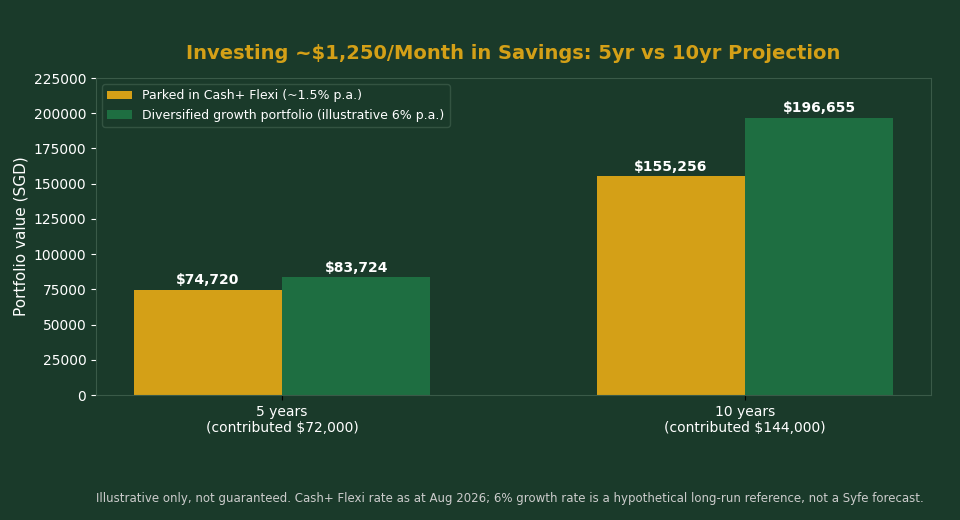
| Timeframe | Contributed | Cash+ Flexi (~1.5%) | Growth portfolio (6%) |
|---|---|---|---|
| 5 years | $72,000 | $74,720 | $83,724 |
| 10 years | $144,000 | $155,256 | $196,655 |
Illustrative only, not guaranteed. Cash+ Flexi rate as at Aug 2026 (net of fees, projected not fixed); the 6% figure is a hypothetical long-run reference, not a Syfe forecast. Calculated assuming monthly contributions compounded monthly, no withdrawals.
Who This Strategy Actually Suits
This combo isn’t for everyone. Here’s a quick gut-check on whether it fits you:
| Profile | Fit? |
|---|---|
| Drives fewer than ~10 hours a week, mostly short trips | Strong fit — TribeCar likely cheaper |
| Needs a car daily for work (deliveries, client visits) | Weak fit — ownership may work out cheaper at high usage |
| Wants flexibility without a 10-year COE commitment | Strong fit |
| Already has an emergency fund and wants savings to work harder | Strong fit — pair with Syfe |
How to Get Started
Setting this up takes about 15 minutes total — sign up for TribeCar, sign up for Syfe, and set a standing reminder to transfer whatever you didn’t spend on a car each month.
- Download the TribeCar app and sign up using our TribeCar referral code and sign-up guide (code: zZDeg) for sign-up credits
- Open a Syfe account through our Syfe referral code and sign-up bonus link (code: SRPRFFFCD) to unlock a welcome bonus
- Decide: Cash+ for safety, growth portfolio for the long run, or a split of both
- Set a recurring monthly transfer for whatever you’d otherwise spend on car ownership
Frequently Asked Questions
Is TribeCar cheaper than owning a car in Singapore?
How much does TribeCar cost per month for a light user?
What is Syfe Cash+ Flexi's current interest rate?
Should I use Syfe Cash+ Guaranteed or Cash+ Flexi for my TribeCar savings?
Is it safe to invest the money I save from not owning a car?
How do I get the TribeCar and Syfe referral bonuses?
For a full breakdown of how idle cash grows over time, see our Singapore retirement calculator, or read our guide to passive income Singapore strategies for where invested savings can go next.
For official rate and pricing references, see the LTA COE bidding results, TribeCar’s official rates page, and Syfe’s Cash+ Flexi page.
Ready to Stop Paying for a Car You Barely Use?
Skipping ownership doesn’t mean skipping mobility — it means redirecting the COE money into your own future instead of a depreciating asset.
This article was researched with the help of AI. While we strive to keep all information accurate and up to date, there may be errors. If you notice any discrepancies, please contact us.