How to Buy Dividend Stocks in Singapore: A Beginner’s Step-by-Step Guide (2026)
Brokers, CDP accounts, board lots, and how to build your first income portfolio — explained without the jargon.
To buy dividend stocks in Singapore, open a brokerage account (CDP-linked or custodian), fund it via PayNow or bank transfer, then purchase shares of S-REITs, local banks, or blue-chip stocks in board lots of 100 through the SGX. Most brokers charge between S$3 and S$25 per trade, and dividends are paid to individual investors completely tax-free.
Not financial advice. All figures are for educational reference only. Data as at August 2026 unless noted.
- You need a Central Depository (CDP) account or a custodian brokerage account before you can buy any SGX-listed dividend stock.
- Shares trade in board lots of 100, so the cheapest S-REITs cost under S$150 for your first lot.
- S-REITs and local bank stocks currently offer some of the highest average yields on the SGX, roughly 4.2% to 6.0%.
- Dividends paid by Singapore-listed companies to individual investors are not subject to Singapore income tax.
- Brokerage commissions range from close to zero (promotional) to around S$25 per trade, so comparing platforms before you start matters.
Contents — Click to expand
- Why Dividend Stocks Make Sense for Singapore Investors
- Step 1: Open a Brokerage Account
- CDP Direct vs Custodian Accounts
- Understanding Board Lots and Minimum Investment
- Where to Buy: Comparing Popular Brokers
- What to Buy: S-REITs, Banks and Blue Chips
- Understanding the Dividend Payment Timeline
- Are Dividends Taxed in Singapore?
- Building Your First Dividend Portfolio
- Common Mistakes Beginners Make
- Frequently Asked Questions
Why Dividend Stocks Make Sense for Singapore Investors
Dividend stocks pay you a share of company profits, usually every quarter, half-year, or year, on top of any capital gains. For Singapore investors, this matters more than it does elsewhere. You get two structural advantages that are hard to find in other markets.
First, dividends from Singapore-listed companies are generally tax-free in the hands of individual shareholders. There is no dividend withholding tax to plan around, unlike US stocks, where a 30% withholding tax eats into every payout. Second, the SGX is home to a deep bench of high-yield vehicles — S-REITs (Singapore Real Estate Investment Trusts), local banks, and business trusts — that consistently offer higher yields than global averages.
You do not need a large starting sum. A single board lot of a lower-priced S-REIT can cost under S$150, which makes dividend investing one of the more accessible ways to start building passive income in Singapore without needing five- or six-figure capital upfront.
Step 1: Open a Brokerage Account
Before you can buy a single share, you need a brokerage account. This is the middleman between you and the SGX — you cannot place an order directly with the exchange. Opening one in Singapore is fully digital now and typically takes 10 to 20 minutes if you have Singpass and a linked bank account.
You will usually need: your NRIC or passport, a local bank account for funding and dividend payouts, and your tax residency details for the account application form. Most brokers approve retail accounts within one to three business days.
| What You Need | Typical Requirement |
|---|---|
| Identification | Singpass e-verification or NRIC/passport scan |
| Funding account | Local bank account (PayNow or FAST transfer) |
| Minimum initial deposit | S$0 to S$1,000 depending on broker |
| Approval time | Same-day to 3 business days |
Source: Broker onboarding pages, illustrative as at Aug 2026
CDP Direct vs Custodian Accounts
This is the decision that trips up most first-time buyers of Singapore dividend stocks. You can hold your shares in one of two ways.
A CDP (Central Depository) account registers shares directly in your own name with the Singapore Exchange. You get shareholder perks like AGM invitations and, for some counters, dividend-in-kind offers. A custodian account holds shares in the broker’s name on your behalf (an omnibus structure), which is how most low-cost digital brokers operate.
| Feature | CDP Direct | Custodian |
|---|---|---|
| Legal owner on record | You | Broker (nominee) |
| Typical commission | Higher (S$10–25) | Lower, sometimes near S$0 |
| AGM voting rights | Direct | Usually via broker request |
| Best for | Long-term buy-and-hold investors | Cost-conscious, frequent traders |
Source: CDP and broker account structures, illustrative as at Aug 2026
If your goal is to collect S-REIT and bank dividends for the next 10 to 20 years and rarely trade, CDP direct is worth the slightly higher commission. If you are starting small and want to reinvest fractional savings quickly, a custodian account keeps costs down.
Understanding Board Lots and Minimum Investment
The SGX trades most stocks in board lots of 100 shares. You cannot normally buy 37 shares of DBS on the open market — you buy in multiples of 100 (some brokers now offer fractional or odd-lot trading for a small fee, but standard board lots remain the norm).
This means your minimum investment depends entirely on the share price. A S$1.20 S-REIT needs S$120 for one lot, before commission. A S$45 bank stock needs S$4,500 for one lot. This is one reason many beginners start with lower-priced REITs rather than the banks.
Board lot economics is also why many beginners pair individual stock purchases with a robo-advisor like Endowus, which allows fractional exposure to a diversified basket without needing full board lots of every counter.
Where to Buy: Comparing Popular Brokers
Commission is the single biggest drag on returns for small, frequent dividend purchases. On a S$5,000 trade, the gap between the cheapest and most expensive broker can be more than S$20 — money that would otherwise compound alongside your dividends.
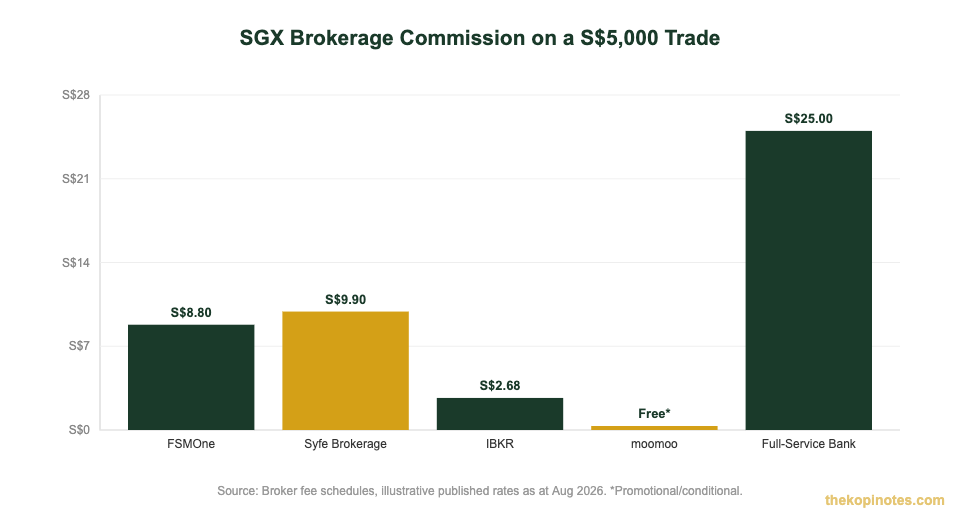
FSMOne is a long-standing custodian platform popular for its low custody fees on income-generating assets and access to bonds alongside stocks. Syfe combines a brokerage arm with its robo-advisory products, so you can hold individual S-REITs and a diversified portfolio under one login. Interactive Brokers (IBKR) tends to offer the lowest per-trade commission of the group and gives access to global exchanges if you eventually want to diversify beyond Singapore dividend stocks.
There is no single “best” broker for everyone. If you plan to buy and hold a handful of S-REITs for years, minimising commission matters less than platform reliability and dividend crediting speed. If you plan to build a diversified basket gradually with smaller, more frequent purchases, low or zero commission platforms compound the savings meaningfully over time.
What to Buy: S-REITs, Banks and Blue Chips
Once your account is funded, the harder question is what to actually buy. Singapore’s dividend universe splits into a few broad categories, each with a different risk and yield profile.
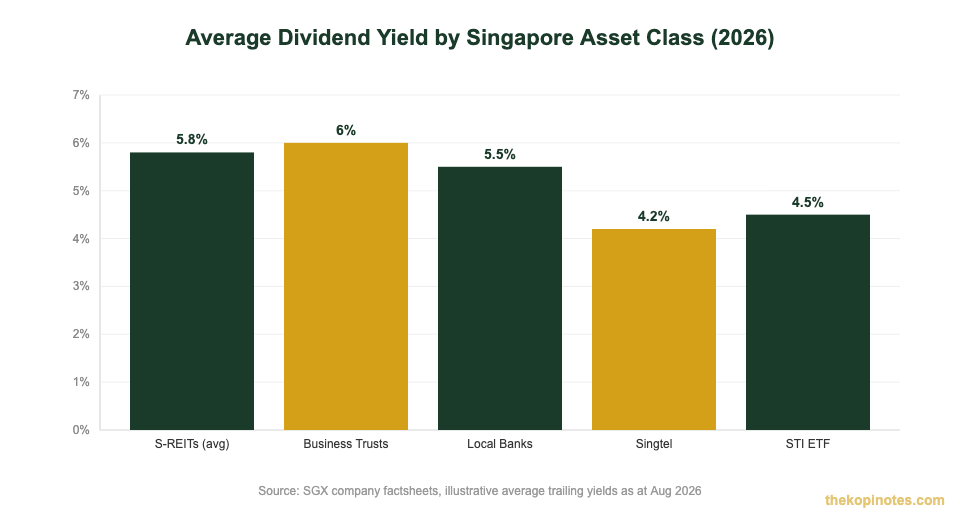
S-REITs own income-producing property — malls, offices, warehouses, data centres — and are legally required to distribute at least 90% of taxable income to unitholders to enjoy tax transparency. This structural payout requirement is why S-REIT yields tend to run higher than ordinary dividend stocks. When comparing S-REITs, watch two metrics: DPU (distribution per unit, the actual cash paid to you per unit held) and gearing (the ratio of a REIT’s debt to its total assets — lower gearing generally means more balance sheet room to acquire new properties without diluting unitholders).
Local banks (DBS, OCBC, UOB) offer steadier, if slightly lower, yields backed by decades of unbroken payout history and strong capital buffers. Blue-chip industrials and telcos like Singtel round out the mix with defensive, if less dynamic, income. For a broader shortlist of individual REIT names with buy-hold-sell context, see our best S-REITs to buy in Singapore guide.
Understanding the Dividend Payment Timeline
New investors are often confused about when they actually need to own a stock to receive its dividend. Three dates matter, and they always happen in this order.
| Date | What It Means |
|---|---|
| Ex-dividend date | You must own the shares before this date to qualify. Buying on or after this date means you miss that payout. |
| Record date | The company checks its books on this date to compile the list of eligible shareholders. |
| Payment date | The date the cash actually lands in your brokerage or CDP-linked bank account, typically 4–8 weeks after the ex-dividend date. |
Source: SGX corporate actions calendar conventions, illustrative as at Aug 2026
Most S-REITs pay quarterly or semi-annually, while banks and many blue chips pay twice a year with an interim and a final dividend. Check each counter’s investor relations page or SGXNET announcements for the exact schedule — it varies by company and is not fixed across the market.
Are Dividends Taxed in Singapore?
For individual investors, dividends paid by Singapore tax-resident companies are exempt from further income tax under Singapore’s one-tier corporate tax system — the company has already paid tax on its profits, so the dividend you receive is not taxed again at your end. This applies to S-REIT distributions and blue-chip dividends alike when held as a personal investor rather than through a trading business.
Foreign dividends can be treated differently depending on remittance and double-taxation treaties, and US-listed dividend stocks are subject to a 30% US withholding tax at source regardless of your Singapore tax residency. This is one more reason SGX-listed dividend stocks are often the simplest starting point for a Singapore-based investor. For the official position, refer to IRAS’ guidance on taxable and non-taxable income (accessed Aug 2026).
Building Your First Dividend Portfolio
Most beginners overthink the first purchase. A simple, sensible starting structure looks like this: two to three S-REITs from different property sub-sectors (for example, one industrial or data-centre REIT, one retail or office REIT, and one diversified or overseas REIT), one or two local bank stocks for stability, and a modest cash buffer for opportunistic buying when prices dip.
Avoid concentrating your entire portfolio in a single property sub-sector (e.g. only retail REITs) or a single bank — sector-specific shocks like tenant defaults, interest rate moves, or regulatory changes can hit correlated holdings at the same time. Spacing out purchases over several months, rather than deploying all your capital in one go, also reduces the risk of buying everything right before a market dip.
If you are investing with a longer horizon in mind, such as retirement income, it is worth modelling how a growing dividend stream compounds over 15 to 25 years using a retirement calculator to sanity-check whether your contribution rate and expected yield realistically get you to your income goal.
Common Mistakes Beginners Make
Chasing the highest yield without checking why it is high. An unusually high yield is often the market pricing in distress — a rights issue, a dividend cut, or a struggling tenant base. Always check the payout’s sustainability against DPU trends and gearing before buying purely on yield.
Ignoring commission drag on small, frequent trades. Buying S$500 of a stock every month on a broker charging S$25 per trade means paying 5% just in fees before any price movement. Match your broker’s fee structure to your intended trading frequency.
Forgetting the ex-dividend date. Buying shares one day after the ex-dividend date, expecting to receive that quarter’s payout, is a common and avoidable mistake explained in the timeline section above.
Treating dividend investing as a get-rich-quick approach. Compounding dividend income into a meaningful passive income stream typically takes a decade or more of consistent contributions and reinvestment, not a single lucky pick.
Frequently Asked Questions
Do I need a lot of money to start buying dividend stocks in Singapore?
No. Since shares trade in board lots of 100, a lower-priced S-REIT priced around S$1 to S$1.50 can cost under S$150 for a full board lot, before commission. You can start meaningfully with a few hundred dollars.
What is the minimum number of shares I can buy on the SGX?
The standard minimum is one board lot, which equals 100 shares, for most SGX-listed counters. Some brokers offer odd-lot or fractional trading for smaller amounts, usually at a slightly higher relative cost.
Is a CDP account necessary to buy dividend stocks?
Not strictly. You can buy and hold shares through a custodian account offered by many digital brokers without ever opening a CDP account. A CDP account is only required if you want shares registered directly in your own name.
Are dividends from Singapore stocks taxed?
Dividends paid by Singapore tax-resident companies to individual investors are exempt from further income tax under the one-tier corporate tax system. This differs from US-listed dividend stocks, which are subject to a 30% withholding tax at source.
Which broker has the lowest fees for buying S-REITs?
Fee structures change and vary by trade size and account type, so compare current published rates directly. As a general pattern, platforms like IBKR and promotional zero-commission apps tend to sit at the lower end, while full-service banks and CDP-direct trades tend to cost more per transaction.
How often do Singapore dividend stocks pay dividends?
It varies by company. Most S-REITs pay quarterly or semi-annually, while many banks and blue-chip industrials pay twice a year with an interim and a final dividend. Always check the specific counter’s payout schedule rather than assuming a market-wide standard.
This article was researched with the help of AI. While we strive to keep all information accurate and up to date, there may be errors. If you notice any discrepancies, please contact us.