Singapore T-Bill Yield Drops to 1.56% in August 2026: What the First Dip Since June Means for You
The 13 August auction snapped three straight increases — and T-bills now pay less than CPF OA.
Singapore’s 6-month T-bill cut-off yield fell to 1.56% at the 13 August 2026 auction, its first drop since 18 June after three straight increases. Applications rose to S$18.5 billion. At 1.56%, T-bills now pay less than CPF Ordinary Account’s 2.5% floor rate — a reversal worth noting if you’ve been parking cash in T-bills instead of your OA.
Not financial advice. All figures are for educational reference only. Data as at 13 August 2026 unless noted.
- The 6-month T-bill yield dipped to 1.56% on 13 August, ending a three-auction rising streak that started 18 June.
- CPF OA’s 2.5% floor rate now beats the T-bill yield — T-bills have paid less than OA since mid-2026.
- Falling short-term yields are historically a tailwind for S-REIT valuations. Here’s what to watch next.
Table of Contents
Contents — Click to expand
- What Happened at the 13 August T-Bill Auction
- T-Bill Yield Trend: June to August 2026
- Why Did the Yield Dip? Demand, Inflation & MAS Policy
- T-Bill vs CPF OA: Which Wins Now?
- T-Bill vs the August Singapore Savings Bond
- What This Means for S-REIT Investors
- How to Apply for the Next T-Bill Auction
- Bottom Line: What Should You Do With Idle Cash?
- FAQ
What Happened at the 13 August T-Bill Auction
You’ve probably seen T-bill yields climb for weeks. That streak just broke. The Monetary Authority of Singapore (MAS) auctioned the latest 6-month Treasury bill (BS26116V) on 13 August 2026, and the cut-off yield came in at 1.56%.
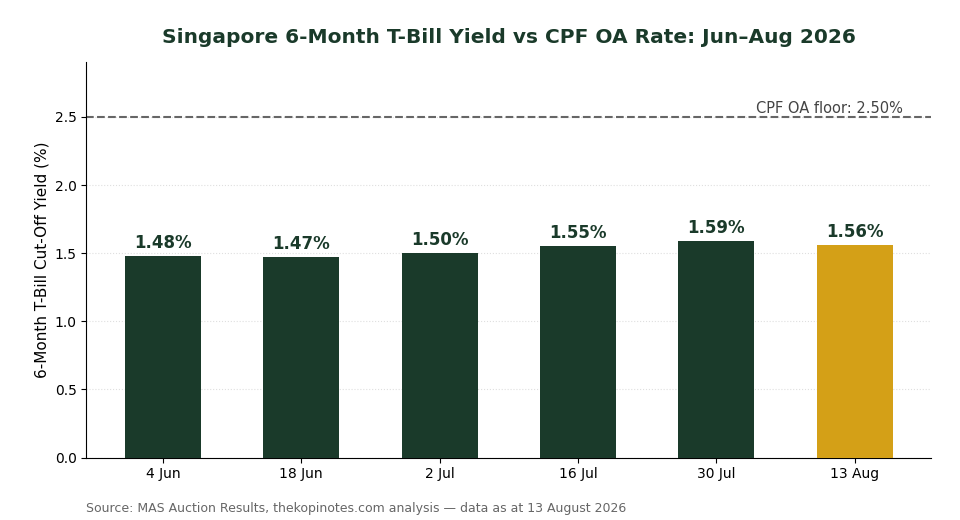
That’s down from 1.59% at the 30 July auction. It’s the first decline since 18 June, after three consecutive rounds of rising yields (2 July, 16 July, 30 July all came in higher than the one before).
Demand didn’t fall — it rose. Total applications hit S$18.5 billion, up from S$18.1 billion on 30 July. More investors chased a smaller slice of return. That’s usually what pushes yields down: when more cash competes for the same bills, the price goes up and the yield comes down.
T-Bill Yield Trend: June to August 2026
Here’s the full run of auction results behind that chart. Look at the pattern: a low in mid-June, then a steady climb, then this month’s reversal.
| Auction Date | Cut-Off Yield | Change |
|---|---|---|
| 4 June 2026 | 1.48% | — |
| 18 June 2026 | 1.47% | ↓ 0.01pp |
| 2 July 2026 | 1.50% | ↑ 0.03pp |
| 16 July 2026 | 1.55% | ↑ 0.05pp |
| 30 July 2026 | 1.59% | ↑ 0.04pp |
| 13 August 2026 | 1.56% | ↓ 0.03pp |
Source: MAS Auction Results, thekopinotes.com analysis — data as at 13 August 2026
Even after the dip, 1.56% still sits above the mid-June low of 1.47%. This isn’t a crash. It’s one auction pulling back after a hot streak. The next auction (due late August) will tell you whether this is a new trend or just a pause.
Why Did the Yield Dip? Demand, Inflation & MAS Policy
Three things are pulling on T-bill yields right now.
Demand. Applications hit S$18.5 billion on 13 August, the highest in this run. When more people bid for the same S$5.6 billion (or similar) issuance size, the average accepted price rises and the yield falls. That’s simple supply and demand, not a policy shift.
Inflation outlook. The Monetary Authority of Singapore has lifted its 2026 inflation forecast to a range of 1–2% for both core and headline inflation, up from an earlier 0.5–1.5% projection. Higher expected inflation usually pushes yields up over time, not down — so this dip looks more like short-term positioning than a structural change.
MAS monetary policy. MAS has held its exchange-rate-based policy steady through 2026, keeping the Singapore dollar policy band’s slope, width, and centre unchanged. A steady policy stance means T-bill yields are driven mostly by global rate expectations and local demand — not by any single MAS announcement.
In short: this looks like a demand-driven pullback, not the start of a sustained decline. That said, if you’re planning your next T-bill application, one auction’s dip is a data point, not a guarantee.
T-Bill vs CPF OA: Which Wins Now?
Here’s the number that matters most for most Singaporeans reading this: your CPF Ordinary Account (OA) pays a legislated floor rate of 2.5% per annum, unchanged for the July–September 2026 quarter. That’s 0.94 percentage points higher than the latest T-bill yield.
If you’re under 55, the first S$20,000 in your OA earns an extra 1% on top of the base rate — an effective 3.5% p.a. If you’re 55 or older, that bonus doubles to 2%, for an effective 4.5% p.a. on your first S$20,000 (combined across OA and other accounts, subject to CPF’s allocation rules). Either way, that beats 1.56% by a wide margin.
| Where Your Cash Sits | Rate (p.a.) | Liquidity |
|---|---|---|
| 6-month T-bill (13 Aug 2026) | 1.56% | Locked 6 months |
| CPF OA (base floor) | 2.50% | Restricted (CPF rules apply) |
| CPF OA (first S$20k, under 55) | 3.50% | Restricted |
| CPF OA (first S$20k, 55 & above) | 4.50% | Restricted |
Source: CPF Board interest rate notice (Q3 2026), MAS auction results — data as at 13 August 2026
The catch, of course, is liquidity. Money inside CPF OA can’t be freely withdrawn before 55 (with limited exceptions for housing and investment). A T-bill is genuinely liquid cash you can redeploy in 6 months, no restrictions. So this isn’t “always choose CPF” — it’s “know the real trade-off before you park fresh cash.”
For a deeper walkthrough on directing CPF savings efficiently, see our CPF investment strategy guide.
T-Bill vs the August Singapore Savings Bond
The August 2026 Singapore Savings Bond tranche (SBAUG26) offers a 10-year average return of 2.06%, with a step-up structure starting at 1.46% in year one and rising to 2.72% by year ten. That first-year rate (1.46%) is actually lower than the latest T-bill yield of 1.56%.
But SSBs give you something T-bills don’t: the option to exit any month without penalty, while still earning the step-up schedule up to that point. A 6-month T-bill locks your cash for the full term with no early exit. If you value flexibility over a fixed 6-month horizon, the SSB is worth comparing side by side before you apply.
What This Means for S-REIT Investors
Falling short-term yields matter beyond your own cash pile. Singapore REITs (S-REITs) compete with T-bills and fixed deposits for the same income-seeking investor. When T-bill yields climb, S-REITs need to offer a wider yield spread to stay attractive — and that usually means unit prices fall to push distribution yields higher.
The reverse also holds. A dip in T-bill yields, if it continues, narrows the gap S-REITs need to clear. That’s historically been a supportive backdrop for REIT valuations, since income investors rotate back toward higher-yielding REIT units once “risk-free” cash returns look less competitive.
One auction isn’t a trend, so don’t rotate your whole cash pile on this alone. But it’s worth watching the next two or three T-bill auctions alongside S-REIT price action. For names to watch, see our best S-REITs in Singapore 2026 roundup.
How to Apply for the Next T-Bill Auction
T-bill auctions run roughly every two weeks, alternating between 6-month and occasionally 1-year tenors. You can apply two ways:
Cash application — via DBS/POSB, OCBC, or UOB internet banking or ATM, using your bank account or SRS funds. Non-competitive bids (the default for most retail investors) guarantee you the cut-off yield, whatever it lands at.
CPF OA application — via CPFIS, through the same three banks, if you want to invest OA savings above the S$20,000 floor amount that must stay in your OA.
Applications typically close the Monday before the Tuesday auction, with allotment results out that same evening. Because yields moved 0.12 percentage points across just three auctions this cycle, timing matters less than most people think — you’re locking in whatever the market clears at on your chosen auction date, not something you can predict precisely in advance.
For step-by-step screenshots and full auction calendar dates, see our Singapore T-bill auction results and application guide.
Bottom Line: What Should You Do With Idle Cash?
Here’s the practical takeaway. If your priority is the highest guaranteed rate on cash you don’t need for 6 months and you’re comfortable with CPF’s withdrawal restrictions, OA at 2.5% (or up to 4.5% on your first S$20,000) currently beats the T-bill’s 1.56%.
If you need genuine liquidity outside CPF — money you might want back in exactly 6 months, no restrictions attached — the T-bill still does a job fixed deposits often can’t match without a lock-in penalty.
Either way, don’t chase last month’s yield. Auction results move in both directions, as this month just proved. Check the actual cut-off yield on your application date before committing a large sum.
If you’d rather put idle cash to work in a diversified portfolio instead of chasing single-instrument yields, robo-advisors like Endowus or Syfe offer cash management portfolios that blend T-bills, SSBs, and money market funds automatically.
Frequently Asked Questions
What was the Singapore T-bill yield on 13 August 2026?
Why did the T-bill yield fall in August 2026?
Is CPF OA better than T-bills right now?
How often are Singapore T-bill auctions held?
How do I apply for a Singapore T-bill?
Does a lower T-bill yield affect S-REIT prices?
Want your idle cash working harder without tracking every T-bill auction yourself?
This article was researched with the help of AI. While we strive to keep all information accurate and up to date, there may be errors. If you notice any discrepancies, please contact us.