Mapletree Logistics Trust Share Price: S$400 Million Perpetual Bond Refinancing Explained (SGX: M44U)
A capital markets deep-dive for Singapore investors — what perpetual securities are, why MLT chose them again, and what changes (and does not) for unitholders.
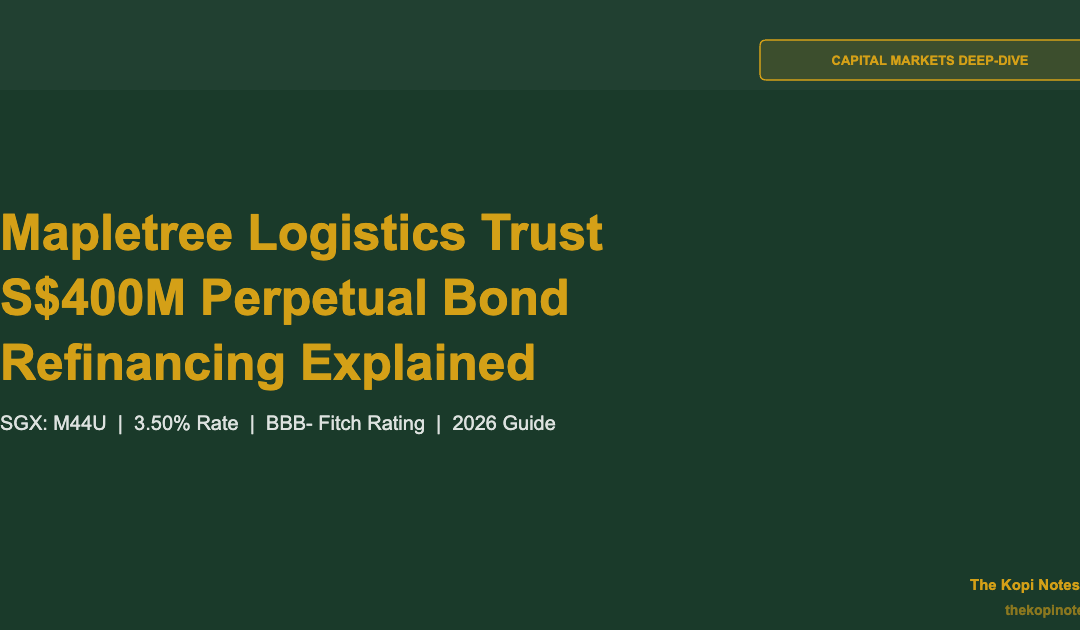
Mapletree Logistics Trust (SGX: M44U) is refinancing S$400 million of existing perpetual securities with a new 3.50% issue rated BBB- by Fitch, targeted to list on the SGX-ST around 13 August 2026. Because the new issue matches the size of the securities it replaces, MLT’s reported gearing of 40.6% (as at 31 March 2026) should not move. Here is what perpetual securities are and what this refinancing actually means for your MLT units.
Not financial advice. All figures are for educational reference only. Data as at 12 August 2026 unless otherwise noted.
- MLT is replacing S$400M of maturing perpetual securities with a new S$400M 3.50% issue — same size, so this is a refinancing, not fresh leverage
- Perpetual securities usually sit in the equity part of a REIT’s balance sheet, not the debt part — that is why they do not push MLT toward MAS’s 50% leverage cap
- You cannot buy this specific bond as a retail investor, but its pricing tells you a lot about how the market currently views MLT’s credit risk
Table of Contents
Contents — Click to expand
- What Happened — MLT’s S$400M Perpetual Securities Refinancing
- What Are Perpetual Securities?
- Key Terms: New Issue vs the Securities Being Replaced
- Why This Does Not Move MLT’s Gearing Ratio
- Credit Rating and Subordination Risk
- What It Means for MLT’s Share Price and DPU
- How This Compares to Other S-REIT Capital Management
- Frequently Asked Questions
What Happened — MLT’s S$400M Perpetual Securities Refinancing
On 5 August 2026, Mapletree Logistics Trust’s manager and trustee (HSBC Institutional Trust Services) announced the proposed issue of S$400,000,000 in 3.50% Subordinated Perpetual Securities. The issue sits under MLT’s S$3,000,000,000 Euro Medium Term Securities (EMTN) Programme — a standing facility that lets MLT raise debt and hybrid capital repeatedly without a fresh prospectus each time.
The proceeds are earmarked for general corporate and working capital purposes, including refinancing an existing S$400,000,000 fixed-rate subordinated perpetual security (ISIN: SGXF7755013) that MLT issued previously. In plain terms: MLT is not borrowing more money. It is swapping one S$400 million perpetual instrument for another of the same size, at a freshly negotiated rate.
DBS Bank and Oversea-Chinese Banking Corporation (OCBC) are the joint lead managers. Application will be made to list the new securities on the SGX-ST, with listing targeted for on or about 13 August 2026. As with most perpetual and bond issuance in Singapore, the offer is restricted to institutional and accredited investors under the Securities and Futures Act — it is not open to the general public.
What Are Perpetual Securities?
If you only invest in MLT’s ordinary units, perpetual securities can look confusing. They sit in a middle category between a regular bond and equity — which is exactly why REITs like MLT use them.
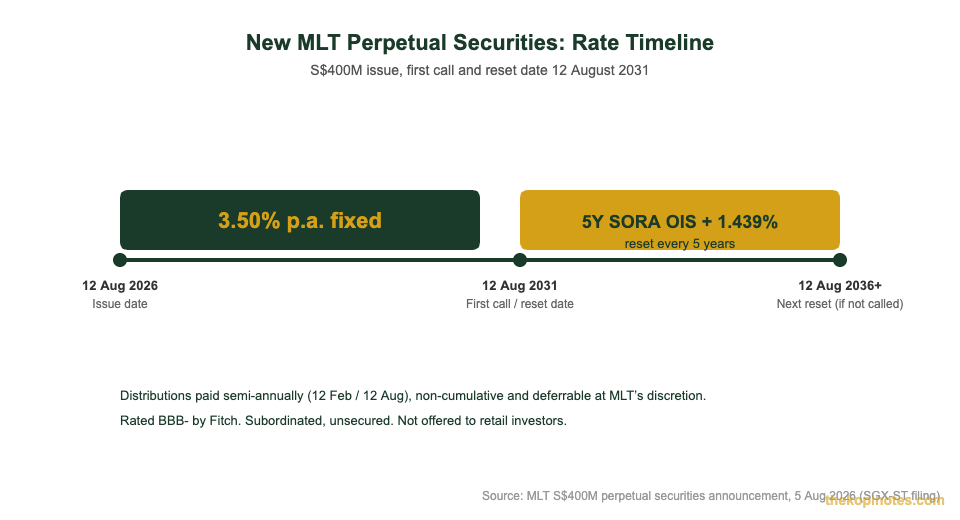
A perpetual security has no fixed maturity date, which is where the name comes from. MLT can choose to redeem (“call”) the securities on set dates — in this case, from 12 August 2031 onward — but it is not obliged to. The distribution rate (3.50% per annum for the first five years) is fixed, but MLT can defer paying it at its own discretion. Crucially, the distributions are non-cumulative: if MLT skips a payment, it does not have to make it up later. In a wind-up scenario, perpetual securities holders rank below senior secured and unsecured creditors, but above ordinary unitholders — this is the “subordinated” part of the name.
Because a perpetual security has no fixed maturity and the issuer controls whether distributions get paid, accounting standards typically classify it as equity rather than a financial liability. That single classification is the reason S-REITs like MLT, CapitaLand Integrated Commercial Trust and Mapletree Industrial Trust keep coming back to this structure: it raises real cash from institutional investors without inflating the debt figure used to calculate gearing against MAS’s regulatory cap for S-REITs.
| Feature | Perpetual Securities | Straight Bond | Ordinary Units |
|---|---|---|---|
| Maturity | None (callable at issuer’s option) | Fixed date | None |
| Payment obligation | Discretionary, non-cumulative | Mandatory (default risk if missed) | Discretionary (DPU policy) |
| Ranking in wind-up | Below senior debt, above units | Senior to perpetuals and units | Last in line |
| Balance sheet treatment | Equity | Liability (debt) | Equity |
Source: General accounting treatment for hybrid capital instruments; terms specific to MLT’s August 2026 issue.
Key Terms: New Issue vs the Securities Being Replaced
The announcement did not restate the coupon on the original 2021-era perpetual securities being refinanced, so we cannot say whether MLT’s all-in funding cost is rising or falling on a like-for-like basis. What we do know are the full terms of the new instrument:
| Term | Detail |
|---|---|
| Issue size | S$400,000,000 |
| Issue price | 100% of principal |
| Fixed rate (Yr 1–5) | 3.50% p.a., 12 Aug 2026 to 12 Aug 2031 |
| Reset rate (from 2031) | 5-year SORA OIS + 1.439% spread, reset every 5 years |
| Distribution frequency | Semi-annual (12 Feb & 12 Aug), first payment 12 Feb 2027 |
| First call/reset date | 12 August 2031 |
| Credit rating | BBB- (Fitch) |
| Refinances | S$400,000,000 existing perpetual securities (ISIN: SGXF7755013) |
| Joint lead managers | DBS Bank, OCBC |
Source: MLT S$400M perpetual securities announcement, SGX-ST filing, 5 August 2026.
Why This Does Not Move MLT’s Gearing Ratio
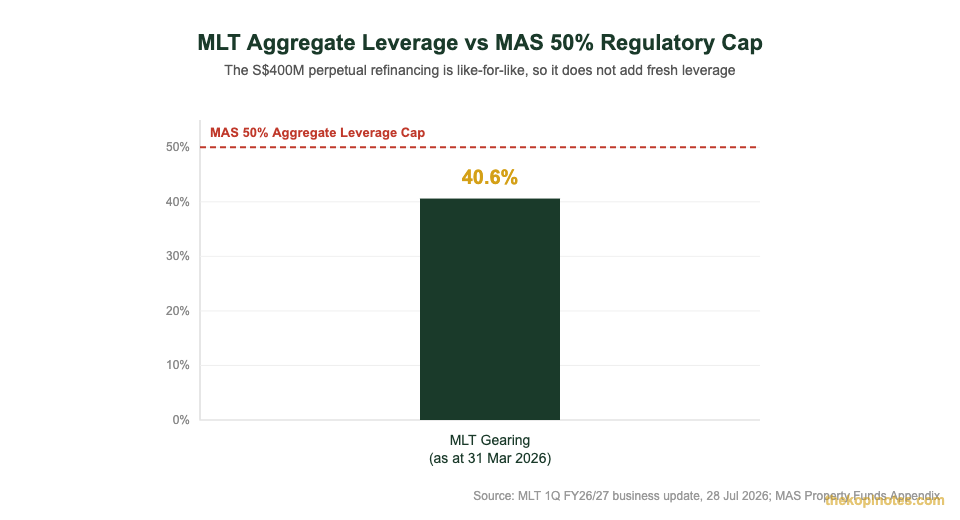
MLT’s most recently disclosed aggregate leverage — the gearing figure MAS caps at 50% of total deposited property for S-REITs — stood at 40.6% as at 31 March 2026, alongside 96.9% portfolio occupancy across 175 properties in eight markets. Its 1Q FY26/27 results did not restate this figure, so 40.6% remains the latest confirmed baseline.
Because this perpetual issue swaps S$400 million for S$400 million — not S$400 million on top of what already exists — it is capital-structure-neutral. It does not fund a new acquisition, and it does not add fresh debt to the balance sheet. Combined with the equity-style accounting treatment discussed above, that means this refinancing should not move MLT’s reported gearing ratio in either direction.
That said, rating agencies and some analysts track a broader “leverage including hybrids” measure that folds perpetual securities back in as debt-like. If you want to run these numbers yourself on any S-REIT, our S-REIT gearing ratio calculator lets you plug in total debt, total assets and NPI to see where a trust sits relative to the 50% ceiling.
Credit Rating and Subordination Risk
Fitch rates the new securities BBB-. That is investment grade, but it sits at the very bottom rung of the investment-grade scale — one notch above “junk.” For context, MLT’s own senior unsecured debt and issuer rating typically sit a few notches higher; the perpetual securities are rated lower mainly because of their subordination and deferral features, not because MLT’s underlying business is riskier.
Three risks are worth understanding in plain English before you treat this as “just another MLT headline”:
Deferral risk. MLT can choose not to pay the 3.50% distribution in any given period, and it never has to make up a missed payment later. This is standard for perpetual securities, but it is a real feature, not boilerplate.
Subordination risk. If MLT ever faced financial distress, perpetual securities holders get paid after senior creditors and before unitholders. In practice, this is a low-probability scenario for a Temasek-linked, investment-grade sponsor — but it is why the securities carry a lower rating and higher coupon than MLT’s senior debt.
Reset risk. After 12 August 2031, the rate no longer stays fixed at 3.50%. It resets every five years to the prevailing 5-year Singapore Overnight Rate Average (SORA) Overnight Indexed Swap rate, plus a fixed 1.439% spread. SORA is the benchmark that replaced SOR and SIBOR in Singapore’s interest rate markets — if SORA is higher in 2031 than today, MLT’s distribution cost on this tranche rises with it.
What It Means for MLT’s Share Price and DPU
Distributions on perpetual securities are paid out of MLT’s income before ordinary unitholders receive their DPU — in that sense, the 3.50% coupon is a cost that sits ahead of your distribution in the waterfall. But because this is a refinancing of an existing S$400 million obligation rather than a new one, it should not introduce a fresh drag on DPU beyond whatever the trust was already paying on the securities it is replacing.
MLT units traded around SGD 1.20 to SGD 1.21 as at 29 July 2026, working out to roughly a 6.05% forward yield on the last confirmed 1Q FY26/27 DPU of 1.816 cents annualised. A successful refinancing at a fixed rate, completed without drama and without needing to pay up for a lower rating, is generally read by fixed-income and equity investors alike as a sign that a REIT retains reasonable access to capital markets — a modestly reassuring data point rather than a reason to expect DPU to move this quarter.
If you are tracking where analysts see MLT’s unit price heading, our Mapletree Logistics Trust price target 2026 article breaks down consensus targets and the DPU assumptions behind them in more detail.
How This Compares to Other S-REIT Capital Management
MLT is not the only S-REIT actively managing its capital structure this reporting season. Trusts across the sector are terming out debt, raising hybrid capital, or funding acquisitions as global interest rates stay elevated relative to the ultra-low-rate years before 2022.
| REIT | Recent Capital Move | Type | Latest Gearing |
|---|---|---|---|
| Mapletree Logistics Trust | S$400M perpetual securities refinancing | Like-for-like refinancing | 40.6% (31 Mar 2026) |
| Frasers Logistics & Commercial Trust | S$441.5M European acquisition | Debt-funded growth | 35.4% (3QFY26) |
Source: Company business updates and SGX-ST filings, as at 5 August 2026.
Read the full breakdown of Frasers Logistics & Commercial Trust’s move in our FLCT 3QFY26 business update — it is a useful contrast, since FLCT’s deal added leverage to fund growth, while MLT’s move is deliberately leverage-neutral.
Frequently Asked Questions
What did Mapletree Logistics Trust just announce?
On 5 August 2026, MLT announced a proposed S$400,000,000 issue of 3.50% Subordinated Perpetual Securities under its S$3 billion EMTN Programme. The proceeds refinance an existing S$400,000,000 perpetual security (ISIN: SGXF7755013). Listing on the SGX-ST is targeted for around 13 August 2026.
What are perpetual securities and how are they different from a regular bond?
A perpetual security has no fixed maturity date, unlike a regular bond. The issuer can choose to redeem it on set call dates but is not required to. Distributions can also be deferred at the issuer’s discretion and are non-cumulative, meaning skipped payments never have to be repaid later. Because of these features, perpetual securities are usually treated as equity, not debt, on a REIT’s balance sheet.
Does this bond issue increase Mapletree Logistics Trust’s gearing ratio?
It should not. The new S$400 million issue refinances an existing S$400 million perpetual security of the same size, so there is no net increase in the amount outstanding. Perpetual securities are also generally treated as equity rather than debt, which is why they do not count toward MAS’s 50% aggregate leverage cap for S-REITs the way a straight bank loan or bond would.
Can retail investors buy MLT’s new perpetual securities?
No. Under the Securities and Futures Act, this offer in Singapore is restricted to institutional and accredited investors only. Retail investors can still gain exposure to MLT’s overall business, including how it is financed, by holding MLT’s ordinary units, which trade on the SGX-ST like any other REIT.
Is MLT’s distribution to unitholders affected by this refinancing?
Not directly. This is a like-for-like refinancing of an existing obligation, not new debt taken on to fund an acquisition or plug a shortfall. It should not, on its own, change MLT’s DPU trajectory. Track MLT’s actual DPU results in our 1Q FY26/27 results breakdown.
What is MLT’s credit rating and why does BBB- matter?
Fitch rates the new perpetual securities BBB-, the lowest rung of investment grade. This mainly reflects the subordination and payment-deferral features of perpetual securities rather than a downgrade of MLT’s core business. MLT’s senior unsecured obligations typically carry a higher rating than its subordinated perpetual securities.
When does the new perpetual security’s interest rate reset?
The 3.50% per annum rate is fixed for the first five years, from 12 August 2026 to 12 August 2031. From the first reset date onward, the rate resets every five years to the prevailing 5-year Singapore Overnight Rate Average (SORA) Overnight Indexed Swap rate plus a fixed spread of 1.439%.
Track S-REIT Capital Management With Confidence
Run your own gearing checks on any S-REIT, or start building a diversified income portfolio through a brokerage with our referral bonus.
This article was researched with the help of AI. While we strive to keep all information accurate and up to date, there may be errors. If you notice any discrepancies, please contact us.