APAC Realty’s Special Dividend: What It Means for Singapore Dividend Investors (1H2026)
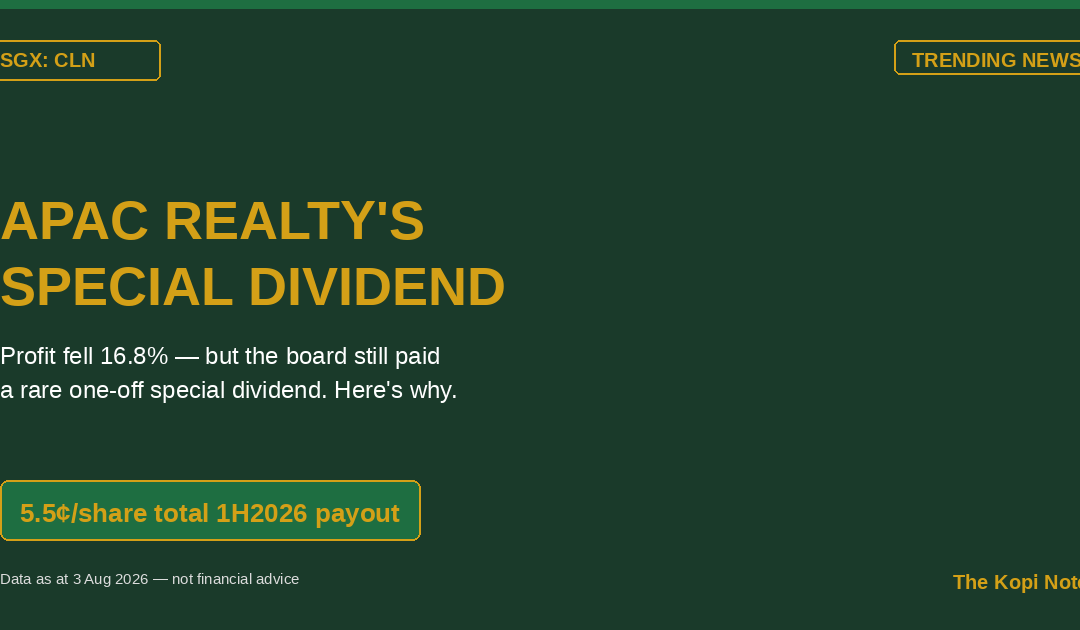
Profit fell 16.8% year-on-year — but the board still approved a rare one-off payout. Here’s the full breakdown and the lesson every SG dividend investor should take from it.
APAC Realty (SGX: CLN), the listed parent of property agency ERA Singapore, has declared a rare special dividend of 3.6 cents per share on top of its usual 1.9-cent interim payout — even as 1H2026 net profit fell 16.8% year-on-year to $9.4 million. For income-focused Singapore investors, it’s a timely reminder that a special dividend and a strong quarter don’t always go together.
Not financial advice. All figures are for educational reference only. Data as at 3 August 2026 unless noted.
- APAC Realty’s 1H2026 profit dropped 16.8% to $9.4 million, but the board still declared a 3.6-cent special dividend — total 1H2026 payout comes to 5.5 cents per share.
- Record date is 26 August 2026 and payment date is 4 September 2026 — you need to hold the shares before the ex-dividend date to qualify.
- It’s a real-world case study in dividend investing: a special dividend usually signals a strong balance sheet, not necessarily strong earnings. Always check the payout ratio and cash position, not just the headline yield.
Table of Contents
Contents — Click to expand
What Happened: APAC Realty’s 1H2026 Results
APAC Realty is the SGX-listed parent of ERA Singapore, one of the biggest property agencies here. On 3 August 2026, it released results for the six months ended 30 June 2026 (1H2026) — and the numbers were soft.
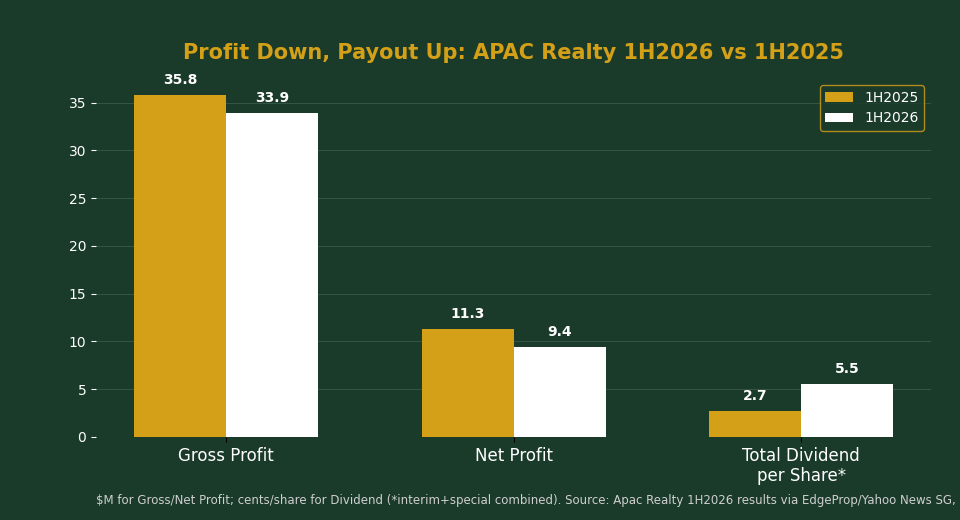
Revenue from brokerage fees and related services fell 3.5% year-on-year to $327.99 million. Revenue from new home sales dropped 11% half-on-half, from $131.2 million in 2H2025 to $116.8 million in 1H2026. Gross profit slipped 5.3% to $33.9 million, and net profit for the period came in at $9.4 million — down 16.8% from a year earlier.
That’s the backdrop. Now here’s the surprising part: the board still recommended a total dividend of 5.5 cents per share for the half — more than double what you’d expect from a “regular” payout.
| Metric | 1H2026 | YoY Change |
|---|---|---|
| Brokerage & related services revenue | $327.99M | −3.5% |
| New home sales revenue | $116.8M | −11% (vs 2H2025) |
| Gross profit | $33.9M | −5.3% (−$1.9M) |
| Net profit | $9.4M | −16.8% |
| Total 1H2026 dividend | 5.5¢/share | Special dividend is new this year |
Source: APAC Realty 1H2026 results announcement, via EdgeProp/Yahoo News Singapore, 3 Aug 2026.
Why Pay a Special Dividend If Profit Fell?
This is the question every dividend investor should be asking. A company doesn’t hand out extra cash to shareholders for no reason — especially in a softer year.
APAC Realty’s own explanation is straightforward: “Following a review of the group’s capital requirements, the board of directors believes it is appropriate to propose a one-off special dividend to recognise the continued support of shareholders and enable them to participate further in APAC Realty’s growth.”
Translated from board-speak: the company has more cash than it needs right now, and it’s choosing to return the excess rather than sit on it. A few numbers back this up. Net assets stood at $165.6 million as at 30 June 2026. Cash and cash equivalents rose by $2.7 million to $53.1 million, supported by positive operating cash flow. Total current liabilities actually fell by $12.9 million over the half.
In other words, the balance sheet is healthy even though the income statement looks weaker. That distinction — cash strength versus earnings strength — is exactly what makes this a useful teaching example.
Breaking Down the 5.5-Cent Payout
The total 1H2026 dividend has two very different parts, and it matters that you understand which is which.
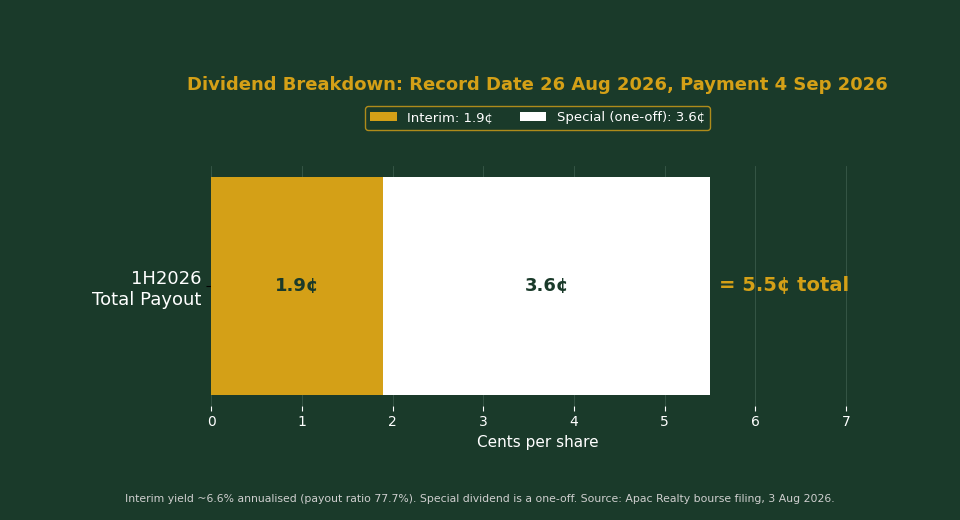
The interim dividend of 1.9 cents per share is the “regular” component — though even this is lower than the 2.7 cents paid in 1H2025, reflecting the softer earnings. This interim portion represents a payout ratio of 77.7% of net profit, and works out to an annualised yield of about 6.6% based on APAC Realty’s recent share price.
The special dividend of 3.6 cents per share is the one-off top-up. There was no special dividend in 1H2025 or in any prior comparable period — this is genuinely new. It shouldn’t be treated as part of the ongoing “run rate” when you’re estimating future income from the stock.
| Component | Amount | Notes |
|---|---|---|
| Interim dividend | 1.9 cents/share | Payout ratio 77.7%; ~6.6% annualised yield |
| Special dividend | 3.6 cents/share | One-off; no prior-year equivalent |
| Total 1H2026 payout | 5.5 cents/share | Record date 26 Aug 2026; payment date 4 Sep 2026 |
Source: APAC Realty bourse filing, 3 Aug 2026, via EdgeProp/Yahoo News Singapore.
If you’re holding CLN shares and want to qualify for this payout, you need to own the shares before the ex-dividend date (typically one business day before the record date). Miss that window and you won’t receive it, even if you buy before 26 August.
The Singapore Property Market Backdrop
APAC Realty’s softer 1H2026 doesn’t exist in a vacuum. It reflects a genuine slowdown across the Singapore residential property market in the first half of the year.
Developers sold 4,154 new private residential units (excluding ECs) in 1H2026, down 9.4% year-on-year. The private resale market saw 7,407 units change hands, a 5.1% year-on-year decline. HDB resale transactions fell too — 12,681 deals in 1H2026, down 7.4% year-on-year.
APAC Realty CEO Marcus Chu described 1H2026 as a “period of consolidation,” with fewer launches and moderating price growth. But he’s expecting a pickup in the second half: the company estimates seven new private residential developments and one executive condo (EC) project will launch in 2H2026, which should support agency transaction volumes and commission income.
This context matters for the dividend story too. A special dividend paid during a market slowdown, backed by a strong cash position, can actually be a sign of financial discipline — the company isn’t over-extending itself to chase growth in a soft market, and it’s comfortable returning capital instead.
The Bigger Lesson: Special Dividends vs Sustainable Yield
Here’s why this case study is worth your attention even if you don’t own APAC Realty shares. It’s a clean, real-world illustration of a mistake many new dividend investors make: chasing the headline yield without checking whether it’s repeatable.
If you only looked at APAC Realty’s 5.5-cent total 1H2026 payout and annualised it, you’d get a yield that looks unusually attractive. But 3.6 cents of that is a one-off. Next half-year, unless the board declares another special dividend (not guaranteed), you’re back down to something closer to the regular interim run-rate.
This is a pattern you’ll also see among S-REITs after a divestment gain, or blue-chip companies after selling a non-core asset. A one-time capital event boosts the payout for a single period — it doesn’t change the underlying, repeatable earning power of the business.
For a more sustainable, diversified source of dividend income, many Singapore investors build a core position in S-REITs, which distribute a large share of rental income by structure, alongside a broader dividend investing strategy that doesn’t depend on any single company’s one-off payout.
How to Evaluate a Special Dividend Before You Buy
Before you buy a stock chasing a special dividend headline, run through this quick checklist:
1. Is it explicitly labelled “special,” “one-off,” or “non-recurring”? Companies are usually upfront about this in the announcement. If it’s not labelled that way, ask why the payout jumped.
2. Check the payout ratio on the regular dividend alone. APAC Realty’s interim-only payout ratio of 77.7% is high but not alarming for a cash-generative brokerage business. A payout ratio consistently above 100% is a red flag — the company is paying out more than it earns.
3. Look at the cash position and debt trend, not just profit. Rising cash and falling liabilities (as seen here) support a special dividend. Falling cash and rising debt alongside a special dividend is a warning sign — it may mean the company is borrowing to pay shareholders.
4. Ask whether the underlying business trend is improving or declining. APAC Realty’s management expects a stronger 2H2026 on the back of new launches. If management guidance is negative and a special dividend still gets paid, treat it with more scepticism.
5. Don’t annualise a one-off. If you’re building an income projection for your portfolio, use only the regular/interim dividend run-rate — not the total including any special component.
This kind of due diligence applies whether you’re evaluating a single blue-chip stock, an S-REIT after an asset sale, or even reassessing your overall passive income plan for retirement. If you want to model how dividend income fits into a longer-term retirement plan, TKN’s retirement calculator is a useful starting point.
Not financial advice. This article is for educational purposes only — always do your own research or speak to a licensed financial adviser before making investment decisions.
Frequently Asked Questions
Why did APAC Realty pay a special dividend if its profit fell?
APAC Realty’s board said the special dividend follows a review of the group’s capital requirements — the company has a strong cash position (up $2.7 million to $53.1 million) and wanted to reward shareholders, even though 1H2026 net profit fell 16.8% year-on-year to $9.4 million. A strong balance sheet, not strong earnings, is what funded this payout.
What is the total APAC Realty dividend for 1H2026?
The total 1H2026 dividend is 5.5 cents per share, made up of a 1.9-cent interim dividend and a 3.6-cent special (one-off) dividend. This is APAC Realty’s first-ever special dividend based on available filings.
When is the APAC Realty dividend record date and payment date?
The record date is 26 August 2026 and the payment date is 4 September 2026. You need to own the shares before the ex-dividend date (usually one business day before the record date) to qualify for the payout.
Is a special dividend the same as a regular dividend for yield calculations?
No. A special dividend is a one-off payout and shouldn’t be annualised or treated as part of a company’s ongoing dividend run-rate. For APAC Realty, only the 1.9-cent interim dividend (annualised yield of about 6.6%) reflects the recurring payout — the 3.6-cent special dividend is a separate, non-repeating event.
How can I tell if a company's dividend is sustainable?
Check the payout ratio (dividend as a percentage of net profit — above 100% consistently is a red flag), the trend in free cash flow and debt, and whether management’s own guidance points to improving or declining business conditions. A sustainable dividend is backed by recurring cash generation, not one-off asset sales or cash reserves being drawn down.
Is APAC Realty a REIT?
No. APAC Realty (SGX: CLN) is a real estate brokerage and franchise operator — it owns ERA Singapore and related agency businesses in the Asia Pacific region. It is not a REIT and does not hold property assets directly, so it isn’t required to distribute a minimum percentage of income the way S-REITs are.
Build a More Reliable Dividend Income Stream
One-off special dividends are a nice bonus — but a solid income portfolio is built on repeatable payouts. Start with S-REITs and diversified ETFs through these platforms.
This article was researched with the help of AI. While we strive to keep all information accurate and up to date, there may be errors. If you notice any discrepancies, please contact us.