Rare Earth ETF Singapore: Complete 2026 Guide
Why China’s export controls are reshaping the rare earth market, and how you can get exposure through LSE and US-listed ETFs.
A rare earth ETF gives you exposure to the miners, refiners, and recyclers of neodymium, dysprosium, and other critical metals used in EVs, wind turbines, and defence systems. Singapore investors buy funds like the VanEck Rare Earth and Strategic Metals ETF through IBKR or Saxo. The LSE-listed UCITS version (REMX.L) offers 15% US dividend withholding tax instead of 30%, plus no US estate tax exposure — the same LSE advantage that applies to CSPX and VWRA.
Not financial advice. All figures are for educational reference only. Data verified as at 7 August 2026 unless otherwise noted.
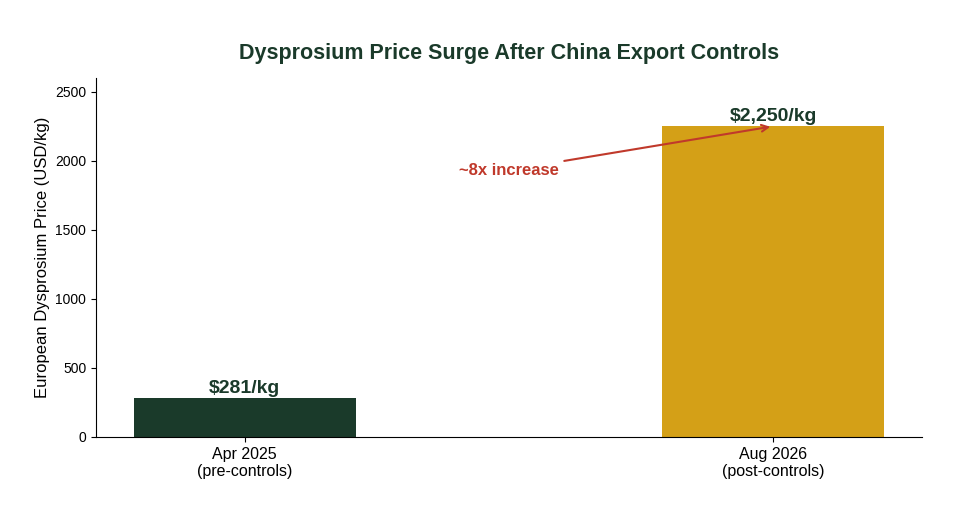
- China’s 2026 export controls pushed European dysprosium prices up roughly 8x, from about US$281/kg to US$2,250/kg — a genuine supply shock, not hype.
- REMX (US-listed) and REMX.L (LSE UCITS) both track the same rare earth miners index. The LSE version saves you 15 percentage points of US dividend withholding tax and removes US estate tax exposure.
- This is a concentrated, volatile sector play — treat it as a small satellite position, not a core holding, and expect big price swings both ways.
Table of Contents
What Is Rare Earth Investing?
Rare earths are a group of 17 metallic elements — think neodymium, dysprosium, praseodymium, and terbium. You will not buy the metals directly. Instead, a rare earth ETF holds shares in the companies that mine, refine, and recycle them.
These metals go into things you already use. Neodymium magnets sit inside EV motors and wind turbine generators. Dysprosium keeps those magnets working at high heat, which is why it is critical for defence radar and fighter jet components too.
China currently controls about 90% of global rare earth processing capacity. That single fact is the whole story behind why this sector has suddenly become an investable, trending theme in 2026 — not because the metals changed, but because who controls them just became a geopolitical flashpoint.
For a Singapore investor, that means a rare earth ETF is really a bet on the geopolitics of supply chains, not on any single company’s earnings growth. You are buying a basket of miners that stand to benefit if Western governments and manufacturers pay up for supply outside China — a very different kind of holding from a broad index fund like VWRA.
Why Rare Earth ETFs Are Trending in 2026
China tightened export controls on rare earths, tungsten, and antimony through 2025 and into 2026. Licensing approval rates for European firms have fallen below 25%. That has starved downstream manufacturers of supply they used to take for granted.
The price impact has been dramatic. European dysprosium prices reportedly jumped roughly eightfold — from about US$281/kg in April 2025 to around US$2,250/kg by July 2026. Analysts estimate the controls put as much as US$6.5 trillion of downstream production at risk across automotive, high-tech, defence, and energy industries.
For you as a Singapore investor, that supply squeeze is the entire investment thesis. Miners and refiners outside China — in Australia, the US, and elsewhere — suddenly look far more valuable, because Western governments and manufacturers need alternative sources fast. That is exactly what a rare earth ETF gives you exposure to.
However, remember that a price spike this sharp can also reverse if China eases controls, or if new supply comes online faster than expected. Treat the “why now” story as context, not a guarantee the rally continues.
Best Rare Earth ETFs for Singapore Investors
There are two practical ways to get diversified rare earth exposure as a Singapore investor: the flagship VanEck fund (in its US or UCITS form), or a broader critical-minerals basket from Sprott.
1. VanEck Rare Earth and Strategic Metals ETF (REMX / REMX.L)
REMX tracks the MVIS Global Rare Earth/Strategic Metals Index — 37 holdings spanning producers, refiners, and recyclers. Top positions include Albemarle, China Northern Rare Earth, Lynas Rare Earths, and MP Materials. The fund returned about 32.9% over the trailing 12 months to early August 2026, though past performance says nothing about the next 12 months in a sector this volatile.
It exists in two flavours: the original US-listed REMX (NYSE Arca, TER 0.58%, AUM roughly US$3.13 billion as at 2 June 2026), and the UCITS version REMX.L on the LSE (ISIN IE0002PG6CA6, TER 0.59%, AUM roughly US$1.5 billion as at 23 June 2026, Ireland-domiciled).
2. Sprott Critical Materials ETF (SETM)
SETM takes a broader approach — uranium, copper, lithium, rare earths, cobalt, nickel, and graphite in one basket, with AUM around US$320 million and a TER of 0.65%. If you want exposure to the wider critical-minerals story rather than rare earths specifically, this is the more diversified pick. A related fund, the Sprott Rare Earths Ex-China ETF (REXC), focuses purely on producers outside China — worth a look if the geopolitical angle is your main reason for investing.
| ETF | Exchange | TER | Domicile | AUM | US Estate Tax Risk |
|---|---|---|---|---|---|
| REMX | NYSE Arca | 0.58% | USA | ~$3.13B | Yes (above USD 60k) |
| REMX.L | LSE | 0.59% | Ireland | ~$1.5B | None |
| SETM | NYSE Arca | 0.65% | USA | ~$320M | Yes (above USD 60k) |
Source: VanEck fund factsheets, justETF, Sprott ETFs — data as at Aug 2026.
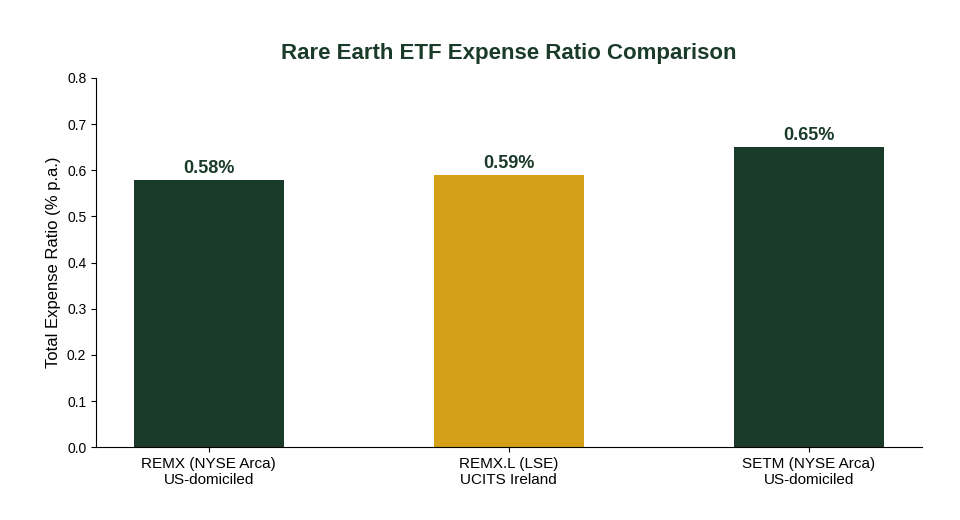
The same logic that applies to how to buy CSPX in Singapore applies here. If you hold the US-domiciled REMX, dividends are taxed at 30% withholding, and your position is exposed to US estate tax if your total US-situs assets exceed USD 60,000. Switch to REMX.L on the London Stock Exchange and that withholding tax drops to 15%, with no US estate tax exposure at all, since the fund is domiciled in Ireland.
How to Buy Rare Earth ETFs in Singapore
You will need a broker that offers access to either the LSE (for REMX.L) or US exchanges (for REMX, SETM, or REXC).
Interactive Brokers (IBKR): the most cost-effective choice for buying REMX.L on the LSE. Fund your account, search “REMX”, filter to the London Stock Exchange listing, and place your order in USD. IBKR also gives you access to the US-listed versions if you prefer those instead.
Saxo Markets: also supports LSE and US listings, with a slightly higher commission structure than IBKR but a more beginner-friendly interface.
moomoo Singapore: covers the US-listed REMX and SETM directly, though not REMX.L on the LSE — useful if you are comfortable accepting the 30% US withholding tax trade-off for a simpler one-market setup.
For context on broker fees and account setup more broadly, see our IBKR vs Saxo vs moomoo vs Syfe broker comparison, or open an account through our Syfe referral code if you are just starting out and want a simpler entry point before graduating to a full brokerage account.
Here is a worked example. Say you put SGD 5,000 (about USD 3,700) into REMX.L through IBKR. On a fund yield of roughly 1% p.a., your dividend would be about USD 37 a year. At 15% withholding tax under REMX.L, you lose about USD 5.55 to tax. Hold the same position in the US-listed REMX instead, and 30% withholding takes about USD 11.10 — roughly double, on the same dividend. The gap grows in dollar terms as your position size grows, which is why the LSE version is worth the small extra step of finding it on your broker’s search bar.
Risks to Consider
This sector is not for your core retirement portfolio. Here is why.
Concentration risk: REMX holds just 37 stocks, many of them small-cap miners. A handful of names driving most of the return also means a handful of names can drive most of the downside.
Price volatility: an 8x price move in dysprosium in little over a year tells you how fast sentiment and supply data can swing. What goes up on a supply shock can come back down just as fast if China eases controls or alternative supply ramps up.
China exposure within the fund itself: ironically, REMX still holds Chinese producers like China Northern Rare Earth. If you specifically want ex-China exposure, REXC is the more targeted choice — but it is a newer, smaller fund with less track record.
If rare earths feel too concentrated a bet, our gold ETF guide covers another geopolitically-driven theme (defence and clean energy ETFs are two more) with a different risk profile. As always, a rare earth ETF should sit alongside a broad-market core like VWRA or CSPX, not replace it — use our retirement calculator to check how a satellite position like this fits your overall plan.
Frequently Asked Questions
What is a rare earth ETF and why do Singapore investors buy it?
A rare earth ETF holds shares in companies that mine, refine, and recycle rare earth metals like neodymium and dysprosium, rather than the metals themselves. Singapore investors buy these funds through brokers like IBKR or Saxo to gain exposure to the sector’s supply squeeze without picking individual mining stocks.
Is REMX the same as REMX.L?
They track the same MVIS Global Rare Earth/Strategic Metals Index and hold nearly identical portfolios, but REMX is US-domiciled (NYSE Arca) while REMX.L is Ireland-domiciled and listed on the London Stock Exchange. REMX.L benefits from a reduced 15% US dividend withholding tax and has no US estate tax exposure, whereas REMX carries the full 30% withholding and US estate tax risk above USD 60,000.
Can I buy rare earth ETFs using my CPF or SRS funds?
Rare earth ETFs like REMX and REMX.L are not CPFIS-approved, so you cannot use CPF Ordinary Account funds to buy them. SRS funds can be used if your broker supports SRS-funded overseas trades — check with FSMOne or your SRS-linked broker before assuming this is available.
Which broker is best for buying rare earth ETFs in Singapore?
Interactive Brokers is generally the most cost-effective for LSE-listed REMX.L due to lower commissions and FX spreads. If you only want US-listed REMX or SETM and prefer a simpler app, moomoo Singapore is a reasonable alternative, though you will pay the higher 30% US withholding tax.
Why did rare earth prices spike so much in 2026?
China tightened export controls on rare earths, tungsten, and antimony through 2025 and 2026, cutting licensing approval rates for foreign buyers below 25% in some markets. Since China controls roughly 90% of global rare earth processing, the resulting supply squeeze pushed European dysprosium prices up roughly eightfold in just over a year.
Is a rare earth ETF safe for a long-term portfolio?
Rare earth ETFs are concentrated, sector-specific, and volatile — they are better suited as a small satellite position than a core long-term holding. If you want broad, diversified long-term exposure, a global index fund like VWRA or CSPX should form the base of your portfolio, with a rare earth ETF as an optional, smaller add-on.
Ready to Start Investing in ETFs?
Open a brokerage account and buy your first ETF today. Use our referral links for exclusive sign-up bonuses.
This article was researched with the help of AI. While we strive to keep all information accurate and up to date, there may be errors. If you notice any discrepancies, please contact us.