How to Invest in Singapore When You’re Nearing Retirement: Shifting From Growth to Income (2026)
Your goal changes from growing your money to making it last — here’s how to shift gears without overreacting.
As you approach retirement, your investing goal shifts from growing your wealth to protecting it and turning it into income. In Singapore, that means gradually moving part of your portfolio from equities into CPF LIFE, T-bills, and Singapore Savings Bonds, so a market crash right before you stop working doesn’t wreck your retirement plans.
Not financial advice. All figures are for educational reference only. Data verified as at 7 August 2026.
- CPF LIFE gives you a guaranteed income floor for life — know your BRS, FRS, and ERS numbers before you decide how much else you need.
- A market crash in the 5 years before you retire hurts far more than the same crash mid-career — this is called sequence-of-returns risk.
- You don’t need to sell everything and go to cash. A gradual glide path from equities into bonds and T-bills protects you without giving up all growth.
Table of Contents
Contents — Click to expand
- Why Retirement Investing Is a Different Game
- The Glide Path: Shifting From Growth to Income
- CPF LIFE: Your Guaranteed Income Floor
- Building a T-Bill and SSB Ladder for Predictable Income
- SRS Withdrawals in Retirement: Timing and Tax
- Sequence-of-Returns Risk: Why Timing Matters More Now
- A Worked Example: Turning $500,000 Into Retirement Income
- What to Do in the 5 Years Before You Retire
- Frequently Asked Questions
Why Retirement Investing Is a Different Game
For most of your working life, the investing question is simple: how do you grow your money as much as reasonably possible? You have decades to ride out crashes, so a heavy equity portfolio makes sense.
Near retirement, the question flips. You’re no longer adding fresh salary to your portfolio every month. Instead, you’re about to start drawing from it. That changes everything about how much risk you can afford to take.
Here’s why: if your portfolio drops 30% at age 35, you have 25+ years of future contributions and market recoveries to make it back. If it drops 30% right before you retire at 65, you may be forced to sell shares at depressed prices just to cover living expenses — locking in the loss permanently. This isn’t about becoming fearful of markets. It’s about matching your risk to your actual time horizon, which is now much shorter for the money you’ll need soon.
The Glide Path: Shifting From Growth to Income
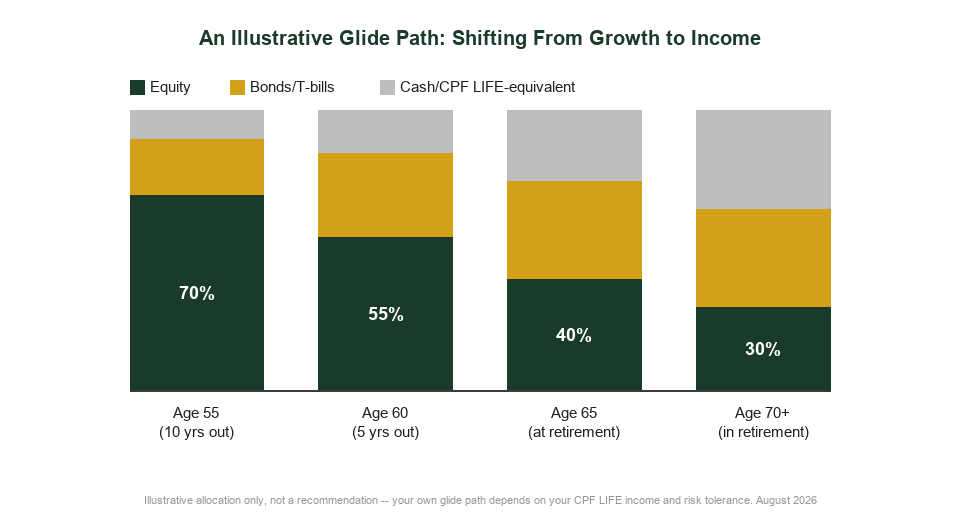
A “glide path” is simply a gradual shift in your asset mix as retirement approaches, rather than an abrupt switch. Instead of being 80% equities on your 64th birthday and 20% equities the next day, you shift a little each year over roughly the final decade of your working life.
A common framework: 10 years before retirement, keep most of your portfolio in equities since you still have time. In the final 5 years, start shifting meaningfully into bonds, T-bills, and cash-equivalents. By the time you actually retire, you want enough in stable, income-generating assets to cover several years of expenses without needing to sell equities during a downturn.
There’s no single “correct” glide path — it depends on how much guaranteed income you’ll have from CPF LIFE, whether you have other passive income like S-REIT dividends, and your own comfort with volatility. Our risk profile guide can help you think through your personal starting point.
CPF LIFE: Your Guaranteed Income Floor
Before you plan how much you need from your own investments, know what CPF LIFE already gives you. CPF LIFE is a national longevity insurance scheme — basically an annuity that pays you a fixed monthly amount for as long as you live, no matter how long that is.
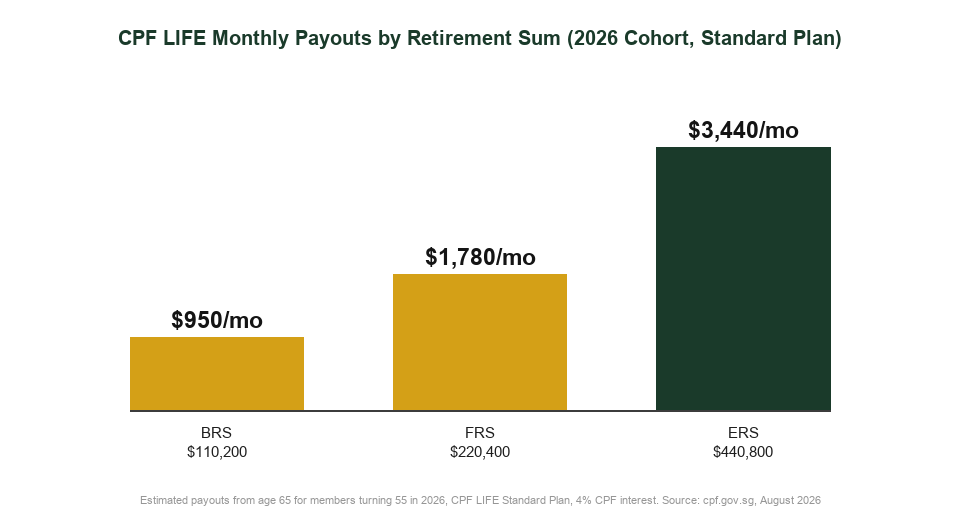
Your payout depends on how much you have in your Retirement Account at age 55, capped with reference to three tiers. For members turning 55 in 2026: the Basic Retirement Sum (BRS) is $110,200, giving an estimated $950 a month from age 65. The Full Retirement Sum (FRS) is $220,400, giving an estimated $1,780 a month. The Enhanced Retirement Sum (ERS) is $440,800, giving an estimated $3,440 a month — all figures based on the CPF LIFE Standard Plan and current 4% CPF interest rate, per CPF Board’s official estimates.
You also get to choose between three CPF LIFE plans. The Standard Plan pays the highest monthly amount but leaves a smaller bequest to your family. The Basic Plan pays roughly 10-15% less but preserves a larger bequest, since your balances decline more slowly. The Escalating Plan starts around 20% lower than Standard but grows 2% every year, which helps offset inflation over a long retirement. There’s no universally “best” plan — it depends on whether you prioritise maximum income now, a larger legacy, or inflation protection.
One more thing worth knowing: CPF payout eligibility age stays fixed at 65 — it is not linked to the statutory retirement age, which is separately rising from 63 to 64 from 1 July 2026 (with re-employment age rising from 68 to 69). These are two different ages that don’t move together.
Building a T-Bill and SSB Ladder for Predictable Income
Once you know your CPF LIFE floor, the next layer is a bond ladder — a set of Treasury bills (T-bills) and Singapore Savings Bonds (SSBs) with staggered maturity dates, so a chunk of cash becomes available every few months without you needing to sell equities.
As at the 4 August 2026 auction, the 6-month T-bill (BS26115N) had a cut-off yield of 1.59%. The August 2026 Singapore Savings Bond issue pays 1.46% in year one, stepping up to a 2.06% average return if held the full 10 years. Neither of these is exciting compared to long-run equity returns, but that’s the point — this money isn’t meant to grow aggressively, it’s meant to be there when you need it.
| Instrument | Typical Use in Retirement | Aug 2026 Yield |
|---|---|---|
| 6-month T-bill | Short-term cash needs, rolled every 6 months | 1.59% |
| Singapore Savings Bond | Medium-term buffer, can redeem early without penalty | 1.46% (yr 1) / 2.06% (10-yr avg) |
| CPF LIFE | Guaranteed income floor for life, starts at 65 | n/a (annuity, not a yield) |
Source: MAS T-bill auction results and MAS Singapore Savings Bonds issue calendar, August 2026.
The SSB is particularly useful here because, unlike most bonds, you can redeem it early in any given month without a capital loss — you simply forgo the future step-up interest. That flexibility matters a lot in retirement, when you don’t want to be forced to hold something until maturity if your plans change. Our SSB interest calculator can help you model a specific ladder against your own timeline.
SRS Withdrawals in Retirement: Timing and Tax
If you’ve been contributing to a Supplementary Retirement Scheme (SRS) account, timing your withdrawals matters as much as timing your CPF and bond ladder moves.
Your SRS withdrawal age isn’t tied to the current statutory retirement age — it’s locked at whatever the statutory retirement age was when you made your very first SRS contribution, for life. If you withdraw before that prescribed age, you face a 5% penalty and 100% of the amount withdrawn is taxable. Withdraw on or after that age, and there’s no penalty, and only 50% of the amount is taxable.
This is why staggering SRS withdrawals over 10 years after reaching your prescribed retirement age is a common strategy — spreading withdrawals keeps each year’s taxable amount low enough that it may fall within tax-free or low-tax income brackets, rather than triggering a large lump-sum tax bill in one year. Annual SRS contribution caps are $15,300 for Singapore Citizens and PRs, and $35,700 for foreigners, per IRAS’s SRS contributions page.
Sequence-of-Returns Risk: Why Timing Matters More Now
Here’s a concept that catches a lot of people off guard: two portfolios with the identical average annual return over 20 years can end up wildly different in value, purely because of when the good and bad years happened.
If a market crash hits early in your retirement, while you’re also withdrawing money to live on, you’re selling more shares (at lower prices) to raise the same amount of cash. That permanently shrinks your remaining share count, even after markets recover. The same crash happening mid-career, when you’re still contributing and not withdrawing, barely dents your long-term outcome — you simply buy more shares while they’re cheap.
This is called sequence-of-returns risk, and it’s the single biggest reason retirement investing looks different from accumulation-phase investing. It’s also exactly why the glide path and bond ladder discussed above matter: having 2-3 years of expenses in stable assets means you’re not forced to sell equities into a downturn right when you can least afford to. Our market crash survival guide covers the historical STI drawdowns that make this risk concrete, not theoretical.
A Worked Example: Turning $500,000 Into Retirement Income
Say you’re 65, have $220,400 in your CPF Retirement Account (giving roughly $1,780 a month for life via CPF LIFE Standard Plan), and hold a separate $500,000 investment portfolio outside CPF. Here’s one illustrative way to structure the $500,000 for income.
| Bucket | Amount | Purpose |
|---|---|---|
| Cash + T-bills | $75,000 | Covers ~2 years of expenses beyond CPF LIFE |
| Singapore Savings Bonds | $100,000 | Years 3-5 buffer, redeemable early if needed |
| Dividend-paying equities / REITs | $175,000 | Income plus continued growth over the long term |
| Global equity ETFs | $150,000 | Longer-horizon growth for later retirement years |
Illustrative example only, not a recommendation. Your own split depends on your actual expenses, health, and other income sources.
Notice the structure: the first few years of spending needs are covered by cash and short-dated instruments, not equities. That buys you time to ride out a downturn in the growth portion without being forced to sell it low. As each “bucket” gets drawn down, you top it up by selling from the equity buckets during good years — not bad ones.
What to Do in the 5 Years Before You Retire
Step 1: Log in to your CPF dashboard and check your projected Retirement Account balance and CPF LIFE payout estimate against the BRS, FRS, and ERS tiers.
Step 2: Decide which CPF LIFE plan fits you — Standard for maximum income, Basic for a larger bequest, or Escalating for inflation protection.
Step 3: Start building a 2-3 year cash and bond ladder using T-bills and SSBs, funded gradually by trimming equities rather than selling everything at once.
Step 4: If you have an SRS account, check your prescribed retirement age and plan a staggered withdrawal schedule once you reach it, rather than withdrawing everything in one lump sum.
Step 5: Revisit your risk profile specifically for this life stage — what felt comfortable at 35 may feel too aggressive at 60, and that’s a normal, expected shift.
Not financial or tax advice. Retirement planning is highly personal — consult a licensed financial adviser for guidance specific to your situation. Data verified as at 7 August 2026.
Frequently Asked Questions
How much will I get from CPF LIFE?
For members turning 55 in 2026, the estimated monthly CPF LIFE Standard Plan payout from age 65 is about $950 at the Basic Retirement Sum ($110,200), $1,780 at the Full Retirement Sum ($220,400), or $3,440 at the Enhanced Retirement Sum ($440,800). These are official CPF Board estimates based on current CPF interest rates.
Does the statutory retirement age change my CPF LIFE payout age?
No. CPF payout eligibility age is fixed at 65 and is not linked to the statutory retirement age, which is rising from 63 to 64 from 1 July 2026 (re-employment age rising from 68 to 69). These are separate ages that move independently.
What is sequence-of-returns risk?
It’s the risk that a market downturn happening early in retirement, while you’re withdrawing money to live on, permanently damages your portfolio more than the same downturn would during your working years, because you’re forced to sell more shares at lower prices to raise the same cash.
Should I move everything to cash before I retire?
Generally no. Moving entirely to cash sacrifices long-term growth you may need over a 20-30 year retirement. A gradual glide path — shifting a portion into bonds and T-bills over the final 5-10 working years while keeping some equity exposure — balances safety with continued growth.
When can I withdraw my SRS savings without penalty?
Your SRS withdrawal age is fixed at the statutory retirement age in force when you made your first SRS contribution, for life — it doesn’t change even if the statutory retirement age later rises. Withdraw on or after that age and only 50% is taxable with no penalty; withdraw earlier and you face a 5% penalty plus 100% taxability.
Planning Your Own Retirement Income Mix?
Open a brokerage or robo-advisor account through our referral links for sign-up bonuses.
This article was researched with the help of AI. While we strive to keep all information accurate and up to date, there may be errors. If you notice any discrepancies, please contact us.