MediSave & Your Integrated Shield Plan Bill: 2 Real MOH Case Studies (2026)
Two official MOH bill breakdowns show exactly how much MediSave covers of your ISP deductible and co-payment — and how much cash you’d still need.
MediSave can pay part of your Integrated Shield Plan (ISP) deductible and co-payment, but not always all of it. In MOH’s own 2026 case studies, a $56,900 private hospital bill left one policyholder paying $6,170 entirely through MediSave, while a $38,700 bill left another paying $1,360 in cash after MediSave. The difference comes down to the new April 2026 rider rules and your MediSave withdrawal limits.
Not financial advice. All figures are for educational reference only. Data verified as at 2 August 2026 against Ministry of Health (MOH) and CPF Board sources.
- MediSave can pay your ISP deductible and 5% co-payment — under the normal hospitalisation withdrawal limits ($1,130/day for the first 2 days, $400/day after), not the smaller limit used for premiums.
- From 1 April 2026, new ISP riders can no longer cover the minimum deductible ($1,500–$3,500, depending on ward class), so more of the bill lands on you first.
- In MOH’s own worked examples, MediSave covered the full amount owed in one case and about 74% in another — the gap is usually cash.
Table of Contents
Contents — Click to expand
- How an Integrated Shield Plan Bill Is Actually Split
- Minimum ISP Deductible by Ward Class (2026)
- MOH Case Study 1: Mr A’s $56,900 Knee Replacement
- MOH Case Study 2: Mrs B’s $38,700 ACL Surgery
- How Much MediSave Can Actually Pay
- Worked Example: A Smaller Class B1 Bill
- What Changed for ISP Riders in April 2026
- Frequently Asked Questions
How an Integrated Shield Plan Bill Is Actually Split
When you’re warded under an Integrated Shield Plan (ISP), your hospital bill doesn’t go to your insurer in one lump sum. It gets split into layers. First comes the deductible — a fixed amount you pay before your ISP pays anything at all, similar to how car insurance works. After that, you pay a 5% co-payment on the remaining bill, up to an annual cap. Only after both of those are cleared does your ISP (and any rider you hold) start picking up the rest.
You can use your MediSave account to pay your ISP deductible and co-payment, subject to CPF Board’s standard hospitalisation withdrawal limits. That’s a separate, larger pool of limits than the Additional Withdrawal Limit (AWL) used to pay your ISP premiums each year. However, MediSave has its own daily caps too, so it doesn’t always cover the full deductible-plus-copayment amount — especially for shorter admissions with high-cost surgery.
Here’s why this matters more in 2026: MOH tightened the design of ISP riders from 1 April 2026. Riders used to be able to cover almost the entire deductible and co-payment for some policyholders, giving near “first-dollar” coverage. That’s no longer allowed for new riders. So the MediSave-versus-cash math in this article isn’t just theoretical — it’s the real gap you’re likely to face at the hospital counter this year.
Minimum ISP Deductible by Ward Class (2026)
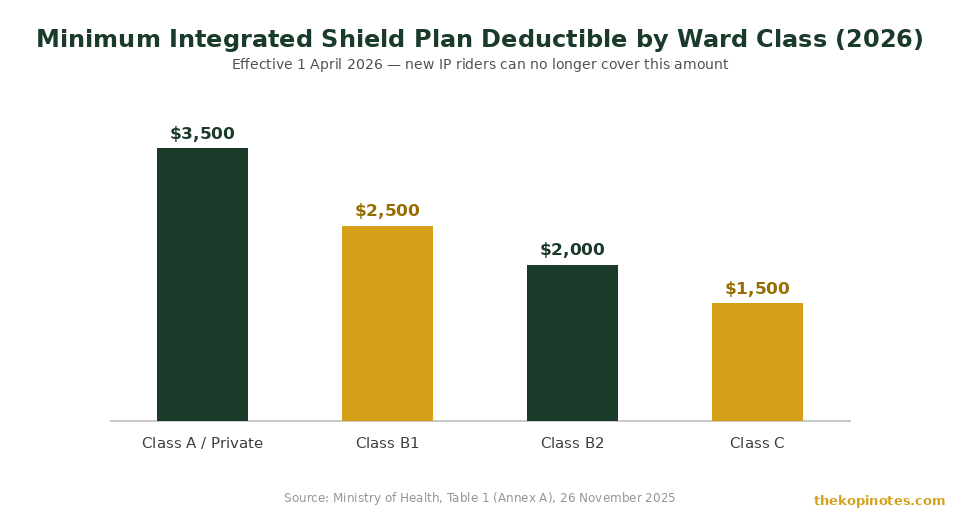
MOH sets a minimum deductible that every ISP must apply, and it varies by the ward class you actually use — not just the plan you bought. If your ISP targets Class A/Private coverage but you’re warded in Class B1, the lower B1 deductible applies instead. Table 1 below is MOH’s official schedule, current as at 1 April 2026.
| Ward Class Utilised | Minimum Deductible |
|---|---|
| Class A / Private | $3,500 |
| Class B1 | $2,500 |
| Class B2 | $2,000 |
| Class C | $1,500 |
| Day Surgery (non-subsidised) | $2,000 |
| Day Surgery (subsidised) | $1,500 |
Source: Ministry of Health, Table 1 (Annex A), 26 November 2025, effective 1 April 2026.
On top of the deductible, you also pay a minimum 5% co-payment on the remaining bill. This part is capped — the annual co-payment cap rose from $3,000 to $6,000 from 1 April 2026, and it applies to co-payments only, excluding the deductible itself.
MOH Case Study 1: Mr A’s $56,900 Knee Replacement
MOH published two worked examples alongside its April 2026 rider changes. The first: a 60-year-old Singaporean, “Mr A,” holds a private hospital ISP with a rider. He switches to the new, cheaper rider design in April 2026, immediately saving 30% on premiums — about $1,600 in cash that year.
Three years later, Mr A has knee joint replacement surgery in a private hospital. The bill comes to $56,900. Here’s how it breaks down under the new rider.
| Item | Amount |
|---|---|
| Total hospital bill | $56,900 |
| ISP deductible (Class A/Private) | $3,500 |
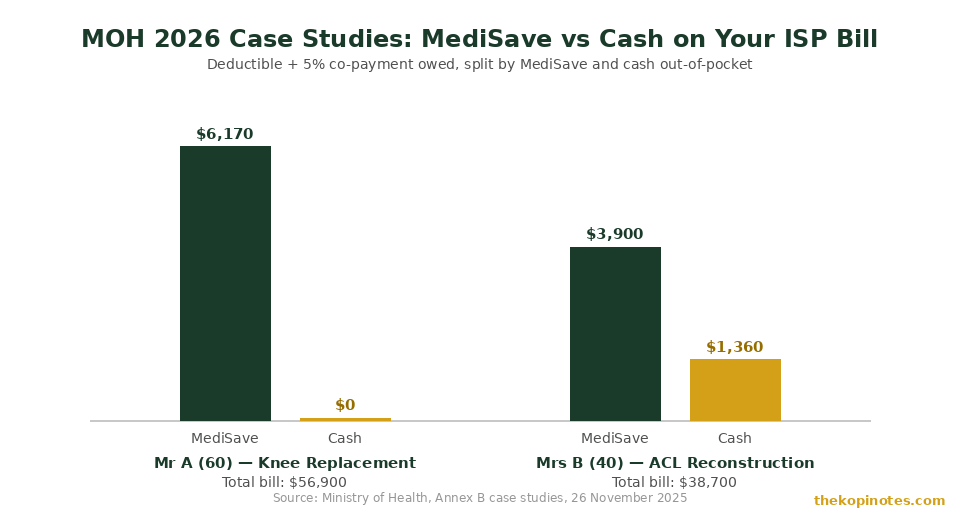
| 5% co-payment on remaining bill | $2,670 |
| Total owed before ISP/rider pays | $6,170 |
| Paid via MediSave | $6,170 (100%) |
Source: MOH, Annex B, Case Example 1, 26 November 2025.
That’s the good outcome: MediSave, based on the applicable hospitalisation withdrawal limits, covered his entire deductible and co-payment. However, this is $3,330 more MediSave usage than he would have paid under his old rider ($2,840). The trade-off: he’d already banked $4,800 in premium savings over the three years before the surgery, more than offsetting the higher claim. Over time, as rider premiums rise with age, those annual savings tend to grow too.
MOH Case Study 2: Mrs B’s $38,700 ACL Surgery
The second example shows a less favourable outcome. “Mrs B,” 40, is on a private hospital ISP but never bought a rider before — premiums felt too high for her budget. With the new, cheaper riders launched in April 2026, she adds one for the first time, paying about $500 less a year than peers who bought riders under the old pricing.
In December 2026, Mrs B tears her ACL playing sports and undergoes reconstruction surgery in a private hospital. The bill: $38,700.
| Item | Amount |
|---|---|
| Total hospital bill | $38,700 |
| ISP deductible (Class A/Private) | $3,500 |
| 5% co-payment on remaining bill | $1,760 |
| Total owed before rider pays | $5,260 |
| Paid via MediSave | $3,900 |
| Cash out-of-pocket after MediSave | $1,360 |
Source: MOH, Annex B, Case Example 2, 26 November 2025.
Her rider still helped: without it, MOH estimates her cash outlay would have been $3,120, more than double the $1,360 she actually paid. The rider absorbed the $1,760 gap between what MediSave covered and the total deductible-plus-copayment owed. This is the pattern to expect under the new rules — MediSave typically covers most, but not all, of your out-of-pocket amount, and a rider closes the remaining gap for a lower premium than before.
How Much MediSave Can Actually Pay
The reason MediSave covered 100% of Mr A’s amount but only 74% of Mrs B’s comes down to CPF Board’s withdrawal limits for hospitalisation, which cap how much you can draw per day of your stay.
| Period of Stay | Maximum MediSave Withdrawal |
|---|---|
| First 2 days | Up to $1,130 per day |
| Each day after | Up to $400 per day |
Source: CPF Board, MediSave Withdrawal Limits, last updated 1 April 2025 and still in effect as at August 2026.
These daily ward-charge limits sit on top of a separate withdrawal table for surgical and anaesthetist fees, which ranges from $240 to $5,290 depending on how complex the operation is. Put together, the total MediSave available for an admission is usually higher than the ward-charge limits alone — but it’s still capped, which is why Mrs B’s shorter, lower-cost admission left a bigger cash gap than Mr A’s.
In practice: the longer your stay and the more your bill leans on eligible ward and surgical charges (rather than items MediSave doesn’t cover, like certain outpatient follow-ups), the more of your deductible and co-payment MediSave is likely to absorb. You can check what an Integrated Shield Plan actually covers before you’re admitted, so there are fewer surprises at discharge.
Worked Example: A Smaller Class B1 Bill
Both MOH examples involve large private hospital bills. Here’s an illustrative, smaller scenario for a Class B1 ward stay — the calculation below is ours, not MOH’s, so treat it as a guide to the mechanics rather than an exact quote.
Say you’re warded in Class B1 for a 2-day stay, and your total bill (ward charges plus a moderate day-surgery procedure) comes to $8,500.
| Step | Amount |
|---|---|
| Total bill | $8,500 |
| Class B1 deductible | $2,500 |
| 5% co-payment on remaining $6,000 | $300 |
| Total owed before rider pays | $2,800 |
| MediSave available for ward charges (2 days × $1,130) | Up to $2,260 |
In this illustration, the $2,800 owed slightly exceeds the $2,260 ward-charge withdrawal limit for a 2-day stay. If part of the bill is an itemised surgical fee, it may draw on the separate surgical withdrawal table instead, which could close some or all of the gap. If not, the shortfall — roughly a few hundred dollars in this example — would need to be paid in cash or by a rider that still covers co-payment amounts. This is exactly the kind of gap the April 2026 rider changes were designed to introduce more of, especially for shorter, less complex admissions.
What Changed for ISP Riders in April 2026
MOH announced the new rider requirements on 26 November 2025, effective for new riders sold from 1 April 2026. The two headline changes: new riders can no longer cover the minimum ISP deductible at all, and the annual co-payment cap (excluding the deductible) rose from a minimum of $3,000 to a minimum of $6,000.
In exchange, MOH says new riders are priced roughly 30% lower on average than the old maximum-coverage riders — about $600 a year cheaper for private hospital riders and $200 a year cheaper for public hospital riders, on average, with bigger savings for older policyholders. If you bought your rider before 27 November 2025, insurers must transition you to a compliant rider no later than your next renewal after 1 April 2028, so the change isn’t instant for everyone.
The logic behind the reform: MOH’s data shows private hospital ISP policyholders with riders are 1.4 times as likely to claim, with claims 1.4 times larger on average, than those without riders. Cheaper, less generous riders are meant to restore some cost discipline while still capping catastrophic bills through the $6,000 co-payment cap. For a step-by-step walkthrough of filing the claim itself, see our Integrated Shield Plan claim guide.
Whichever ward class you’re in, it’s worth stress-testing your own MediSave balance against these numbers before you need to use it. Our Singapore retirement calculator can help you see how healthcare costs fit into your broader CPF and retirement picture, and if you’re weighing where to put your other savings alongside MediSave, our CPF investment strategy guide and the Syfe referral code sign-up bonus are good next stops.
Frequently Asked Questions
Can MediSave pay my Integrated Shield Plan deductible?
Yes. MediSave can pay your ISP deductible and 5% co-payment, subject to CPF Board’s normal hospitalisation withdrawal limits (up to $1,130 a day for the first 2 days, $400 a day after, plus a separate table for surgical fees). This is different from the smaller Additional Withdrawal Limit used to pay your annual ISP premium.
How much MediSave can I use for my ISP hospital bill?
It depends on how long you’re warded and how your bill is itemised between ward charges and surgical fees. In MOH’s own 2026 case studies, MediSave covered 100% of a $6,170 deductible-plus-copayment amount in one case, and about 74% ($3,900 of $5,260) in another, shorter admission.
What changed for ISP riders in April 2026?
From 1 April 2026, new ISP riders can no longer cover the minimum deductible set by MOH, which ranges from $1,500 to $3,500 depending on ward class. The annual co-payment cap also rose from a minimum of $3,000 to $6,000. In exchange, MOH says new riders are priced about 30% lower on average than the previous generation.
Why did my out-of-pocket cash payment go up in 2026?
If you bought a new rider on or after 1 April 2026, it’s designed to cover less of the deductible and co-payment than older riders did, so more of a smaller bill may land on your MediSave or cash. In return, your annual premium is meant to be lower — MOH’s examples show the premium savings can outweigh the higher claim cost over several years for most policyholders.
Is the co-payment cap the same as the deductible?
No. The deductible is a fixed amount ($1,500 to $3,500) you pay once per policy year before your ISP pays anything. The co-payment cap is a separate, higher ceiling ($6,000 a year from April 2026) on the 5% co-payments you pay after the deductible is met. The two are calculated and capped separately.
Can I use MediSave for the 5% co-payment on my ISP bill, not just the deductible?
Yes. Both the deductible and the 5% co-payment can be paid using MediSave, subject to the same hospitalisation withdrawal limits. MOH’s Case Example 1 shows a policyholder using MediSave to cover both components in full, totalling $6,170 for a single admission.
Know What You’ll Actually Pay Before You’re Admitted
Check your MediSave balance, your ISP’s deductible tier, and whether your rider still needs a top-up under the 2026 rules.
Get Free Insurance Advice
Speak with a licensed insurance advisor. No obligation, no cost.
By submitting this form, you agree to our Privacy Policy.
This article was researched with the help of AI. While we strive to keep all information accurate and up to date, there may be errors. If you notice any discrepancies, please contact us.