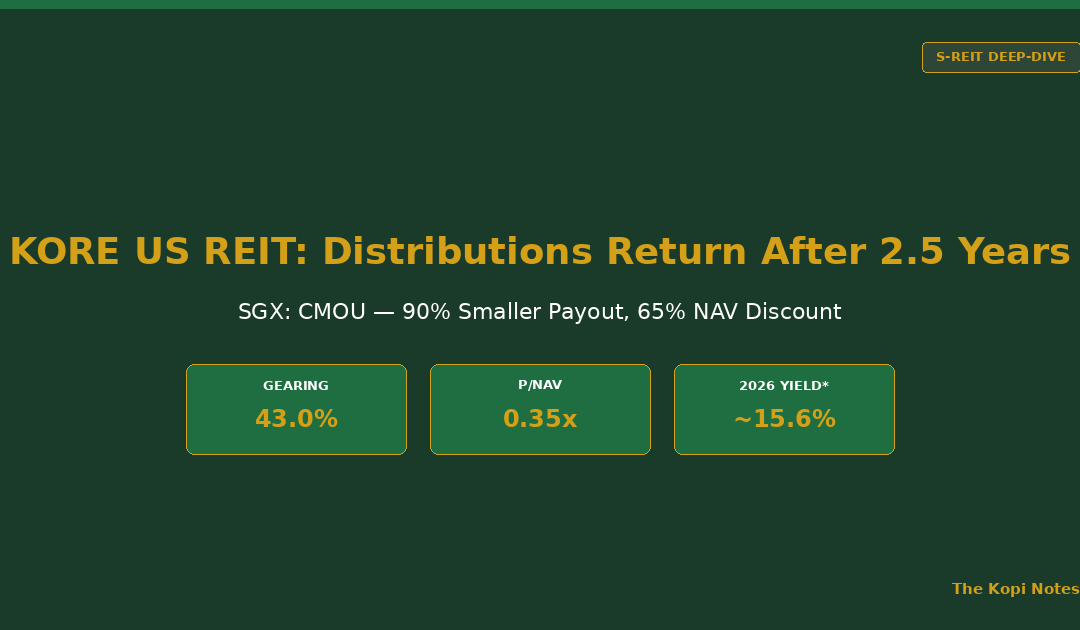
KORE US REIT 2026: Distributions Return After 2.5 Years — But 90% Smaller
SGX: CMOU — What the 65% NAV Discount Really Means for Singapore Investors
KORE US REIT — formerly Keppel Pacific Oak US REIT — resumed distributions in early 2026 after suspending payouts for two and a half years under its Recapitalisation Plan. The new 0.25 US cent DPU is 90% smaller than the last dividend it paid in 1H2023. Units still trade around US$0.235, roughly a 65% discount to the US$0.69 NAV per unit.
Not financial advice. All figures are for educational reference only. Data as at July 2026 unless otherwise noted.
- KORE (SGX: CMOU) resumed distributions in early 2026 after suspending payouts for 2.5 years — but the 0.25 US cent DPU is 90% below the 2.50 cents it last paid in 1H2023.
- Units trade near a 65% discount to NAV, but a substantial unitholder’s possible stake sale is a real overhang on the price.
- Gearing (43%) and interest coverage (2.5x) sit comfortably within MAS limits, and no term loan matures until 2027 — the balance sheet looks steadier than the beaten-down price suggests.
Table of Contents
Contents — Click to expand
- What Is KORE US REIT?
- Why Distributions Were Suspended for 2.5 Years
- Distributions Are Back — But 90% Smaller
- Balance Sheet Check: Gearing, ICR & Debt Maturities
- Portfolio Snapshot: 13 Buildings, 8 Markets
- Valuation: A 65% Discount to NAV
- The Overhang Risk: Pacific Oak’s Stake Sale
- Verdict: Who Should (and Shouldn’t) Buy KORE US REIT
- FAQs
What Is KORE US REIT?
KORE US REIT is the new name for Keppel Pacific Oak US REIT, effective 5 February 2026 per the manager’s official announcement. You’ll still see it quoted on SGX under the ticker CMOU. The manager says the rename “better reflects the REIT’s operations going forward” as it emerges from a rough two-year stretch.
The REIT owns 13 freehold office buildings and business campuses spread across eight US growth markets — cities chosen for technology and innovation demand, not the traditional gateway cities like New York or Chicago. As at 31 December 2025, the portfolio was worth about US$1.3 billion with roughly 4.8 million square feet of net lettable area (NLA) — basically the total rentable floor space across all 13 buildings.
One thing to flag upfront: KORE’s units are denominated in US dollars, not Singapore dollars. That means your returns depend on both the REIT’s performance and the USD/SGD exchange rate. A stronger SGD against the USD quietly erodes your returns even if the REIT itself does fine.
Sponsor Keppel Ltd, through Keppel Capital, remains firmly in control of the manager. In fact, as you’ll see later, Keppel’s continued control is baked directly into one of KORE’s loan agreements. The manager has also been transitioning to a new US-based asset manager as part of the broader turnaround, replacing the previous Pacific Oak-led asset management arrangement.
Why Distributions Were Suspended for 2.5 Years
Here’s the backstory. In 2022, KORE’s distribution per unit (DPU) — basically how much cash each unit pays you — fell 8.5% year-on-year, even as gross revenue kept climbing. The culprit was the US Federal Reserve’s fastest rate-hiking cycle in decades. KORE’s finance expenses jumped 27.1% year-on-year to US$18.7 million in FY2022, pushing its all-in average cost of debt to 3.2% by end-2022.
It got worse fast. By 1H2023, finance expenses had soared a further 42.5% year-on-year to US$11.7 million, and the average cost of debt climbed to 3.99%. KORE still paid a DPU of 2.50 US cents for 1H2023 — a 16.0% annualised yield at the time — but the writing was on the wall.
On 15 February 2024, the manager announced a Recapitalisation Plan: suspend distributions entirely, starting from 2H2023, through to the 2H2025 distribution that would otherwise have been paid in 1H2026. That’s a full 2.5 years without a single payout — a long time to hold a REIT purely for the yield.
The goal wasn’t punishment for its own sake — it was survival. By keeping cash in-house instead of paying it out, KORE bought itself room to refinance maturing loans and delever the balance sheet without a fire sale of buildings into a weak US office market.
Distributions Are Back — But 90% Smaller
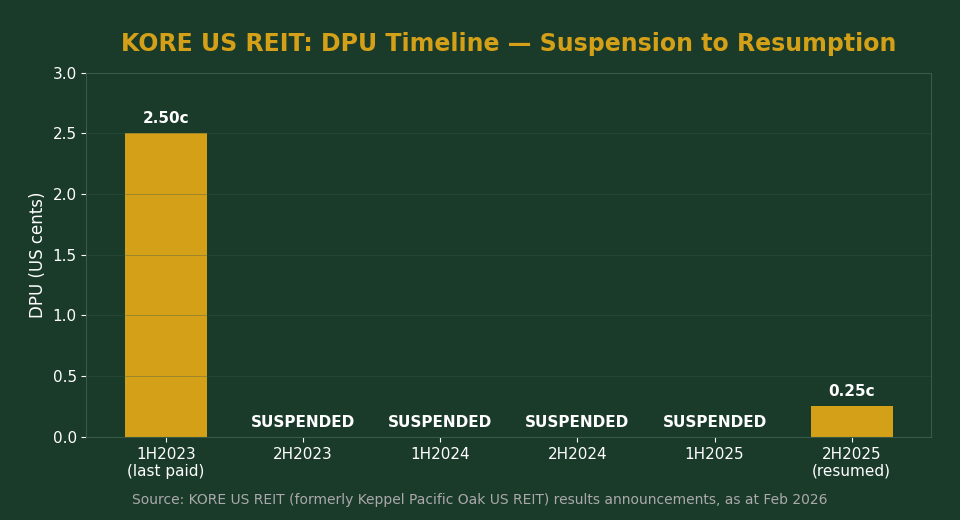
The Recapitalisation Plan was supposed to run through the 2H2025 distribution, which would normally be paid in 1H2026. Instead, KORE resumed early — and declared a DPU of 0.25 US cents for the 1 July to 31 December 2025 period. That’s good news for the “is this REIT still alive” question, but the number itself is tiny next to what long-time holders remember.
| Period | DPU (US cents) | Status |
|---|---|---|
| 1H2023 | 2.50 | Last paid before suspension |
| 2H2023 – 1H2025 | 0.00 | Suspended under Recapitalisation Plan |
| 2H2025 | 0.25 | Resumed early, ahead of schedule |
Source: KORE US REIT (formerly Keppel Pacific Oak US REIT) results announcements, Feb 2026
Do the maths: 0.25 US cents versus the 2.50 US cents last paid works out to a 90% cut. That’s the plain reality behind the headline “distributions resumed.” Management has been explicit that this is a deliberately conservative starting payout, with the stated aim of raising it toward a “sustainable level” over time — not a promise, just a stated intention.
Some analysts project a full-year 2026 distribution yield of around 15.6% on the current price, assuming the payout ramps up through the year. Treat that figure as an optimistic projection, not a guarantee — it depends entirely on whether cash flow allows the “conservative” starting DPU to actually rise as promised.
Balance Sheet Check: Gearing, ICR & Debt Maturities
The reason the distribution cut matters less than it sounds is what it bought: a genuinely repaired balance sheet. Here’s how KORE stacks up against MAS’s rules for all S-REITs — a leverage (gearing) cap of 50% and a minimum interest coverage ratio (ICR) of 1.5x once gearing passes 45%.
| Metric | KORE (latest) | MAS Limit | Verdict |
|---|---|---|---|
| Gearing | 43.0% | 50.0% max | Within limit, but tighter than best-in-class S-REITs (usually low-30s%) |
| Interest coverage ratio (ICR) | 2.5x | 1.5x min | Comfortably above the minimum |
| Next term loan maturity | 2027 | — | Near-term refinancing risk de-risked |
Source: KORE US REIT FY2025 results, MAS REIT leverage framework, as at Feb 2026
During the recapitalisation, KORE secured an additional US$37.5 million term loan facility, bringing total new term loan facilities obtained since Q4 2025 to-date to US$152.5 million. Combined with the earlier restructuring, that means no term loan matures until 2027 — a meaningfully longer runway than KORE had a year ago.
One structural detail worth knowing: KORE has a separate US$40 million credit facility with a specific trigger clause. If Keppel Ltd’s collective stake in the manager falls below 50%, if the manager itself changes, or if Keppel Capital Investment Holdings’ unitholding drops below a specified threshold, the facility becomes due for mandatory prepayment within 10 business days. In plain English: Keppel staying in control isn’t just about strategy continuity — it’s directly tied to KORE’s debt obligations.
Portfolio Snapshot: 13 Buildings, 8 Markets
KORE’s 13 freehold office buildings and business campuses sit across eight US markets chosen specifically for technology and innovation-driven demand — think secondary tech hubs, not legacy central business districts. That’s a deliberate strategy: these markets tend to have younger, more diverse employer bases than pure finance-and-law CBDs like Midtown Manhattan.
Occupancy has held in a fairly narrow band. Committed occupancy stood at 87.2% at the end of FY2025, within the roughly 87%–90% range the portfolio has maintained through the recapitalisation period — a sign that active leasing management, not just lucky timing, has kept tenants in place through a genuinely difficult US office cycle.
Tenant mix is the other half of the defensive story. TAMI (technology, advertising, media and information) tenants plus medical and healthcare tenants together make up roughly 51% of KORE’s cash rental income. Healthcare tenants in particular tend to sign longer leases and are far less prone to shrinking their office footprint than, say, a law firm or a bank going hybrid.
Valuation: A 65% Discount to NAV
Here’s where KORE gets genuinely interesting for value-minded investors. At a unit price of roughly US$0.235 in July 2026, against a NAV (net asset value) per unit of US$0.69, KORE trades at a price-to-NAV (P/NAV) ratio of about 0.35x. In plain terms: you’re paying US$0.235 for a dollar’s worth of assets that the REIT itself values at 69 cents — a roughly 66% discount.
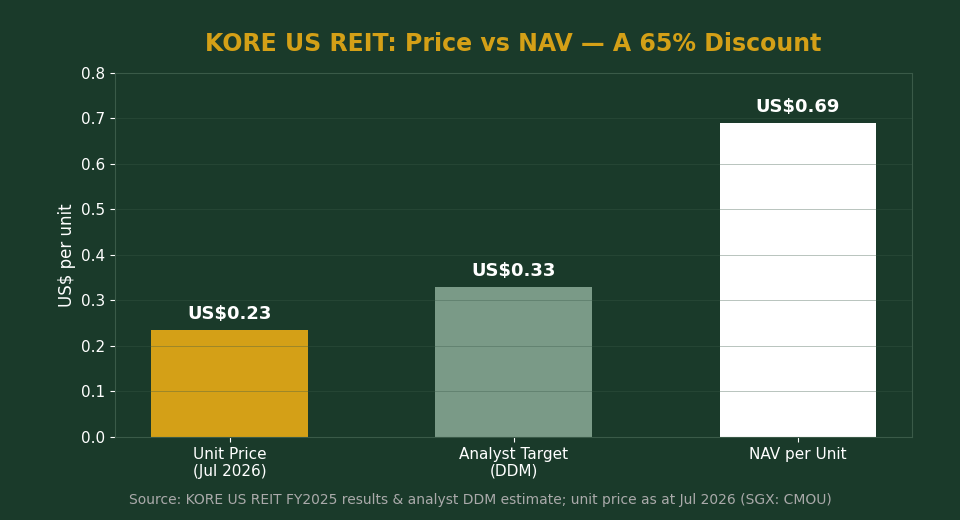
Analyst estimates aren’t much more optimistic in the near term — one dividend discount model (DDM) target price sits at US$0.33, using a cost of equity of 10.5% and terminal growth of just 0.5%. Even that “bullish” case still implies a persistent discount to book value, just a smaller one than today’s.
Here’s the honest caveat: deep NAV discounts on US office REITs often aren’t a pricing mistake waiting to be corrected — they can reflect real structural risk. Higher-for-longer US interest rates, the slow bleed of hybrid work on office demand, and refinancing risk across the sector have kept valuations depressed for years, not months. A REIT trading at 35% of book value isn’t automatically cheap; the market may simply be pricing in further NAV write-downs.
The Overhang Risk: Pacific Oak’s Stake Sale
There’s one more risk worth knowing before you go anywhere near this REIT. Pacific Oak Strategic Opportunity REIT, a substantial unitholder that indirectly holds about 6.14% of KORE, is pursuing its own plan of liquidation. It has approached KORE’s manager about a potential sale of its units, per The Edge Singapore. No units have actually been sold yet — but the possibility of a large block sale or placement hangs over the price, since a forced seller rarely gets a good price, and buyers on the other side of that trade know it.
Separately, KORE has also been transitioning to a new US-based asset manager, moving on from the earlier Pacific Oak-affiliated asset management arrangement. Management changes at this stage of a turnaround are usually a net positive if handled well, but they’re still a variable worth watching rather than a settled fact.
Verdict: Who Should (and Shouldn’t) Buy KORE US REIT
If you need reliable income today, KORE probably isn’t for you. The resumed DPU is small, the payout “ramp-up” is a stated intention rather than a promise, and the Pacific Oak overhang could cap the unit price for a while yet.
If you’re a contrarian, value-oriented investor who can stomach US office and currency risk, KORE is at least a name worth watching. The balance sheet genuinely looks safer than it did two years ago — gearing within MAS limits, ICR comfortably above the floor, and nothing due until 2027. That’s a real turnaround, even if the unit price hasn’t caught up.
It also helps to compare KORE against Manulife US REIT, whose dividend is still frozen — KORE resuming payouts, however small, is a meaningfully different signal from a peer that hasn’t. For a broader read on where US office S-REITs sit in the current recovery, see our S-REIT Recovery 2026 breakdown, and for names further along their turnaround, our Best S-REITs Singapore 2026 guide is a good next stop.
Curious exactly how big that NAV discount really is in dollar terms for your own portfolio size? Run the numbers with our S-REIT P/NAV Discount & Premium Calculator. And if single-name US office REIT risk isn’t your style, our passive income Singapore guide covers lower-drama ways to build recurring cash flow, while our retirement calculator can show how any REIT income fits into your bigger retirement picture.
If you’d rather build diversified REIT/ETF exposure than bet on a single turnaround story, robo-advisors and brokerages make that easy to automate. Sign up with Endowus using referral code 2V343 or Syfe using referral code SRPRFFFCD to get started with diversified portfolios instead of single-stock bets.
Frequently Asked Questions
What happened to Keppel Pacific Oak US REIT’s name?
It changed its name to KORE US REIT, effective 5 February 2026. The SGX ticker stayed the same: CMOU. The manager said the new name better reflects the REIT’s operations as it moves past its recapitalisation period.
Why did KORE suspend its distributions?
Rapidly rising US interest rates pushed KORE’s finance costs up sharply in 2022 and 1H2023. On 15 February 2024, the manager launched a Recapitalisation Plan that suspended distributions from 2H2023 through the 2H2025 payout (that would otherwise have been paid in 1H2026), freeing up cash to refinance debt and delever.
How much is KORE’s DPU now?
KORE resumed distributions with a DPU of 0.25 US cents for the 2H2025 period (1 July – 31 December 2025) — about 90% smaller than the 2.50 US cents it last paid in 1H2023.
Is KORE US REIT’s dividend safe going forward?
It’s more secure than it was two years ago — gearing (43.0%) and interest coverage (2.5x) are within MAS limits, and no term loan matures until 2027. But management has only committed to a “conservative” starting payout with an intention, not a promise, to raise it over time.
What is KORE’s gearing ratio and is it within MAS limits?
KORE’s gearing is approximately 43.0%, below MAS’s 50% aggregate leverage cap for all S-REITs. Its interest coverage ratio of 2.5x is also comfortably above the 1.5x regulatory minimum that applies once gearing exceeds 45%.
Why does KORE trade at such a big discount to NAV?
KORE trades around a 0.35x price-to-NAV ratio, roughly a 65–66% discount to its US$0.69 NAV per unit. This reflects the US office sector’s structural headwinds — higher-for-longer rates, hybrid work, and refinancing risk — plus the specific overhang from a substantial unitholder’s potential stake sale.
What is the Pacific Oak stake sale overhang?
Pacific Oak Strategic Opportunity REIT holds about 6.14% of KORE and is pursuing its own liquidation plan. It has approached KORE’s manager about a possible unit sale. No units have been sold as of writing, but a future block sale or placement could pressure KORE’s unit price.
Is KORE US REIT a buy in 2026?
That depends on your risk tolerance. Income investors who need reliable payouts today should probably wait — the resumed DPU is small and the overhang risk is real. Contrarian value investors comfortable with US office and currency risk may find the de-risked balance sheet and deep NAV discount worth watching, though not necessarily buying immediately.
How does KORE compare to Manulife US REIT?
Both are Singapore-listed US office REITs that have faced distribution pressure. The key difference: KORE has resumed paying distributions (albeit at a much lower rate), while Manulife US REIT’s dividend remains frozen as of this writing — a meaningfully different signal about where each REIT is in its turnaround.
This article was researched with the help of AI. While we strive to keep all information accurate and up to date, there may be errors. If you notice any discrepancies, please contact us.