Bitcoin ETF Singapore: Can You Buy IBIT, FBTC & Crypto ETFs in 2026?
What MAS actually allows, which spot Bitcoin and Ethereum ETFs Singapore investors can access, and the US estate tax trap most guides skip.
There is no Bitcoin ETF listed on SGX — MAS has not approved one for retail sale in Singapore. But you can still buy overseas-listed spot Bitcoin ETFs like IBIT, FBTC, or the LSE-listed CoinShares BITC through licensed brokers such as IBKR, moomoo, or Saxo, after a mandatory risk assessment. The catch: most popular options are US-domiciled, exposing you to US estate tax.
Not financial advice. All figures are for educational reference only. Data verified as at 28 July 2026 unless noted.
- MAS blocks SGX-listed crypto ETFs for retail investors, but you can still buy overseas-listed ones through a licensed broker after a suitability check.
- US-listed funds like IBIT, FBTC and ETHA carry US estate tax exposure above USD 60,000. The LSE-listed CoinShares BITC (Jersey-domiciled) avoids this entirely.
- Crypto ETFs aren’t CPFIS-approved and most brokers won’t let you use SRS funds for them — you’ll need a cash brokerage account.
Table of Contents
Contents — Click to expand
What Is a Bitcoin ETF?
A spot Bitcoin ETF is a fund that holds actual bitcoin in cold storage with a regulated custodian. When you buy a share, you get exposure to bitcoin’s price. You never touch a crypto wallet or private key.
This is different from a futures-based ETF like ProShares BITO, which holds bitcoin futures contracts instead of the coin itself. Futures-based funds can drift from the spot price over time due to a cost called “roll yield.” Spot funds track the price much more closely.
For Singapore investors, the appeal is simple. You get bitcoin exposure inside your normal brokerage account — no exchange sign-ups, no seed phrases to lose, no separate custody arrangement. You buy and sell it exactly like you would buy CSPX or VWRA.
Why Bitcoin ETFs Are Trending in 2026
Bitcoin has been volatile in 2026, trading anywhere from the high-USD 50,000s to the low USD 70,000s over the year, and sitting near USD 65,000 as at 24 July 2026. That swing has pulled in both traders and long-term allocators.
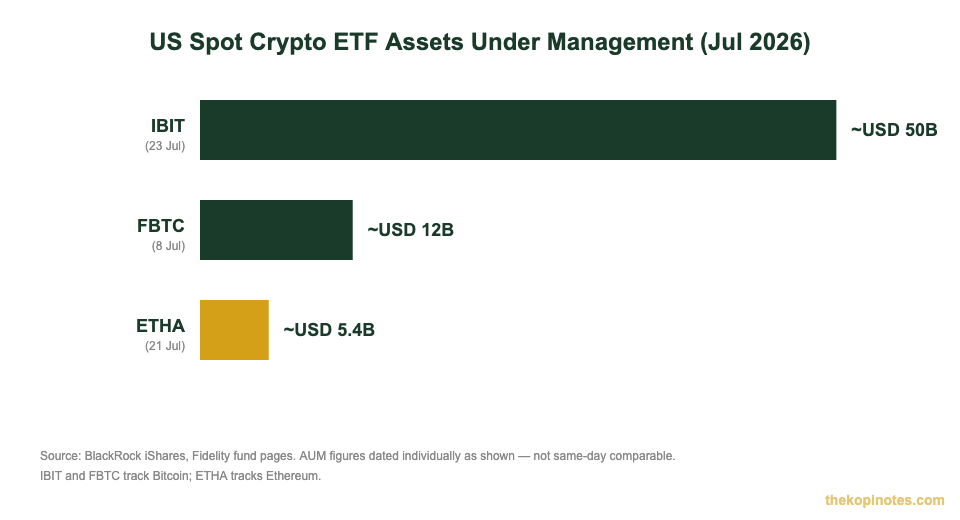
US spot Bitcoin and Ethereum ETFs have absorbed tens of billions of dollars in assets since their 2024 launch. IBIT alone has grown into one of the largest ETF launches in history by AUM. This institutional demand is a big reason crypto ETFs keep making headlines.
Singapore has caught a version of this wave too. SGX-listed ETFs overall saw a record S$20.5 billion in inflows during 2026, and search interest in crypto ETFs has risen alongside it — even though the products driving that search interest aren’t listed here.
Can Singapore Investors Actually Buy One?
Here’s the part most articles get muddled: MAS has never approved a crypto ETF for listing on SGX. Under Singapore’s rules, cryptocurrencies aren’t treated as eligible assets for a retail ETF here. MAS has cited the “highly volatile and speculative” nature of crypto as the reason.
That does not mean you’re locked out. MAS has confirmed that retail investors can still buy overseas-listed spot Bitcoin ETFs — think IBIT on Nasdaq or BITC on the London Stock Exchange — through a licensed capital markets intermediary based in Singapore.
The condition: your broker must give you adequate risk disclosures and assess suitability before letting you buy. In practice, this usually means a short online questionnaire or a “complex product” acknowledgement the first time you try to trade one. It’s a one-time step, not a recurring hurdle.
So the honest answer is: no SGX listing exists, but yes, you can buy these ETFs through IBKR, moomoo, Saxo and similar MAS-licensed brokers, once you clear that suitability check.
Best Bitcoin & Ethereum ETFs for Singapore Investors
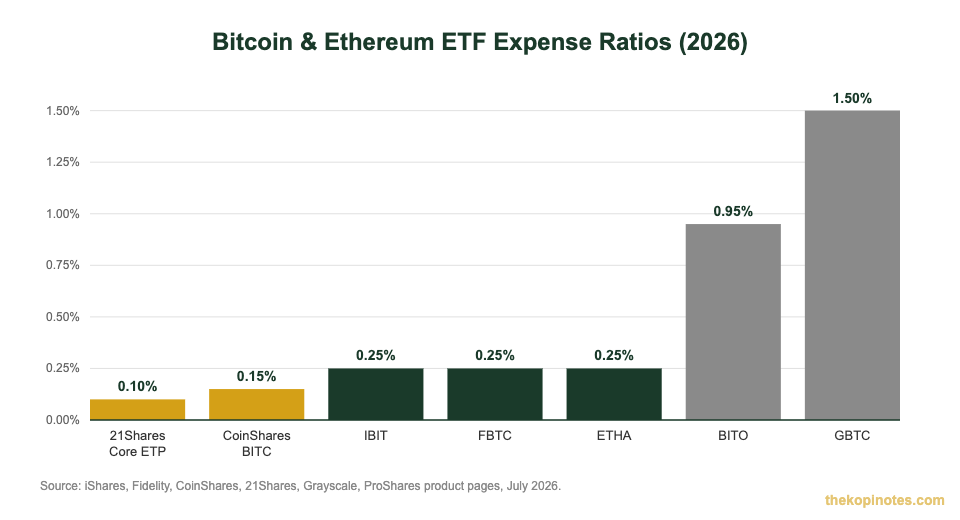
Not all crypto ETFs are built the same. Fees, domicile and structure vary a lot. Here’s how the main options compare as at July 2026.
| ETF | Ticker | Exchange | Domicile | TER | Type |
|---|---|---|---|---|---|
| iShares Bitcoin Trust | IBIT | Nasdaq | USA | 0.25% | Spot |
| Fidelity Wise Origin Bitcoin Fund | FBTC | NYSE Arca | USA | 0.25% | Spot |
| iShares Ethereum Trust | ETHA | Nasdaq | USA | 0.25% | Spot |
| CoinShares Physical Bitcoin | BITC | LSE / Xetra / SIX | Jersey | 0.15% | Spot ETP |
| 21Shares Bitcoin Core ETP | CBTC | Xetra / SIX | Switzerland | 0.10% | Spot ETP |
| Grayscale Bitcoin Trust ETF | GBTC | NYSE Arca | USA | 1.50% | Spot (legacy, high fee) |
| ProShares Bitcoin Strategy ETF | BITO | NYSE Arca | USA | 0.95% | Futures (not spot) |
Source: iShares/BlackRock fund pages, Fidelity, CoinShares, 21Shares, Grayscale, ProShares product pages, July 2026.
According to the iShares IBIT fund page, IBIT and FBTC are the two largest and most liquid spot Bitcoin ETFs by far, which matters if you care about tight bid-ask spreads. ETHA is the equivalent play on Ethereum. BITC and the 21Shares Bitcoin Core ETP are the two cheapest, non-US-domiciled options — and the ones that avoid the tax issue covered next. GBTC is a legacy fund with a much higher fee that most new buyers should skip. BITO isn’t a spot fund at all, so its price can lag actual bitcoin over long periods.
The Tax Risk Most Guides Don’t Mention
Long-time readers of this site know the drill from our CSPX vs VOO tax breakdown (linked at the end of this guide): US-domiciled funds create a US estate tax problem for non-US investors. Bitcoin ETFs are no exception.
IBIT, FBTC, ETHA, GBTC and BITO are all structured as US-domiciled trusts. That makes them “US-situs assets.” Under IRS rules for non-resident aliens, if you die holding more than USD 60,000 in US-situs assets, your estate can owe US estate tax of up to 40% on the amount above that threshold.
Here’s a worked example. Say you hold SGD 100,000 in IBIT — roughly USD 77,500 at the July 2026 USD/SGD rate of about 1.29. That’s well above the USD 60,000 threshold. Your estate could face US estate tax on the excess before your heirs receive anything, unless proper estate planning is in place.
One nuance that trips people up: spot Bitcoin ETFs typically don’t pay dividends, since bitcoin itself generates no yield. So the usual 30% US dividend withholding tax story that applies to US-listed equity ETFs like VOO mostly doesn’t apply here. The estate tax exposure is the real issue with crypto ETFs, not withholding tax.
| ETF | Domicile | US Estate Tax Risk |
|---|---|---|
| IBIT / FBTC / ETHA / GBTC / BITO (US-listed) | USA | Yes, above USD 60,000 |
| BITC (LSE / Xetra / SIX) | Jersey | None |
Source: IRS estate tax rules for non-resident aliens; CoinShares product domicile disclosures, 2026.
This is exactly why the LSE-listed CoinShares Physical Bitcoin ETP (ticker BITC) is worth a look if you’re planning to hold a meaningful position long-term. It’s Jersey-domiciled, not a US trust, so it sits outside the US estate tax regime entirely — the same logic that makes CSPX and VWRA more tax-efficient than their US-listed equivalents.
How to Buy a Bitcoin ETF in Singapore
The process is broker-dependent, but the general steps are the same everywhere.
1. Open and fund a brokerage account. You’ll need a broker that lists US or LSE markets. IBKR, Saxo and moomoo all qualify.
2. Complete the suitability or complex-product assessment. This is the MAS-mandated step. Expect a short online quiz about your investing experience and risk tolerance before your first crypto ETF trade unlocks.
3. Search for the ticker on the right exchange. IBIT and FBTC trade on US exchanges (Nasdaq and NYSE Arca). BITC trades on the London Stock Exchange under the ticker BITC-GB, alongside Xetra and SIX Swiss Exchange listings.
4. Place your order in the listing currency. US-listed funds settle in USD; BITC settles in USD or GBP depending on the exchange you route through.
On fees: moomoo lists popular crypto ETFs including IBIT, ETHA and BITO at a flat USD 0.99 per trade, and separately supports direct crypto trading if you’d rather hold the coin outright instead of a fund wrapper. IBKR and Saxo charge standard US or European exchange commissions, which tend to suit larger, less frequent trades better. If you’re still deciding between brokers generally, our IBKR vs Saxo vs moomoo vs Syfe comparison breaks down fees and FX spreads in detail.
CPF, SRS & Risks to Consider
Crypto ETFs are not on the CPFIS list of approved investments, so your CPF Ordinary or Special Account funds can’t touch them. Most SRS-participating banks also exclude crypto-linked products from their approved fund lists, given MAS’s classification of crypto as high-risk and speculative. Check with your SRS bank before assuming otherwise — you’ll almost certainly need a regular cash brokerage account instead.
Beyond the tax and CPF/SRS points above, weigh these risks before buying:
Volatility. Bitcoin swung between roughly USD 58,000 and USD 74,000 in 2026 alone. A crypto ETF moves with the underlying coin — there’s no smoothing effect from diversification the way there is with a broad index ETF like VWRA.
Premium or discount to NAV. Older trust structures like GBTC have historically traded away from their underlying bitcoin value. Spot ETFs with active creation and redemption mechanisms (like IBIT and BITC) are designed to keep this gap small, but it can still widen briefly during volatile periods.
Regulatory risk. MAS’s current stance allows access via licensed brokers, but rules on crypto-linked products have shifted before and could shift again. Don’t assume today’s access rules are permanent.
Custody and counterparty risk. You’re trusting the fund’s custodian to actually hold the bitcoin securely. Established issuers like BlackRock, Fidelity and CoinShares use regulated, audited custodians, which reduces — but doesn’t eliminate — this risk.
Given all this, a Bitcoin ETF works best as a small, deliberate slice of a portfolio that’s already anchored by broad ETFs and a properly planned retirement strategy (calculator linked below), not as a core holding on its own.
Frequently Asked Questions
Is there a Bitcoin ETF listed on SGX?
No. MAS has not approved any spot or futures Bitcoin ETF for retail listing on SGX, citing the volatile and speculative nature of crypto. Singapore investors access Bitcoin ETFs through overseas exchanges instead, via a licensed local broker.
Can Singapore investors buy IBIT or FBTC?
Yes. MAS allows retail investors to buy overseas-listed spot Bitcoin ETFs like IBIT and FBTC through MAS-licensed capital markets intermediaries, such as IBKR, moomoo and Saxo, after a risk disclosure and suitability check.
Do I need to pass a test before buying a Bitcoin ETF in Singapore?
Most brokers require a one-time suitability or “complex product” assessment before your first crypto ETF trade. It’s usually a short online questionnaire about your investing experience and risk tolerance, not a formal exam.
What's the difference between IBIT and CoinShares BITC?
Both are spot Bitcoin funds, but IBIT is a US-domiciled trust listed on Nasdaq, while BITC is a Jersey-domiciled ETP listed on the London Stock Exchange, Xetra and SIX. BITC’s non-US domicile means it avoids US estate tax exposure that applies to IBIT for non-US holders above USD 60,000.
Can I use my CPF or SRS to buy a Bitcoin ETF?
No, in almost all cases. Crypto ETFs aren’t on the CPFIS approved investment list, and most SRS-participating banks exclude crypto-linked products from their fund lists. You’ll typically need a regular cash brokerage account.
Are Bitcoin ETFs safer than buying Bitcoin directly?
They remove some risks, like losing a private key or using an unregulated exchange, since a regulated custodian holds the coins. But you still take on full bitcoin price volatility, plus fund-specific risks like premium/discount to NAV and issuer counterparty risk.
Ready to Build a Diversified Portfolio?
A Bitcoin ETF should be a small slice, not the whole plan. Open a brokerage account and start with a solid core first.
This article was researched with the help of AI. While we strive to keep all information accurate and up to date, there may be errors. If you notice any discrepancies, please contact us.