Best Money Changer in Singapore (2026): Physical Changers vs YouTrip, Wise & Revolut Compared
Licensed money changers, banks, and zero-FX cards — a real cost comparison with SGD 1,000 worked examples.
The best money changer in Singapore is usually The Arcade at Raffles Place, where more than a dozen licensed changers compete for your business and rates run 1 to 3% better than banks. But for everyday spending and ATM withdrawals overseas, zero-FX cards like YouTrip, Wise, and Revolut typically beat even the best physical money changer.
Not financial advice. All figures are for educational reference only. Data verified as at 24 July 2026 unless otherwise noted.
- The Arcade (Raffles Place) and Mustafa Centre offer the sharpest cash rates in Singapore, typically 1 to 3% off mid-market.
- YouTrip, Wise and Revolut usually beat physical money changers for card spending and ATM withdrawals, often at zero or near-zero markup.
- Airport money changers are consistently the worst deal in town — only exchange a small emergency amount there.
Table of Contents
Contents — Click to expand
- Is a Money Changer the Same as a Bank or a Card?
- How to Check a Money Changer Is MAS-Licensed
- The Best Physical Money Changers in Singapore
- Money Changers vs YouTrip, Wise & Revolut
- Real Cost Comparison: Exchanging SGD 1,000
- Why You Should Avoid Airport Money Changers
- How to Get the Best Rate Every Time
- Who Should Use What?
- Frequently Asked Questions
Is a Money Changer the Same as a Bank or a Card?
A money changer is a business licensed by MAS to buy and sell foreign currency notes over the counter. That’s different from a bank, which exchanges currency as one of many services, and different again from a multi-currency card like YouTrip or Wise, which converts your money digitally at the point of spend.
Each one prices its exchange rate differently. Money changers and banks quote a “buy” and “sell” rate with their margin already baked in. Cards like YouTrip pass through the wholesale Mastercard or Visa rate — the same rate banks use to trade with each other — with little to no markup on top.
That difference in pricing model is why you can get a meaningfully better deal depending on how, and how much, you’re exchanging.
How to Check a Money Changer Is MAS-Licensed
Every legitimate money changer in Singapore must hold a Money-Changing Licence issued by the Monetary Authority of Singapore (MAS) under the Payment Services Act. As at July 2026, more than 260 firms are authorised to conduct money-changing here, according to MAS’s Financial Institutions Directory.
Before you hand over cash, look for the licence certificate displayed at the counter, and double-check the shop name against the MAS Financial Institutions Directory. Walk away if a changer can’t show a valid licence, refuses to state the rate upfront, or pressures you to exchange quickly before you can compare.
The Best Physical Money Changers in Singapore
If you want cash in hand before you fly, these four locations consistently offer Singapore’s most competitive licensed rates.
| Location | Address | Known For | Hours (Typical) |
|---|---|---|---|
| The Arcade | 11 Collyer Quay, Raffles Place | Sharpest rates — 20+ changers compete under one roof | Mon–Fri 10am–5pm, Sat 10am–12.30pm, closed Sun |
| Mustafa Centre | 145 Syed Alwi Road, Little India | Singapore’s only near round-the-clock money changer | Extended hours, often till late — check in-store |
| People’s Park Complex | 1 Park Road, Chinatown | Strong rates for CNY, TWD, HKD and other Asian currencies | Daily, typical retail hours |
| Lucky Plaza | 304 Orchard Road | Convenient if you’re already along Orchard Road | Daily, typical retail hours |
Source: You.co money changer guide (Feb 2026, updated), MAS Financial Institutions Directory. Hours vary by individual shop — always check before visiting.
Rates can vary 1 to 2% between shops even within the same building, so it’s worth comparing two or three counters, or checking an aggregator like CashChanger.co, before you commit. The Arcade’s density of changers is what drives its rates down — with 20-plus licensed shops competing in one building, no single changer can afford to price itself far out of line with its neighbours.
Money Changers vs YouTrip, Wise & Revolut
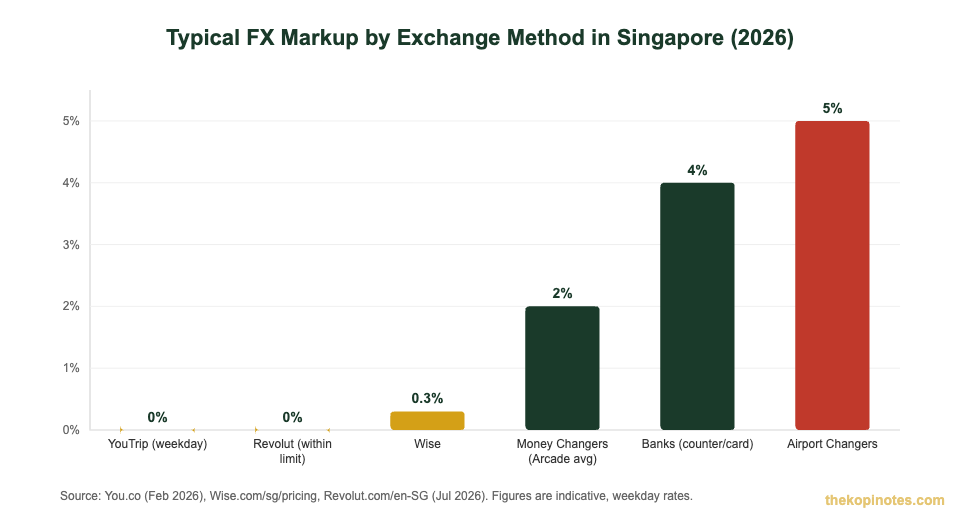
You don’t have to choose one or the other, but it helps to know what each option actually charges. Here’s what the three big zero-FX cards offer as at July 2026, verified against their official pricing pages.
YouTrip converts at the Mastercard wholesale rate with zero markup on card payments and in-app currency conversion. There’s no card issuance fee and no annual fee. ATM withdrawals overseas are fee-free up to S$400 a month, then a 2% fee applies beyond that. Read our full YouTrip Card review for the complete breakdown, or grab the YouTrip referral code and sign-up bonus before you apply.
Wise charges a small, transparent conversion fee starting from 0.23%, depending on the currency pair, rather than hiding a markup inside the rate. The physical card costs a one-off S$8.50 to order. ATM withdrawals are free up to S$100 a month, then 1.75% applies on the amount above that, and Wise cards can’t be used for local ATM withdrawals within Singapore itself. See our Wise Singapore review for the full fee schedule.
Revolut’s free Standard plan lets you convert up to S$5,000 a month at the interbank rate with no extra fee on weekdays, plus fee-free overseas ATM withdrawals up to S$350 a month or five withdrawals. A 1% fee applies to weekend conversions on the Standard plan only — Premium and Metal subscribers avoid this entirely. Check our Revolut Singapore review before signing up, and see how it stacks up against the competition in our YouTrip Card vs Trust Bank vs GXS comparison.
The trade-off with all three: they’re built for digital spend and ATM withdrawals, not for handing someone a stack of foreign banknotes on the spot. If you need physical cash before you leave Singapore — for a market stall, a taxi in a country where cards aren’t common, or just peace of mind — a licensed money changer still has its place.
Real Cost Comparison: Exchanging SGD 1,000
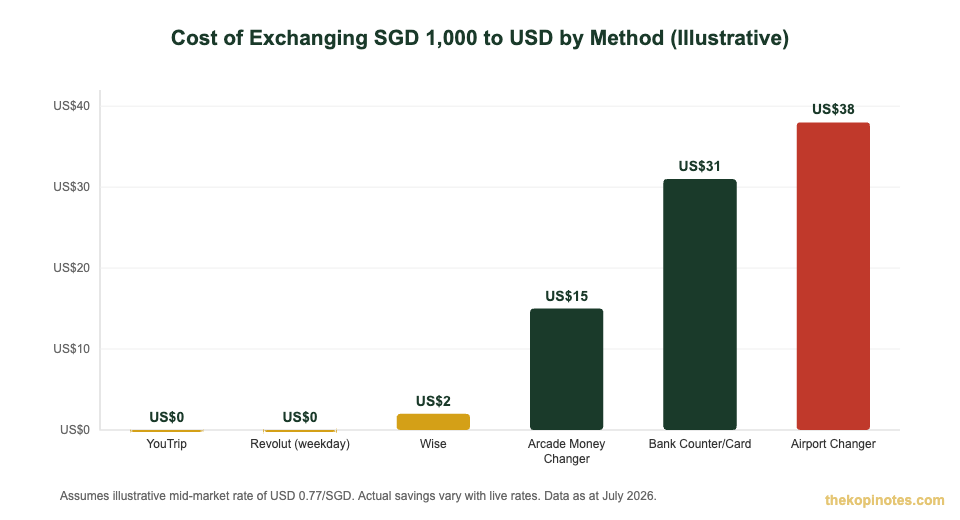
Here’s what SGD 1,000 actually turns into under each method, using an illustrative mid-market rate of USD 0.77 per SGD. Your real numbers will shift slightly with the live rate on the day, but the relative gap between methods holds fairly steady.
| Method | Approx. Markup | You Receive (USD) | Cost vs Mid-Market |
|---|---|---|---|
| YouTrip | 0% | USD 770 | USD 0 |
| Revolut (weekday, within limit) | 0% | USD 770 | USD 0 |
| Wise | from 0.23% | ≈ USD 768 | ≈ USD 2 |
| The Arcade (money changer) | ≈ 1–3% | ≈ USD 755 | ≈ USD 15 |
| Bank counter or card | ≈ 3–5% | ≈ USD 739 | ≈ USD 31 |
| Airport money changer | ≈ 2–5%+ | ≈ USD 732 | ≈ USD 38 |
Source: Wise.com/sg/pricing, Revolut.com/en-SG/our-pricing-plans (Jul 2026), You.co money changer guide (Feb 2026). Illustrative worked example — actual rates fluctuate daily and vary by currency and counter.
The gap between YouTrip or Revolut and a bank counter works out to roughly USD 30, or about SGD 40, on a single SGD 1,000 exchange. That’s before you factor in a bank’s separate overseas ATM withdrawal fees, which typically run 3 to 5% plus a flat charge per transaction on top of the FX markup.
Why You Should Avoid Airport Money Changers
Money changers at Changi Airport operate under the same MAS licensing rules as everyone else, so they’re not scams. But they’re consistently the worst value in Singapore. With a captive audience and limited competition airside, rates typically run 2 to 5% worse than what you’d get at The Arcade or Mustafa Centre — sometimes more, depending on the currency.
The practical fix is simple. Exchange a small amount at Changi if you land somewhere without an ATM nearby, or need cash the moment you touch down. Do the bulk of your exchange in town beforehand, or better yet, spend and withdraw through a zero-FX card once you land.
How to Get the Best Rate Every Time
A few habits make a real difference to how much you keep, no matter which method you use.
Compare before you commit. Rates move throughout the day and vary between shops. A quick check on CashChanger.co, or a walk past two or three counters at The Arcade, takes minutes and can save you 1 to 2%.
Avoid the lunch-hour crowd. Weekday mornings and mid-afternoons tend to be quieter at The Arcade, with less pressure to rush your decision. Peak lunch hours (12pm to 2pm) draw longer queues.
Say no to Dynamic Currency Conversion. When an overseas card terminal asks “pay in Singapore dollars?”, decline. That’s DCC, and it typically bakes in a 5 to 8% markup versus letting your card issuer convert at its own rate.
Don’t over-exchange. Leftover foreign cash gets converted back at the “buy” rate, which is usually 2 to 3% worse than what you paid. If you’re using a card like YouTrip alongside cash, you can top up smaller amounts as needed instead of guessing upfront.
Who Should Use What?
Use a physical money changer if: you need cash in hand before you land, you’re heading somewhere with limited ATM access or low card acceptance, or you’re exchanging a currency that’s hard to load onto a digital card.
Use YouTrip, Wise, or Revolut if: most of your spending will be by card or ATM withdrawal overseas, you want to track multiple currencies in one app, or you simply want the closest thing to the real market rate without haggling at a counter.
Most Singapore travellers do best with both — a zero-FX card for the bulk of spending and ATM cash, plus a small buffer of physical currency from a licensed changer like The Arcade for situations where cards won’t cut it.
Frequently Asked Questions
Which is the best money changer in Singapore?
The Arcade at Raffles Place generally offers Singapore’s sharpest cash rates, since more than 20 licensed changers compete under one roof. Rates still vary 1 to 2% between individual shops, so compare a few counters, or check CashChanger.co, before committing.
Is it cheaper to use YouTrip or Wise than a money changer?
For most major currencies, yes. YouTrip converts at zero markup on card spend, and Wise charges from just 0.23%, while even the best physical money changer typically adds 1 to 3%. Money changers still make sense when you need physical cash in hand before you fly.
How do I know if a money changer is MAS-licensed?
Every licensed money changer must display a valid Money-Changing Licence issued under the Payment Services Act. You can verify any firm against the MAS Financial Institutions Directory before handing over cash — don’t rely on the shop’s signage alone.
Are airport money changers a rip-off?
They’re licensed and legitimate, but consistently the worst value in Singapore. Rates at Changi typically run 2 to 5% worse than money changers in town. Exchange only a small emergency amount at the airport and do the rest at The Arcade or through a zero-FX card.
Should I bring cash or use a card overseas?
A mix works best for most travellers. Use a zero-FX card like YouTrip, Wise, or Revolut for the bulk of your spending and ATM withdrawals, and carry a small amount of cash from a licensed money changer for markets, tips, or places where cards aren’t widely accepted.
What's the minimum amount I should exchange at a money changer?
There’s no official minimum. Some changers offer marginally better rates, around 0.2 to 0.5% better, above SGD 500 to 1,000. Below that threshold, the difference versus a zero-FX card is usually small enough that convenience should decide.
Ready to Cut Your FX Costs?
Compare a licensed money changer against a zero-FX card before your next trip — the difference on SGD 1,000 can be worth a nice dinner out.
This article was researched with the help of AI. While we strive to keep all information accurate and up to date, there may be errors. If you notice any discrepancies, please contact us.