BHS 2026 Increase: Does It Raise Your Shield Plan MediSave?
CPF’s Basic Healthcare Sum jumped to $79,000 in 2026. Here’s what that cap actually controls, and why it won’t change how much MediSave you can put toward your Integrated Shield Plan premium.
No, the higher Basic Healthcare Sum (BHS) does not raise how much MediSave you can use for your Integrated Shield Plan premium. From 1 January 2026, the BHS rose from $75,500 to $79,000, giving you more room to hold MediSave savings. But the amount you can actually spend on your Shield Plan’s private insurance component each year is set by a separate rule, the Additional Withdrawal Limit (AWL), which stays at $300 to $900 a year depending on your age and has not moved since 2015.
Not financial advice. All figures are for educational reference only. Data verified as at 24 July 2026 against official CPF Board sources unless otherwise noted.
- The BHS is a storage cap for your MediSave account. It rose to $79,000 in 2026, up from $75,500.
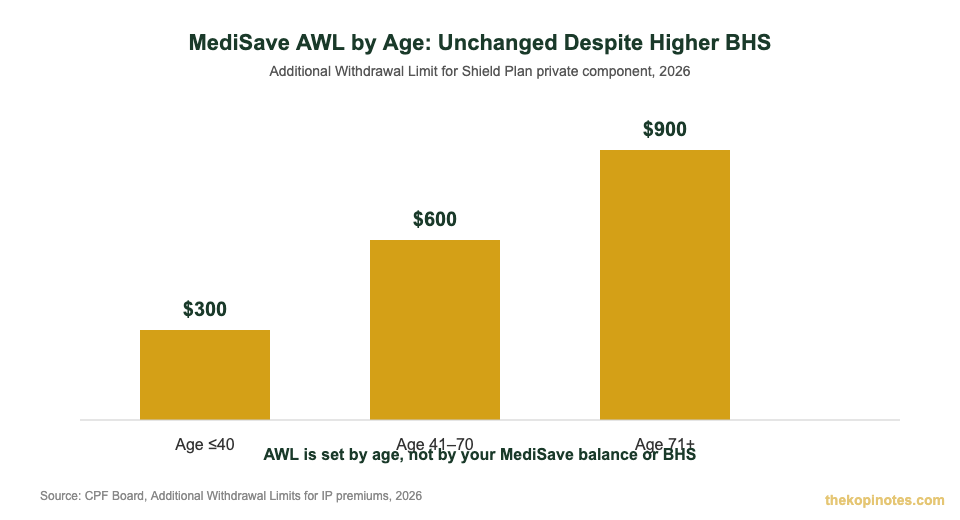
- The AWL is a spending cap for your Shield Plan premium. It’s a completely different rule, and it did not change: still $300 (age 40 and below), $600 (41 to 70), or $900 (71 and above) per year.
- A bigger BHS means a bigger buffer for future hospital bills. It does not mean MediSave will suddenly cover more of your premium this year.
Table of Contents
Contents — Click to expand
- What Is the Basic Healthcare Sum (BHS)?
- What Changed: BHS Raised to $79,000 in 2026
- Why a Higher BHS Doesn’t Mean More MediSave for Your Premium
- What the BHS Actually Controls
- Worked Example: Bigger Buffer, Same Premium Cap
- Who Actually Benefits from the Higher BHS
- What This Means for Your Retirement Healthcare Planning
- Frequently Asked Questions
What Is the Basic Healthcare Sum (BHS)?
Your MediSave Account isn’t a bottomless pool. CPF Board caps how much you can hold in it. That cap is called the Basic Healthcare Sum, or BHS.
Think of the BHS as a savings target, not a spending rule. It’s meant to represent roughly what you’ll need for basic subsidised healthcare costs in old age. If your MediSave contributions would push your balance above the BHS, the extra amount doesn’t disappear. It automatically flows into your CPF Special Account (or Retirement Account, if you’re 55 and above) instead.
The BHS is adjusted every year for members below 65, to keep pace with rising healthcare costs. Once you turn 65, your BHS is fixed for life at whatever the prevailing figure is that year. That’s called your “cohort BHS”, and it never rises again after that, even if the national BHS keeps climbing for younger cohorts.
For a broader look at how MediSave fits into your CPF accounts, see our guide to how much MediSave you can use per year.
What Changed: BHS Raised to $79,000 in 2026
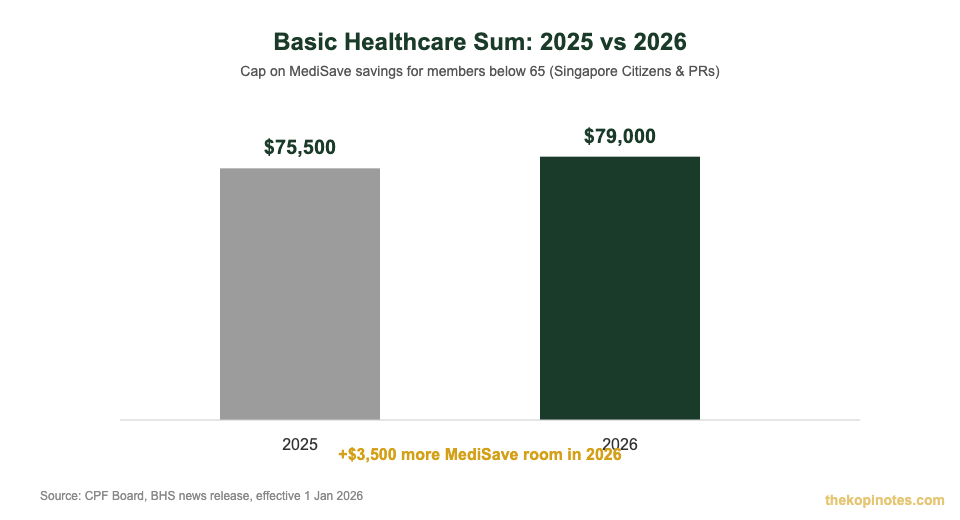
From 1 January 2026, CPF Board raised the BHS for members below 65 from $75,500 to $79,000, an increase of $3,500. If you turn 65 in 2026, your BHS is fixed at $79,000 from this year onward, and it won’t rise further for you personally. If you’re already 66 or older, this change doesn’t affect you at all. Your cohort BHS was fixed in an earlier year and stays exactly where it is.
| Cohort | 2025 BHS | 2026 BHS |
|---|---|---|
| Members below 65 in 2026 | $75,500 | $79,000 |
| Members turning 65 in 2026 | N.A. | $79,000 (fixed for life) |
Source: CPF Board, CPF interest rates and Basic Healthcare Sum for 2026, published January 2026.
Why a Higher BHS Doesn’t Mean More MediSave for Your Premium
Here’s the mix-up. When people hear “MediSave cap raised”, they assume it means MediSave can now pay for more of their Shield Plan premium. It’s an understandable guess. It’s also wrong, because two completely separate CPF rules are at play, and they answer two different questions.
The BHS answers: how much can I hold in my MediSave account? It’s a storage limit. Raise it, and you simply have more room to accumulate savings before the overflow spills into your Special or Retirement Account.
The Additional Withdrawal Limit (AWL) answers a different question: how much of my Shield Plan premium can I pay for using MediSave this year? It’s a spending limit, and it’s banded by age, not by your account balance.
Your MediShield Life premium is fully MediSave-payable regardless of your BHS or your balance. But the private insurance component of your Integrated Shield Plan is capped at your AWL, full stop. Whether you have $10,000 or $79,000 sitting in your MediSave account, the AWL doesn’t budge. For the full mechanics of the AWL and how it interacts with rider premiums, see our complete guide to using MediSave for your Integrated Shield Plan premium.
What the BHS Actually Controls
The BHS shows up in a few places that matter, none of which touch your annual premium spending power:
Contribution overflow. If your MediSave contributions this year would push your balance above the BHS, the excess is automatically redirected into your Special Account (below 55) or Retirement Account (55 and above). A higher BHS means less of your contribution gets diverted away, so more stays in MediSave specifically.
Hospitalisation withdrawal capacity. A bigger MediSave balance, made possible by the higher BHS, gives you a larger buffer against future hospital bills, especially the portions not covered by insurance, like deductibles and co-payments.
Voluntary top-ups. You can top up your own or a family member’s MediSave up to the BHS. A higher BHS means more room to top up, which is useful if you’re helping a retiree parent build a cushion. For a full walkthrough on this, read our guide on how much MediSave you can use and top up each year.
None of these three levers change your AWL. That’s the part worth remembering: BHS is about how much you can save, AWL is about how much you can spend on premiums. Raising one doesn’t touch the other.
Worked Example: Bigger Buffer, Same Premium Cap
Numbers make the distinction concrete. Say you’re 50 years old, and at the end of December 2025 your MediSave balance sat right at the old cap of $75,500. Any further contributions that month would have overflowed into your Special Account.
From 1 January 2026, your personal BHS rises to $79,000. That extra $3,500 of headroom means your upcoming CPF contributions can now stay in MediSave instead of spilling over, assuming you haven’t already hit the new cap. Over a year or two of regular contributions, that’s a meaningfully bigger balance sitting in your MediSave account.
Now look at your Shield Plan. You’re in the 41 to 70 AWL band, so MediSave can still only cover up to $600 a year toward the private insurance component of your premium; that limit was true on 31 December 2025, and it’s still true on 1 January 2026. If your plan’s private component costs $1,800 a year, you still pay $1,200 in cash, exactly as you did the day before the BHS increase took effect.
| What Changed on 1 Jan 2026 | Before (2025) | After (2026) |
|---|---|---|
| MediSave storage cap (BHS) | $75,500 | $79,000 |
| Shield Plan AWL, age 41–70 | $600/year | $600/year (no change) |
| Cash you pay on a $1,800/year private component | $1,200 | $1,200 (no change) |
Source: CPF Board, BHS 2026 news release and Additional Withdrawal Limits FAQ. Illustrative example; actual premiums vary by insurer, plan tier, and individual factors.
The higher BHS is genuinely good news, just not for the reason people sometimes assume. It builds a bigger reserve for the years when your premiums, deductibles, and hospital co-payments will be at their highest. It just doesn’t shrink the cash portion of this year’s premium bill.
Who Actually Benefits from the Higher BHS
The BHS increase helps some CPF members more than others. It’s worth knowing where you sit.
Members below 65 with rising MediSave balances. If your contributions have been pushing up against the old $75,500 ceiling, you’ll now retain more in MediSave itself rather than seeing it automatically shifted to your Special or Retirement Account. This group benefits most directly.
Members turning 65 in 2026. Your BHS locks in at the new, higher $79,000 figure for the rest of your life. That’s a better lifetime cohort BHS than someone who turned 65 in, say, 2023 or 2024, when the figure was lower.
Members who are 66 and older. This group sees no change at all. Your cohort BHS was fixed in a previous year and doesn’t move regardless of what happens to the national BHS afterward.
Members whose MediSave balance is well below the old cap. If you’re nowhere near $75,500 in the first place, the BHS increase is largely academic for you right now. It only starts to matter once your balance approaches the ceiling.
What This Means for Your Retirement Healthcare Planning
The real lesson from the 2026 BHS increase isn’t about this year’s premium bill. It’s about the gap between what MediSave will cover and what you’ll pay in cash as you age, a gap that a bigger BHS helps you prepare for, but doesn’t close.
Your Shield Plan premiums climb steeply with age, while your AWL stays flat at $300, $600, or $900 depending on your band. That means the cash portion of your premium, paid via GIRO at renewal, grows every few years as you move into a higher age band, even though your MediSave withdrawal cap for that purpose does not. A higher BHS gives you a larger cushion to draw on for the hospitalisation bills themselves, but it won’t reduce your annual premium cash outlay.
Practically, this means two things are worth doing well before retirement. First, treat your Shield Plan’s cash premium portion as a recurring expense in your retirement budget, not a MediSave line item. Second, use the extra BHS headroom deliberately, through regular contributions or voluntary top-ups, so your MediSave balance is genuinely working toward future hospitalisation costs rather than sitting idle below the new cap. If you want to map this against your broader retirement numbers, our Singapore retirement calculator can help you factor in healthcare cash flow alongside your other expenses.
Disclaimer: This article is for educational purposes only and does not constitute financial, insurance, or medical advice. BHS and AWL figures are sourced from CPF Board as at July 2026 and are subject to change. Always verify current limits on cpf.gov.sg or with a licensed financial adviser before making decisions about your MediSave or Integrated Shield Plan.
Frequently Asked Questions
Does the 2026 Basic Healthcare Sum increase mean I can use more MediSave for my Shield Plan premium?
No. The Basic Healthcare Sum (BHS) only controls how much you can hold in your MediSave account, not how much you can spend on your Integrated Shield Plan premium. The amount you can use for your premium’s private insurance component is set by the Additional Withdrawal Limit (AWL), which is unchanged at $300 to $900 a year depending on your age.
What is the Basic Healthcare Sum for 2026?
The BHS for CPF members below 65 rose to $79,000 from 1 January 2026, up from $75,500 in 2025. Members who turn 65 in 2026 have their BHS fixed at $79,000 for life. Members already 66 or older are unaffected, since their cohort BHS was fixed in an earlier year.
What happens if my MediSave contributions exceed the BHS?
Contributions above your BHS are automatically transferred to your CPF Special Account if you’re below 55, or your Retirement Account if you’re 55 or older. Your MediSave balance is effectively capped at the prevailing BHS at all times.
What is the MediSave Additional Withdrawal Limit (AWL) in 2026?
The AWL is $300 per year for those aged 40 and below (age next birthday), $600 per year for ages 41 to 70, and $900 per year for age 71 and above. These bands apply to the private insurance component of your Integrated Shield Plan premium and have been unchanged since MediShield Life launched in 2015.
Is my MediShield Life premium affected by the BHS or the AWL?
No. Your MediShield Life premium is fully payable using MediSave regardless of your BHS or AWL. The AWL only applies to the additional private insurance coverage component sold by private insurers like AIA, Great Eastern, Prudential, NTUC Income, or Singlife.
Should I top up my MediSave now that the BHS is higher?
It can be worthwhile if you have spare cash and want a bigger buffer for future hospitalisation costs, and voluntary MediSave top-ups also qualify for income tax relief. Just be aware that topping up will not increase how much MediSave you can use toward your Shield Plan premium this year, since that’s governed by the separate AWL.
Know Your MediSave Limits Before Renewal
Understand the difference between what you can save and what you can spend, then plan your Shield Plan cash outlay with confidence.
Get Free Insurance Advice
Speak with a licensed insurance advisor. No obligation, no cost.
By submitting this form, you agree to our Privacy Policy.
This article was researched with the help of AI. While we strive to keep all information accurate and up to date, there may be errors. If you notice any discrepancies, please contact us.