CDL Hospitality Trusts Share Price 2026 (SGX: J85): DPU, 6.2% Yield & the 8-Country Hotel Portfolio Explained
The only S-REIT with hotels on four continents — here’s what its 1Q2026 results, gearing de-leveraging and DPU history mean for you.
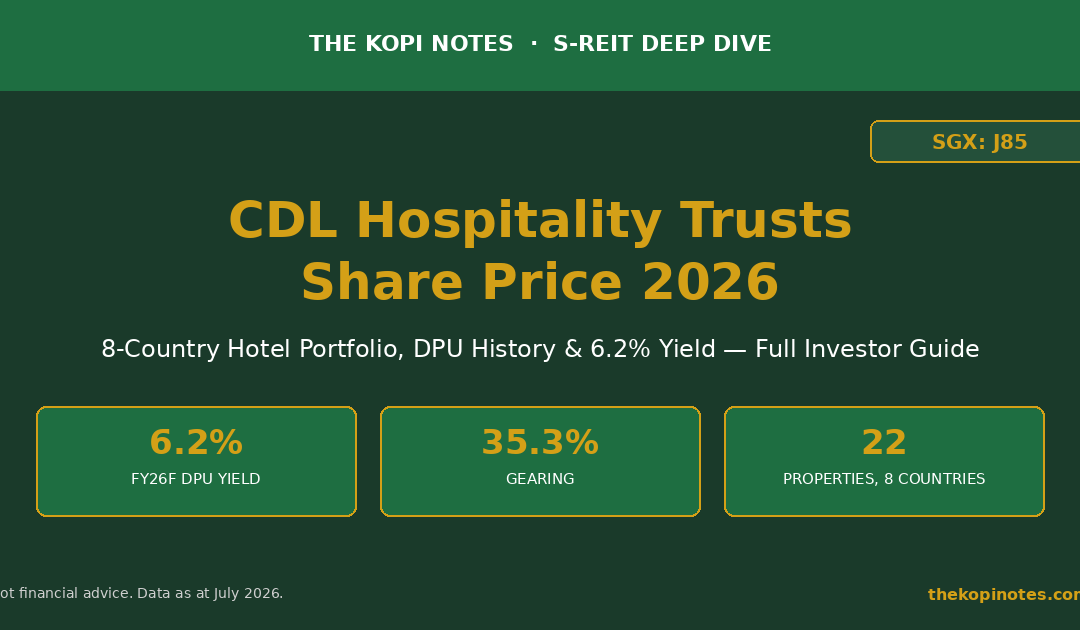
CDL Hospitality Trusts (SGX: J85) is a Singapore-listed stapled trust owning 22 hospitality and living assets across 8 countries — Singapore, Australia, New Zealand, Japan, the Maldives, the UK, Germany and Italy. Trading near S$0.78 with a forward FY26F DPU yield of about 6.2% and gearing down to 35.3%, it’s a diversified but geopolitically exposed way to play the global travel recovery.
Not financial advice. All figures are for educational reference only. Data as at July 2026 unless noted.
- CDLHT’s gearing has fallen from 42.4% to 35.3% in just two quarters — real de-leveraging, not just a paper metric, thanks to S$250 million of perpetual securities used to retire pricier debt.
- FY2025 DPU fell 9.8% to 4.8 cents, but the trust trades at roughly 0.55x book value (NAV S$1.41) — a steep discount most analysts think is overdone.
- 1H2026 results land Tuesday, 28 July — five days from today. Singapore RevPAR, gearing, and the Moxy Clarke Quay timeline are the numbers to watch.
Table of Contents
Contents — Click to expand
- What Is CDL Hospitality Trusts?
- Share Price & Key Stats (July 2026)
- 1Q2026 Financial Performance
- Portfolio: 22 Properties Across 8 Countries
- Country-by-Country Performance
- Balance Sheet & De-Leveraging
- DPU History & Dividend Yield
- Growth Catalysts to Watch
- Risks You Should Know
- Is CDL Hospitality Trusts a Buy in 2026?
- FAQ
What Is CDL Hospitality Trusts?
CDL Hospitality Trusts (CDLHT) is a stapled security. That means when you buy one unit on SGX, you’re actually buying two things stapled together: a unit in CDL Hospitality Real Estate Investment Trust and a share in CDL Hospitality Business Trust. You can’t trade them separately.
The trust was sponsored by City Developments Limited (CDL), one of Singapore’s largest property developers, and listed on SGX in 2006. It was Singapore’s first hotel REIT — and today it’s still the most geographically diversified one, with assets spread across Singapore, Australia, New Zealand, Japan, the Maldives, the UK, Germany and Italy.
Unlike a typical office or retail REIT, CDLHT’s income comes mostly from hotel operations, not fixed rental leases. Its Singapore and overseas hotels are run under master lease and management contract structures, so its net property income (NPI) — you can think of this as the REIT’s take-home operating profit before financing costs — moves with occupancy and room rates (known as RevPAR, or Revenue Per Available Room), not a flat rental escalation clause. That makes CDLHT more cyclical than a REIT like Frasers Centrepoint Trust, but it also means DPU can grow faster when travel demand recovers.
Share Price & Key Stats (July 2026)
Here’s where CDLHT stood as at early July 2026, based on the most recent quarterly disclosures and broker coverage:
| Metric | Value |
|---|---|
| Ticker | SGX: J85 |
| Share price (approx.) | ~S$0.78 |
| Market capitalisation | ~S$993 million |
| Book value (NAV) per unit | ~S$1.41 |
| Price-to-NAV (P/NAV) | ~0.55x (45% discount to book) |
| FY26F DPU yield | ~6.2% |
| Gearing ratio | 35.3% (31 Mar 2026) |
| Analyst consensus (avg. of 11) | Hold, avg. target ~S$0.87 (+12% upside) |
| Next results date | Tuesday, 28 July 2026 (1H2026) |
Source: StockAnalysis.com (data as at 2 June 2026), CGS International Securities report (4 May 2026). Share price and yield move daily — check a live quote before trading.
That discount is the central tension in the CDLHT story. If you trust the S$1.41 book value, the market is pricing in a lot of pessimism. However, hotel valuations can swing hard with travel demand and interest rates, so a persistent discount isn’t automatically a “buy signal” — it’s a reflection of real earnings volatility across CDLHT’s eight markets.
1Q2026 Financial Performance
CDLHT’s 1Q2026 business update (released 30 April 2026) showed broad-based improvement. Gross revenue rose 5.9% year-on-year to S$67.1 million, while NPI grew even faster — up 10.4% to S$33.1 million. That gap between revenue growth and NPI growth is a good sign: it usually means costs are being managed well, not just that more rooms got sold.
The improvement was driven mainly by Singapore, where the Singapore Airshow 2026 and strong MICE (Meetings, Incentives, Conferences and Exhibitions) demand pushed occupancy to 80.4%, up from 75.0% a year earlier. RevPAR — the single best measure of a hotel’s earning power, since it combines both occupancy and room rate — rose 6.6% to S$184.
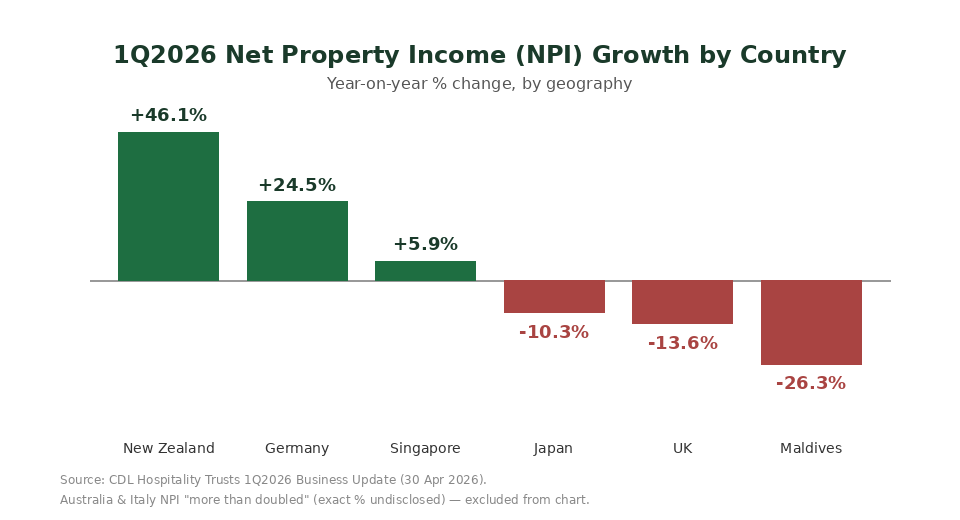
New Zealand was the standout overseas market. Grand Millennium Auckland’s RevPAR jumped 16.3% and its NPI surged 46.1%, helped by the opening of the New Zealand International Convention Centre (NZICC) next door and the completion of post-renovation upgrades.
Portfolio: 22 Properties Across 8 Countries
This is what genuinely sets CDLHT apart from every other S-REIT. Where Far East Hospitality Trust is a pure Singapore play, CDLHT spreads its 22 properties — 4,924 hotel rooms, plus 352 Build-to-Rent (BTR) apartments and 404 Purpose-Built Student Accommodation (PBSA) beds — across eight countries:
| Country | Key Assets |
|---|---|
| Singapore | 6 hotels + Claymore Connect retail mall |
| United Kingdom | Hotel Indigo Exeter, Hilton Cambridge City Centre, The Lowry Hotel, voco Manchester; The Castings (BTR), Benson Yard (PBSA) |
| New Zealand | Grand Millennium Auckland |
| Australia | Mercure Perth, Ibis Perth |
| Japan | Hotel MyStays Asakusabashi, Hotel MyStays Kamata |
| Maldives | Angsana Velavaru, The Halcyon Private Isles Maldives |
| Germany | Pullman Hotel Munich |
| Italy | Hotel Cerretani Firenze – MGallery |
Source: CDL Hospitality Trusts Investor Relations, 1Q2026 Business Update, 30 April 2026.
This spread cuts both ways. If Japan tourism slows, Germany or New Zealand can pick up the slack — you’re not betting the whole portfolio on one country’s travel cycle. But it also means you’re exposed to eight different currencies, eight different regulatory regimes, and geopolitical events (like the Middle East conflict affecting Maldives flight routes) that a Singapore-only landlord never has to think about.
Country-by-Country Performance (1Q2026)
Here’s the so-what: not every market is pulling its weight. In 1Q2026, three markets grew NPI double digits — New Zealand (+46.1%), Germany (+24.5%), and Australia (more than doubled to S$1.6 million, off a small base). Meanwhile, three markets went backwards: the UK (-13.6%), Japan (-10.3%), and the Maldives (-26.3%).
The UK decline needs context — combined RevPAR across CDLHT’s four UK hotels actually rose 5.4%, but NPI still fell because of higher payroll costs and business rates (some of which were one-off adjustments). The UK’s living assets (the BTR and PBSA properties) partly offset this, contributing a S$1.1 million NPI uplift.
Japan’s weakness stems from softer inbound Chinese tourist flow amid Japan-China tensions, while the Maldives faces flight suspensions tied to the Middle East conflict and higher fixed operating costs it can’t easily pass through. These are genuine, ongoing risks — not one-quarter blips — and worth watching each quarter.
Balance Sheet & De-Leveraging
If there’s one number that’s genuinely improved at CDLHT over the past two quarters, it’s gearing — how much of the trust’s assets are funded by debt versus unitholder equity. Singapore’s MAS caps S-REIT gearing at 50%. CDLHT was uncomfortably close to that ceiling at 42.4% as at 30 September 2025. By 31 March 2026, it had fallen to 35.3%.
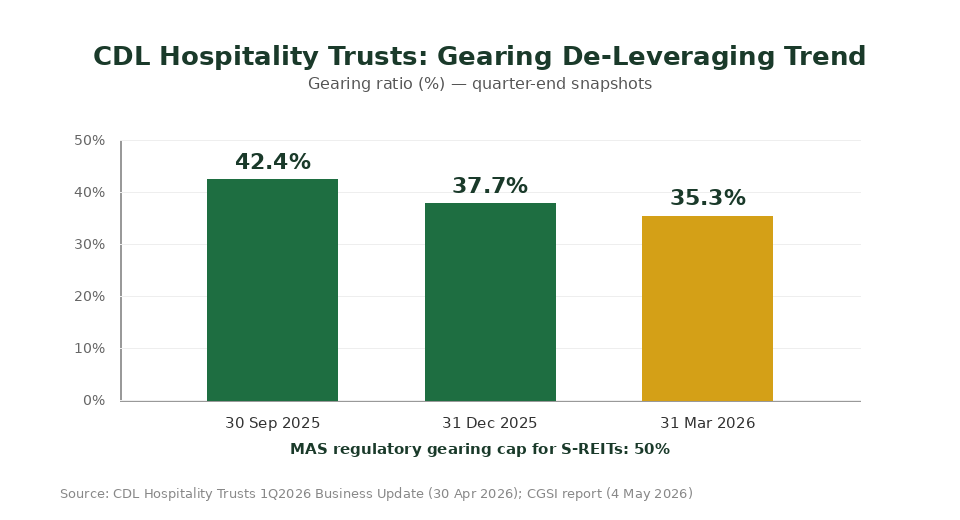
This wasn’t luck — it was a deliberate capital-raising move. CDLHT issued S$250 million of perpetual securities in two tranches: S$150 million at 3.7% p.a. in November 2025, and a further S$100 million at 4.0% p.a. in February 2026. Perpetual securities sit between debt and equity — they pay a fixed distribution but don’t count as “debt” for gearing purposes, and CDLHT used the proceeds to retire higher-cost borrowings.
The payoff shows up in two places: the weighted average cost of debt fell from 3.0% to 2.8%, and management estimates annualised net interest savings of S$4.6 million, which translates to roughly 3.1% DPU accretion on a pro forma FY2025 basis. Interest coverage ratio (ICR) — how many times over the trust’s earnings can cover its interest payments — improved to 2.4x. As at 31 March 2026, CDLHT held S$78.5 million in cash, S$155.8 million of undrawn revolving credit facilities, and total debt of S$1,170 million.
DPU History & Dividend Yield
Full-year FY2025 distribution per stapled security (DPS) came in at 4.8 cents, down 9.8% from FY2024. That’s the headline number that scares off yield-focused investors — and it’s worth being honest about why it happened: higher financing costs, renovation-related NPI disruption (a combined S$5.9 million shortfall from W Singapore – Sentosa Cove and Grand Millennium Auckland being closed for upgrades), and uneven recovery across CDLHT’s overseas markets.
But the trend has turned. 2H2025 DPU rose 0.4% year-on-year to 2.82 cents, supported by 2H2025 NPI growth of 3.5% to S$71.1 million — with Australia alone contributing NPI growth of 93.9% following the relaunch of the renovated Ibis Perth. That’s your first evidence that the worst of the renovation drag is behind the trust, not still ahead of it.
At a share price of roughly S$0.78, that FY2025 DPU implies a trailing yield of about 6.2%. Consensus FY26F DPU is expected to hold in a similar range, which is where the ~6.2% forward yield figure quoted by CGS International Securities comes from. If you’re a Singapore investor holding S$20,000 in CDLHT units at this yield, that’s roughly S$1,240 a year in distributions, paid semi-annually — before accounting for any DPU growth or decline in the year ahead.
Growth Catalysts to Watch
Three developments could move CDLHT’s earnings and share price over the next 12–24 months:
Moxy Singapore Clarke Quay. CDLHT has a forward purchase agreement for this 475-key lifestyle hotel, expected to complete in 1H2027. Once added, it will lift CDLHT’s Singapore room count by 18.6% — a meaningful organic growth lever without needing an equity fundraising.
Continued de-leveraging. If gearing keeps trending toward 30%, CDLHT gains more headroom for further acquisitions or unit buybacks (shareholder yield is already running at roughly 5.1%, factoring in both distributions and buyback activity), and lower gearing typically supports a re-rating toward book value over time.
Singapore tourism tailwinds. The Singapore Tourism Board expects 17.0–18.0 million visitor arrivals in 2026, above 2025’s 16.9 million, with major events like the Singapore Airshow and large-scale concerts continuing to support hotel demand through the year.
Risks You Should Know
CDLHT isn’t a “set and forget” income holding. Four risks deserve your attention before you buy:
Geopolitical exposure. The Maldives resorts are directly affected by Middle East flight route disruptions, and Japan hotels face softer Chinese tourist flow amid regional tensions — these aren’t things Singapore-only REITs have to manage.
Earnings volatility. Because hotel income tracks RevPAR rather than fixed rental escalations, CDLHT’s NPI can swing much harder within a single year than a retail or industrial REIT’s would — you saw this first-hand in the 1Q2026 country breakdown above.
UK regulatory change. The UK’s Renters’ Rights Act 2025 affects lease duration visibility for CDLHT’s Build-to-Rent assets, which management says it’s “proactively managing” — but it’s a genuine unknown, not a settled matter.
DPU still below prior-year levels. FY2025’s DPU decline means CDLHT hasn’t yet proven it can sustainably grow distributions — 2H2025’s modest 0.4% uptick is encouraging, but it’s one data point, not a trend.
Is CDL Hospitality Trusts a Buy in 2026?
| Case | Reasoning |
|---|---|
| Bull case | 0.55x P/NAV discount, gearing falling fast, 6.2% forward yield, Moxy Clarke Quay adds 18.6% to SG rooms in 2027, Singapore tourism at 94.5% of 2019 levels and rising |
| Bear case | FY2025 DPU still down 9.8% YoY, three of eight countries in NPI decline, geopolitical risk in Maldives/Japan, analyst consensus rated “Hold” |
CGS International Securities maintains an “Add” (Buy) rating with a S$0.90 target, implying 11.1% upside from S$0.81. The broader 11-analyst consensus tracked by StockAnalysis.com is more cautious — an average “Hold” rating with a S$0.87 target (+12.3%). Both agree the stock has upside from current levels; they disagree on conviction.
If you’re considering CDLHT, the honest framing is this: you’re not buying a stable, bond-like income stream the way you might with an industrial or retail S-REIT. You’re buying a diversified but genuinely cyclical hospitality operator at a discount to book value, with a management team that has spent the last two quarters visibly fixing the balance sheet. Whether that’s a “buy” depends on your own risk tolerance for RevPAR-driven income and geopolitical variability — this isn’t investment advice, and you should size any position accordingly.
Frequently Asked Questions
What is CDL Hospitality Trusts and what does SGX: J85 mean?
Is CDL Hospitality Trusts a REIT or a stapled trust?
What is CDL Hospitality Trusts' current dividend yield?
Why has CDL Hospitality Trusts' DPU fallen over the past year?
Is CDL Hospitality Trusts undervalued?
Who is the sponsor of CDL Hospitality Trusts?
What countries does CDL Hospitality Trusts operate in?
When does CDL Hospitality Trusts release its 1H2026 results?
Is CDL Hospitality Trusts a buy in 2026?
How is CDL Hospitality Trusts different from Far East Hospitality Trust?
Further Reading
For more S-REIT coverage, see our guides to the best S-REITs in Singapore 2026, the highest yield REITs in Singapore, and blue chip REITs Singapore 2026. If you want the pure-Singapore hospitality comparison, read our Far East Hospitality Trust guide. New to REIT metrics? Start with what DPU means for Singapore REITs.
Planning your broader retirement income mix around dividend-paying assets like S-REITs? Try our free Singapore retirement calculator to see how REIT income fits your numbers.
Want to Start Building a REIT Portfolio?
If you’re looking to buy S-REITs like CDLHT directly on SGX, a low-cost broker matters. Syfe Trade and FSMOne are two low-cost ways Singapore investors access SGX-listed REITs directly.
This article was researched with the help of AI. While we strive to keep all information accurate and up to date, there may be errors. If you notice any discrepancies, please contact us.