How to Invest in Singapore: CPF, SRS or Cash First? The Right Order (2026)
A practical order-of-operations guide to investing your CPF Ordinary Account, SRS and cash savings — with 2026 rates, fees and a worked example.
Most Singaporeans should fund SRS for the tax relief first, then invest CPF Ordinary Account savings above $20,000 for the 2.5% opportunity cost, then top up cash investments — after securing a cash emergency fund. The right order depends on your tax bracket, age and liquidity needs, not a single formula.
Not financial advice. All figures are for educational reference only. Data verified as at 23 July 2026 against CPF Board, IRAS and platform sources unless otherwise noted.
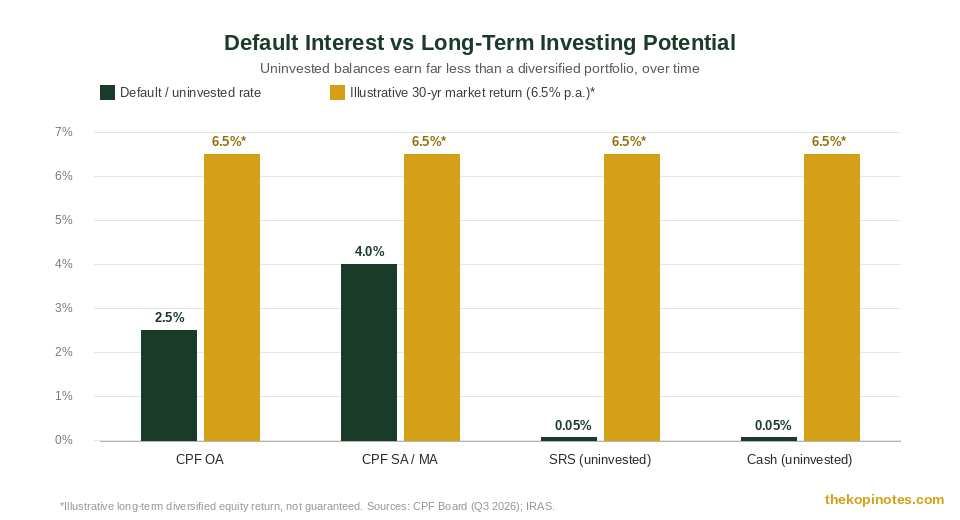
- CPF OA earns a fixed 2.5% floor and CPF SA/MA earn 4%. SRS cash and idle brokerage cash earn close to 0%, so uninvested SRS and cash usually cost you the most in lost growth.
- If you pay income tax, fund SRS first — the tax relief is immediate and guaranteed, unlike investment returns.
- Keep 3–6 months of expenses in cash, then work through SRS, CPF OA above $20,000, and finally a taxable cash brokerage or robo-advisor account.
Table of Contents
Contents — Click to expand
- Why the Order You Invest In Actually Matters
- The Default Order Most Singaporeans Should Follow
- Investing Your CPF Ordinary Account
- Why SRS Usually Comes First
- Endowus vs Syfe vs FSMOne for CPF and SRS
- Cash Investing: Why It’s Usually Last
- Adjusting the Order by Life Stage
- Common Sequencing Mistakes to Avoid
- Worked Example: $2,000 a Month, Three Ways
- Frequently Asked Questions
Why the Order You Invest In Actually Matters
Every dollar sitting uninvested has a cost. It’s not a fee you see — it’s the return you didn’t earn. Economists call this an opportunity cost, and in Singapore it varies wildly depending on which account the dollar is sitting in.
Your CPF Ordinary Account (OA) earns a guaranteed 2.5% a year. Your CPF Special and MediSave Accounts (SA/MA) earn 4%. But cash sitting in your SRS account, or in a bank account waiting to be invested, typically earns close to 0.05% — next to nothing. That gap is why sequencing matters: the accounts with the lowest default return usually deserve your attention first, provided the trade-offs (tax relief, lock-in, liquidity) work in your favour.
The Default Order Most Singaporeans Should Follow
There’s no single formula that fits everyone. But for a typical working adult with a stable income, this order works well as a starting point:
- Emergency fund first. Hold 3–6 months of expenses in cash before investing anything. This isn’t about returns — it’s about not being forced to sell investments at a bad time.
- SRS, if you pay income tax. Every dollar you put into your Supplementary Retirement Scheme (SRS) account reduces your chargeable income by the same amount, up to the annual cap.
- CPF OA above $20,000. Once your OA balance clears the $20,000 you must keep aside, the amount above that is earning “only” 2.5% by default — a candidate for CPFIS investing if you have a long horizon.
- Cash brokerage or robo-advisor. Whatever is left goes into a diversified cash portfolio, where you keep full flexibility and no lock-in.
However, this order should flex. A fresh graduate paying little to no tax gets almost nothing from SRS relief this year, so cash investing (even a simple regular savings plan) may come before SRS. Someone in their late 50s, closer to CPF payouts, should weigh CPF investment strategy moves like Special Account shielding differently from someone in their 20s. Read the sections below before locking in an order for yourself.
Investing Your CPF Ordinary Account (CPFIS-OA)
The CPF Investment Scheme (CPFIS) lets you invest part of your OA and Special Account savings in unit trusts, ETFs, bonds, stocks and more, instead of leaving everything at the default interest rate. Two rules matter most for OA:
- The $20,000 set-aside. You must keep the first $20,000 of your OA balance untouched. Only the amount above that is available for CPFIS-OA investing.
- The 35% stock limit. Shares, REITs and non-gold ETFs combined can’t exceed 35% of your investible OA savings (your OA balance plus what you’ve already withdrawn for investment and education). Gold investments, including gold ETFs, are separately capped at 10%.
If you go over the limit, CPF Board won’t force a sale — you simply can’t make further stock purchases until your ratio comes back under 35%. This is a real constraint for OA investors: it pushes many toward unit trusts and bonds instead of an all-equity portfolio. Full rules are set out on the CPF Board’s CPFIS options page.
| CPF Account | Base Interest (2026) | Extra Interest |
|---|---|---|
| Ordinary Account (OA) | 2.5% p.a. (legislated floor) | Extra 1% on first $20,000 of OA (credited to SA/RA), or 2% if 55+ |
| Special / MediSave / Retirement Account | 4.0% p.a. floor (extended to 31 Dec 2026) | Below 55: extra 1% on first $60,000 combined balances. 55 and above: extra 2% on first $30,000, extra 1% on next $30,000 |
| SRS Account (uninvested cash) | 0.05% p.a. (typical bank rate) | None |
Source: CPF Board, “CPF interest rates from 1 July to 30 September 2026” and “Government extends 4% interest rate floor… until 31 December 2026” news releases, verified 23 Jul 2026.
This is why many investors leave the first $20,000–$60,000 in CPF alone: the SA/MA extra-interest tiers already pay close to what a conservative bond portfolio would return, without any investment risk or CPFIS fees.
Why SRS Usually Comes First
SRS is often the highest-priority account for anyone with a taxable income, for one reason: the tax relief is immediate and certain, while investment returns are not.
Every dollar contributed to SRS — up to $15,300 a year for Singapore Citizens and Permanent Residents, or $35,700 for foreigners — reduces your chargeable income dollar-for-dollar, subject to the overall $80,000 personal income tax relief cap. If your marginal tax rate is 15%, maxing out SRS this year effectively gives you a guaranteed 15% “return” on that contribution, before you’ve even invested a cent of it.
The trade-off is liquidity. Withdraw before the statutory retirement age in force when you made your first SRS contribution (63 today, rising to 64 from 1 July 2026), and you pay a 5% penalty with the full amount taxed. Withdraw at or after that age, spread over up to 10 years, and only 50% of each withdrawal is taxable — full detail is on IRAS’s SRS withdrawal tax page. That’s a real lock-in — don’t put money into SRS that you’ll need for a house deposit or a wedding in three years.
Endowus vs Syfe vs FSMOne for CPF and SRS Investing
Leaving CPF OA above $20,000 or SRS cash uninvested means settling for 2.5% or 0.05%. Three Singapore platforms let you invest both: Endowus, Syfe and FSMOne. Their fee structures work differently, so the “cheapest” one depends on which account you’re funding.
| Platform | SRS Fee | CPF Fee |
|---|---|---|
| Endowus | 0.40% p.a. (advised, 2+ funds) or 0.30% (single Fund Smart fund) | Same flat 0.40% / 0.30% structure as SRS |
| Syfe | 0.65% (Blue, no minimum) down to 0.25% (Diamond, $5M+) on Managed Portfolios | CPF not currently supported on Syfe — SRS and cash only |
| FSMOne | 0.35% p.a. on non-fixed-income unit trusts up to $300,000 (0.20% for fixed income); 0% at Diamond tier ($500,000+ AUA) | 0% platform fee on unit trusts bought with CPF |
Source: endowus.com/pricing, syfe.com/pricing, secure.fundsupermart.com/fsmone pricing structure — all verified 23 Jul 2026. Fund-level expense ratios apply on top of platform fees on all three platforms.
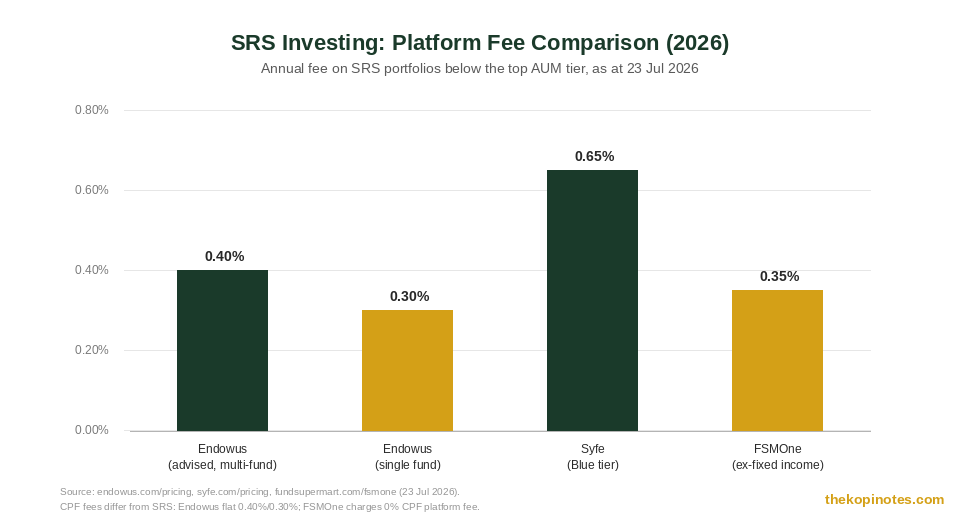
For CPF specifically, FSMOne’s 0% platform fee stands out — you’d only pay the fund manager’s own expense ratio. For SRS, Endowus is usually cheapest below $300,000 if you’re happy with an advised, diversified portfolio. If you want to compare providers side by side before signing up, our Syfe vs Endowus breakdown covers cash portfolios in more depth, and you can get started through the Endowus referral code, Syfe referral code or FSMOne referral code pages for current sign-up offers.
Cash Investing: Why It’s Usually Last (But Not Ignored)
Cash sitting in a brokerage account earns close to nothing, just like SRS. So why does it usually come last in the order?
Because it’s the only account with zero lock-in and zero tax advantage to lose. If you invest CPF OA or SRS, you’re accepting reduced flexibility in exchange for a guaranteed floor rate or a tax break. Cash gives you neither benefit — so there’s less urgency to move it out of your bank account the moment you have it, compared with SRS or CPF sitting idle.
That said, “last” doesn’t mean “never.” Once your SRS is funded for the year and your CPF OA is either invested or intentionally left for its 2.5%–4% floor, any spare cash should still go to work — ideally through regular monthly contributions into a diversified portfolio, rather than sitting in a savings account earning under 1%.
Adjusting the Order by Life Stage
The default order above is a starting point, not a rule. Here’s how it typically shifts:
20s, early career, low or no tax payable: Build your emergency fund, then start a simple cash regular savings plan. SRS relief is worth little if you’re barely paying tax yet, so it can wait until your income rises. CPF OA is usually small at this stage and best left untouched.
30s–40s, peak earning years, higher tax bracket: This is when SRS relief is most valuable — often worth 15% to 22% of every dollar contributed. Max SRS first, then look at CPF OA above $20,000 if you have a 10+ year horizon, then cash.
55 and above, approaching CPF payouts: CPF Special and Retirement Account balances now earn the highest guaranteed rates in the system (4% plus extra interest tiers), and strategies like CPF SA shielding become relevant before the account closes at 55. SRS withdrawal planning also starts to matter — you can withdraw over 10 years from your statutory retirement age at just 50% tax on each amount. For age-specific detail across every decade, see our life-stage investing guide, which this article complements.
Common Sequencing Mistakes to Avoid
A few mistakes come up again and again when Singaporeans get the order wrong:
- Locking cash into SRS you’ll need soon. SRS is a retirement account. Money you’ll need for a home deposit or wedding in the next few years shouldn’t go in, no matter how good the tax relief looks.
- Forgetting the $20,000 CPF OA set-aside. Some investors try to invest their entire OA balance and get rejected at the point of purchase — the first $20,000 is never available for CPFIS.
- Chasing tax relief while paying down high-interest debt. If you’re carrying credit card or personal loan debt above 15–20% interest, clearing that beats almost any SRS or CPF strategy.
- Ignoring CPF OA before a home purchase. If you’ll need OA savings for a down payment or mortgage servicing within a few years, investing it through CPFIS adds risk you may not want right before a big withdrawal.
Worked Example: SGD 2,000 a Month, Three Ways
Consider a 32-year-old Singaporean earning enough to sit in the 15% marginal tax bracket (roughly $120,001–$160,000 in chargeable income), with a 6-month emergency fund already saved and $2,000 a month available to invest.
- SRS first: $1,275 a month ($15,300 ÷ 12) goes into SRS until the annual cap is reached. At a 15% marginal rate, that’s roughly $2,295 in tax saved for the year — before any investment growth.
- Remaining cash: The other $725 a month goes into a diversified cash portfolio through a robo-advisor, building long-term wealth outside the CPF and SRS system with full liquidity.
- CPF OA, reviewed separately: Once a year, this investor checks whether their OA balance has grown past $20,000 by more than they’re comfortable leaving idle, and decides whether to top up a CPFIS unit trust portfolio with the excess.
Over a 20-year horizon, this sequencing captures the SRS tax relief every year it’s available, keeps cash flexible, and avoids leaving large CPF OA balances earning just 2.5% by default. The exact numbers will differ for your income and goals — the sequence, not the dollar amounts, is what matters here.
Frequently Asked Questions
Should I invest my CPF OA or my SRS first?
If you pay income tax, SRS usually comes first because the tax relief is immediate and guaranteed, up to $15,300 a year for citizens and PRs (or $35,700 for foreigners). CPF OA above the $20,000 set-aside still earns a guaranteed 2.5% by default, so it’s a reasonable second priority rather than an urgent one.
How much of my CPF Ordinary Account can I invest?
You must keep the first $20,000 of your OA balance untouched. Above that, you can invest through the CPF Investment Scheme (CPFIS-OA), subject to a 35% cap on shares, REITs and non-gold ETFs, and a separate 10% cap on gold investments, calculated against your investible OA savings.
What happens if I withdraw from SRS before the retirement age?
Withdrawing before the statutory retirement age in force when you made your first SRS contribution (63 today, rising to 64 from 1 July 2026) triggers a 5% penalty, and 100% of the amount withdrawn is taxable. Withdraw at or after that age, spread over up to 10 years, and only 50% of each withdrawal is taxed.
Is Endowus or Syfe cheaper for CPF and SRS investing?
For SRS, Endowus charges a flat 0.40% (advised portfolios) or 0.30% (single fund) regardless of balance, while Syfe’s Managed Portfolios start at 0.65% and step down to 0.25% as your balance or net deposits grow. For CPF specifically, Syfe isn’t currently available — Endowus and FSMOne are the main options, with FSMOne charging 0% platform fee on CPF-funded unit trusts as at 23 Jul 2026.
Do I need an emergency fund before investing SRS or CPF?
Yes. Build 3–6 months of expenses in accessible cash before locking money into SRS or CPFIS. Both accounts restrict when and how you can withdraw, so investing before you have a cash buffer risks forcing an early, penalised withdrawal.
Can foreigners in Singapore use SRS and CPF the same way?
Foreigners working in Singapore can open an SRS account and contribute up to $35,700 a year — more than the citizen/PR cap, since they don’t receive CPF contributions from their employer. However, foreigners generally do not have a CPF account unless they’ve obtained permanent residency, so CPFIS-OA investing typically doesn’t apply to them.
Ready to Put Your CPF, SRS or Cash to Work?
Compare providers, check the retirement calculator, and start with whichever account is costing you the most in lost growth.
This article was researched with the help of AI. While we strive to keep all information accurate and up to date, there may be errors. If you notice any discrepancies, please contact us.