Prudential Critical Illness Insurance Singapore 2026: PRUActive Protect Reviewed
A plain-English look at PRUActive Protect and Prudential’s five other critical illness plans — coverage, riders, and who each one actually fits.
Prudential’s main critical illness plan in Singapore is PRUActive Protect, covering 37 critical illnesses with a payout of up to 100% of your sum assured, plus optional riders for early-stage conditions and multiple claims. It sits alongside five other Prudential CI plans, from the cancer-only PRUCancer 360 to the no-medical-question PRUActive Crisis Guard, each suited to a different budget and risk profile.
Not financial advice. All figures are for educational reference only and sourced from Prudential Singapore’s official product pages and MAS-mandated Product Summary (Version 07/2025). Data verified as at July 2026.
- PRUActive Protect covers 37 critical illnesses and pays 20% of your sum assured on death — but it only pays out once for a critical illness claim unless you add the Protect Plus rider.
- Prudential sells five other CI plans too: PRUCancer 360 (cancer-only), PRUEarly Stage Crisis Cover, PRUMan/PRULady (gender-specific), and PRUActive Crisis Guard (guaranteed renewal, just one health question).
- Prudential doesn’t publish a standard premium rate table — PRUActive Protect goes through full medical underwriting, so your actual premium depends on your age, health, and sum assured.
Table of Contents
Contents — Click to expand
- What Does Critical Illness Insurance Actually Cover?
- Prudential’s 6 Critical Illness Plans Compared
- PRUActive Protect: The Flagship Plan
- Protect Plus, Early Protect & the Multiclaim Riders Explained
- Other Built-In Benefits: Child Cover & Spouse Waiver
- The Rest of Prudential’s CI Lineup
- PRUMan & PRULady: Gender-Specific Cover
- How Much Does It Cost?
- Pros and Cons
- Who Should Buy Prudential Critical Illness Insurance?
- Common Mistakes to Avoid
- FAQ
What Does Critical Illness Insurance Actually Cover?
Critical illness (CI) insurance pays you a lump sum if you’re diagnosed with a serious condition like major cancer, a heart attack, or a stroke. You get the money regardless of your actual medical bills. You can use it to cover lost income, pay off a mortgage, or fund your recovery however you need to.
This is different from a hospitalisation plan like PRUShield, which reimburses your medical bills directly. CI insurance exists because a serious illness often means months or years away from work. The payout replaces income, not just medical costs.
Prudential runs six separate CI plans in Singapore, each built for a different situation. Before picking one, it helps to understand what makes PRUActive Protect — Prudential’s flagship CI plan — tick.
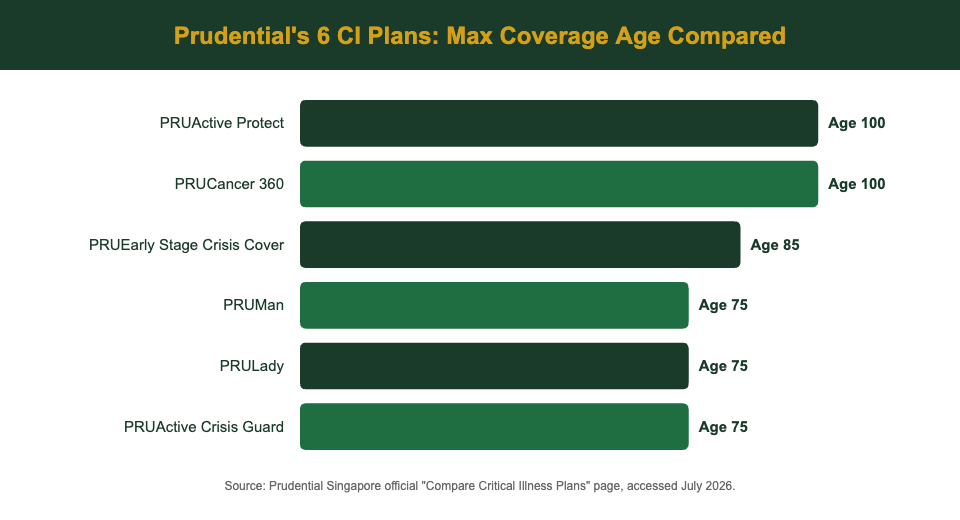
Prudential’s 6 Critical Illness Plans Compared
Here’s how Prudential’s full critical illness lineup stacks up, based on the official comparison Prudential publishes on its own site.
| Plan | What It Covers | Death Benefit | Continued Coverage After Claim | Policy Term |
|---|---|---|---|---|
| PRUActive Protect | 37 critical illnesses, option to add pre-critical (early) stage cover | 20% of sum assured | Yes, with Protect Plus / Early Protect Plus riders | Min 10 yrs, up to age 100 |
| PRUCancer 360 | Cancer only | Flat $5,000 | No | 5-yr renewable, to age 100 (max renewal age 95) |
| PRUEarly Stage Crisis Cover | Advanced-stage + pre-critical conditions built in | Flat $3,000 | Yes | Min 10 yrs, up to age 85 |
| PRUMan | Male-specific illnesses | None | Yes | To policy anniversary before age 65 or 75 |
| PRULady | Female-specific illnesses (+ optional maternity add-on) | None | Yes | To policy anniversary before age 65 or 75 |
| PRUActive Crisis Guard | Major cancer, heart attack & stroke only (the “big 3”) | 25% of sum assured | Yes | 5-yr renewable, to age 75 (max renewal age 70 next birthday) |
Source: Prudential Singapore, “Compare Critical Illness Plans” official comparison page, accessed July 2026.
PRUActive Protect: The Flagship Plan
PRUActive Protect is a regular-premium, non-participating term plan — meaning it’s pure protection with no cash value or savings component. You choose a policy term anywhere from 10 to 99 years, with cover running up to age 100.
The base plan covers 37 named critical illnesses, confirmed against Prudential’s official product page (information correct as of 1 December 2025). These include major cancer, heart attack of specified severity, stroke with permanent neurological deficit, major organ or bone marrow transplantation, and end-stage kidney, liver, and lung failure, among others.
One detail worth flagging: if both you and your spouse hold PRUActive Protect, your children get free coverage under the Child Cover Benefit against 36 of these illnesses plus 9 separate juvenile conditions — one fewer condition than the adult plan, since one covered illness isn’t clinically applicable to children. More on this in the Child Cover Benefit section below.
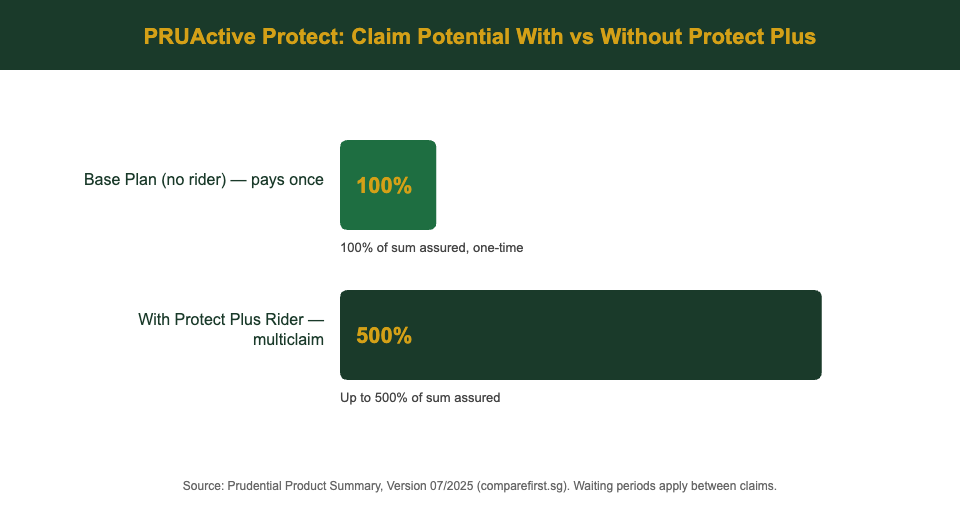
If you’re diagnosed with any one of the 37 illnesses and survive at least 7 days, Prudential pays 100% of your sum assured. That’s it for the base plan — once paid, the Critical Illness Benefit ends. You’ll need the Protect Plus rider (covered below) if you want coverage to continue after a claim.
Two smaller benefits come built into the base plan. The Additional Benefit pays 10% of your sum assured (capped at $25,000) if you need angioplasty or similar invasive coronary treatment — and it doesn’t reduce your main sum assured. The Crisis Care Accelerator pays 50% of your sum assured (capped at $100,000) if you undergo vital-organ surgery and spend at least 3 consecutive days in the ICU as a result.
Protect Plus, Early Protect & the Multiclaim Riders Explained
The base PRUActive Protect plan pays out once. If you want more, Prudential sells six optional riders on top of it.
Protect Plus restores your critical illness coverage to 100% after a claim, letting you claim up to 500% of your original sum assured across multiple illnesses. There’s a catch: you need a 12-month gap between claims for illnesses in different categories, and a 24-month gap for a recurrence of the same category — with medical evidence showing the earlier illness was in complete remission first.
Early Protect pays a lump sum if you’re diagnosed with a pre-critical stage (early-stage) condition, accelerated from your base sum assured. Once 100% of your Early Protect sum assured is paid out, the benefit ends — unless you’ve also added Early Protect Plus, which works like Protect Plus but for early-stage conditions, up to 500%.
Three more optional add-ons round out the lineup: Life Protect Plus pays an extra death benefit of up to 100% of your CI coverage, Severe Infections Protect pays out if a serious infectious disease puts you in the ICU for 5 or more consecutive days (capped at $100,000), and Monthly Benefit adds a $100–$5,000 monthly payout for 1, 2, or 3 years on top of your lump sum, paid once on your first CI claim.
Other Built-In Benefits: Child Cover & Spouse Waiver
Two more benefits come free with the base policy, no extra premium required.
The Child Cover Benefit kicks in when both you and your spouse each hold a PRUActive Protect policy. Your children under 17 then get free coverage against 36 of these critical illnesses plus 9 juvenile medical conditions — up to $25,000, or 25% of the higher parent’s sum assured, whichever applies, paid once per child. It only activates after your policy’s second anniversary; between the first and second anniversary you get half the payout, and nothing before the first anniversary.
The Spouse Waiver Benefit waives your PRUActive Protect premiums for 12 months if your spouse is diagnosed with one of the 37 covered illnesses. You can only claim this once, and you’ll need to submit your marriage certificate as proof.
The Rest of Prudential’s CI Lineup
PRUActive Protect isn’t the only option if the full 37-illness plan doesn’t fit your budget or health profile.
PRUCancer 360 is a cheaper, cancer-only plan on a 5-year renewable term running to age 100 (renewal capped at 95). Applying only requires answering one health question, which makes it a fast option if you want basic cancer protection without full underwriting.
PRUEarly Stage Crisis Cover builds both advanced-stage and pre-critical (early-stage) protection into a single plan from day one — no separate rider needed. It also waives future premiums after you’ve made a claim of at least 50% of your sum assured under its Severity Payout structure. Term runs to age 85.
PRUActive Crisis Guard only covers the “big 3”: major cancer, heart attack, and stroke. In exchange, it comes with guaranteed renewability and guaranteed convertibility regardless of your health at renewal — useful if you’ve been declined or loaded elsewhere. It’s a 5-year renewable term running to age 75, with a maximum renewal age of 70 next birthday.
PRUMan & PRULady: Gender-Specific Cover
PRUMan and PRULady cover illnesses specific to men and women respectively — think prostate-related conditions for PRUMan, and breast, cervical, or ovarian-related conditions for PRULady. Both come with a biennial medical screening benefit, a medical procedures benefit, a reconstructive surgery or skin grafting benefit, and a loyalty benefit. PRULady also offers an optional maternity coverage add-on.
Both plans waive premiums for 36 months once you’ve claimed at least 50% of your sum assured, and run to the policy anniversary before you turn 65 or 75, depending on the option you pick.
Treat these as top-ups rather than replacements for PRUActive Protect — they cover a narrower list of gender-specific conditions, not the full range of 37 critical illnesses.
How Much Does It Cost?
Prudential doesn’t publish a standard premium rate table for PRUActive Protect on its website. Unlike PRUCancer 360’s single health question, PRUActive Protect goes through full medical underwriting — so your actual premium depends on your age, gender, smoker status, medical history, sum assured, and which riders you add.
For an exact figure, get a personalised illustration from a Prudential Financial Consultant, or compare quotes across insurers via compareFIRST.sg, the free comparison portal jointly run by MAS, the Life Insurance Association, and the General Insurance Association.
Two structural points matter more than any single quote you’ll get. First, PRUActive Protect is not a Medisave-approved product, so you’ll pay premiums entirely in cash, not from your Medisave account. Second, the policy has no surrender value — since it’s pure protection with no savings feature, you get nothing back if you stop paying or never make a claim.
Pros and Cons
| Pros | Cons |
|---|---|
| 37 conditions covered as standard, plus 6 optional riders you can layer on as your needs grow | No cash value — pure protection, nothing back if you never claim |
| Coverage can run all the way to age 100 on a term up to 99 years | Multiclaim protection isn’t built in — Protect Plus and Early Protect Plus cost extra |
| Child Cover Benefit is genuinely free if both parents are insured | Full medical underwriting means pre-existing conditions can mean loading, exclusion, or decline |
| Flexible conversion to whole life or endowment before age 65, no fresh medical checks | Premiums are not guaranteed and can be revised with 30 days’ notice |
Who Should Buy Prudential Critical Illness Insurance?
PRUActive Protect suits you if you want one insurer you can grow with — starting with base CI cover in your 20s or 30s, then layering on Early Protect, Protect Plus, or Monthly Benefit riders later as your income and family responsibilities increase.
If you specifically want the cheapest, simplest cancer protection, PRUCancer 360’s single-question underwriting and lower premium may suit you better than the full PRUActive Protect base plan.
If you’ve been declined or loaded elsewhere because of your health history, PRUActive Crisis Guard’s guaranteed renewability is worth a look — though remember it only covers the “big 3” conditions, not the full 37.
Before you commit to any sum assured, work out how much coverage you actually need. Use the Insurance Gap Calculator to check your existing coverage against your income and debts, or the Life Insurance Needs Calculator to size your sum assured using the DIME method (Debt, Income, Mortgage, Education).
You can buy directly from Prudential (DPI — Direct Purchase Insurance, no advice given, usually cheaper) or through a financial adviser (FA route, includes a full needs analysis, usually the same premium but with ongoing service). If you’re unsure how PRUActive Protect stacks up against other insurers, our Best Critical Illness Insurance Singapore comparison guide lines up plans from AIA, Manulife, Singlife, and others side by side.
Common Mistakes to Avoid
- Assuming the base plan covers early-stage conditions. It doesn’t — you need the Early Protect rider for pre-critical stage payouts.
- Ignoring the waiting periods. Protect Plus needs 12 months between different-category claims and 24 months for same-category recurrence, with proof of remission.
- Guessing your sum assured. Run the numbers with the Insurance Gap Calculator instead of picking a round number.
- Assuming Medisave can pay for it. PRUActive Protect isn’t Medisave-approved — premiums are cash-only.
- Under-disclosing your medical history at application. Non-disclosure can void a claim later, even years into the policy.
For a deeper look at pre-critical stage coverage specifically, see our Early Critical Illness Insurance Singapore guide. And if you’re comparing critical illness cover against a term life policy for the same budget, our Term Life Insurance Singapore Comparison breaks down how the two work together.
Frequently Asked Questions
How many critical illnesses does PRUActive Protect cover?
Does PRUActive Protect pay out more than once?
Is there a death benefit under PRUActive Protect?
Can I use CPF Medisave to pay for PRUActive Protect?
What's the difference between PRUActive Protect and PRUActive Crisis Guard?
Does PRUActive Protect have a cash value?
How much does PRUActive Protect cost?
Is my child covered under PRUActive Protect?
Can I convert PRUActive Protect to a whole life or endowment plan later?
Size Your Coverage Before You Buy
Run your numbers through the Insurance Gap Calculator, then compare investment options for whatever you’re setting aside for premiums.
Get Free Insurance Advice
Speak with a licensed insurance advisor. No obligation, no cost.
By submitting this form, you agree to our Privacy Policy.
This article was researched with the help of AI. While we strive to keep all information accurate and up to date, there may be errors. If you notice any discrepancies, please contact us.