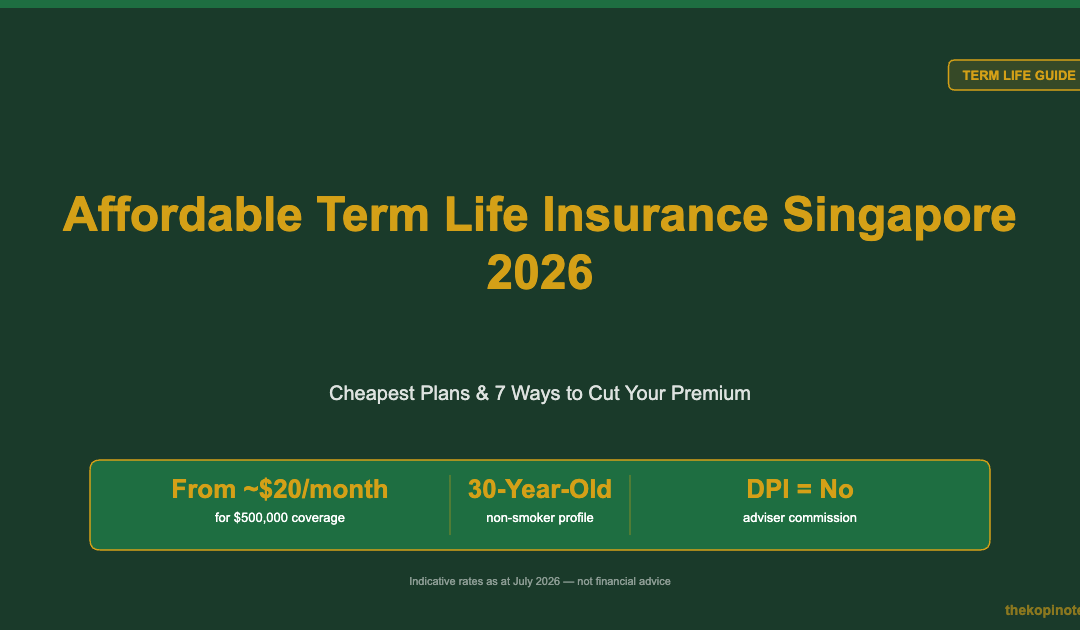
Affordable Term Life Insurance Singapore 2026: Cheapest Plans & 7 Ways to Cut Your Premium
Real premium comparisons, the DPI shortcut, and the exact moves that lower your quote — without cutting the coverage you actually need.
Affordable term life insurance in Singapore means paying $20 to $50 a month for $500,000 of coverage as a healthy 30-year-old non-smoker — the exact price depends on the insurer, your age, and how you buy it. Direct Purchase Insurance (DPI) plans skip adviser commissions entirely, while choosing the right term length and sum assured tier can cut your premium by 20 to 30%.
Not financial advice. All figures are for educational reference only and are indicative rates as at July 2026 — actual premiums depend on individual underwriting. Data verified as at 15 July 2026.
- A healthy 30-year-old non-smoker can get $500,000 of term life cover for roughly $20 to $50 a month, depending on the insurer and term length.
- Direct Purchase Insurance (DPI) skips financial adviser commissions — often the single biggest lever for a lower premium.
- Buying young, staying smoke-free, and hitting the $500,000 sum assured discount tier are the three moves that save the most money long-term.
Table of Contents
Contents — Click to expand
- What Makes Term Life Insurance “Affordable”?
- How Much Does Term Life Insurance Cost in Singapore?
- Cheapest Term Life Insurance Options Compared
- 7 Ways to Lower Your Term Life Insurance Premium
- DPI vs Financial Adviser: Which Is Actually Cheaper?
- Term vs Whole Life vs ILP: Why Term Wins on Price
- 5 Mistakes That Quietly Inflate Your Premium
- How Much Coverage Do You Actually Need?
- FAQ
What Makes Term Life Insurance “Affordable”?
Term life insurance is pure protection. You pay a premium, and the insurer pays out the sum assured only if you die or suffer total permanent disability (TPD) within the policy term. There is no cash value, no investment component, and no payout if you outlive the term.
That stripped-down design is exactly why term life is the cheapest way to buy a large amount of coverage. Whole life and investment-linked policies (ILPs) bundle in a savings or investment component, so a much bigger slice of your premium goes toward building cash value rather than pure protection.
“Affordable” for term life comes down to three levers you control: how you buy it (Direct Purchase Insurance vs a financial adviser), how long a term you lock in, and whether your sum assured crosses a discount tier. We’ll walk through all three below.
How Much Does Term Life Insurance Cost in Singapore?
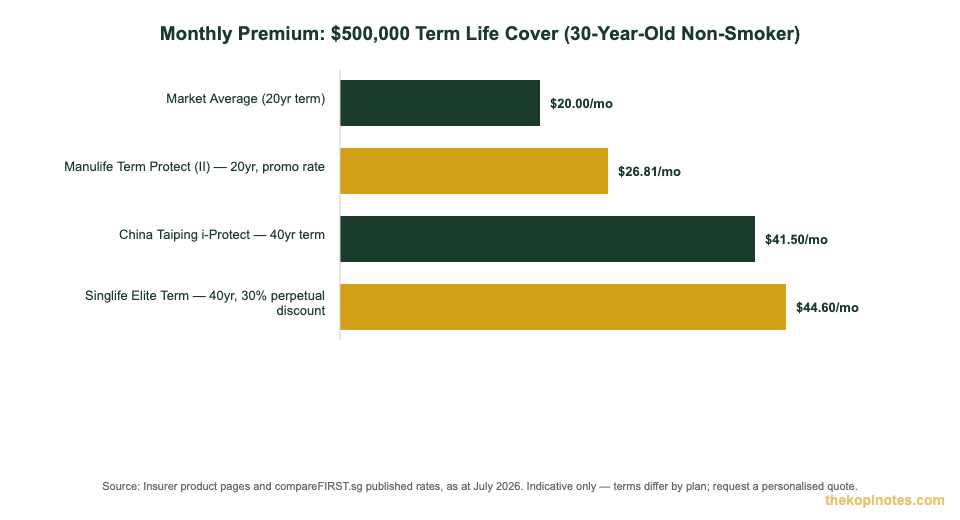
For a healthy 30-year-old non-smoker, $500,000 of term life cover typically runs $20 to $50 a month — but the exact figure depends heavily on the term length and any promotional discounts running at the time. The table below shows real published rates. Note that some plans quoted are 40-year terms rather than 20-year terms, which naturally cost more for the same monthly comparison, so we’ve labelled each term length clearly.
| Insurer / Plan | Term | Indicative Monthly Premium |
|---|---|---|
| Manulife Term Protect (II) | 20 years | ~$26.81 (with promotional discount) |
| China Taiping i-Protect | 40 years | ~$41.50 |
| Singlife Elite Term | 40 years | ~$44.60 (with 30% perpetual discount, sum assured ≥$500,000) |
| FWD Term Life Plus | Varies | From $3 (entry-level headline rate, lower coverage) |
| Market average (multiple insurers) | 20 years | ~$20 |
Source: Insurer product pages and compareFIRST.sg (MAS-linked comparison tool), published rates as at July 2026. Rates are indicative and change with promotions, underwriting outcome, and health rating — always request a personalised quote before deciding.
Three factors move your quote the most. Age matters because premiums step up each year you wait — locking in a rate at 30 is meaningfully cheaper than waiting until 40. Gender matters too: female rates tend to run lower, reflecting longer average life expectancy. And smoking status matters a lot — smokers typically pay 1.5 to 2.5 times the non-smoker rate across every insurer.
Coverage amount also unlocks pricing tiers. A healthy 30-year-old non-smoking male can often secure $1,000,000 in death and TPD coverage for under $500 a year — about $40 a month — because many insurers give a “perpetual discount” once your sum assured crosses $500,000 or $1,000,000. Buying slightly more coverage can sometimes cost less per dollar of protection than buying just under the threshold.
Cheapest Term Life Insurance Options Compared
“Cheapest” isn’t always the same plan for every buyer — it depends on your age, health, and how long a term you need. Here’s how the main contenders position themselves on price, based on published comparison data:
| Plan | Distribution | Why It’s Competitive |
|---|---|---|
| Singlife Elite Term (II) | Direct / DPI-adjacent | Consistently ranks in the bottom 20% for pricing industry-wide, plus a 30% perpetual discount above $500,000 sum assured |
| China Taiping i-Protect | Financial adviser | Among the lowest published rates for long (40-year) terms |
| Manulife Term Protect (II) | Financial adviser / online | Regular promotional discounts bring the effective rate close to DPI pricing |
| FWD Term Life Plus | Direct online | Low entry point and fully digital application, no adviser commission |
| AIA DIRECT Term | DPI | No commission by regulatory design — see our AIA term life insurance review |
Rather than picking a plan off this table alone, run your own profile through compareFIRST.sg — the free, MAS-backed comparison tool that pulls live rates from every insurer. It’s the single best way to confirm which plan is genuinely cheapest for your age, gender, and health profile today.
7 Ways to Lower Your Term Life Insurance Premium
- Buy through DPI, not a financial adviser. Direct Purchase Insurance products are sold without commission, so the savings go straight into a lower premium. The trade-off is you won’t get personalised advice — fine if you already know how much coverage you need.
- Lock in your rate while you’re young. Premiums are priced on your age at application. Buying at 30 instead of 40 can lock in a rate that’s 30 to 50% cheaper for the same coverage, and it stays fixed for the term (on level-premium plans).
- Stay smoke-free, or quit well before you apply. Most insurers require 12 months of being smoke-free before you qualify for non-smoker rates. Since smokers pay 1.5 to 2.5 times more, this is one of the largest single levers available.
- Hit the $500,000 sum assured discount tier. Several insurers apply a “perpetual discount” once your coverage crosses $500,000 (and again at $1,000,000). If you’re close to the threshold, topping up can lower your per-dollar cost.
- Choose the shortest term that still covers your need. A 30-year term costs more than a 20-year term because it covers you for longer. Match the term to when your dependants will no longer need the payout — often when your mortgage is paid off or your youngest child is financially independent.
- Skip riders you don’t actually need yet. Critical illness and early critical illness riders add real value, but they also add cost. If budget is tight, consider a pure term plan first and add a standalone early critical illness plan later once cash flow improves.
- Compare on compareFIRST.sg before you commit. This MAS-backed tool shows live premiums across insurers for your exact profile in minutes — the fastest way to confirm you’re not overpaying.
DPI vs Financial Adviser: Which Is Actually Cheaper?
Direct Purchase Insurance (DPI) is a class of standardised term and whole life products, identified by the word “DIRECT” in the product name, that MAS created specifically so consumers could buy life insurance without going through a financial adviser. Because no commission is paid, the premium is lower for the same coverage.
| Factor | DPI | Financial Adviser Channel |
|---|---|---|
| Commission | None — lower premium | Built into premium |
| Personalised advice | None — you self-select coverage | Yes, includes needs analysis |
| Product range | Standardised, limited riders | Full product suite, customisable |
| Best for | Buyers who already know their coverage need | First-time buyers, complex needs, business insurance |
Source: Monetary Authority of Singapore, Notice 321 on Direct Purchase Insurance Products; Life Insurance Association Singapore, DPI consumer guide.
If you’re confident in how much coverage you need — for example, using the DIME method below — DPI is usually the more affordable route. If you’re unsure, the cost of a financial adviser’s commission may be worth paying for a proper needs analysis, especially if your situation involves business loans, complex dependants, or multiple policy types.
Term vs Whole Life vs ILP: Why Term Wins on Price
All three product types can provide $500,000 of life coverage, but the monthly cost differs enormously because whole life and ILPs bundle in savings or investment components on top of the pure protection cost.
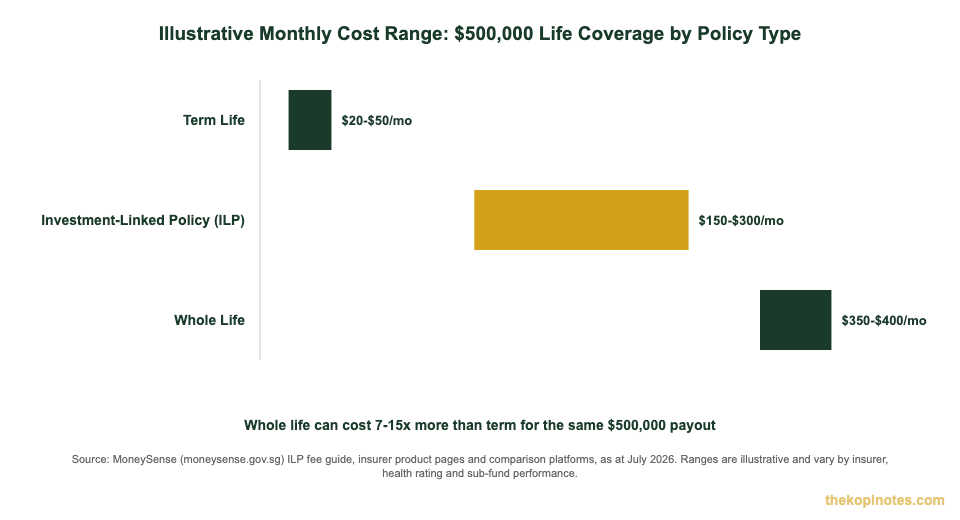
| Policy Type | Monthly Cost Range ($500k cover) | What You’re Paying For |
|---|---|---|
| Term Life | $20-$50 | Pure protection only, no cash value |
| Investment-Linked Policy (ILP) | $150-$300 | Protection plus fund investment, layered fees (2.5-4.5% p.a. RIY) |
| Whole Life | $350-$400 | Lifetime protection plus guaranteed cash value |
Source: MoneySense (moneysense.gov.sg) investment-linked policy fee guide; insurer product pages; comparison platforms, as at July 2026. Ranges are illustrative and vary by insurer, health rating, and sub-fund performance.
If your goal is maximum coverage per dollar — say, to protect a mortgage or replace income for young dependants — term life is almost always the more affordable route. Whole life and ILPs make more sense once pure protection needs are met and you’re specifically looking to combine insurance with long-term savings or investment, which our investment-linked policy guide covers in detail.
5 Mistakes That Quietly Inflate Your Premium
- Buying based on premium alone, ignoring claims history. The cheapest quote isn’t always the best value if the insurer has a weak claims track record. Check LIA’s industry claims statistics before committing to the lowest bidder.
- Piling on riders before you need them. Every rider — critical illness, early critical illness, waiver of premium — adds to your monthly cost. Start with core protection and add riders as your budget and needs grow.
- Not reviewing your policy after major life changes. Getting married, having a child, or paying off your mortgage all change how much coverage you need. Reviewing every 3 to 5 years prevents you from over-insuring (and overpaying) or under-insuring.
- Choosing a term that outlives your financial dependants’ need. A 30-year term costs meaningfully more than a 20-year term. If your youngest child will be financially independent in 22 years, a 30-year term is paying for years of coverage you likely won’t need.
- Skipping full disclosure on your health declaration. Understating a health condition to get a lower premium is non-disclosure, and insurers can void the entire policy at claim time — leaving your family with nothing. Full disclosure, even if it raises your premium slightly, is what actually makes the policy “affordable” in the way that matters.
How Much Coverage Do You Actually Need?
Buying a policy that’s “affordable” only matters if it also covers what your family actually needs. The DIME method is a simple starting framework: add up your outstanding Debt (mortgage, loans), Income replacement (annual income times years until your youngest dependant is independent), Mortgage (if not already counted under debt), and Education costs for your children.
Rather than estimating by hand, run your numbers through our free Insurance Gap Calculator or the more detailed Life Insurance Needs Calculator — both take under five minutes and give you a coverage figure to quote against on compareFIRST.sg or with a financial adviser.
For a full side-by-side of specific insurer plans beyond just price, see our Term Life Insurance Singapore Comparison 2026, which covers riders, coverage limits, and underwriting requirements across six major insurers.
Ready to Compare Your Own Numbers?
Check your coverage gap, then start investing what you save on premiums.
Frequently Asked Questions
What is the cheapest term life insurance in Singapore?
What's the difference between DPI and buying through a financial adviser?
Does smoking really double my premium?
Should I buy a 20-year or 30-year term?
Can I get affordable term life insurance with a pre-existing condition?
Is $500,000 coverage enough, or should I buy more to get the discount?
Can I switch insurers later if I find a cheaper plan?
Do I need a critical illness rider, or does that make it less affordable?
Get Free Insurance Advice
Speak with a licensed insurance advisor. No obligation, no cost.
By submitting this form, you agree to our Privacy Policy.
This article was researched with the help of AI. While we strive to keep all information accurate and up to date, there may be errors. If you notice any discrepancies, please contact us.