How to Invest in Singapore: Build Your First Portfolio in 5 Steps (2026)
A practical, step-by-step action plan for everyday Singaporeans — from CPF optimisation to buying your first ETF.
To invest in Singapore, follow a proven order: first maximise your CPF contributions (which earn a guaranteed 2.5%–4% p.a.), then build a 6-month emergency fund in a high-yield account like SSBs or T-bills, and finally invest monthly into low-cost global ETFs through brokers like IBKR or Syfe. Even S$300 a month, consistently invested, can compound into a meaningful retirement nest egg over 20–30 years.
Not financial advice. All figures are for educational reference only. Data verified as at 10 July 2026.
- Start with CPF — it’s the best guaranteed return in Singapore at 2.5%–4% p.a.
- Keep 3–6 months of expenses in SSBs or T-bills before investing in markets
- Invest monthly in a globally diversified ETF (like VWRA or CSPX) via IBKR or Syfe for long-term growth
Table of Contents
Contents — Click to expand
The Investment Pyramid: Building From the Bottom Up
Most Singaporeans make the same mistake: they jump straight into stocks or REITs without sorting out their financial foundations first. This leaves them exposed. When markets dip and they simultaneously face a job loss or emergency, they’re forced to sell investments at the worst possible moment.
Think of your personal finances as a pyramid. You build upward from the base — not from the top down.
| Level | What It Includes | Priority |
|---|---|---|
| Base (Foundation) | CPF contributions, emergency fund, basic insurance | Do this first |
| Middle (Stable Returns) | SSBs, T-bills, fixed deposits, CPF voluntary top-ups | Do this second |
| Top (Growth) | ETFs, REITs, individual stocks, alternative assets | Only once base and middle are solid |
Framework adapted from standard personal finance principles. Not prescriptive advice — individual circumstances vary.
This guide walks you through all five steps, in order. If you’re brand new to investing, read our complete Singapore investing guide first, then come back here for the portfolio-building framework.
Step 1 — Maximise Your CPF Returns
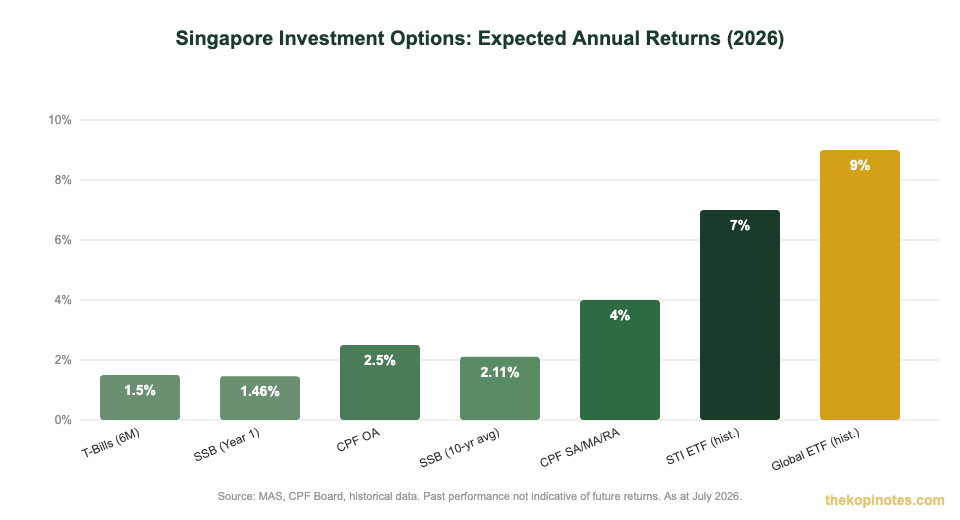
Before you invest a single dollar in the market, make sure your CPF is working as hard as possible. Here’s why this matters: your CPF Special Account (SA) earns 4% p.a. — guaranteed by the Singapore government. Your Ordinary Account (OA) earns 2.5% p.a., also guaranteed.
No stock, ETF, or bond reliably guarantees those returns at zero risk. CPF is literally Singapore’s best-kept investment secret.
Here are the three CPF levers most Singaporeans underuse:
1. Retirement Sum Topping-Up Scheme (RSTU). You can voluntarily top up your SA (or your loved ones’ RA) with cash and earn the 4% guaranteed rate. Contributions are also tax-deductible up to S$8,000 per year for self-top-ups.
2. CPF Ordinary Account Transfer to Special Account. If you don’t need your OA funds for housing soon, transferring OA balances to your SA earns you an extra 1.5% p.a. (from 2.5% to 4%). This is irreversible, so consider carefully before transferring.
3. First S$60,000 bonus interest. The first S$60,000 of combined CPF balances earns an additional 1% p.a. on top of the base rate. For the SA, this effectively means up to 5% p.a. on the first S$20,000.
For a full breakdown of how to optimise each CPF account, see our guide on CPF investment strategy Singapore.
Step 2 — Build Your Emergency Fund
Your emergency fund is 3–6 months of living expenses, kept in a liquid account you can access within days. In Singapore, you have excellent options that earn more than a standard savings account.
| Option | Current Rate (Jul 2026) | Liquidity | Min Amount |
|---|---|---|---|
| Singapore Savings Bonds (SSB) | 1.46% (Yr 1), 2.11% avg (10 yr) | Redeem any month, no penalty | S$500 |
| 6-Month T-Bills | ~1.50% p.a. | Locked 6 months | S$1,000 |
| High-Yield Bank Savings | Up to 3%+ (with salary credit, spend) | Instant | Varies |
Sources: MAS Treasury Bills Statistics; MAS Singapore Savings Bond issuance GX26070F; July 2026.
SSBs are the top pick for most people’s emergency fund. You get a competitive rate, full capital protection, no lock-in, and government backing. The catch: you can only invest up to S$200,000 lifetime. For anything beyond that, T-bills and high-yield savings accounts fill the gap.
The golden rule: never invest your emergency fund in equities or REITs. If markets crash at the same time you lose your job, you would be forced to sell at a loss. That’s the exact scenario the emergency fund exists to prevent.
Step 3 — Know Your Investment Options in Singapore
Once your CPF is working hard and your emergency fund is in place, it’s time to invest for growth. Singapore investors have access to a wider range of options than most realise. Here is a side-by-side comparison:
| Option | Expected Return | Risk | Min. Investment | Singapore Tax |
|---|---|---|---|---|
| CPF OA | 2.5% p.a. | None | — | Exempt |
| CPF SA / RA | 4% p.a. | None | — | Exempt |
| Singapore Savings Bonds | 1.46%–2.11% avg | None | S$500 | Exempt |
| 6-Month T-Bills | ~1.50% p.a. | Very Low | S$1,000 | Exempt |
| Global ETF (LSE-listed) | 7%–10% (hist. long-term) | Medium-High | ~S$150 per unit | None |
| Singapore REITs (S-REITs) | 5%–7% distribution yield | Medium | ~S$1 per unit | None |
| Individual SG Stocks | Variable | Medium-High | ~S$50 | None |
Sources: MAS, CPF Board, historical fund performance data. Past returns not indicative of future results. Data as at July 2026.
A key advantage of Singapore is that there is zero capital gains tax and zero dividend tax on most investment returns. For globally diversified ETFs listed on the London Stock Exchange (LSE) — like VWRA (Vanguard FTSE All-World) or CSPX (iShares Core S&P 500) — Singapore investors pay no tax on growth at all. This is a structural advantage that UK or US investors simply don’t have.
For investors who want regular income alongside long-term growth, S-REITs are worth considering. Our guide on the best S-REITs in Singapore 2026 covers the highest-quality REITs by sector.
If you prefer passive income from dividends and REIT distributions, read our detailed guide on passive income Singapore strategies for a full breakdown by income level.
Step 4 — Build Your First Portfolio
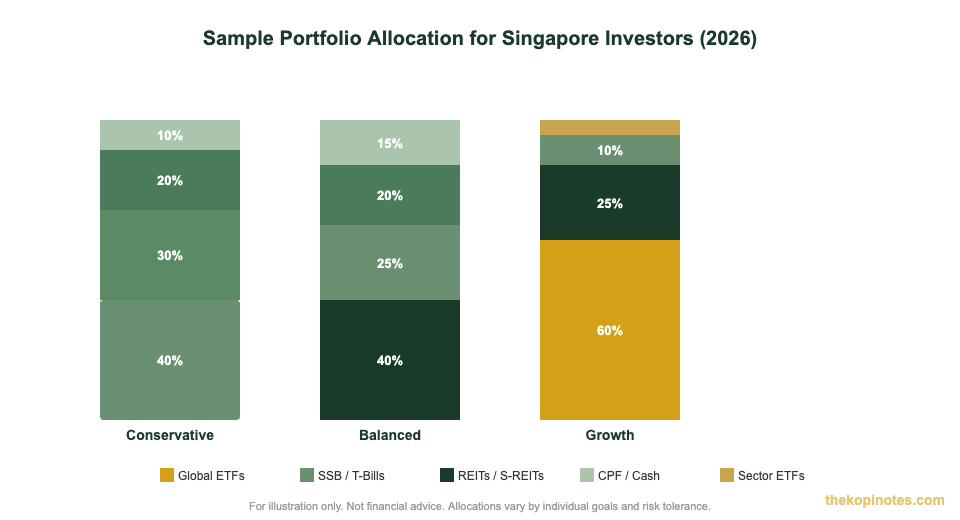
There is no single “correct” portfolio. Your allocation depends on three things: your investment horizon (how long until you need the money), your risk tolerance (how you’d react to a 30% portfolio drop), and your income stability.
Here are three starting frameworks, designed for different profiles:
| Profile | Global ETFs | S-REITs | SSB / T-Bills | Cash / CPF Buffer |
|---|---|---|---|---|
| Conservative 50+, low risk tolerance |
20% | 20% | 40% | 20% |
| Balanced 30–50, moderate risk |
40% | 20% | 25% | 15% |
| Growth 20–35, long horizon |
60% | 25% | 10% | 5% |
Illustrative allocations only. Not personalised financial advice. Consult a licensed financial adviser for specific guidance.
For the growth profile with a 20-year horizon, here’s what S$500 per month could look like, assuming a blended 8% annual return on the equity portion:
S$500/month × 20 years ≈ S$120,000 contributed → estimated portfolio value ≈ S$295,000 (at 8% average annual return). That’s more than double what you put in — with zero active management required.
To calculate your own retirement target, use our free Singapore retirement calculator.
Step 5 — Choose a Broker and Place Your First Trade
To buy ETFs or REITs, you need a brokerage account. The right choice depends on your portfolio size and where you want to invest.
| Broker | SG Stocks | US / LSE Stocks | Min. Deposit | Best For |
|---|---|---|---|---|
| IBKR | 0.08% (min S$2.50) | From ~USD 1/trade | None | LSE ETFs, larger portfolios |
| Syfe Trade | From S$0 | From S$0 | None | Beginners, no minimums |
| moomoo SG | From 0.03% | From USD 0.0099/share | None | Active traders, US stocks |
| FSMOne | 0.08% (min S$10) | — | None | Regular Savings Plan (RSP) |
Sources: Broker official pricing pages as at July 2026. Fees subject to change.
For beginners, the Syfe referral code is a great starting point — no minimum deposit, zero commission on US stocks, and a clean mobile app. Use referral code SRPRFFFCD for a sign-up bonus.
For larger portfolios buying LSE-listed ETFs like VWRA or CSPX, IBKR (Interactive Brokers) is the most cost-efficient choice. Use referral code jianxiong368 when opening your account.
If you prefer a managed portfolio in SGD — or want to invest using CPF or SRS funds — the Endowus referral code gives you access to institutional-grade funds with CPF/SRS compatibility. Use code 2V343 for a bonus on your first investment.
For FSMOne, use referral code P0544985. FSMOne is particularly good if you want a Regular Savings Plan (RSP) for automatic monthly ETF purchases without needing to manually place orders.
Common Mistakes to Avoid as a New Investor
Most investing mistakes aren’t about picking the wrong stock — they’re behavioural. Here are the five most common traps Singaporean beginners fall into:
1. Waiting for “the right time”. Markets will always feel uncertain. Waiting for a crash or a clearer signal means staying in cash while your money loses value to inflation. Time in the market consistently beats timing the market over long periods.
2. Putting all savings into Singapore stocks. SGX (Singapore Exchange) represents a tiny fraction of global market capitalisation — roughly 0.3%. Concentrating only in SG stocks means missing 99.7% of global growth. Global ETFs like VWRA fix this instantly.
3. Checking your portfolio every day. Short-term market fluctuations are noise. Checking daily leads to emotional decisions — panic selling during dips or chasing rallies. Log in monthly at most.
4. Ignoring currency risk. If you buy LSE ETFs in GBP, your SGD returns are affected by the SGD/GBP exchange rate. This cuts both ways — it can help or hurt — but it’s a risk to understand and accept.
5. Forgetting to rebalance. If global ETFs surge 40% in a year and your target allocation was 60% equities, you might now be 75% equities. Rebalancing once a year (selling a bit of the winner, buying the laggard) keeps your risk level consistent.
For a deeper look at generating income from your investments while you build your portfolio, explore our Singapore REIT ETF guide — one of the most popular entry points for SG investors seeking yield.
Frequently Asked Questions
How much money do I need to start investing in Singapore?
You can start investing in Singapore with as little as S$500 for Singapore Savings Bonds, S$1,000 for T-bills, or as little as the price of one ETF unit (around S$100–S$200 for VWRA on LSE) through brokers like IBKR or Syfe. Syfe Trade also offers fractional US stocks from just US$1. There is no minimum deposit required to open most brokerage accounts.
What is the best investment for beginners in Singapore?
For most beginners, a two-step approach works well: park your emergency fund in Singapore Savings Bonds (safe, liquid, government-backed at ~1.46% Year 1 / 2.11% 10-year average as at July 2026), then invest your surplus monthly into a globally diversified ETF like VWRA (Vanguard FTSE All-World) or CSPX (iShares S&P 500) through IBKR or Syfe. This approach is low-cost, globally diversified, and requires minimal ongoing management.
Can I use my CPF to invest in ETFs?
You can use CPF Ordinary Account (OA) funds to invest through the CPF Investment Scheme (CPFIS), which allows investment in certain unit trusts, ETFs, and Singapore shares listed on SGX. However, LSE-listed ETFs like VWRA and CSPX are not CPF-investable — these must be purchased with cash. For CPF-compatible managed portfolios, Endowus (referral code 2V343) allows you to invest your CPF OA and SA funds in low-cost globally diversified portfolios.
How do I buy ETFs in Singapore step by step?
To buy ETFs in Singapore: (1) Open a brokerage account — Syfe Trade or IBKR are popular choices with no minimum deposit; (2) Fund your account via bank transfer; (3) Search for the ETF ticker (e.g. VWRA for LSE, or ES3 for the STI ETF on SGX); (4) Select the correct exchange (LSE for VWRA/CSPX, SGX for STI ETF); (5) Place a market or limit order for the number of units you want. Your first trade typically processes within minutes during market hours.
Is there capital gains tax on investments in Singapore?
No. Singapore does not impose capital gains tax. If you buy shares or ETFs and they rise in value, you pay zero tax when you sell. Singapore also does not tax dividends received by individual investors. This makes Singapore one of the most tax-friendly environments in the world for long-term investors — a structural advantage over investors in countries like the US, UK, or Australia who pay capital gains and dividend taxes on their investment returns.
What is the difference between ETFs and S-REITs for Singapore investors?
ETFs (Exchange-Traded Funds) and S-REITs (Singapore Real Estate Investment Trusts) are both listed on stock exchanges but serve different purposes. ETFs (like VWRA or CSPX) typically track broad market indices and aim for long-term capital growth — they are globally diversified and best for wealth building. S-REITs are property trusts that distribute at least 90% of taxable income as dividends — they provide regular passive income (typically 5%–7% distribution yield) but with concentration in Singapore real estate. Most Singapore investors benefit from holding both: ETFs for growth, S-REITs for income.
Ready to Build Your First Portfolio?
Open a brokerage account today and start investing. Use our referral links for exclusive sign-up bonuses.
This article was researched with the help of AI. While we strive to keep all information accurate and up to date, there may be errors. If you notice any discrepancies, please contact us.