INVESTMENT INSURANCE GUIDE
What Is an Endowment Plan? 2026 Guide to Returns, How It Works & Is It Worth Buying in Singapore
Guaranteed returns of 3.20–3.55% p.a. compared — with verified July 2026 data, types comparison & step-by-step buying guide.
An endowment plan is a life insurance policy that doubles as a savings vehicle. You pay premiums over a fixed term — typically 2 to 25 years — and receive a guaranteed lump-sum payout at maturity, plus non-guaranteed bonuses from the insurer's participating (par) fund. Short-term endowment plans in Singapore currently offer 3.20–3.55% p.a. guaranteed — significantly above fixed deposit rates of ~1.50% p.a. as at July 2026.
Not financial advice. All figures are for educational reference only. Data verified as at July 2026 unless noted.
- Short-term endowment plans pay 3.20–3.55% p.a. guaranteed — well above the best FD rate of ~1.50% p.a. in July 2026.
- The trade-off is illiquidity — surrendering early means getting back less than you paid in, especially in the first few years.
- They suit disciplined savers with a specific goal and a horizon of 2+ years, but are not suitable for emergency funds.
Table of Contents
What Is an Endowment Plan?
An endowment plan is a hybrid financial product sold by MAS-licensed insurers in Singapore. It combines two things in one policy: a life insurance death benefit and a disciplined savings mechanism that grows your money over a fixed term.
Here is the simple version. You pay premiums — monthly, yearly, or as a single lump sum — for a set number of years. When the plan matures, you receive a payout: your premiums back plus an interest component. If you pass away before maturity, your nominated beneficiary receives the death benefit instead.
The word “endowment” comes from the idea that the plan builds up a sum of money for a specific future purpose. Common goals in Singapore include funding a child’s university education, building a retirement nest egg, or simply growing savings with capital protection.
All endowment plans in Singapore are regulated under the Insurance Act and sold by licensed financial advisers or through direct purchase channels. Because they include a life insurance component, proceeds are generally paid directly to your nominee — without going through probate. That can be a useful estate planning feature.
How Does an Endowment Plan Work?
When you pay your premiums, a portion covers the insurance cost (the death benefit), and the rest goes into the participating (par) fund — a large pooled investment managed by the insurer.
The par fund invests in a diversified mix of bonds, equities, property, and other assets. Based on the fund’s performance, the insurer declares bonuses. These come in two types:
- Reversionary bonuses: Added to your policy each year and guaranteed once declared. Think of them as interest “locked in” annually that cannot be taken back.
- Terminal bonuses: Paid only at maturity or upon a valid claim. These are not guaranteed — they depend on the par fund’s long-term performance and the insurer’s discretion.
Your guaranteed maturity benefit is fixed from day one. The non-guaranteed portion can add to your payout if the par fund performs well, or reduce the projected amount if it underperforms. This is why insurers show two projected scenarios in policy illustrations: a conservative 3.25% p.a. and an optimistic 4.75% p.a.
Surrender Value: The Key Risk
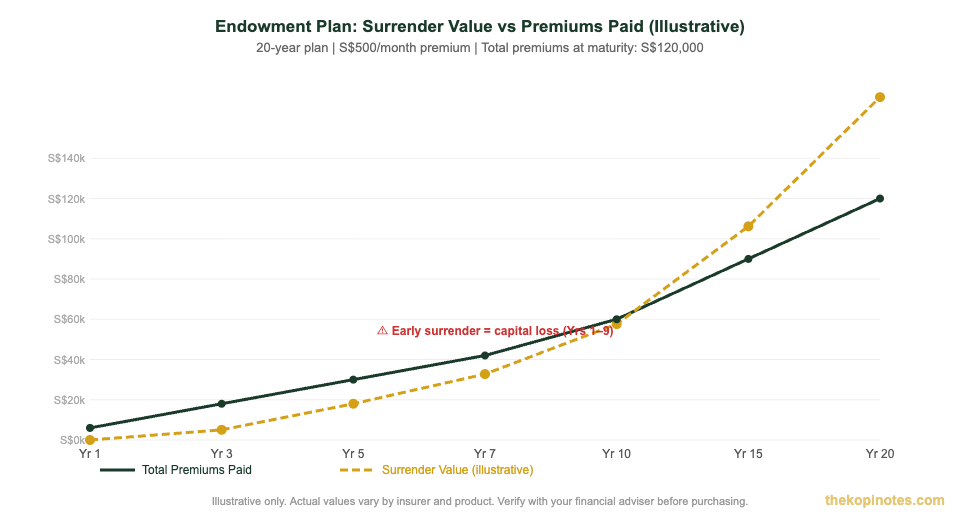
If you stop paying premiums or cash out before maturity, you receive the surrender value — typically less than your total premiums paid, especially in the early years.
Most plans only build a meaningful surrender value from year 2 or 3 onwards. In the first two years, you often get back very little or nothing. Many plans reach break-even — where surrender value equals total premiums paid — only around year 10 to 12 for a 20-year plan.
This illiquidity is the biggest risk. Before committing, ask yourself honestly: “Am I confident I will not need this money before maturity?” If the answer is no, an endowment plan is likely not the right fit.
What Returns Can You Expect from an Endowment Plan?
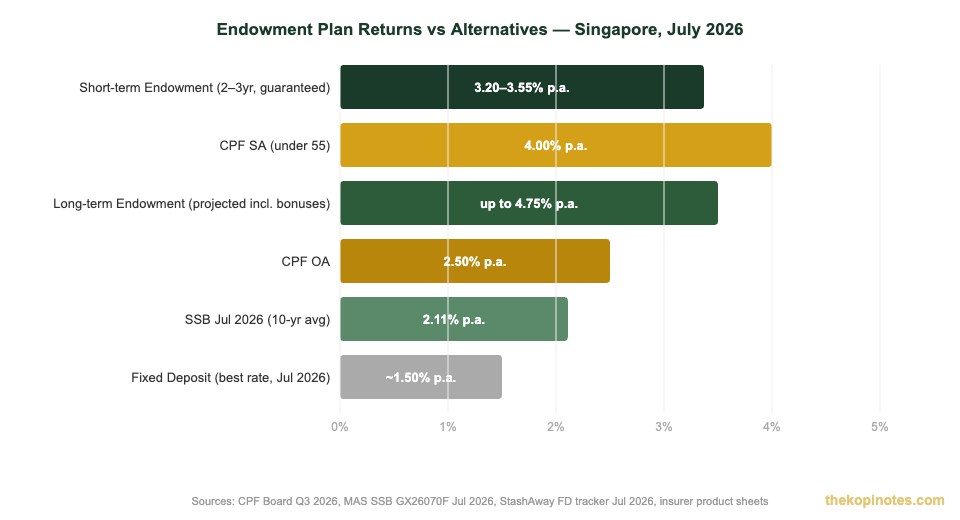
Returns vary by plan type and tenor. Short-term endowment plans currently offer some of the best risk-free guaranteed rates in Singapore. Long-term plans offer lower guaranteed rates but higher projected upside if bonuses materialise.
Here is a verified comparison as at July 2026:
| Product | Guaranteed Return | Non-Guar. (Projected) | Flexibility |
|---|---|---|---|
| Short-term Endowment (2–3 yrs) | 3.20–3.55% p.a. | N/A (single/short premium) | Low — locked for 2–3 yrs |
| Long-term Endowment (15–25 yrs) | ~1.5–2.5% p.a. | Up to 4.75% p.a. | Very low — penalty for early exit |
| Fixed Deposit (best rate, Jul 2026) | ~1.20–1.50% p.a. | N/A | High — 6–12 months |
| Singapore Savings Bond (Jul 2026) | 2.11% p.a. (10-yr avg) | N/A | Very high — redeem any month |
| CPF Ordinary Account (OA) | 2.50% p.a. | N/A | Restricted — CPF rules apply |
| CPF Special Account (SA, under 55) | 4.00% p.a. | N/A | Very low — locked till retirement |
Source: CPF Board (Q3 2026 rates), MAS Singapore Savings Bond GX26070F (Jul 2026), StashAway FD tracker (Jul 2026), NTUC Income Gro Capital Ease and Great Eastern GREAT SP product sheets.
Types of Endowment Plans in Singapore
Not all endowment plans are the same. The right type depends on your goal, time horizon, and how much flexibility you need.
| Type | Tenor | Premium Structure | Best For |
|---|---|---|---|
| Short-term / Single Premium | 2–5 years | One lump sum or 2–3 annual payments | Parking a lump sum, FD alternative |
| Regular Premium (Participating) | 10–25 years | Monthly or yearly over full term | Retirement fund, child education |
| Limited Pay Endowment | 15–25 years | Pay for 10–15 yrs, policy runs longer | Higher earners, cash flow flexibility |
| Child / Education Endowment | 15–21 years | Regular premiums from birth onwards | University fund for children |
| SRS-Funded Endowment | 5–20 years | Premiums paid from SRS account | Pre-retirees maximising tax relief |
Source: MAS licensed product categories, insurer product guides as at 2026.
The most popular right now are short-term single premium plans — largely because they offer higher guaranteed returns than fixed deposits. To see the best current offerings side by side, visit the endowment plan Singapore 2026 guide which compares NTUC Income, Great Eastern, Prudential, AIA, and Manulife plans in detail.
Endowment Plan vs Alternatives: Which Is Right for You?
Before committing, it helps to see how an endowment plan stacks up against other savings and investment options commonly used by Singapore investors:
| Option | Return (Jul 2026) | Capital Guaranteed? | Flexible? | Insurance? |
|---|---|---|---|---|
| Short-term Endowment | 3.20–3.55% p.a. | Yes (at maturity) | No | Yes |
| Fixed Deposit | ~1.50% p.a. | Yes | Yes | No |
| Singapore Savings Bond | 2.11% p.a. (10-yr avg) | Yes | Very High | No |
| CPF OA / SA | 2.5–4.0% p.a. | Yes | No | No |
| S-REITs | 5–7% yield (variable) | No | Yes | No |
| Robo-Advisor (Syfe, Endowus) | Variable (hist. 4–8% p.a.) | No | Yes | No |
Source: CPF Board Q3 2026, MAS SSB Jul 2026, StashAway FD tracker Jul 2026, insurer product sheets. S-REIT yields based on sector average.
The key insight here: short-term endowment plans currently beat fixed deposits by more than two percentage points. However, if you value flexibility above all else, the SSB (fully redeemable any month) or a robo-advisor cash portfolio may suit you better. You can use the endowment plan returns calculator to model your exact projected payout.
SRS and CPF Strategies for Endowment Plans
One of the most underused advantages of endowment plans in Singapore is their compatibility with the Supplementary Retirement Scheme (SRS) — giving you a tax relief boost on top of the plan’s returns.
SRS Strategy
You can fund certain endowment plan premiums directly from your SRS account. This gives you two benefits at once: income tax relief on your SRS contribution (up to S$15,300 per year for Singapore citizens and PRs in 2026) plus the guaranteed returns from the endowment plan itself.
For example, if you are in the 15% tax bracket and contribute S$15,300 to SRS, you save approximately S$2,295 in taxes in that year. That upfront tax saving effectively boosts your effective return significantly in Year 1. SRS-funded endowment plan proceeds at maturity are subject to 50% concessionary tax on withdrawal — still very tax-efficient overall.
CPF Strategy
Some endowment plans are approved under the CPF Investment Scheme (CPFIS-OA), allowing you to use CPF Ordinary Account savings to purchase them. Since CPF OA earns a risk-free 2.5% p.a., this only makes financial sense if the endowment plan’s guaranteed returns clearly exceed 2.5%. Short-term plans meet this bar (3.20–3.55% p.a. guaranteed). Long-term regular premium plans may not on the guaranteed portion alone.
Use our Singapore retirement planning calculator to model how an endowment plan fits into your broader retirement income picture alongside CPF LIFE and other income streams.
Who Should Buy an Endowment Plan in Singapore?
Endowment plans are not for everyone. Here is a practical decision framework based on common Singapore investor profiles:
| Profile | Suitable? | Reason |
|---|---|---|
| Investor with lump sum seeking FD alternative (2–3 yr) | Yes | 3.20–3.55% p.a. guaranteed vs ~1.50% FD |
| Parent saving for child’s university fund (15–18 yr horizon) | Yes | Long-term plans with insurance built in; enforces savings discipline |
| Pre-retiree maximising SRS tax relief (50s+) | Yes | Double benefit: tax saving + guaranteed returns |
| Young investor who has not yet built an emergency fund | No | Emergency fund must be liquid first; endowments are illiquid |
| Growth investor comfortable with equity market risk | Maybe | Robo-advisors or ETFs typically offer higher long-term growth |
| Anyone who may need the money before maturity | No | Early surrender leads to capital loss in most plans |
Source: TKN editorial framework based on MAS financial planning guidelines and insurer product guides, 2026.
How to Buy an Endowment Plan in Singapore
There are two main channels. Both have their merits depending on your situation.
Route 1: Licensed Financial Adviser (FA) — A licensed FA compares plans across multiple insurers and recommends the most suitable one for your specific goal, risk profile, and budget. FA commissions are built into the product cost. Always ask for a cost disclosure before signing.
Route 2: Direct Purchase Insurance (DPI) — Some insurers offer endowment plans as direct purchase products with no adviser needed. This suits people who already know what they want and want to avoid distribution costs.
Whichever route you choose, here is the six-step process:
- Set your goal and horizon — Know exactly what you are saving for and by when. Use the retirement planning calculator if the goal is retirement.
- Calculate your premium budget — How much can you commit monthly or as a lump sum? You must be comfortable not touching this money until maturity.
- Compare plans across at least 3–4 insurers — Key metrics: guaranteed yield at maturity, illustrated yield (non-guaranteed), total premiums paid, surrender value at years 5 and 10.
- Check CPFIS and SRS eligibility — If you plan to use CPF OA or SRS funds, confirm the plan is approved for these schemes.
- Read the policy illustration carefully — Understand which portion is guaranteed and which is projected. Never assume the illustrated rate will be achieved.
- Submit application and set up GIRO — Once decided, submit the application, arrange payment (GIRO for regular premium plans), and name a beneficiary.
For a current side-by-side comparison of the best plans, see the endowment plan Singapore 2026 guide and the broader savings plan Singapore guide. If you prefer a robo-advisor approach instead, the Endowus referral code 2V343 gives a fee waiver on your first S$10,000 invested, while the Syfe referral code SRPRFFFCD includes a welcome bonus for new sign-ups.
Frequently Asked Questions About Endowment Plans in Singapore
What is the difference between an endowment plan and a savings account?
A savings account is fully liquid — you can withdraw anytime, but interest rates at Singapore banks are currently very low (often under 1% p.a. for base rates). An endowment plan locks your money for a fixed term (2–25 years) but offers a guaranteed, higher return — currently 3.20–3.55% p.a. for short-term plans. The trade-off is illiquidity: early withdrawal (surrender) typically results in a capital loss, especially in the first few years. If you need your money accessible at any time, an SSB or savings account is more appropriate.
Are endowment plan returns guaranteed?
Partially. Every endowment plan has a guaranteed component — the minimum payout you receive if you hold the policy to maturity and pay all premiums. On top of this, the insurer may declare reversionary bonuses each year (guaranteed once declared) and a terminal bonus at maturity (not guaranteed). The non-guaranteed projections shown in the policy illustration (3.25% and 4.75% scenarios) are estimates only, not promises. Always base your financial planning on the guaranteed maturity benefit, and treat any bonus as a potential upside.
Can I use CPF money to buy an endowment plan?
Yes, if the plan is approved under the CPF Investment Scheme (CPFIS-OA). This lets you use CPF Ordinary Account savings to purchase it. Since CPF OA earns 2.5% p.a. risk-free, this only makes sense if the endowment plan’s guaranteed returns clearly exceed 2.5%. Currently, short-term endowment plans do (3.20–3.55% p.a. guaranteed). Long-term plans may not on the guaranteed portion alone. Always confirm CPFIS eligibility with the insurer before applying.
Can I use SRS money to pay endowment plan premiums?
Yes. Many endowment plans accept Supplementary Retirement Scheme (SRS) funds as payment. Using SRS gives you income tax relief of up to S$15,300 per year (for Singapore citizens and PRs in 2026). For someone in a 15% tax bracket, this saves approximately S$2,295 in taxes in the contribution year — significantly boosting your effective return. SRS-funded endowment proceeds are subject to 50% tax concession on withdrawal at or after the prescribed retirement age (currently 63 for new SRS accounts), making them still highly tax-efficient overall.
What happens if I miss a premium payment?
If you miss a premium payment, most regular premium endowment plans have a grace period of 30 days. After that, the policy may lapse — your coverage stops and you receive only the current surrender value, which is likely less than your premiums paid (especially in the first few years). Some plans allow an automatic premium loan (APL), where the insurer uses your accumulated cash value to pay the premium on your behalf. Check your specific policy document for the exact grace period and lapse rules before signing up.
What is the surrender value of an endowment plan?
The surrender value is the amount the insurer pays you if you cancel your policy before maturity. In years 1–2, the surrender value is typically zero or very low. It grows gradually over time, but usually only equals your total premiums paid around year 10–12 for a 20-year plan. Surrendering early almost always means a financial loss. Before purchasing, always review the surrender value table in the policy illustration to understand the exact cost of exiting at different points.
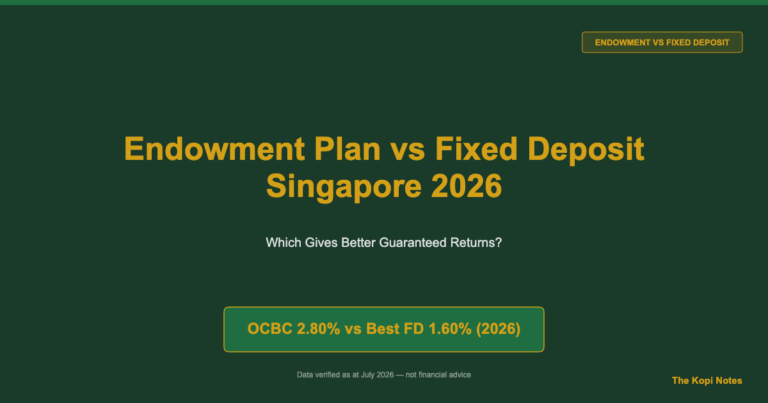
Is an endowment plan better than a fixed deposit in Singapore?
For a 2–3 year horizon in July 2026 — yes, in terms of returns. Short-term endowment plans offer 3.20–3.55% p.a. guaranteed, compared to the best FD rate of approximately 1.50% p.a. at major Singapore banks. However, fixed deposits are more flexible (6–12 month terms) and covered by SDIC insurance up to S$75,000. Endowment plans are backed by the insurer’s solvency and MAS regulatory oversight, but are not SDIC-insured. If flexibility is paramount, consider the Singapore Savings Bond (2.11% p.a. 10-yr average, fully redeemable monthly) as a middle ground.
How are endowment plan proceeds taxed in Singapore?
In Singapore, proceeds from a matured or surrendered endowment plan are generally not subject to income tax. Singapore does not have capital gains tax, and insurance payouts (including endowment maturity proceeds) are typically tax-exempt. The exception is SRS-funded endowment plans: when you withdraw SRS funds at or after the prescribed retirement age, 50% of the withdrawn amount is added to your chargeable income — still highly beneficial compared to a full withdrawal from a taxable account.
What is the minimum amount needed to start an endowment plan?
It varies by plan type and insurer. Short-term single premium endowment plans typically require a minimum lump sum of S$5,000 to S$10,000. Regular premium plans (long-term) can start from as little as S$100–S$200 per month. SRS-funded plans often have higher minimums due to the annual SRS contribution cap (S$15,300 for Singapore citizens and PRs in 2026). Check each insurer’s product sheet for the exact minimum premium, as this changes with product launches and promotions throughout the year.
Get Free Insurance Advice
Speak with a licensed insurance advisor. No obligation, no cost.
By submitting this form, you agree to our Privacy Policy.
This article was researched with the help of AI. While we strive to keep all information accurate and up to date, there may be errors. If you notice any discrepancies, please contact us.