How to Invest in Singapore (2026): Complete Beginner’s Guide
A step-by-step framework covering CPF, SSB, ETFs, REITs, and robo-advisors — with 2026-verified data and portfolio examples for every budget.
To invest in Singapore, you have more options than most people realise — CPF interest of up to 5% per year, tax-free Singapore Savings Bonds, low-cost ETFs on the London Stock Exchange, and robo-advisors that start from $0. The right starting point depends on your goal: safety first (CPF and SSB), steady long-term growth (index ETFs), or hands-off investing (robo-advisors). This guide walks you through every option for 2026.
Not financial advice. All figures are for educational reference only. Data verified as at 9 July 2026.
- Start with your CPF and SRS — they give you guaranteed returns plus tax relief before you invest a single dollar elsewhere.
- For growth, Ireland-domiciled ETFs (like CSPX or VWRA on the London Stock Exchange) beat US-listed equivalents for Singapore investors due to lower withholding tax.
- If you want hands-off investing, Syfe or Endowus are the go-to robo-advisors — both are MAS-licensed and start from $0.
Table of Contents
Contents — Click to expand
- Why Invest in Singapore?
- Investment Options at a Glance
- CPF and SRS — Use Your Tax-Advantaged Accounts First
- Singapore Savings Bonds and T-Bills
- ETFs — The Long-Term Growth Engine
- REITs — Passive Income in Singapore
- Robo-Advisors — The Hands-Off Approach
- How to Choose a Broker in Singapore
- Building Your First Investment Portfolio
- Common Investing Mistakes to Avoid
- Frequently Asked Questions
Why Invest in Singapore?
Let’s start with the uncomfortable truth: leaving your money in a bank savings account earns you roughly 0.05% per year at most major banks. Inflation in Singapore runs at around 2–3% annually. That means every year you sit on idle cash, your money quietly loses purchasing power.
Investing flips that equation. Here’s why Singapore is actually one of the best places in the world to build wealth:
No capital gains tax. Unlike the UK, US, or Australia, Singapore does not tax you on profits when you sell shares, ETFs, or property (with some exceptions for professional traders). Buy an ETF for $10,000, sell it for $18,000 five years later — the $8,000 gain is yours, tax-free.
No dividend tax for individuals. When your REITs or dividend stocks pay out cash, you keep every cent. No withholding tax, no income tax on dividends received in Singapore.
Government-backed returns through CPF. Your CPF Ordinary Account earns 2.5% per year, guaranteed. Your CPF Special Account earns 4% per year, with the 4% floor extended to December 2026. These rates beat most bank savings accounts without any market risk.
A regulated, stable financial system. Every investment platform you use in Singapore must be licensed by the Monetary Authority of Singapore (MAS). That gives you a layer of protection you won’t find in many other markets.
The question isn’t whether to invest. It’s where to start — and how to invest in Singapore in a way that matches your risk tolerance, timeline, and goals.
Investment Options at a Glance
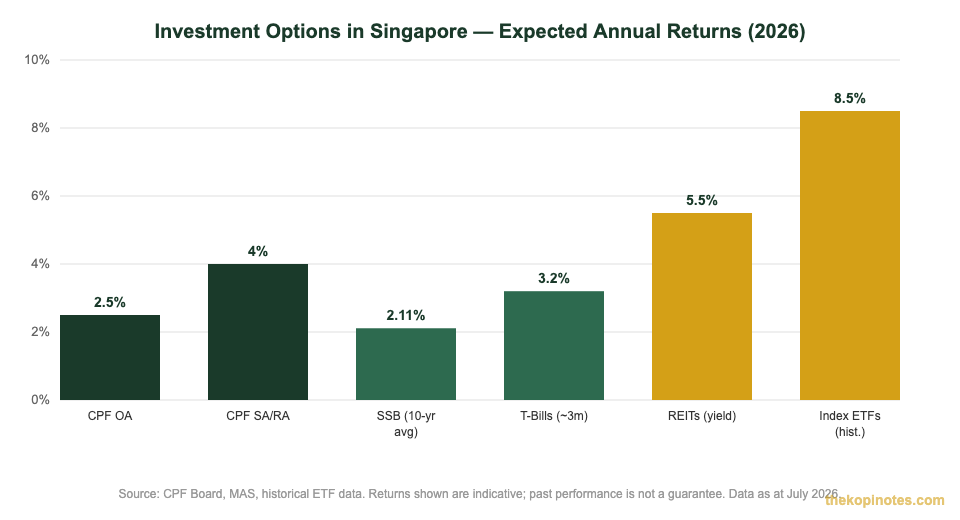
Here is a side-by-side comparison of every major investment option available to Singapore investors in 2026. Use this as your starting reference — we’ll go deeper into each one below.
| Product | Risk | Expected Return | Min. Invest. | Key Tax Benefit |
|---|---|---|---|---|
| CPF OA | None | 2.5% p.a. | Auto | Tax-free growth |
| CPF SA / RA | None | 4% p.a. | Auto | Tax relief on cash top-ups |
| SSB (10-yr avg) | None | ~2.11% p.a. | $500 | Tax-free interest |
| T-Bills (6m) | None | ~3.2% p.a. | $1,000 | Tax-free interest |
| Robo-Advisors | Low–Med | 4–8% hist. | $0 | SRS & CPF eligible |
| Index ETFs (LSE) | Medium | 7–10% hist. | ~$200 | 15% WHT (not 30%), SRS eligible |
| S-REITs | Medium | 4–7% yield | ~$200 | Dividends tax-free |
| Individual Stocks | High | Variable | ~$200 | No capital gains tax |
Source: CPF Board, MAS, iShares, historical data. Returns are indicative and not guaranteed. Data as at July 2026.
CPF and SRS — Use Your Tax-Advantaged Accounts First
Before you open a brokerage account, maximise your tax-advantaged accounts. This is the single most impactful move most Singapore investors skip.
Your CPF is already working for you. Your Ordinary Account (OA) earns 2.5% per year — that’s a guaranteed, risk-free return better than most savings accounts. Your Special Account (SA) earns 4% per year, with the 4% floor rate extended to 31 December 2026 by the CPF Board. You also earn an extra 1% interest on the first $60,000 of your combined CPF balances (with up to $20,000 from your OA), which pushes your effective return even higher.
As part of the CPF investment strategy Singapore many financial planners recommend: leave your OA and SA balances to compound at these guaranteed rates before chasing higher-risk investments. Time in the market compounds — and 4% guaranteed for 20 years is genuinely powerful.
SRS: the tax-saving account most people ignore. The Supplementary Retirement Scheme (SRS) lets you contribute up to $15,300 per year if you’re a Singapore citizen or PR, or $35,700 if you’re a foreigner. Every dollar you put into SRS reduces your taxable income dollar-for-dollar, up to the annual cap. At a 15% marginal tax rate, that’s up to $2,295 in annual tax savings — just from making the contribution.
Here’s the kicker: you can invest your SRS money in stocks, ETFs, unit trusts, and more. It’s not just a savings account. The investment returns inside your SRS account accumulate tax-free until withdrawal. That makes SRS one of the most powerful investing vehicles in Singapore for anyone in a higher tax bracket.
Singapore Savings Bonds and T-Bills — The Risk-Free Foundation
For money you can’t afford to lose — an emergency fund, a house down payment in 3 years, or retirement savings you want to protect — Singapore Savings Bonds (SSB) and Treasury Bills (T-Bills) are your best friends.
Singapore Savings Bonds (SSB) are issued monthly by MAS. The July 2026 SSB (GX26070F) pays 1.46% in Year 1, stepping up to 2.81% by Year 10, with a 10-year average return of 2.11% per annum. You can invest from just $500, and there’s no lock-in — you can redeem early at any time with interest paid for the months held. Interest earned is completely tax-free.
T-Bills are shorter-term government securities (6-month or 1-year tenors) that typically pay slightly higher than SSB Year 1 rates. Recent 6-month T-Bill auctions have cut rates to around 3.2% per annum. The catch: your money is locked for the full term. T-Bills are best if you know you won’t need the cash for 6–12 months.
Both SSB and T-Bills are backed by the full faith of the Singapore government — they are as close to zero risk as any investment can get. Use them to park your emergency fund and your low-risk savings before moving into market-linked products.
ETFs — The Long-Term Growth Engine
For long-term wealth building, index Exchange-Traded Funds (ETFs) are the most widely recommended starting point — and for good reason. Instead of trying to pick winning stocks, an ETF lets you own a slice of hundreds or thousands of companies through a single purchase.
For Singapore investors, there’s one critical decision: which stock exchange to buy your ETFs on. This matters far more than most beginners realise.
Buy on the London Stock Exchange (LSE), not the US markets. ETFs listed on the LSE — like CSPX (iShares Core S&P 500) and VWRA (Vanguard FTSE All-World) — are domiciled in Ireland. This gives you two massive advantages:
First, the withholding tax on US dividends is 15% (under the Ireland-US tax treaty) instead of 30% for US-domiciled ETFs. On a $100,000 portfolio earning 2% in dividends, that’s $300 per year in extra returns you keep.
Second, there’s no US estate tax risk. Non-US persons face potential US estate tax on US-domiciled assets above $60,000. With LSE-listed ETFs domiciled in Ireland, this risk disappears entirely.
The most popular LSE-listed ETFs among Singapore investors in 2026 are CSPX (tracks S&P 500, TER 0.07%), VWRA (tracks FTSE All-World, TER 0.22%), and SPYL (tracks S&P 500, TER 0.03%). All three are accumulating ETFs — dividends are reinvested automatically, so you don’t pay tax on distributions along the way.
REITs — Passive Income in Singapore
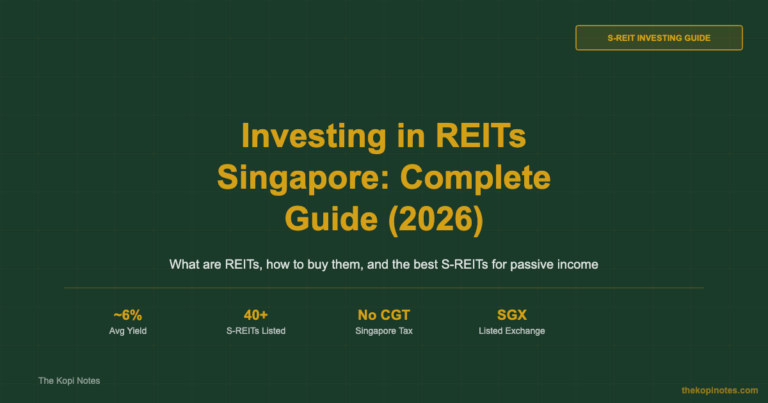
Singapore Real Estate Investment Trusts (S-REITs) let you earn rental income from shopping malls, industrial parks, data centres, and hospitals — without buying property yourself. S-REITs are legally required to distribute at least 90% of their taxable income to unitholders, which is why they typically yield 4–7% per year.
For income-focused investors — especially those approaching retirement — REITs are an attractive way to generate passive income Singapore investors can rely on. The distributions you receive are tax-free in your hands as an individual investor.
The largest and most liquid S-REITs include Mapletree Industrial Trust, CapitaLand Integrated Commercial Trust (CICT), and Parkway Life REIT. If you prefer diversification, you can buy a REIT ETF that holds a basket of S-REITs in one purchase. See our guide to the best S-REITs in Singapore 2026 for a full breakdown.
The risk: REIT unit prices fluctuate with interest rates and property market conditions. When interest rates rise, REIT prices often fall. Treat REITs as an income play, not a capital growth strategy.
Robo-Advisors — The Hands-Off Approach
If picking ETFs or REITs feels overwhelming, robo-advisors handle everything for you. You answer a few questions about your risk tolerance and investment goals, put in your money, and the platform automatically builds and rebalances a diversified portfolio of ETFs on your behalf.
All major robo-advisors in Singapore are licensed by MAS. The three biggest platforms to consider are:
Syfe charges a management fee of 0.65% per year for portfolios below $50,000, reducing to 0.55% for $50,000–$250,000. Syfe offers a range of portfolios including Equity100, REIT+, and Core Defensive. Their platform is beginner-friendly and has no minimum investment. Use the Syfe referral code and sign-up bonus when opening your account.
Endowus is particularly strong for CPF and SRS investing, charging just 0.40% per year for CPF and SRS portfolios (versus 0.60% for cash investments up to $200,000). This makes Endowus the go-to choice if you want to invest your SRS money in a diversified portfolio. Get started with the Endowus referral code for access fees rebated for the first six months.
StashAway charges 0.2–0.8% per year depending on portfolio size, with the fee decreasing as your portfolio grows. StashAway uses a proprietary ERAA (Economic Regime-based Asset Allocation) framework that adjusts your portfolio based on macroeconomic conditions.
How to Choose a Broker in Singapore
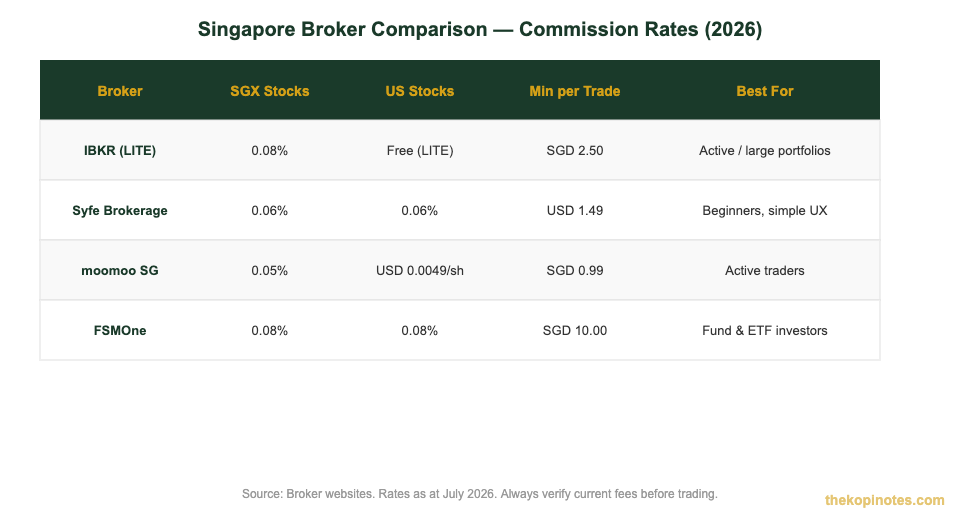
To buy ETFs, REITs, or stocks, you need a brokerage account. Here’s a quick comparison of the most popular brokers for Singapore investors in 2026:
| Broker | SGX Commission | US Stocks | Min. per Trade | Best For |
|---|---|---|---|---|
| IBKR (Pro) | 0.08% | 0.005%/sh | SGD 2.50 | Active traders, LSE ETFs |
| Syfe Brokerage | 0.06% | 0.06% | USD 1.49 | Beginners, simple UX |
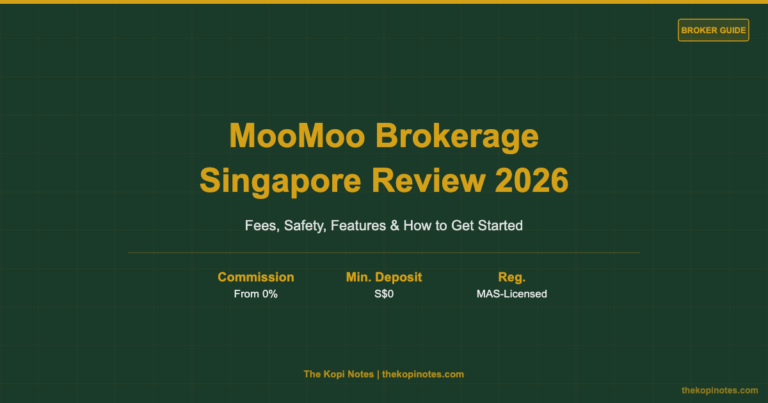
| moomoo SG | 0.03–0.05% | USD 0.0049/sh | SGD 0.99 | Active traders, research tools |
| FSMOne | 0.08% | 0.08% | SGD 10.00 | Regular savings plans, funds |
Source: Broker websites (interactivebrokers.com.sg, syfe.com, moomoo.com, fsmone.com). Rates as at July 2026. Verify current fees before opening an account.
For most beginners buying LSE ETFs once or twice a month, Interactive Brokers (IBKR) offers the best value. The minimum commission of SGD 2.50 per trade is hard to beat. For those who want a single, simpler platform that handles both brokerage and robo-advisory, Syfe is a strong all-in-one choice.
Use the FSMOne referral code if you prefer their platform’s regular savings plan feature, which lets you automate monthly ETF purchases from as little as $50.
Building Your First Investment Portfolio
The hardest part of investing isn’t picking the right stock. It’s starting. Here’s a simple framework for three different budget levels — all based on 2026-verified data.
Budget: SGD 500–$2,000 per month
Start with SSB or a robo-advisor while you build your knowledge. Put $500 into a Singapore Savings Bond (minimum $500) for your emergency fund buffer. Invest the rest into a Syfe or Endowus Core portfolio — let the platform diversify for you. Once your portfolio crosses $5,000, consider adding a direct IBKR account to buy VWRA or CSPX for lower ongoing fees.
Budget: SGD 2,000–$5,000 per month
Max your SRS first ($15,300 per year = $1,275 per month). Invest your SRS with Endowus for the lowest fees on SRS portfolios. Use the remaining cash to buy CSPX or VWRA monthly via IBKR using dollar-cost averaging. Separately, consider allocating 10–20% to S-REITs for income.
Budget: Building a retirement corpus
Use our Singapore retirement calculator to work out exactly how much you need and what monthly contributions will get you there. A common approach: 60% in global index ETFs (VWRA), 20% in S-REITs, 10% in SSB/T-Bills, 10% in cash reserves.
Whichever budget you’re in, the single most important rule is this: invest consistently, every month, regardless of what the market is doing. Dollar-cost averaging — buying a fixed dollar amount regularly — removes the psychological burden of trying to time the market.
Common Investing Mistakes to Avoid
Most investing mistakes aren’t about picking the wrong stock. They’re about getting the fundamentals wrong. Here are the five most common ones we see among Singapore investors:
1. Leaving money in a savings account instead of investing. A savings account at 0.05% loses to inflation every year. Even a Singapore Savings Bond at 2.11% is a better default than cash sitting idle.
2. Not using your SRS account for tax relief. If you’re in the 15%+ tax bracket and not maxing your SRS, you’re paying more tax than you need to. The $15,300 annual contribution limit is one of the most generous tax reliefs available to Singapore residents.
3. Buying US-domiciled ETFs like SPY or VOO instead of LSE-listed equivalents. SPY and VOO track the same index as CSPX — but Singapore investors who hold them face 30% withholding tax on dividends instead of 15%, plus US estate tax risk above USD 60,000. There’s no upside to buying the US version from Singapore.
4. Panic-selling during market corrections. Markets correct regularly. The S&P 500 has had 10%+ corrections in most decades — and has still returned roughly 10% per year on average over the long run. Selling at the bottom locks in losses permanently.
5. Over-concentrating in a single stock or sector. Putting everything into one stock or sector is speculation, not investing. Even if you have high conviction in a company, keep individual stock positions to a maximum of 5–10% of your portfolio.
Frequently Asked Questions
How much money do I need to start investing in Singapore?
You can start with as little as $500 for Singapore Savings Bonds or $0 for robo-advisors like Syfe, which have no minimum investment. To buy ETFs or REITs directly on the stock exchange, you typically need around $200–$500 for a single lot. The more important question is not how much to start with — it’s starting consistently, every month, at whatever amount fits your budget.
Is it safe to invest in Singapore as a beginner?
Investing always carries some risk, but Singapore’s regulatory environment is among the most robust in the world. All investment platforms must be licensed by the Monetary Authority of Singapore (MAS), and government-backed products like SSB and T-Bills carry zero default risk. For beginners, starting with low-risk products (SSB, T-Bills, robo-advisor Core portfolios) before moving into ETFs and REITs reduces the chance of making costly early mistakes.
What is the best low-risk investment in Singapore in 2026?
For capital that needs full protection, Singapore Savings Bonds (SSB) are the top choice — government-backed, tax-free, and redeemable at any time. The July 2026 SSB offers a 10-year average return of 2.11% per annum, with a Year 1 rate of 1.46%. T-Bills offer slightly higher short-term rates (around 3.2% for 6-month tenors as at mid-2026) but lock your money for the full term. CPF remains the highest guaranteed risk-free return at 2.5% (OA) and 4% (SA).
Can I use my CPF savings to invest in ETFs and stocks?
Yes, through the CPF Investment Scheme (CPFIS). Your CPF OA funds can be used to invest in eligible unit trusts, ETFs, and stocks listed on SGX, subject to certain limits and eligibility rules. However, note that LSE-listed ETFs like CSPX and VWRA are not CPF-eligible — only SGX-listed products qualify. Many financial planners recommend leaving CPF in OA and SA to compound at guaranteed rates (2.5% and 4%) before investing it, since CPFIS products need to outperform these benchmarks to be worthwhile.
Are robo-advisors worth it in Singapore?
Yes, for most beginners who don’t want to manage their own portfolio. Robo-advisors like Syfe, Endowus, and StashAway charge 0.40–0.65% per year to build and automatically rebalance a diversified ETF portfolio for you. That fee is very reasonable compared to the cost of picking individual stocks or hiring a financial adviser. Endowus is particularly valuable for investing CPF or SRS money, where it charges just 0.40% annually. As your portfolio grows and your knowledge deepens, you may choose to manage some of it yourself to reduce fees — but robo-advisors are an excellent starting point.
Do I pay tax on investment returns in Singapore?
Singapore investors enjoy generous tax treatment on investments. There is no capital gains tax — profits from selling shares, ETFs, or property are generally tax-free for individuals. Dividend income from Singapore companies and REITs is also not subject to personal income tax. Interest from SSB and T-Bills is tax-free. The main tax to watch out for is the withholding tax on dividends from US stocks — if you hold US-domiciled ETFs (like SPY or QQQ), 30% of US dividends are withheld. Choosing Ireland-domiciled LSE-listed ETFs reduces this to 15%, which is why CSPX and VWRA are preferred over their US equivalents.
Ready to Start Investing in Singapore?
Open an account and make your first investment today. Use our referral links for exclusive sign-up bonuses.
This article was researched with the help of AI. While we strive to keep all information accurate and up to date, there may be errors. If you notice any discrepancies, please contact us.